… and in the end … part four of a review of Eight Days a Week, the Touring Years

A review of Eight Days a Week; the Touring Years

A film by Ron Howard

Part Four: 1966 and beyond…


Read Part one here.

Read Part two here.

Read Part three here.


1966 was the end of the Beatles as a touring band. The movie shows their frustration.

The year began with three months off! The Fabs are shown lounging in a pool. We see Ringo’s and John’s homes and family snapshots with their children – the only mention of their spouses and children in the entire film (and only Julian is shown).

Although John hardly lived in familial bliss, it showed the band start to drift apart physically and musically. We are introduced to George’s love of Indian music, for example.

We finally see their warts – something the film has avoided up until now. But then again, it had never affected their live performing.

The film tells us the story and shows a montage of the Butcher cover for the US album “Yesterday … and Today”.

On that subject: is this the ONLY documentary of the Beatles that does NOT even MENTION “Yesterday”?! They performed it live in 1966, but there is no clip of their singing it. Leaving out “Hey Jude” is understandable – the song is out of the movie’s timeline – but a song that has been played over seven million times? Of which there are over two thousand versions?

Wow …

The film next shows us the recording of the “Revolver” album. George Martin, Howard Goodall and the Fabs describe how their musical tastes are finally diverging. They are using Indian music and avant-garde techniques in their recordings. More importantly, they describe how hard (impossible) it will be to replicate these songs in a baseball stadium, where even an announcer’s voice sounds like white noise. “Tomorrow Never Knows?” Forget it …

There is one clip that I have never seen (it still amazes me that after over 50 years there are still film clips and photos that are truly so rare) and it shows the rot of 1966 – even the press is turning against the Fabs. In Hamburg a reporter asks the group why they are so “horrid snobby”.

“That’s your interpretation,” John says, in a tone we will hear a lot in the late 60s and early 70s usually in a bed with Yoko at his side. Paul gives a diplomatic answer (akin to “the quality of our answers reflects the quality of your questions”) which gets an applause, but his tone still has bite. Yikes! Even Paul is getting snippy!

The rest of the 1966 segment is filled with familiar Beatle lore: the protests in Tokyo, the Marcos “snub” in the Philippines and the US tour marred by protests over John’s “bigger than Jesus” remark – events even the poorest of Beatle documentaries portray (that’s not meant to be derogatory – it just means that I won’t go into detail about them here).

And again despite the complaints of their quality, Budokan (for example) is an excellent show with clear audio and video! Bootlegs of the concert exist.

The movie shows the silent film made of the last live performance in San Francisco, with the Fabs providing commentary.  George started the group’s anti-touring movement as early as the Shea stadium show, but by the time this Frisco show was finished, the other three finally agreed.

Paul McCartney has a poor cassette recording of this concert made by Tony Barrow. As bad as the sound quality (perhaps not the music) undoubted is, why didn’t he share it with the producers anyway? It can’t be any worse than the sound recording of the village fete where Paul met John …

The Mania Years were over.

***

For the next five minutes the movie does a recap of the Studio Years. They spend most of the time showing the evolution of “Strawberry Fields Forever” with the Beatles in their Carnaby-Street-pre-Sgt-Pepper clothing as well as clips of the party leading up to the recording of “All You Need is Love”. There is a photo montage of their last six albums.

A placard tells us of one last live performance on the rooftop of Apple Records in January 1969.

***

Three songs performed at the rooftop concert concluding “Let It Be” complete the film. The clips are clear, clean and sound fantastic! Despite assurances that everything Apple Corps is resolved we STILL do not have “Let It Be” in DVD. Why? I’m glad this movie managed to get permission to use more than just a brief clip: we hear nearly the entirety of “Don’t Let Me Down”, for example. Although “Let It Be” is available as a bootleg, it will be nice to finally get a clean copy.

***

“Eight Days a Week” is an excellent primer on the Beatles, their music and their live performances, along with the good and bad that came with it. It focuses on only one part of the Beatle mythos but does so thoroughly.

For other events during the Mania Years – or the Early or Studio Years – you may have to rely on documentaries such as “the Compleat Beatles” or “the Beatles Anthology”. Like those, “Eight Days a Week” is something of a white-washed version. For more dirt you may have to rely on books such as Cynthia Lennon’s books on John or former insider Peter Brown’s “The Love You Make”, of which Beatles insiders protesteth too much; if you know what I mean. Ron DiLello’s “The Longest Cocktail Party” is a rollicking fun read on the Fabs’ Apple Corp. The recent “Paul McCartney: A Life” by Phillip Norman is another warts-and-all biography. I am currently listening to the audio book and will review that in a few weeks.

Eric Idle’s “The Rutles: All You Need is Cash” is the closest anyone has come to likely capturing the real Beatles experience … from the Beatles’ viewpoint! George and John are on record as having loved it (George produced and appeared in it).

The only similar documentary is the recent “the Beatles: The First US Visit”, a re-release of a BBC documentary made in 1964 of the Fab’s US tour.

But “Eight Days a Week” has a broader scope than that made-for-television doc.  The movie is excellently done. It’s a great jumping-on point for young people first learning about their parent’s (grandparent’s?) favorite group and more about them can be learned elsewhere if their curiosity is whetted.

Old fans can bask in the Mania they may have been too young to experience. Plus there is enough “new” or unseen material to keep us interested.

5:50 into the movie is when Paul almost tears up. The movie is worth that alone.

It is available free to Hulu subscribers or on pay-per-view. It will be released in DVD sometime in the next few months.

I would buy the soundtrack if it consisted of live performances and the rehearsals. The movie rarely plays studio recordings and then mostly over commentary. If you have the Beatle’s music catalogue there will be nothing new here.

I already have the studio recording of “I Want to Hold your Hand”, thank you; but I’ll take the rehearsals of “Eight Days a Week” and the live “Nowhere Man”, please!

***

I cannot resist one personal story: when I loaded Hulu to watch it for the first time my six-year-old daughter walked into the living room and asked what I was watching. When I told her the film title she looked at me and said, “Daddy! There aren’t eight days in a week!” Which pretty much summed up her feelings about the movie.


I did not intend for this review to go on for four blogs; it must have meant I enjoyed writing about it as much as I enjoyed watching the movie. I hope you enjoyed it!

Corporate shill department: I published a fictional account of John F Kennedy meeting the Beatles, titled, appropriately enough, “The Day John F Kennedy met the Beatles”, available here on Kindle. I hope you enjoy it!


Original Material copyright 2016 Michael Curry


Beatlemania, American Style! “8 Days a Week” review part two!

A review of Eight Days a Week; the Touring Years

A film by Ron Howard

Part Two: 1964 Mania, American Style


Read Part one here.


“Eight Days a Week” shows us (and proves to us) the hectic pace set by the Beatles from 1963 through 1966. During this time they toured constantly, stopping only to record singles and albums.

Other documentaries focus on the press constantly asking about their long hair (particularly in the US), but the most frequently asked questions (as shown in this film) were “How long do you think you will last?” and “What will you do when the bubble bursts?”

Because of the fear of the bubble bursting, the Beatles were not only put on a grueling tour schedule, but an equally grueling recording schedule –a new single every three months and a new album every six months. Milk it, baby, milk it!

November 22nd, 1963 was the day US President John F Kennedy was assassinated, but also the day the Beatles’ second album, “With the Beatles” was released. The movie shows each album and it’s time at #1 on the British charts. These are placed chronologically along with the performance clips.

A British radio reporter tells us about the Kennedy assassination and Paul tells us the bands reaction. None, well, not much. Diplomatically, he says they were too young to comprehend what had happened and they were too busy touring to let it really sink in.

At that point, touring America is discussed. Paul tells us they did not want to go to America until they had a #1 record. They did not want to go to America, flop, and then come home with their tails between their legs.

During clips of their shows in Paris, we learn “I Want to Hold Your Hand” was #1 in America. While the song plays in the soundtrack, we watch photos of the Fabs clowning around in their Paris hotel room.

There is much Beatle lore left out of this movie – its focus is on live performances and their records. The movies “A Hard Day’s Night” and “Help” were shown in clips, but only as it related to their recording and performing schedules.

There is no mention of, for example, John’s two books, their personal lives (two were married and two had children during this period) or their introduction to marijuana and LSD.

If you blink you will miss the one shot of Jimmy Nichols with the band. When Ringo had tonsillitis, Jimmy Nichols replaced him in shows in Denmark and elsewhere.

Ringo was back by the time the Fabs toured Australia to young people in the grip of a Beatlemania perhaps even larger than the American version!

During this time they were guests (and sometimes hosts) in many television shows all through Europe. Although the movie uses some of the interviews from the various television programs, it does not use the performances. Perhaps because of copyright issues; but it cements that the heart of the movie is live performances, not studio performances.

So no television performances.

With one exception.

A documentary set during the time of Beatlemania can skip Stuart Sutcliff and Yoko Ono; a documentary focusing on live performances can skip Lennon’s books of poetry and Jane Asher; but no Beatle documentary – even ones that are not Ameri-centric – can skip “the Ed Sullivan Show”.

The viewership was mentioned (half of the population of the United States watched) and bits of trivia (no reported crime in New York that evening), but the film focused on the performance itself rather than its impact.

That being said, the film does a fine job showing America in the total grip of Beatlemania with shots of fans at airports and hotels with newsreels and at-the-time interviews with the Fabs and the fans.

I finally have a complaint about the film: the first US press conference as well as footage of the Washington DC concert were colorized. Poorly so. Why? Why didn’t you colorize “Ed Sullivan” and “Hard Day’s Night”, too? Showing black-and-white footage won’t befuddle us or lose our attention. Treat us like adults, please? Ron Howard, you of all people should know … why don’t you colorize the black-and-white episodes of a certain show set in Mayberry, instead? Because you don’t have to. They are both fine as is. Leave them alone.

The only other complaint of the film? Another point that shows the producers do not have much faith in their viewers: unnecessary false audio. Documentaries showing silent films (particularly World War I docs) are bad about this too. In “8 Days a Week” it shows home movies of the Beatles swimming in a pool. We hear a “splash” at the appropriate time, but no other ambient noise. At other times the fans’ individual screams are dubbed in. At one point a girl screams Ringo’s name. It’s easy to lip-read. Yet the film-makers dub a youngster shouting “Ringo” 52 years after that clip was made. At no point while watching clips of girls screaming during Beatle concerts did I ever say, “What did she say? What’s wrong with the sound?” Again, please treat us like adults.

So, “Ed Sullivan” aside, no TV shows. During the US publicity tour, the film interludes with a brief biography of Brian Epstein and how he met the Beatles and became their manager. Bare bones – a youngster asked for a copy of their record in Eppy’s record shop, his curiosity made him seek the band out. He signed them on as clients. Back to the tour …

The Fabs move to Washington DC and then Miami (no concert footage) and back to the UK to film “A Hard Day’s Night”.

A little time is spent showing clips and some background on the film, but then back to the music and the grinding tour schedule; including an August tour of the US.

Which is a pity: Lennon didn’t like the film in retrospect. After two days following the band, the writers developed personalities for the Fabs that are still unshakeable – the smart one, the cute one, the quiet one, the lovable one.

However, one of the best lines from “A Hard Day’s Night” captures the essence of the Beatles on tour. “… so far I’ve been in a train and a room, a car and a room, and a room and a room,” says Paul’s film-grandfather. They should have used that – sums up their touring schedule perfectly!

Something I have not heard mentioned in Beatle movies or documentaries: the controversy over segregating the Gator Bowl! There were plenty of clips of the Fabs at the time decrying segregation – “Why treat other people like animals?” “We refuse to play a segregated hall”. How much controversy did this cause in the summer of 1964? The kerfuffle over Lennon’s Jesus quip in 1966 is brought up in nearly every documentary (this one, too), but surely bigots protested their comments on segregation, too!

And the movie probably gives the Fabs a bit too much credit on this point. The Gator Bowl may have been desegregated during their show, but afterward…? And segregation certainly did not end in the south due to their American Tour of 1964; more hearty seed had already been planted and would take root in the years to come.

Moving on to 1965 next time …

***

            Corporate shill department: I published a fictional account of John F Kennedy meeting the Beatles, titled, appropriately enough, “The Day John F Kennedy Met the Beatles”, available here on Kindle. I hope you enjoy it!

Original Material copyright 2016 Michael Curry

The Mania Begins! Part One of my review of “Eight Days a Week”

A Review of Eight Days a Week; the Touring Years

A film by Ron Howard (yes that Ron Howard)

Part One: Mania Begins!

This documentary covers the Beatles during their Mania Years (March 1963 through August 1966) focusing primarily on their live performances and then their album recording sessions.

With only a few exceptions, the rest of the Beatle mythology during that time is ignored.

This is fine. As the title suggests, this is about their live shows. If you want a clip of John Lennon reading from “In His Own Write”, however, you had best look elsewhere.

Not that there was that much to leave out: during that time the band’s touring and recording sessions were marathons – it would have drained any mortal human beings. Their time “mach schau”-ing in Hamburg during the Early Years not only improved their musicality (as is frequently pointed out), but their stamina. 25 shows in 30 days while touring America? Grueling? You bet, but at least they are able to sleep at night. In beds. Separately.

The two big documentaries of the Fabs: “the Compleat Beatles” and “Beatles Anthology” encompass the members’ and their entourage’s lives up until 1970. This film has a much narrower focus. Only “the Beatles: The First US Visit” has a more narrow focus – their 1964 US tour. But that was a BBC documentary meant for television, not a feature film.

Most narrative films focus on the Early Years, of which little is really known and there are only vague photographs and fewer recordings extant: the band’s childhood, their formation and early days as a band. Movies such as the excellent “Backbeat” from 1994 and “Nowhere Boy” from 2009 are examples.

More rare are films of the Studio Years or the Solo Years showing the Beatles’ break-up and solo output. 1985’s “John & Yoko: A Love Story”, 2000’s “Two of Us” (although the creators state at the film’s outset that it is entirely fictional) and 2010’s “Lennon Naked” for instance.

And nothing more clearly shows the break-up of the band than “Let It Be”.

But this movie shows us neither the beginning nor the end, but the glorious middle, when Beatlemania was in full flower. For a fun fictional account, find the 1978 Roger Zemeckis movie “I Want to Hold Your Hand”.

The film as a whole shows the mania’s rise and fall. The movie opens with songs from their 1963 show in Manchester – the clips’ vivid color and sound are a wonder! Why isn’t the entire set released on DVD yet? Or has it been?

There is no narration for the film – no Malcom McDowell from “the Compleat Beatles”. It is told to us by the Fab Four themselves and their entourage ala “Beatles Anthology”. Current interviews with Paul and Ringo are interspersed with clips from John and George, as well as Beatle insider/roadie Neil Aspinall – who was with them from the beginning – and their film director Richard Lester. Most of George’s comments were culled from “Anthology” while John’s were taken from various lengthy interviews during the 1970s (Mike Douglas, Tom Snyder, Dick Cavett, etc.).

Note to Hulu: there were a few mistakes in your subtitles. You told us George was speaking when it was John. When asked about the fan reaction, John did NOT say, “the mob was incredible”, he said, “amazing, incredible”

The movie is chronological with only a few interludes taking us further back in time.

One such interlude starts about 4 minutes into the film for a three-and-a-half minute primer on the Early Years. But it was a very quick statement by John Lennon on bringing in Paul and then George and playing in Hamburg – but even here the focus is on the live performances as a upcoming band. Not of growing up in war-torn Liverpool. This means there is no mention of Pete Best, Alan Williams, Cynthia Powell or even Stuart Sutcliffe.

There is a surprisingly tender moment six minutes in – Paul talks about their first session with Ringo as drummer. His eyes mist up and he chokes back a tear. I’ve never seen him so emotional when discussing the Beatles …

After that the movie starts in earnest. It shows us the release of “Please Please Me” and then it’s on to the live shows!

One fun clip was of football fans in 1963 Liverpool singing “She Loves You” in unison. Young men bellow at full throttle whilst old men (wearing hats) are jostled as they keep smiling … but they don’t sing along.

There are the mandatory archival interviews with young people (“I love them!”) and the older generation (“They make an awful row!”).

The live music is real. No studio tracks with an audience dubbed in – as far as I can tell. The clips we watch may not be from the venue the soundtrack was recording, but the editors did an excellent job of splicing it together. Only on occasion does the mouth not match the soundtrack. In some spots, it is obvious the film is slowed down so the soundtrack can keep up, but that is forgivable.

And it is fun after all these years to still be able to see footage I have never seen before! Most notably the European concerts.

More next time …

Corporate shill department: I published a fictional account of John F Kennedy meeting the Beatles, titled, appropriately enough, “The Day John F Kennedy met the Beatles” available here on Kindle. I hope you enjoy it!


Original Material copyright 2016 Michael Curry

Blogs of things to come!

I have changed my web-page!

I added a tab for my Financial Wise Guide books. As an attorney I have helped thousands of people (and businesses) with their financial problems and have put that knowledge in a series of books. The books (available only through Kindle – so far) include a guide on how to get out of debt and guides on bankruptcy.

Another tab is for my fiction.  So far it only includes my short story “The Day John F Kennedy Met the Beatles”, but I will add others as they are published – also through Kindle.

On October 1st I hope to have two short stories ready for reading: a horror tale and a horror/historical fantasy story. Just in time for Halloween!

December should see a Christmas mystery short story.

More about that as the details develop! But browse my newly-edited web page and tall me what you think!


The Last Suicide Squad Movie Review (part 2)

In my last Suicide Squad blog I talked about the history of the Squad and a synopsis of the plot.

Let’s dig deeper:

I think most critics were put off by the fumbling opening of the film. It soured them to the rest of the movie.

Our heroes – er – villains were introduced in a very comic-booky sequence. Amanda Waller sat in a restaurant with men who may or may not have been her superiors. She plunked down a dossier of each of her recruits.

Deadshot! The screen fills with his stats. Then the movie flashed back to show the character and a bit of his background (in this case, his relationship with his daughter and eventual capture by Batman).

Harley Quinn! The screen fills with her stats!

Et cetera and so on…

Works for a comic book, not for a movie. It was as bad as an obvious info dump in a science fiction novel. “As you know Bob, we are on the first manned mission to Mars!” “Yes, I know, why are you telling me this?”

***

            You know what would have worked? They could have taken this entire twenty-minute introduction and put it online two weeks before the movie opened, either as a free download or on Youtube. Wherever.

Then they could open the movie twenty minutes in: with the bad guy doing his thing in Midway City and then showing the Special Forces dragging the Squad from their cells and on to their mission.

Of course if you missed the preview you might be a little lost at first. “How can we introduce all these characters in one movie and get to know all their personalities without the previews?!” “Aaa-chooguardiansofthegalaxy …!”

Then again, if you wanted to go see the movie, you probably would have found the preview online. In this day and age do people still wander into a theater not knowing what they want to see? “Oo, this looks interesting Margaret; let’s take a chance and spend a week’s income to see THIS movie!”

It could have started a trend: Watch this mega-preview first!

And they then could have added in all these scenes rumored to be on the cutting room floor that made the movie darker or funnier depending on who you believe.

***

            There are hundreds of reviews of “Suicide Squad”. Most of them were published on my Facebook wall by frenzied fans. I agree with parts of them and disagree with parts of them. Some random thoughts:

***

            Harley Quinn was fun and not as eye-rolling as the previews led me to believe she would be. A psychopath? Sure, but at least it was toned down from her comic book-y levels. And there was one moment that was wonderful. She slipped out of character for a few seconds. When the rest of the Squad caught up to her, she held up her head, pasted on the smile and was back to her psychotic self. That’s about as close as she came to three dimensions.

And she did steal every scene she was in. It helped that she was usually near the center of every the shot…

***

            Much as been made of Jared Leto’s Joker. He was on-screen for less than ten minutes total and got second billing. Unlike what some have writ, I do not think he stole every scene he was in. But is WAS a unique interpretation of the Joker. Crazy? I suppose, but no more so than villains we have seen on TV’s “Daredevil” or “Constantine”.

The actor is purportedly miffed that his best lines remain on the cutting room floor. I believe it: his Joker is a homicidal drug-dealing gangster running a nightclub. Will Smith’s wife also did that on “Gotham” with about the same body count. Leto’s Joker leans more towards Nicholson’s crazy than Ledger’s Lord of Chaos. In fact, in the few lines he had I thought “What if Johnny Depp’s Captain Jack Sparrow played Al Pacino’s role in “Scarface”? Relax, Leto fans, I’m comparing him favorably to Jack Nicholson, Johnny Depp and Al Pacino fer crissake!

Leto may or may not be back in the DC Movie Universe as the Joker, depending on the articles you read. He will have to be replaced by a DC villain who is psychotic and runs Gotham’s Underworld. Maybe the Penguin? A shame, but frankly the Joker is overused anyway.

And you don’t keep an actor who doesn’t WANT to play the character anymore! It would be like hiring someone who actively dislikes Superman to direct another … movie … Oh, yeah. I guess we WILL see Leto’s Joker soon…

***

            Will Smith was kept on a short leash and did very well with Deadshot. Granted, that of all of the Squad, he had the most characterization to sink his teeth into; but he avoided the “too cool to fool” hipness (dare I say, being Fresh?) of, for example, “Independence Day”.  Of course, a list of the things wrong with “Independence Day” would fill up a flashdrive…

He was given star billing, although Margot Robbie (Harley Quinn) and Leto got most of the press. He did a good job.

***

            Amanda Waller – more evil than even the bad guys – and Captain Boomerang – sowing seeds of rebellion and approaching Waller’s boundaries without ever crossing them – were the characters most like the comic book. The second series, of course.


SPOILER

            Slipknot? He was never given a preview at the beginning of the movie and introduced about a half-hour into the film. When they DID introduce him to the team, all but the most non-savvy movie-goers knew what was going to happen to him.  He might as well have been wearing a red shirt from the original “Star Trek”. His fate was so telegraphed it made the first “Jurassic Park” seem taut and suspenseful. Little things like this are why movies get bad reviews. They should have given him a preview and put him in the lineup of the movie posters, something…

END OF SPOILER


“Suicide Squad” wasn’t as dark as I thought. Even when Amanda Waller showed her VERY dark side, I wasn’t shocked by it.

It is relative: “Superman, The Man of Steel” being dark is shocking; “Suicide Squad” being dark is expected.

***

            So I liked it, I didn’t love it; I may or may not see the inevitable sequel. I will see “The Magnificent Seven” again. The original, not the remake. Dun dun-dundun, dundundun-dundun-dun; dun dun-dundun…


Original Material Copyright Michael Curry 2016


The Last Suicide Squad Movie Review

A cast of bad guys – outright villains, misfits, killers and sociopaths each with a unique mind-set and world view – are gathered by a morally ambiguous government agent to rid a town from an evil worse than even their own members. Along the way they bicker, fight and some of them die. But eventually they become a team!

The film was called “The Dirty Dozen”.

***

            Regular readers of this blog know I rarely go to movies on the first week.  By the time I see a movie so has most of the rest of the world.

That has its advantages: smaller crowds, shorter lines; but – most importantly – by the time I get around to reviewing the movie most of the spoilers have already been spoiled! But I will still try to warn you in advance.

I saw “Suicide Squad” with low expectations. The critics savaged the film. The only ones who seemed to like it were the same cheerleaders that thought “Batman vs Superman” was the epic of their generation.

You might even say I went to the movie expecting to dislike it: Movies based on DC’s superheroes have been very dark of late. And I like neither dark superheroes nor dark superhero movies.

So imagine how I felt when they announced a movie featuring DC Villains and based on a comic that is, by this time, sloshed with the uber-violent fare typically vomited upon the comic-book-buying public.

The usual group of … Hmm, what would the collective noun be for the fans of dark DC – the films of late, most of the “New 52” comic … ah, got it!

The usual goth of DC Dark fans have drooled over every preview and picture since the movie was announced.

I kept quiet. I chose to neither get excited over the movie nor to actively say I was not going to see it. But truthfully? Had my friend not invited me to an afternoon matinee, I might never have seen it.

I liked the movie! It wasn’t bad. It wasn’t a perfect movie. No movie is perfect.

Okay, Godfather I & II are perfect … but you know what I mean.

***

            Let’s go back and do a primer on what the Suicide Squad is …

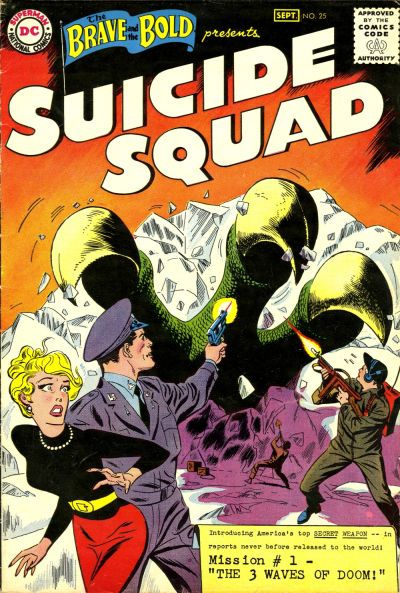
The Suicide Squad debuted in the comic book the Brave & the Bold #25 in 1959.  It had only four members, including Commander Flag, but they were all normal humans – although all were experts in their field (astrophysics, etc.).  They fought the bug-eyed monsters typical of the era – intelligent dinosaurs, aliens, beings from the center of the earth, etc. They appeared in only six issues.

The Suicide Squad disappeared until 1987, when they showed up in their own magazine. This group was firmly ensconced in the super-hero genre. As with the movie Amanda Waller gathered a group of bad guys to fight global threats. Waller said in issue #1: “the administration needs something they can disavow if things go wrong. That’s us.” Rick Flag, Captain Boomerang, Deadshot and the Enchantress among others were in that first issue. It lasted 66 issues.

Back to the movie …

So we have the evil (and we see her being truly soulless in a few scenes) Amanda Waller gathering a group of villains to fight worse bad guys led by a morally bankrupt soldier.

It’s “The Dirty Dozen”. Before that it was “The Magnificent Seven”; and before that it was “Seven Samurai”.

In fact, one of the previews shown in my theater was the remake of “The Magnificent Seven” with Denzel Washington, et. al. Tip to DC Entertainment: Don’t remind us of a legendary film, even a remake (which itself has BIG shoes to fill), before showing us your movie… Do you REALLY want us to compare them?

We have old Batman villain Deadshot, “new” (the last thirty years is hardly “new”, but I am an old fart) Batman villains Harley Quinn and Killer Croc, Flash rogue Captain Boomerang, El Diablo (a villain who debuted in 2011 in the Suicide Squad comic. This was DC’s third character named El Diablo. The first was a GREAT Weird Western star that should have gotten more page time in the 1970s), the Enchantress – who started life in 1966 as a macabre hero until the character was completely rebooted in 2011, and Firestorm baddie Slipknot.

Along the way we meet Katana, a samurai-sword wielding hero used as Flag’s back-up in case any of the bad guys get uppity.  Her sword contains the souls of everyone the sword has killed, including her husband. She talks to her husband. That’s about all we know of her in the movie. Coincidentally, her comic book debut was in Brave & Bold #200, the same comic book that debuted the Suicide Squad 20+ years earlier.

SPOILER

The Enchantress was in the group, but very quickly defected. It seems the chief bad guy is her brother. Blood is thicker than … gallons of blood.

END OF SPOILER

In the movie they were gathered to fight off future threats to earth. What if the next Superman was a bad guy? How can we fight an evil Superman?

With bullets, boomerangs and a baseball bat, apparently.

But how will they be able to control this group of killers?

In the best Amanda Waller way: threaten them! “We know about your daughter. We will reduce your sentence. And ALL of you have implants at the base of your skull that will blow your head off if you disobey.”

Dry shave!

Sorry, Dirty Dozening again…

This time it is not an alien threat but a demon from earth’s past. He and his sister are in Midway City (the home of DC’s Hawkman, although he is never mentioned) building a machine to take over the world.

So our heroes – er – villains take on the demonic duo.

Along the way they bicker, fight and some of them die. But eventually they become a team!


More thoughts next time.

Corporate whore department: If you are interested in the original Suicide Squad, Katana or the Brave and the Bold comic book -read my free ebook available at Barnes & Noble! http://www.barnesandnoble.com/w/the-brave-and-the-bold-michael-curry/1120872264?ean=2940046443011


Original Material Copyright Michael Curry 2016


A review of Suicide Squad: the 1959 DC comic book team (who did YOU think I meant)?

With comic book fans a-quiver over the Suicide Squad movie, I thought we should look back to the original team!

Brave_and_the_Bold_v.1_25

“Introducing America’s Top Secret Weapon” screamed issue #25 in September 1959, “in reports never before published to the world!!”  Thus was introduced The Suicide Squad:  Colonel Rick Flagg, command pilot; Jess Bright, nuclear physicist; Dr. Evans, astronomer/astrophysicist; and Karin Davies, eye-candy, er, space-medicine nurse.  Yes, Task Force X, “known as the Suicide Squad because of the fantastic perils it unhesitatingly faces with supreme courage and unique methods.”

Rick and Karin are in love of course (typical 1950s science fiction – there’s always a female assistant who is in love with the leading man).  However, Jess and Dr. Evans love Karin too!  So Rick and Karin decide to keep their love for one another to themselves for the good of the team.  A love quadrangle would only get in the way of team missions!  This was mentioned every issue and was pretty much the sole character development.

The Suicide Squad was Robert Kanigher’s attempt at “The Challengers of the Unknown”, with wonderful Ross Andru/Mike Esposito art instead of wonderful Jack Kirby art!  The art was typical 1959 – straightforward and realistic-looking men, women and machinery.  Imaginations were let loose on the “perils” – gigantic aliens and beasts attacked our heroes non-stop.  While the artwork was good, the storylines were for the most part … well … silly; even for the times.  The perils were usually of the science-run-amuck-we-tampered-in-God’s-domain found in the “B” movies of the time.  One expected to find Peter Graves or Leslie Nelson popping in to help!

In their first story (#25: Three Waves of Doom) an earthquake awakens a dinosaur-like creature that sets fire to Tokyo er Atlantic City, freezes metal and absorbs all chlorophyll!  The Suicide Squad defeats it by tricking the beast into grasping onto a rocket and shooting it toward the sun!

The stories seem to talk down to its youthful audience.  Facts are thrown in almost as if the characters are showing off their intelligence (one character actually says, “It’s a good thing we have enough sodium manganate on board!”  What?!).

And in six issues we never learn Dr. Evans’ first name!

The Suicide Squad was given three issues to do their thing (#25 – 27) and another three-issue try-out later in 1961 (#37 – 39), without success.  The plots of the other five issues read like an edition of Weekly World News:

  • Radiation shrinks the Squad down to matchstick size, yet they must still thwart a submarine attack against America! (#26: The Sun Curse)
  • Dinosaur-like serpent attacks Paris metro, boats on the Seine and the Eiffel Tower! (#26: Serpent of the Subway)
  • Scientist turns self into ten-story reptile – carries A-bomb into city! (#27: Creature of Ghost Lake)
  • Intelligent dinosaurs from other dimension invade earth! (#37: Raid of the Dinosaurs)
  • Planeload of nuclear missiles land on island of Cyclops! (#37: Threat of the Giant Eye)
  • Alien giant’s pet pterodactyls capture warships, planes, Statue of Liberty! (#38: Master of the Dinosaurs)
  • Other-dimensional “mirage men” try to kill the Suicide Squad! (#38: Menace of the Mirage People)
  • Gigantic dinosaur-shaped spacecraft contains Jurassic zoo! (#39: Prisoner of the Dinosaur Zoo)
  • Sculptor-Sorcerer kills scientists by turning them into gold statues! (“Mr. Kanigher? The attorneys for Ian Fleming are still holding on line three!”) (#39: Rain of Fire)

The texts in the issues were interesting, albeit soon forgotten: “real” sea serpents and dragons were examined, including the one spotted in Gloucester Harbor, Massachusetts in 1817.  Another text teaches us how sonar can track a submarine.

Task Force X faded into obscurity for twenty-five years.  Keith Griffin brought back the idea of a Suicide Squad in the late 1980s as a companion to his new “Justice League” title.  This time, Rick Flagg recruits villains and minor superheroes (including fellow B&B alumni Nemesis) to do battle with evil.  Flagg even went toe-to-toe with Batman to a mutual draw (not even Superman could do that in the late 1980s!).  That version of the Squad was definitely more successful, being fully entrenched in the superhero genre.  But these six issues are the originals and a fun read: just as the Thunderbirds TV show was some years later – silly, but charming.

***

Enjoy the movie!

Excerpt from The Brave & the Bold: From Silent Knight to Dark Knight, a guide to the DC comic book. Available here:

http://www.barnesandnoble.com/w/the-brave-and-the-bold-michael-curry/1120872264?ean=2940046443011

The Day John F Kennedy Met the Beatles – the Story Behind the Short Story

Announcing my first frenetic foray into fiction

I’ve been writing fiction since I was a kid in grade school. I love writing as much as I love reading but getting my stories published has always been frustrating.

Alas, I am writing in an age where fewer and fewer publishers are … publishing.  Were that this be the early twentieth century when newsstands were lined with magazine after magazine filled with fiction of every genre in all their pulpy goodness!

Those days are gone, but now cyberspace has replaced the old newsstand. You can still read stories of any genre and of any length online.

I have published three books online with some success. Regular readers know the titles by heart as I hype them with the frequency of a carnival barker: Abby’s Road, the Long and Winding Road to Adoption, Toddler TV and The Brave & the Bold: from Silent Knight to Dark Knight. All non-fiction.

I have not published any fiction – novels, novelettes or short stories.  Until now!

(trumpet fanfare)

JFK Beatles moptops'

“The Day John F Kennedy Met the Beatles” is a short story (just over 5000 words) available through Amazon.

Wait, you say, John F Kennedy never met the Beatles. True.

All fiction starts with “What if…?”  What if elves and dragons were real? What if man could sail among the stars? What if vampires and zombies roamed the earth? What if three penniless sisters move to Kent, England during the Regency Period and experience love, romance, sense and …

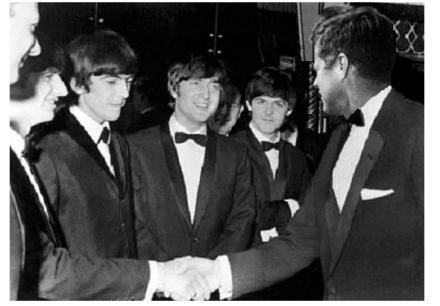
What if Kennedy had lived? Either by surviving the assassination or by it not having occurred at all? What if he lived to see Beatlemania invade American shores? What if he asked them to perform at the White House?

Why would he ask them? Would the Beatles and their management agree? Would they say, “Stuff it”?


As a history buff, my recycling bin is filled with issues of History Channel Magazine (now defunct), Colonial Williamsburg Magazine (name and format now changed), Smithsonian Magazine and Renaissance Magazine.

I wrote “The Day John F Kennedy Met the Beatles” as if it came from such a magazine. It is very fact-driven – even with faux-footnotes.  Remember the old writing trope “show don’t tell”?  This is filled to the brim with “tells”. Think of it as a piece of fiction that thinks it is a piece of non-fiction.

And I like it! But then I say that about everything I’ve written.

But it’s true – I do like this story! It’s the kind of piece I would enjoy reading. I loved doing the research on the Beatles’ history and melding them with a fictional history of Kennedy’s second term.

I’ve also included quotes from the involved parties. Sometimes it was hard getting the voice correct – but I think I succeeded. I am particularly pleased with the quotes from George Reedy (LBJ’s advisor) and the humor in the press conference (“Did you vote for Kennedy?” Lennon: “I didn’t even vote for the queen.”)

I hope you enjoy it. Look for it on Amazon. It is available for viewing on Kindle and only costs $0.99.  You can enjoy it at lunchtime, before bed, or as one of many stories you can enjoy during a lazy summer.

Kennedy meets the Beatles

Here is the link to the short story available through Amazon:

https://www.amazon.com/Day-John-Kennedy-Met-Beatles-ebook/dp/B01HQQ7F8K/ref=sr_1_1?ie=UTF8&qid=1467304185&sr=8-1&keywords=beatles+kennedy+curry#nav-subnav

More fiction to come!


Copyright 2016 Michael Curry

False Filing: Protect yourself from Identity Theft and False Tax Returns

You probably know someone who has been the victim of identity theft. Perhaps YOU have been the victim of identity theft as well. Someone has used my credit card or got a credit card in my name; someone has used my social security number on a tax return.

As a bankruptcy attorney, I have seen the latter quite a lot in the last few years. In both the Chapter 7 liquidation and Chapter 13 consolidation bankruptcy, Debtors are required to give some of their tax refund money to the trustee to disburse to their creditors.

But I have had a few Debtors who were unable to file their taxes (and get their refunds) because taxes have already been filed in their name! Fortunately, both the court and the trustee are sympathetic and do not put them on a deadline while the IRS sorts out the problem.

The Debtors in those cases were lucky – the identity theft was discovered. What if I were on social security, disabled, not employed or otherwise were not required to file a tax return? How can I find out if someone is using my social security number to file tax returns?

This type if scam could go on for years. You would have no idea someone was using your social security number to file tax returns and receive refunds – because you do not HAVE to file! The only time you would discover it is if, for some reason, you decided to file taxes OR the scammers goofed up and the IRS or state department of revenue contacted you about an error or other red flag.

You can check to see if anyone has used your social security number by preparing and filing Form 4506-T Request for Transcript of Tax Return.

4506t

Now hold on, you say. How can I request a transcript of a tax return I did not file?

Fill in the top of the form – name, address, social security number, etc. Then check box #7:  Verification of Nonfiling, which is proof from the IRS that you did not file a return for the year. Current year requests are only available after June 15th. There are no availability restrictions on prior year requests. Most requests will be processed within 10 business days.

Line 7

The IRS will verify that you did not file tax returns. At worst, they will verify there HAS been a tax return filed under your social security number in the past. You will then have to take steps to report the identity theft to the IRS and elsewhere. This blog post does not go into those details, but Google it – there are dozens of places you can seek advice on where to go and what to do next.

Note the June 15th date – you cannot check to see if someone filed a return under your social security number for 2015 until June 15, 2016. Information on 2014 and prior years are available before that June date.

Identity theft leaves us feeling sick and angry. But in this high-tech society, it is something we have to watch out for; something we have to ardently guard against. This particular type of theft – tax returns filed for people who do not have to file returns – is particularly heinous because it can be left undiscovered for years. Someone is using you to line their pockets with our tax dollars – and this time we didn’t vote for them!

If you are worried about this issue, request verification. Do it every year.

Original Material Copyright 2016 Michael Curry

Form 1099-C; When Forgiving is NOT Divine, part two

1099-C, when forgiving is NOT divine…

Part Two

Read Part one here.

If a Creditor forgives some of the debt you owe it, the IRS considers that amount as additional income for you that year. The Creditor can send you a 1099-C for the amount they wrote off and that is added to your total income. It may be enough to jump you into the next tax bracket – especially if it is a mortgage loan of tens of thousands of dollars.

During the few times clients ask me about debt consolidation, I advise them about the possibility of a 1099-C being sent to the IRS. I also tell them to seek the advice of an accountant or a tax attorney as to any forgiven debt and its tax consequences.  This, plus the fact that SOME debt consolidation companies are scams, are enough to convince them not to abandon the idea.  There ARE plenty of good debt consolidation companies out there, and I recommend a few – particularly Clearpoint – but otherwise caveat emptor (Google it)!

In over 5000 bankruptcies filed, I have had perhaps one percent of my Debtors receive a 1099-C on the forgiven debt. But since they filed for bankruptcy and received a discharge, there IS something they can do about it.

If you filed bankruptcy and received a discharge, and you later receive a 1099-C on the debt from the Creditors, you do not have to worry about it. You still have to DO something about it, but you do not need to WORRY about it.

Simply, a debt discharged in bankruptcy is not forgiven, instead the creditor is required to stop collecting the debt! The debt is still owed, but it is uncollectible, so the creditor might as well write it off on their own taxes and submit it to their insurance.

But they send out a 1099-C to you anyway. Why? Good question, do they get any monetary benefit from it? No, unless it helps keep their bankruptcy insurance premiums down, I suppose. They report it to the IRS and now you have to spend extra time and forms.

How can they send the IRS a 1099-C form on a debt that has not, technically, been forgiven? Another good question. I am not a tax attorney and the tax code is second only to the Harry Potter series in page count. Perhaps somewhere in that former rainforest of volumes, the tax code says that debt discharged in bankruptcy still counts as forgiven debt (although it is excepted). Perhaps it says the opposite; perhaps it does not address it at all (most likely).

Perhaps it may mention what happens when a company sends the IRS an intentionally false 1099-C.  An Attorney General (state or federal) looking to make some bonafides with a non-big-business constituency can look into this if they are looking for some political clout should they ever run for office.

I am sure some attorney, SOMEWHERE, has looked into this…

Regardless, the credit company sent you a 1099-C on a debt you discharged in bankruptcy. You HAVE to claim it on your taxes – the IRS has a copy of the 1099-C as well and will be looking for that income on your returns! What do you do?

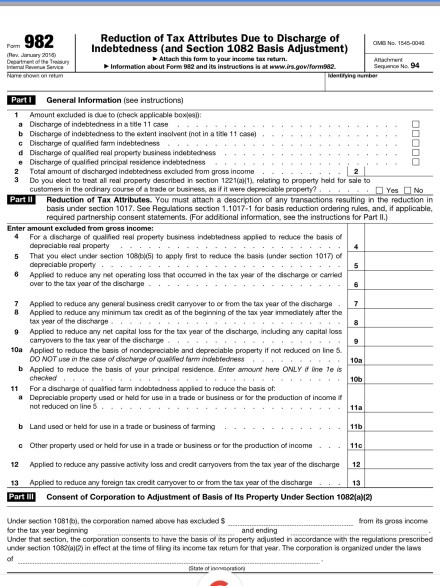
When you file your taxes, you should also file a Form 982, labelled Reduction of Tax Attributes Due to Discharge of Indebtedness (and Section 1082 Basis Adjustment).

982

Fill in your name and social security number, check box 1a and fill in Line 2 with the amount on the 1099-C. Then complete the rest of Form 982 and file it with your taxes.

Don’t do this by yourself! I cannot stress this enough! It’s okay to get the forms free online, but take them to an accountant or a good tax preparer. I have nothing against the people who work in the kiosks in discount department stores or the people who volunteer their time at churches and care facilities who help with taxes. If not for the 1099-C I have no problem recommending you go to them to help you with your taxes. But this is worth paying a little extra. Remember – the IRS is waiting for you to account for the amount on that 1099-C.

Same for credit companies. Some loan companies will help you file your taxes. That’s fine … but they may be the same companies that will send you their own 1099-C in the future.

If you discharged the debt in bankruptcy, a 1099-C is nothing to worry about, although it may cost you extra time and costs when you file your taxes (you can deduct the cost of the tax preparer on next year’s taxes if that is any consolation). A 1099-C is the final thrash at you from a discharged creditor.

Mean? Yes. Petty? Yes. Are you stuck with it? Yes. Can you do something about it? Yes – if it was discharged in bankruptcy.


Original Material Copyright 2016 Michael Curry