Abby’s Road gets a wonderful review at Reader Views!

Abby’s Road: The Long and Winding Road to Adoption and how Facebook, Aquaman and Theodore Roosevelt Helped received a wonderful review from Reader Views online.

The cover of Abby's Road

The cover of Abby’s Road

Here is the review:

Abby’s Road: The Long and Winding Road to Adoption

Michael Curry
Curry Books (2014)
ISBN 9780692221532
Reviewed by Daryn Watson for Reader Views (2/15)

Michael Curry’s book “Abby’s Road: The Long and Winding Road to Adoption” shares the trials and tribulations of the author and his wife Esther as they embark on their quest to adopt a baby. After trying naturally and using in vitro fertilization methods, the couple realizes that in order to fulfill their dreams of becoming parents, they must chose adoption.

After waiting four more years, Michael and Esther become proactive with their decision to adopt. They discuss their fears of birth mothers appearing to reclaim their child, similar to what is portrayed in Lifetime movies. They also discussed foreign adoptions and the challenges of obtaining a child from overseas. Eventually they decide on the route of domestic adoption and their adoption adventure begins.

After compiling a very detailed profile about themselves, along with a few dozen photos, Michael and Esther are chosen as suitable adoptive parents from a couple in Long Island, New York.  The expecting mother, Valerie, had previously relinquished two children to adoption and at the age of thirty-eight, her third child would be going to the Curry’s.

Michael Curry has a great way of describing in detail the steps of their journey. He is very witty and entertaining with his delivery of their adoption journey. He describes very well in detail the surroundings of the places he and Esther visit while awaiting the arrival of their bundle of joy from Valerie.  Eventually the baby arrives and the joyous couple make their way back home to Central Illinois to begin their life as new parents.

“Abby’s Road: The Long and Winding Road to Adoption” by Michael Curry is fun, informative and entertaining. As a reader, I gained a great deal of knowledge of what the adoption process is like for adoptive couples. However, the book does very little to educate the public on the experience of other sides of the adoption triad. The trauma and loss that both the birth parents and the infant adoptee experience.  As an adoptee myself, I feel these topics need to be discussed in order to educate the public on adoption trauma. During the update at the end of the book, I would like to have known of any contact (if any) the family had with the birth mother.


Reader Views website with the review is here.


And I agree with the reviewer – it would have been nice to show the adopting parents’ side of the triangle. But unfortunately, in our story, that door was closed by the parents. The birth mother specifically did not want to see the baby or to meet with us. We set up an online photo sharing account with Smugmug and had no visits from her over the past three years. The birthmother called the adoption agency to contact us for the password and information on how to access the picks, and in the next week there was a spike of visits to the site, but nothing since.

I can only imagine what the birth mother thought and felt during the process and afterward. But anything I wrote about it would be a fiction I created,  as I do not know how Valerie felt or feels. That’s very sad.  We kept a letter she sent to us, some of the voice mails she left (so Abby will be able to hear her voice) and the onsie she brought with her when she was in labor. It is the only thing we have to give Abby that was from her birth mother – other than her pretty eyes and pouty profile. The  sweetness she gets from my wife and her temper from me!

We miss Valerie. We never met her, but we’re both very sorry we never got to. Both? I mean all three of us.

“Abby’s Road, the Long and Winding Road to Adoption and how Facebook, Aquaman and Theodore Roosevelt Helped” leads a couple through their days of infertility treatments and adoption. It is told with gentle (and sometimes not-so-gentle) humor from the perspective of a nerdy father and his loving and understanding wife.

Join Mike and Esther as they go through IUIs and IFVs, as they search for an adoption agency, are selected by a birth mother, prepare their house, prepare their family, prepare themselves and wait for their daughter to be born a thousand miles from home.


Winner, Honorable Mention, 2014, Great Midwest Book Festival


Abby’s Road is available at Amazon here: http://www.amazon.com/Abbys-Road-Long-Winding-Adoption/product-reviews/0692221530/ref=cm_cr_pr_top_recent?ie=UTF8&showViewpoints=0&sortBy=bySubmissionDateDescending


at Barnes and Noble here: http://www.barnesandnoble.com/w/abbys-road-the-long-and-winding-road-to-adoption-and-how-facebook-aquaman-and-theodore-roosevelt-helped-michael-curry/1119971924?ean=9780692221532


and at Smashwords here: https://www.smashwords.com/books/view/457270


Original Material Copyright 2015 Michael Curry; the Reader View review copyright its holder or holders.


Weird Western Tales #35

DC SALUTES THE BICENTENNIAL

#3

Weird Western Tales #35

wwt35

Published bi-monthly, thirty cents, August

Cover Artist: Ernie Chua (Chan)

Editor: Joe Orlando

            The modern era has forgotten how huge the western genre was. In the 1950s television was as thick with western programs as it was with sitcoms in the 1980s, with cop shows in the 1970s and with utter crap now.

            Comic books reflected this craze. Westerns sold well in the 1950s into the 1960s. Marvel and DC each had several titles still running into the 1970s.

            The comic Weird Western Tales was a direct descendant to the golden age’s All Star Comics starring the Justice Society of America! All Star changed its name to All Star Western in May 1951 and continued the original numbering with #58 going to #119 in July 1961. 

            All-Star Western (with a hyphen) was revived with issue #1 in September 1970. It ran for 11 issued until it changed its title (and format) to Weird Western Tales with #12 (July 1972). Jonah Hex debuted in #10 and continued as the star of the series until #38 (February 1977) when he was spun off into his own series. The comic then featured Scalphunter until the series was cancelled with #70 (August 1980).

            The change in title and format was due to the success of Weird War Tales, another DC comic that combined two (obvious) genres.

            Jonah Hex was introduced in the still-called All-Star Western #10. As a child he was sold into slavery to an Apache tribe, but was made a full tribe member when he saved the chief. He was left for dead while fighting the chief’s son over a woman.

            As an adult, he joined the US Army during the Civil War, eventually shifting loyalties and joining the Confederate Army. He turned himself in after Lee’s surrender.

            (From Wikipedia): Jonah then locates his old tribe and tells the chief how the chief’s son, Noh-Tante betrayed Jonah years before. The chief decrees that this must be settled by a tomahawk battle. Noh-Tante secretly sabotages Jonah’s tomahawk so that the handle will break. In an act of desperation during the fight, Jonah pulls a knife and kills Noh-Tante. As punishment for breaking the rules, Jonah is bound and the chief presses a heated tomahawk to the right side of Jonah’s face giving him “The Mark of the Demon.” The tribe banishes Jonah.

            Jonah then became a bounty hunter, with a reputation as the most fierce and deadly gunslinger in the west.

            The character was thrust into a post-apocalyptic future in the 1980s. He was revived in the 2000s as a successful western comic. A Jonah Hex series (in a thrice-revived All-Star Western) was introduced in 2011 as part of DC’s “New 52” line for 34 issues.

***

            “The Hangman!”, Michael Fleisher (w), George Molintorni (a)

            Hex is ambushed by the Yellow Mask Gang and left for dead in the Arizona desert to die. He is rescued by “Red Eye” Charlie. Hex accompanies Red Eye to the town of Hall Valley.

            When they arrive, Hall Valley is having a town fair – highlighted by the hanging! The woman to be hung took $10.00 from a drunken cowboy. The Marshall of the town certainly keeps stern law and order, it seems.

            Red Eye is later arrested for public drunkenness.

            The Yellow Mask Gang robs the Hall Valley bank. Hex captures one member (Bill) and goes into the countryside after the rest. We find out the Marshall is in cahoots with the Yellow Mask Gang, but shoots the captured gang member before he reveals all. Red Eye overhears Marshall’s conversation with Bill and witnesses the shooting from his cell. To shut him up, the Marshall plants evidence that Red Eye is a member of the Yellow Mask Gang and sentences him to hang (the Marshall is also the justice of the peace in these parts, ya see…).

            Hex dispatches the Gang and returns with some live prisoners and asks for the reward. He returns just in time to save Red Eye from the gallows and Red Eye reveals the Marshall’s shooting of Bill.

            Bill’s brother, Jed, is shocked and angry at his brother’s death and tells everyone the truth about the Marshall!

            The Marshall is hanged as the festivities continue. Popcorn! Hot fudge! Cold Beer!

            Hex is offered the job of marshal for good, steady pay as long as he keeps up the hangings every few weeks like the old marshal did. Good for morale, good for business, ya know.

            Hex rides away in disgust.


            Thet lingo the karkters tawk in thet the rahters spell out foh-neticly shore gits noyin’ after whahl…


Trail Talk (letter page): comments for WWT #32 – Mark Schmeider, Concord, Mass (positive), Matthew Elyosin, Madison, CT (negative) and John Elliot, New York, NY (positive).


***

Original Material copyright 2015 Michael Curry


            Images used are copyright their respective holders and and reproduced here under the “fair Use” doctrine of 17 USC 106 & 106a for the purposes of criticism and comment.

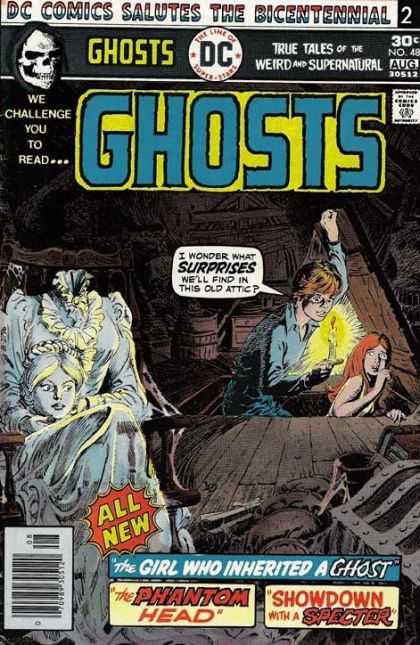
Ghosts #48

DC SALUTES THE BICENTENNIAL

 #2

Ghosts #48

ghosts 47

Published bi-monthly, thirty cents, August

Editor: Murray Boltinoff

            Only the most ardent Marvel zombie would refuse to admit that of all the possible comic book genres published by both DC and Marvel, DC at least led in the horror division. Marvel published many a horror title, but with a few exceptions, they featured reprints from the 1950s and early 1960s. Most comics of their line rarely lasted over a year.

            DC’s horror titles featured new stories with rare exceptions. Ghosts differed even from the DC fare in two ways: until its last few issues it did not have a “host” introducing the stories or otherwise having a framing segment to introduce and finish a tale (other than text boxes on the first and last panels) and until issue #75 (April 1979), it claimed its stories were true!

            Ghosts was published from September-October 1971 until issue #112 (May 1982). (Boy is my spell-checker going berserk over the first two words of that last sentence…).

            Neither the Grand Comics Database nor the DC Comics Database state who did the cover or wrote any of the stories…

 ***

Showdown with a Specter”, Terry Hensen (a)

            In 1968 Villem Kruger and his family visit his grandfather’s diamond mine abandoned decades before. When Villem moves away stones blocking the mine – he releases the ghost of a worker killed in the mine. The ghost vows to destroy the descendant of the evil Kruger. Villem’s son Jon offers to take the place of his father for the ghost’s revenge.

            The ghost explains he cannot take Jon’s life as he was adopted and not a descendant of Grandfather Piet Kruger . As the father of an adopted child I am rather irked by this…

            The ghost decides since Villem adopted a child and raised him with so much love that the child was willing to sacrifice himself for his father, Villem does not have the evil that was in his grandfather and spares the family. As the father of an adopted child the ghost redeemed himself from his narrow-minded statement from the paragraph before…

 ***

The Phantom Head”, Buddy Gernale (a)

            July 1505: Michelangelo is haunted by a floating head – every painting and sculpture he tries to complete has the head of the ghost. If he does not complete the portrait of Cesara Borgia by the end of the week, Borgia will likely take Michelangelo’s head! Even the pope cannot help!

            The ghost stops visiting Michelangelo after his disappointing visit to the pope and all is well.

            The painting of the floating head is found 288 years later and identified as the head of King Louis XVI, who was decapitated during the Revolution!

 ***

The Girl Who Inherited a Ghost”, Gene Ureta (a)

            In France in April 1957, the mother of painter Gaston Poulard is angry at him for marrying Californian Becky. Rightly so – Becky is a gold digger who is after the mother’s fortune! Becky stands by during the mother’s fatal heart attack; holding the mother’s heart medicine. The mother’s ghost haunts Becky – throwing plates at her and chasing her through the house!

            Mrs. Poulard sends a letter to a ghost hunter, Henry Thorson-Jones (they don’t call him a ghost hunter per se, but you know …) to rid the house of the intruder. The ghost tricks the hunter into pushing Becky down the staircase, killing her. Thorson-Jones discovers the letter sent by Mrs. Poulard was NOT his wife, but his mother – written and mailed after her death. The intruder written about in the letter … was Becky!


Text feature: The Jigsaw Ghosts. Written (presumably) by Murray Boltinoff.

            Guests at a resort in northern Britain in 1904 see the top half of a woman floating through their room. The servants see the bottom half of the woman walking through their quarters. It seems a prior owner chopped his wife in half, and …

            In 1923, a visiting minister wakes to find a disembodied girl’s hand tugging on his. Later he discovers the prior owner chopped off his daughter’s hand and hid her body in the wall of that room…

            New owners of a Providence, Rhode Island home in 1960 heard footsteps in a sealed-off section of their home. Opening the unused room revealed fresh footprints leading to a chest. Inside the chest were the prior owner’s last will and testament and a pair of boots – whose footprints fit exactly with the fresh prints on the floor …

            This text feature was in the place of a letter column.


 Original Material copyright 2015 Michael Curry

             Images used are copyright their respective holders and and reproduced here under the “fair Use” doctrine of 17 USC 106 & 106a for the purposes of criticism and comment.


Our Army at War #294

DC SALUTES THE BICENTENNIAL

#1

Our Army At War #294

Our_Army_at_War_Vol_1_294

Published monthly, thirty cents, July

Cover artist and Editor: Joe Kubert

            Our Army At War premiered in August of 1952 and lasted 302 issues until February 1977 when the title was changed to Sgt. Rock to reflect the popularity of its main character. Sgt. Rock would last until July 1988 with issue #422.

            Our Army At War is known for its main character, Sgt. Frank Rock of Easy Company. Although a character nicknamed “The Rock” debuted in GI Combat, Sgt. Rock as we know him debuted in this comic in 1959. He was created by Robert Kanigher.

            Easy Company was the unnumbered regiment he commanded. It saw action in every European theater. Easy contained African-American members – an anachronism for more enlightened times. Some members were given nicknames such as Bulldozer (the second-in-command), Wildman, Jackie Johnson, Little Sure Shot, Ice Cream Soldier and Four Eyes.

            Our Army At War also earns its place in comic book history for the first appearance of Enemy Ace in #151 (February 1965) – the flying ace of WWI who proved very popular as an anti-hero.

            But by July 1976 the Enemy Ace feature was gone and Sgt. Rock and Easy Company dominated the comic.

***

“A Coffin for Easy”, Robert Kanigher ( w ), F. Redondo (a)

            Easy Company runs out of ammunition and prepares to face a troop of Nazis with bayonets. Monks in a hearse drawn by two horses approach – it is Mlle. Marie and her brother Jules, who bring ammunition in the coffin!

            Mlle. Marie, Rock and Easy fight off the Nazis. Rock reveals their mission – find and destroy the secret oil pipeline in the village of Aix. This is the village in which Mlle. Marie’s brother Jules lives! Her brother is a … er … brother in Aix’s church.

            While searching the church, Rock finds the oil pipeline following an underground river. Jules rings the church bells to warn the villagers to evacuate before Easy detonates the explosions. The Nazis investigate and Jules is killed in the battle.

            Rock, Easy and Mlle. Marie make it to the hills as the pipeline explodes, collapsing the village in the river and killing off the Nazis stationed there. The church bells ring one last time as if to honor Jules’ sacrifice.

***

Bob Kanigher’s Gallery of War: “A Pair of Boots”, Robert Kanigher ( w ), Ric Estrada (a).

            Near Warsaw, Pvt. Fritz Vorst Wermacht-is issued boots that are too painful for his feet. He stops to eat and shoos away two cardinals trying to eat his crumbs. He kills a Polish officer and steals his soft leather boots. He tries to assault a village girl and kills her when she tries to run away. He is killed hiding in a farmhouse during a mortar barrage. The two cardinals he shooed away nest in his empty boots (boots, shoos, get it?).


Take Ten (Letter page): comments for OAAW #289. Walter Green of Wading River, NY (positive), Terry Chadwick of Phoenix, AZ (positive), Wade Sears of Calgary, Alberta (mostly positive, but critical of the lack of Commonwealth soldiers – UK, Canada, Australian, etc. and questioning the accuracy of Nazi tank tactics.), James Parker of Clarksville, TN (negative – questioning the time setting of the story in #289 being only 8 months before the end of the war. The editor explains that the stories depicted are not chronological) and Robert LaChine of Chicago, IL (negative). E. Nelson Bridwell answered the letters.


Original Material copyright 2015 Michael Curry


            Images used are copyright their respective holders and and reproduced here under the “fair Use” doctrine of 17 USC 106 & 106a for the purposes of criticism and comment.


DC Comics advertisements (July/August 1976)

DC SALUTES THE BICENTENNIAL

Part Three: But First, a Word from Our Sponsor…


            There have been ads in comic books as long as there have been comic books. Some of the ads have become part of our pop culture – more memorable than most of the comic book characters themselves. Sea Monkeys, anyone?

seamonkeyscomicad

            During my prime-time comic reading, I quaked in fear at the Deadliest Man Alive – Count Dante’! 

Count Dante

             I wanted X-Ray Specs and to learn to throw my voice and go on the Tilt-A-Whirl at Palisades Park (free admission with my Superman coupon) and to win valuable prizes selling Christmas cards and what the hell is Grit?

            The 33 DC comics with the Bicentennial heading contained either 32 pages or 48 pages – not counting the covers (which would add four more pages). Counting those four, all the comics contained 17 pages of the same ads. They might not appear in the same places – an ad from page 12 of one comic would be on page 23 of another – and some reprint titles would have house ads at the bottom third of the page ending a chapter or a story. I will tell you about those variations when I talk about the specific issues. But otherwise the ads were all the same. The centerfold (the middle four pages) of the 32-page comics were all ads, which was traditional for DC at the time.

            I’ll use the first Bicentennial Comic – Our Army At War #294 as the template.

            Inside front cover: Hostess Cupcake ad: “Superman Saves the Earth” – there are websites dedicated to these classic Hostess ads. DC, Marvel, Harvey and Archie comics had dozens of them featuring every popular character you can think of – the Joker starred in three, Josie of “…and the Pussycats” fame? 19! This one is typical – aliens meet to discuss the fate of the earth. Because it is so primitive and backward, humanity must be destroyed! Superman takes the aliens to a grocery store and introduces them to Hostess Cupcakes. The aliens love the cupcakes and spare the earth (the aliens are obviously of great intellect – in this writer’s opinion the original Hostess Cupcakes are tangible proof of the existence of God…). A species that can create such spongy cake and creamy filling deserves a chance! Whew … good thing the aliens decided this in 1976 and not after Hostess went bankrupt … we’d be doomed!

superman saves the earth

            A few DC Comics exchange this Superman ad with one starring the Joker called “The Cornered Clown”. He is trapped in a building cordoned off by the police. He tosses them Hostess Fruit Pies to distract them as he escapes out the back. Despite such tasty treats, the police are not fooled and are waiting to arrest him. Now if he had only thrown glazed doughnuts he might have succeeded. I will let you know which comics feature the Superman ad and which feature the Joker ad.

cornered clown

            Page 5: a full-page ad for Charms Blow Pops.

            Page 6: two half-page ads for selling social security plates (checkbook-sized holders with your number and an American eagle emblazed above it) – this was before identity theft was prevalent, obviously; and an ad for Slim Jims.

            Page 11: a full-page ad for Grit. Grit is still around, you know. It’s not a newspaper anymore; it’s a glossy magazine, but still around. Did anyone out there sell Grit for big money and prizes?

            Page 12: a full-page DC house ad for its latest tabloid-sized Limited Collector’s Edition comics C46 (Justice League of America) and C47 (Superman Salutes the Bicentennial) – see Part Two – the Leftovers for more about these comics.

limited collectors ad

            Page 15: two half-page ads selling Isokinetics (an exercise technique – are they implying that readers of comic books are out of shape? Well, we ARE, but I resent the implication…) and another ad for the social security decorative plates/holders from page 6.

            Page 16: a full-page ad for NCG Merchandise’s comic book binders.

            Page 17: a full-page ad for Action Lure to catch more and bigger fish (comic book fans fish? Really?)

            Page 18: a full page of house ads – a half-page ad for the Amazing World of DC Comics #11 (the Super-Villains issue – I have this one!) and a half-page DC Comics subscription form

            Page 21: a full-page ad from the US School of Music – a self-taught guitar program

            Page 22: a half-page ad for New American Physique and a half page of 10 S. Schwarz & Company ads of various sizes: learn vehicle decor customizing, hobby coin company sales, Universal Inc. muscle growing technique, custom bicentennial t-shirts for sale, Jack Hunt (comic book back issues), the famous X-Ray Specs, Estell (comic book back issues), Abracadabra Magic Tricks, Debt Relief solutions, and Discount Comics (comic book back issues).

            Page 23: a full page public service ad for Justice For All Includes Children. This is #5 of the series. Superman instructs children on their rights and duties as citizens. Here he advises the kids not to crash a party. Trespassing is illegal and could be dangerous!

Justice for all includes children, 5

            Page 27: a full-page ad for “DC Salutes the Bicentennial” reproduced in Part One of this series.

            Page 28: 14 ads from S. Schwarz & Company of varying sizes: “Space 1999” models for sale, learn karate, Robert Bill (comic book back issues), Richard Alt (comic book back issues), Pacific Comics (comic book back issues), weight lifting techniques, stamps for sale, Howard Rogofsky (comic book back issues), muscle building techniques, baseball card holders (called “lockers” – now we would call them deck holders), CCCBA (comic book back issues), techniques to grow taller, live seahorses for sale, and then several small ads designed as “classified newspaper” ads for: earning money stuffing envelopes, selling t-shirt iron-on decals, secret agent pens for sale, gliders for sale, earn money addressing and mailing envelopes.

            Page 32:  a full-page ad for muscle building (from the same company as one of the smaller ads on page 28).

            Inside front cover: a full-page ad for Monogram flying airplanes.

monogram

            Back cover: Spalding gloves (with as-always-excellent Jack Davis art!)

spalding

***

            Eyes spinning yet? I haven’t even begun to review the 33 comics yet! I’ll start with #1: Our Army At War #294…

             All comic covers, advertising, characters and images are the property of their respective copyright holders and reprinted here for your entertainment and review under the Fair Use Doctrine as commentary, criticism and … sometimes … parody.

            Keep in mind the actual creators probably only received a fraction of their creative worth at the time of their creation … but that is a whole other story …


Original Material Copyright 2015 Michael G Curry

DC Salutes the Bicentennial (part two)

DC SALUTES THE BICENTENNIAL

Part Two: The Leftovers


            Collect 25 of 33 DC comic book headings with the special Bicentennial cover and a free Superman belt buckle will be yours all yours!

            Even back then I wasn’t too thrilled to get the belt buckle. But the comics? They, not the buckle, were the goal.

            These were comics cover dated July and August 1976, which meant they were released in April or May of that year.

            At my count there were 48 series released by DC those months. Earlier in 1976 DC cancelled some series that I loved (like Phantom Stranger and Stalker) and that fall they would release an explosion (I know, I know, I was uncomfortable using the words “DC” and “explosion” in the same sentence…) of titles – some of which sound familiar even to casual or modern fans (Welcome Back Kotter, Isis, Starfire, Superfriends, Ragman and the revival of Green Lantern). Warlord started its classic run in February 1976 but took a hiatus during the summer and was brought back that fall. Shazam and House of Secrets both released issues in March and then September – a six-month hiatus. Young Love had them all beat – releasing an issue that January and not another until December of 1976.

            In July and August (I will hereafter use the cover dates), along with regular-size comic books DC also released three of their Limited Collector’s Editions. These were large-size comics (tabloid-size: a regular comic unfolded and turned on its side). At that point these comics featured all reprints. They were #45 (Secret Origins Super-Villains), 46 (Justice League) & 47 (Superman Salutes the Bicentennial). #47 was particularly notorious for featuring Superman only on the cover. The interior stories featured reprints of the Revolutionary War character Tomahawk.

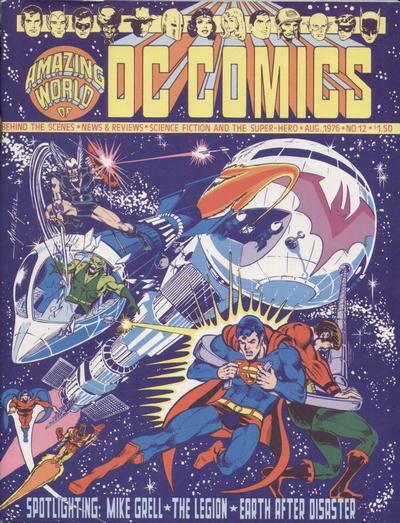
            In July 1976 DC released Amazing World of DC Comics #12, a “fanzine” featuring interviews and coming attractions. This issue focused on science fiction-ish comics (Green Lantern, the Legion, Earth After-Disaster, etc.) and featured a nifty Mike Grell cover.

Amazing_World_of_DC_Comics_Vol_1_12

            DC also released Charlton Bullseye #5 in July with art by Alex Toth and John Byrne (in separate stories), but it wasn’t really part of the DC pantheon. It being ignored made some sense. But still – why not? I guess they wanted to make collecting the headings easier, not harder.

            These larger comics and fanzines were harder to find for the average kid and I understand why DC did not include them in the 33.

            But why not the others? Why didn’t every issue of the line feature the Bicentennial heading? No amount of my internet trolling can find the answer. Does anyone know?

            It’s not because the issues missed were too expensive. Yes, some were fifty cents, but so were some of the 33. Some of the comics left out weren’t exactly the best-sellers, but neither were some of the 33.  Sales may have had a bigger impact than I let on – some of the comics left off the list were real stinkers.

            Which July and August 1976 DC comics did not have the Bicentennial heading?

            Swamp Thing #23. This was the last issue of this iconic series. It was also the first issue I owned of Swampy’s adventures, ironically. It ended on a cliffhanger and Hawkman was touted to appear in #24, and even mentioned on DC’s “Daily Planet” – a one-page house ad made to look like a newspaper hyping upcoming issues. The cover and some page lay-outs of issue #24 can be found online. Is the complete story somewhere in DC’s dark basement?

sw24

            Witching Hour #64. Only the most die-hard Marvel troll would disagree that, although Marvel frequently out-did DC in the superhero department, DC did some fine horror-titles. Still, this was one of their lowest sellers.

            Flash #243. What!? Flash was third only to Superman and Batman back then – the concept of a “trilogy” with Wonder Woman was a modern-era creation – a poll of Justice League members in the late 1970s didn’t even place her in the top five. Why wasn’t Flash given a Bicentennial heading? Sure, it wasn’t their best selling comic, but … Flash no, Plop yes? Wha…?

            Perhaps it was because of DC Super Stars #5. It had a bicentennial cover and featured Flash reprints. Too much of the Scarlet Speedster, perhaps?

            Kobra #3. This was a great series, but sold dismally for its seven issues despite a unique premise (especially for DC) – twin brothers who shared a telepathic link. Injure one, the other feels it. Too bad one of them is the leader of a murderous cult bent on world domination. Great pulpy fun!

            DC Special #22. New stories of the Three Musketeers and reprints of Robin Hood from Brave & Bold.

            Star-Spangled War Stories #200.  Another baffling omission. Our Fighting Forces gets a Bicentennial banner but not SSWS? Featuring the Unknown Soldier, this book focused more on WWII spy thrillers than DC’s other war books (another genre at which DC arguably excelled over Marvel). The Unknown Soldier was (in my opinion, if not sales) second only to Sgt. Rock, with the Haunted Tank a close third (it was actually the other way around – Rock, then the Tank, then the Unknown Soldier).

            And the July 1976 issue was #200! Two. Hundred. Captain America #200 was published in August of 1976 and Marvel milked that for all it was worth.

            This issue featured not only the Unknown Soldier but also Enemy Ace.

300px-Star-Spangled_War_Stories_Vol_1_200

            Did its letter column even mention the wonderful synergy of cover date/issue number and content (what a better way to celebrate America’s birthday than by watching the Unknown Soldier cold-cock a Nazi on a moving train)? Boy did DC drop the ball on THIS one…

            Super-Team Family #5. Part of the “family” series of books – this one featured reprints of teams and team-ups with a few new tales scattered about. Soon they would change format to feature new tales of the Challengers of the Unknown. Later they would change formats again to feature new team-ups – the first four issues of the new format focusing on the Atom’s hunt for his kidnapped wife. An excellent story arc that needs to be gathered into a trade paperback! Issue #5 features all reprints, including the Batman-Eclipso team-up from Brave & Bold.

            Hercules Unbound #5. DC’s version of the man-god awoke after centuries to Earth-After-Disaster. Later issues had superb art by Walter Simonson.

            Metal Men #46. A series long past its prime that would limp along for another year or so, although I thoroughly enjoyed its last two years of issues. They featured Walt Simonson covers and interiors, with some interiors by current Dick Tracy artist Joe Staton and covers by legendary Jim Aparo.

            Plastic Man #13. Plas was originally a character with Quality Comics during the Golden Age and purchased by DC along with the Blackhawk, GI Combat, the heroes who would eventually become the Freedom Fighters, etc. Plas’ first DC comic lasted ten issues in the 1960s and this revival (beginning with issue #11) also lasted ten issues – folding in 1977. Great art by Ramona Fradon throughout this second run. This issue was written by Steve Skeates!

            Superman Family #177. All right, enough! They left out a Superman book. A. Superman. Book! With sales flagging, the Superman division of National combined three of their books – Superman’s Pal, Jimmy Olsen, Superman’s Girlfriend, Lois Lane and Supergirl into one book rotating the three stars. A new story for one of the stars and reprints for the other two. Of all the “family” books this was the most successful – publishing into the 1980s. 

            Wonder Woman #224. The (still) beautiful Lynda Carter-starring TV show was a big hit at this time, but despite that, until the mid-1980s, the Wonder Woman book was always a bit of a sales bomb – middling at best. National tried to boost her sales – just years before they stripped her of her superpowers and turned her into more Diana Riggs than Diana Prince, and in later years there were excellent stories featuring art by the legendary Gene Colon (in the issues before #300). But despite low sales they kept the series going so they wouldn’t lose their copyright on the character. DC eventually bought the character outright in the late 1980s which was also when her fortunes started to turn and the character become the iconic powerhouse it is now. Coincidence? Um, sure… Anyway, this issue features art by Curt Swan, doing a rare non-Superman-related title. The next issue is of more interest – Wonder Woman fights off “black lightning” on the cover. Not the inspiration for Tony Isabella’a character debuting within a year, but an interesting coincidence.

            Did I miss any?

***

            Why not put Bicentennial banners on all their books? And why decide on 33? What was the significance of that number or those particular issues?

            Choosing which of the 33 would have been a tough choice, and any book selected or rejected could have been debated and argued. I hope that was the case and the editors or whoever was involved didn’t just pick books from the top of the list.

            Why not include low-selling books to help its sales – like Swamp Thing? They had the next-issue blurb as the last panel; so why not boost sales for one last issue?

            Why not push up the publication of Starfire, or better still, Ragman – which debuted with a September cover date – and introduce them to new readers who may have otherwise passed on the books.

Why not move the publication of Green Lantern #90 up one month? The original run of the Silver Age Green Lantern ended with #89 – which was also the last issue of the iconic Denny O’Neil/Neal Adams “hard riding heroes” epic. This moniker was given to the “arc” much later. Denny O’Neil again wrote the revived title with Mike Grell as the new artist. The series lasted into the 1990s. You KNOW the issue was in the can by the time of the bicentennial promotion.  Its cover declared, “At Last! The Return of the Greatest Comic of Them All!” Not great enough to merit a Bicentennial heading obviously…

            Or would that be “too much” publicity? A big bicentennial promotion PLUS adding two new comics to the shelves? Oh, no, no, no, no…

            C’mon! If Marvel had done it, they would have done it better– as was usual with their business acumen of superhero books in the 1970s. Youngsters would be frothing at the mouth to get their hands on Kobra or Plastic Man and eagerly snapping up the new titles Starfire, Ragman and Green Lantern. Newsstand owners would be shooing kids off with brooms as the brats tore the headings off to GET THAT BELT BUCKLE!!!

            But these 12 comics above were not among the 33 chosen to represent DC’s Bicentennial celebration. We may not like it, but we have to accept it.

***

            My reviews of the chosen 33 will start soon, but first, a word from our sponsor…


            All comic covers, advertising, characters and images are the property of their respective copyright holders and reprinted here for your entertainment and review under the Fair Use Doctrine as commentary, criticism and … sometimes … parody.

            Keep in mind the actual creators probably only received a fraction of their creative worth at the time of their creation … but that is a whole other story…


Original Material Copyright 2015 Michael G Curry

DC Salutes the Bi-Centennial (part one)

DC SALUTES THE BICENTENNIAL

Part One: An Introduction


“DC Salutes the Bicentennial”. Does that ring a bell? July 4, 1776 is the most important date in our country’s mythos. Most people born before 1970 remember events on and around July 4, 1976 – the Bicentennial!

            I was 11 years old on July 4, 1976 – turning 12 that November. On the day itself we were out of town at a funeral, but I remember seeing plenty of fireworks in the distance as we drove through the night. CBS television had a “Bicentennial Minute” every evening through the first part of the year – a notable star or politician described what happened 200 years ago that day. President Gerald Ford had the honor of describing the monotonous – er – momentous events of July 4, 1776: our founding fathers voted approval of our Declaration of Independence (it wasn’t signed until several weeks later).

            By then I was already firmly entrenched in my nerdiness – I watched “Star Trek” and read the novelizations, my favorite TV shows were science-fiction-y and usually of the Saturday Morning variety. By this time next year “Star Wars” would dominate my culture. Can you imagine a world before Star Wars? Hardly seems possible, doesn’t it?

            Within two years my brother will join the Air Force and give me his record collection – including several albums by a British mop-topped quartet. This would start a love affair that has yet to diminish. Not just “With the Beatles” (heh-heh), but with rock music, too. In later years I discovered my beloved Badfinger and the Moody Blues.

            But in the first part of 1976 my loves were foremost comic books and related merchandise – superhero action figures, albums, etc.

            I lived near Sparta, Illinois, home of World Color Press. They printed DC, Harvey & Archie comics. So those were the comics my friends and I read – usually given to us free by World’s employees. Marvel was foreign to us – although World Color printed Marvel, they weren’t in the free bundles given out to employees. 

            My dad, by the way, did not word at World Color, but he did carpool with a lady whose husband worked there. “You have kids? Here!” Every few months we were in heaven when dad brought home a bundle of funny books.

            Marvel comics were available in supermarkets, though, but why buy comics when we can get them for free? Otherwise those characters were known only through their TV cartoons. By that I mean Spider-Man and the Fantastic Four. I was in my teens before I even knew who Iron Man or Thor was. I was in college before I knew what an X-Man was – hard to believe that, too, nowadays, isn’t it?

            So when I say I read comics as a kid – I mean DC comics. Archies went to my sister and Harvey (Casper and company) went to my youngest sister. A good division.

            National Comics (they wouldn’t officially call their releases DC Comics until cover-date February of 1977 – which means somewhere around November of 1976 – I’ll explain what that means later) celebrated our nation’s 200th birthday in a big way! Here is a house-ad that appeared in DC comics:

DC house ad

            In case it is hard to read:

            “DC Salutes the Bicentennial with a Great Free Offer! Look for our July and Aug(ust) covers which have the RED, WHITE and BLUE headings and are identified by a right-corner number 1 through 33.

            “If you send us at least 25 different cover headings, we will send, FREE, a METAL SUPERMAN BELT BUCKLE! (in antique silver finish!)

            “Example: … Cut and Send Top of Magazine!

            “Collect then, save them and then send them! Only these issues will be accepted!! Be the first on your block to collect the 25 headings!”

            And them the coupon with DC’s address and disclaimer (excludes wholesalers, employees and their families.)

***

            Note that we are talking about cover dates here, not release dates. Ever since there have been comic books the cover date is about two to three months after the release date. Once upon a time comic books were sold on newsstands …

            Let me back up; once upon a time there were such things as newsstands…

            A comic book with the cover date of July 1945 may have been released and on sale in April or May of 1945. This would “trick” the salesmen into keeping the comic on the shelf longer. “Eh? This-a Superman comic says July, ees-a only June-ah. I beddah not troh it away-ah.” It didn’t work – newsstand owners weren’t stupid – but the tradition sticks to this day.

            So the comics listed were on the stands and selling in April or May of 1976.

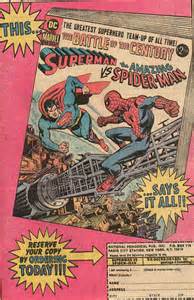
            These ads first appeared in the June issues – I checked three comics I had full runs of at that time World’s Finest, Brave & Bold and Justice League of America.  I checked the May issues and earlier and they had no ads for the Bicentennial; they each had ads for the Superman vs Spider-Man Tabloid-sized comic book out that year, however.

superspidey

             So this gave us only one month to save enough money to buy at least twenty-five comics while they were on the stands and then mail it all to DC Comics before the July 4th deadline. On top of saving for the Battle of the Century! Oh the pressure…

            This is nothing new. Kids have been collecting wrappers and box tops as long as there have been wrappers and box tops. This is not even a new thing in comics – ever since the first comics appeared in the 1930s kids were encouraged to cut out an ad or a symbol and cash in!

            But on this scale the only thing that I can think of as equivalent are the Marvel Value Stamps. In the letter pages of various Marvel comics were “stamps” of their characters on their letter pages. The stamps were only an two or three-inches-square and printed on the page as if it were any ad or text. Collect all 100 , purchase the handy-dandy Stamp book, paste the stamps on the inside and collect valuable prizes.

            The prizes consisted of discounts at various upper east coast conventions, free knick-knacks at said conventions, etc. A boy stuck in rural southern Illinois (a redundant term) didn’t find much use for such stamps.

            But a Superman belt buckle!? A Superman BELT BUCKLE!?

            Meh.

            Even at eleven years old … meh.

            It’s true – the prize didn’t thrill me. And twenty-five headings at thirty cents a comic (at the cheapest – some, like DC Super Stars #5 were fifty cents) was $7.50: a princely sum for a pre-teen.

            But forty years later it is another story. Collecting comics is now a fun hobby. They still entertain me – more so than modern comics. I want to read and review all 33 comics on the list. Maybe I’ll send in the tops (and ruin their value, true) and ask for my belt buckle. Oh sure the event ended on July 4th, 1976, but they might still have a few buckles lying around. Maybe DC will run across a box of them when as they pack for their move to LA.

            Writer Tony Isabella inspired me to do this series of reviews. For many years his blog contained reviews of comics released on the day of his birth. He now blogs about the comics released at the same time Fantastic Four Annual #1 was published – the comic that inspired him to want to be in the business. It was a day that changed his life.

            I considered doing comics released on the day of my birth, but nixed it. I don’t have that many and am not that interested in doing that much research. But DC’s Bicentennial issues – comics I have or can get for the price of a current comic? Why not?

            In past blogs I’ve reviewed the Adventure Line series of comics DC released in 1975 https://michaelgcurry.com/2015/01/02/the-dc-comics-adventure-line/, and released a companion/review of The Brave and the Bold comic as an ebook https://www.smashwords.com/books/view/497750. So I’ve had plenty of experience writing about and reviewing my favorite comics!

            So I decided to review the 33 comics with the Bicentennial headings in order of their number – regardless of issue number or release date. I will discuss the plot, art and creators of the particular issue and discuss the comic series itself. I will list the contributors of the letter columns and, if interesting enough, may sum up what they wrote. I will load each review with enough details to bore even the most ardent comic book fan.

            Will you join me on this trip back to July 1976? That’s the Spirit!

            Heh, see what I did there …


            All comic covers, advertising, characters and images are the property of their respective copyright holders and reprinted here for your entertainment and review under the Fair Use Doctrine as commentary, criticism and … sometimes … parody.

            Keep in mind the actual creators probably only received a fraction of their creative worth at the time of their creation … but that is a whole other story …


Original material copyright 2015 Michael G Curry


Unnecessary Farce, Act Two

     cast     

               Winter storm Uvula dumped a whopping three inches of snow in town. Some towns up north and to the south got 8-10 inches; enough for my boss to close the offices. It reminds me of my college days when youthful citizens of a certain megopolis in the northeast reaches of my state mocked local schools for closing when there were only a few inches of snow and ice.

                I could do a whole blog ranting about naming winter storms to give the drama queens that are weather forecasters better ratings.

                I could also do a whole blog ranting about northerners not realizing that school busses taking kids to school in the Ozark foothills have a little more to worry about than their fellow flatland metro bus drivers who might bump into another bus or a pole at 3 miles an hour … tumbling sideways into a creek bed comes to mind…

                But this gives me a chance to blog about the upcoming play I am performing in: “Unnecessary Farce”. It is put on by the Sparta Community Chorus and performance dates are February 27th, 28th, March 1st, 6th, 7th, & 8th.

              Last year I tried out for and was given a part in their 2014 Winter Play “Murder in the Magnolias”. I met a lot of new friends and finally performing a play we had to cancel in high school brought back a lot of memories and I blogged extensively about it then.

                This year it is wonderful to connect back with my old new friends and make new ones. It also helps this is a hilarious play – funnier than last year’s, I think.

                The Facebook page and website of the play itself provides some fun stuff – here are two posters of performances recently in Singapore and Iceland. I wonder if they did the play in English. I wonder how the actors handled the thick Scottish brogue of two of the characters.

Singapore

iceland  

              “Unnecessary Farce” has a great premise and I will try to tell you without any spoilers. There are a few fun twists and turns – all is not as it seems – and I won’t ruin it for you.

                Two cops, Billie and Eric, are given their first real assignment that doesn’t involve pushing pencils behind a desk. Karen, the city accountant, has found discrepancies in the city budget – someone is milking the city for millions of dollars. All evidence points to the mayor.

                Mayor Meekly is meeting Karen in a seedy motel room where Eric and Billie set up a sting. Karen’s job is to video-tape the Mayor confessing to embezzling the money. Easy, right?

                Nope, it seems the Mayor is a bit of a dope. Eric and Karen, while not incompetent, are very inexperienced. And Eric and Karen fall passionately in love with one another.

                The head of town hall security, Agent Frank, shows up in the midst of Karen’s interview with the mayor and stops it. To ensure the security of the motel room, he says. When the Mayor leaves, he warns Karen that the real reason he is there is to inform her that the Scottish Mafia, who REALLY runs the city, knows what she is doing and is sending a hit man to stop her.

                The hit man shows up. So does the Mayor’s wife, just as silly and clueless as her husband, looking for him (he tends to wander off, you see).

                Will the hit man take out Karen? Can the two young police officers fight off such a vicious killer? Will the mayor be exposed as the embezzler?

                It is a fun and wonderful script. With about ten days to go before the opening night, everyone is nervous – there are a lot of lines and a LOT of choreography with the motel doors. One person leaves just as another enters. Our lines depend on the verbal and physical cues of others. A few times my character doesn’t enter until I hear (or see if I peep out the slightly-opened bathroom door) others leave or hide. If I don’t hear/see the door shut, the other actors will have to wait until I appear.

                Fortunately we have a wonderful cast who have been in dozens of plays and musicals. They needn’t be nervous – we will all know our lines and cues and it will be rollicking fun.

                I’ve been performing in plays since before all but two of my cast members have been born, starting in 1979, but I am still the only “newbie” on the cast. This will only be my second time performing in play since 1982! But our director has picked a perfect cast! I was amazed at the first rehearsal I attended how the script flowed out of everyone so naturally. When you come see the play, compliment her on her perfect casting.

                Hopefully even that heavy-set fellow in the kilt…

 cast 2


Budgeting, avoiding debt and getting out of debt, Part 2

budget

Budgeting, avoiding debt and getting out of debt

Part 2

            On January 27, 2015 I was asked to speak to families by the BCMW Head Start program in Centralia about budgeting, avoiding debt and getting out of debt.

            I prepared a thirty-minute speech with handouts and other documents. Most of my speech was cobbled together from notes online, and I thought I would write it up as a blog to share with you.

            Note that these are lecture notes and not originally done to be read. It’s like reading a play – something I always complained about in school when studying Shakespeare, etc. It’s like trying to “listen” to Mozart or the Beatles by only looking at the sheet music. So it is a little disjointed, but I hope you enjoy it.

            Check the first part of my speech here.

***

            Now that you’ve found a small pool of “extra” savings, how can you use that to get out of debt?

            Make a conscious decision to stop borrowing money. Right now. If you want to get out of debt fast, you have to stop using debt to fund your everyday expenses and lifestyle. This means no more financing furniture, no more signing up for credit cards, no more test driving brand new cars that you don’t have the cash to pay for. This will help you focus solely on the debt that you currently do have so that you can develop a game plan to pay it off quickly.

            DON’T take out a big loan to pay off all the smaller ones; you can’t borrow your way out of debt. Especially if you are still used to using debt to finance your everyday expenses. In a few years, or even months, you’ll be back to several loans and credit cards AND the big loan that paid off your previous debt…

            Ask for a lower interest rate: Frankly I usually have doubts about this working, but I’ve had people tell me they have had some success. Grab a bill from any account charging you more than 15% interest. Dial the toll-free number on the bill and ask to have your rate reduced — say, to 10%. Tell them that you’d really like to stay with them as a customer, but you are facing financial difficulty and have received offers for much-lower-rate cards. Stand firm and remember that, to them, you are both a customer and a means of profit. You have nothing to lose – all they can say is “No.” Thank them and hang up. But if they say yes, you could save some money. And always, always ask a letter from them confirming the new rate.

            Should you switch to a low-interest or no-interest credit card? Well, why not? If you stick to the payment plan it will save you money in the long run. One saying is applying for lots of credit cards at one time hurts your credit. Odds are your credit is already hurting right now … so where’s the real harm? And all the new credit cards can say is no and you can cancel them before charging anything on them – but watch out for the transfer fees. Is it worth paying no interest when they add a thousand dollars to your bill?

            Is there any way to earn extra cash? Books and financial gurus tell us to “go get a second job”. Yeah, right. I earn more money, I lose my aid.  Or “start your own business”. Seriously? How can they say that and keep a straight face?

            But maybe the older children can help with part-time jobs. And they can help with expenses. They can start learning about income and not using debt to fund living expenses. A habit they’ll get into that will benefit them the rest of their lives!

            Can you sell things? Don’t think of ways to make some extra money as a waste of time. You might spend all day on Saturday sitting at your yard sale for $40.00. But it’s $40.00! What else would you be doing? Watching TV? The kids can help count money and make change – my gosh they might learn something!

            Take old toys to consignment shops, sell old clothes on those online or Facebook yard sales.

            Once you have found some extra cash, it’s time to organize your debt and start paying it off.

***

            Financial gurus use two approaches:

  1. List your debts smallest to largest regardless of the interest rate. This helps build momentum. When we paid off our first debt it’s encouraging and exciting! Even though we had higher interest debts, this gave us something that was very powerful: the belief that we could get out of debt quickly if we stuck to the plan. Then when that debt is paid off, roll that monthly payment into the next debt.

            Example: you’ve found a pool of $75.00 extra per month and pay that on a bill until that is paid down. Then you go to the next bill and pay that bill the extra $75.00 plus its minimum payment, let’s say $30.00, too. So you have $105.00 going to pay that bill. Once that is paid off in a few months to a year roll that $105.00 to the next bill and add its minimum payment – let’s say $40.00 per month. So you are making $145.00 per month on that third bill!

  1. List your debts starting with the highest interest rate first and end with the debt with the lowest interest rate. This will save the most money in interest over time.

            Regardless of which process you choose, the key is to stick with it.

            Throw that excess cash at your debt

            I mentioned this before … if extra money comes to you, take this cash and use it to tackle your debt. Some good examples would be a tax refund, selling a car, selling toys at consignment shops or online. The more cash you can put towards your debt, the faster it will disappear.

            Be aggressive in paying down debt, but don’t get so ambitious that you risk missing minimum payments on your mortgage, automobile, or any other secured credit account. (Secured means that if you miss enough payments, the bank can show up and take away your stuff.)

***

            Then there is bankruptcy, this is what I do. I am a bankruptcy attorney. In this debt pay-off plan I consider this the nuclear option. Boom!  I’ll explain why in a bit.

            There are two kinds of bankruptcy you can file – the Chapter 7 and the Chapter 13. Why they are called that is because the bankruptcy code is like any book – it’s divided into chapters and the chapters that apply to people at 7 and 13. Chapter 13 is a consolidation of all your debt – kind of like what we are talking about right now. The Chapter 7 eliminates or liquidates all debt.

            There’s a lot more to it than that, such as car loans and house loans, but that would take up another half hour.

            The trouble with filing bankruptcy is the same as getting a big loan to pay off your debt. You need to get in the habit of not financing your everyday expenses with credit. Bankruptcy will eliminate your credit cards and loans, but if you don’t learn to live and spend without them – you’ll be back to owing more credit cards and loans in a few years, or months!

            Remember that originally credit cards were a safe substitute for cash – usually in bigger cities or stores. I charge on my account and pay it off at the end of the week. In rural areas people charged until they had the cash available. It’s too wet to cultivate the beans, but after ten days of sunshine I can harvest the crop and pay store or bank debt.

            Debit cards are now the substitute for cash. I use a debit card instead of cash. It’s safer and most places take them now. Don’t use credit cards for food or clothes. When Wal-Mart announced in the mid-1990s they would start accepting credit cards, I knew the impact it would have on people dependent on credit cards.

***

            OK, so I’ve paid off all my debt, now what? Establish a starter Emergency Fund of $1000.

            You might be wondering, ‘Why is having an emergency fund important’? Well, if you don’t have any money in the bank and an emergency does happen, how are you going to pay for it? For most people, credit cards become the funding source for those emergencies. If you are trying to get out of debt then you need to put a buffer between you and debt; that is exactly what an emergency fund does.

            A fun way to save money is to add money into a jar or piggy bank at the rate of the same amount of dollars as the week of the year beginning January 1st (we’re nearly in February so you will have to catch up quick). $1.00 the first week, $2.00 the second week, etc. This might get tight by the time you get to week 30 or so… (this will be mid-July), but by then you’ve collected $465.00 – in ten weeks that will be $820.00 (mid September): there’s your Christmas spending money. If you can make it to Week 48 (just after Thanksgiving), that’s $1,176.00. That’s a nice way to save up for your emergency fund. By the way, if you want to catch up, the end of January totals $15.00.

***

            When you have a huge debt load you feel isolated and bummed out. But if there is one thing to remember is that you are not alone. And there are people you can turn to for help. There are lots of books and financial gurus out there. You can check out books and DVDs from the library or buy them cheaply on ebay.

            And by the way, check your local libraries or museums or conservatories for free activities for kids and families – game days, reading nights, movie nights, etc. Substitute that instead of paying for the family to see a movie.

            When it comes to getting out of debt one of my favorites is John Cummuta. His earlier tapes and DVDs talk about this system of paying off your debt slowly and I like what he says and his down-to-earth style. Nowadays he also talks about what to do with all that extra money: invest in this, invest in that, start your own business, etc.; but his method to climb out of debt is still good advise.

            But there are also so many scam artists and charlatans out there, so be careful. You know, “I can help you make a millions dollars. Just send one dollar to “How to Make a Millions Dollars”…” and their secret is to get one million people to send them a dollar…

            And don’t put up with smarmy condescending jerks. The type that says it’s not your fault and then spend twenty minutes telling you why it’s your fault.

            Debt doesn’t have to be forever. Develop your financial game plan and start your journey toward being debt-free.

***

            (The suggestions and ideas of this blog are cobbled together from various internet sites and blogs. Some ideas and suggestions are original; some taken from various “un-cited” sources. Copyrights, if any, are held by the proper holders.) 

Michael Curry

Budgeting, avoiding debt and getting out of debt, Part 1

budget

Budgeting, avoiding debt and getting out of debt

Part 1

            On January 27, 2015 I was asked to speak to families by the BCMW Head Start program in Centralia about budgeting, avoiding debt and getting out of debt.

            I prepared a thirty-minute speech with handouts and other documents. Most of my speech was cobbled together from notes online, and I thought I would write it up as a blog to share with you.

            Note that these are lecture notes and not originally done to be read. It’s like reading a play – something I always complained about in school when studying Shakespeare, etc. It’s like trying to “listen” to Mozart or the Beatles by only looking at the sheet music. So it is a little disjointed, but I hope you enjoy it.

***

            If you do not have debt, congratulations. There aren’t many people out there that can say that. Most of us have debt and that can cause stress & anxiety.

            If you’re afraid to open letters, answer the phone or open the door, but they are ignoring the problem – but it won’t go away.

            Being in debt can be a stressful experience. No matter what your circumstance is, if you signed for a loan, you are obligated to pay it back even if you have a life altering experience like losing a job, getting into an accident, or even if you have increased expenses due to having a child.

            Money is the No. 1 cause of relationship breakdown.

            Ignoring it may also make you dread what tomorrow might bring. And it’s all because of money worries.

            Facing up to the problem can be a frightening thought, but it is the first step towards doing something about it.

***

            To avoid debt or to get out of the debt trap you are in is to know your income and expenses.  What you have coming in and going out…

            Few of us were taught the basics of money management.  Drawing up a budget is a mystery to many. Yet it has an impact on our day-to-day living.

            Look at your income; I made an income sheet that details your gross, your deductions and then you final net income – your take-home pay.

 Gross Income                                             $

Overtime (average):                                $

Total:                                                             $_____________

 DEDUCTIONS:

Taxes

            Federal                                              $

            State                                                   $

            Social Security                               $

            Medicare                                           $

            Other (FICA, etc.)                         $

 Insurance

            Health                                                $

            Life                                                      $

            Vision                                                 $

            Dental                                                $

            Disability                                          $

            Other                                                  $

 RETIREMENT                                            $

 UNIFORMS/SHOES/EQUIPMENT    $

 OTHER                                                          $


NET INCOME:                                             $

 Determine your monthly income:

            Paid weekly*?                                                         x 4 =

            Paid every other week*?                                     x 2 =

            Paid two times per month?                               x 2 =

            Paid monthly?                                                        x 1 =


*(actually, weekly is 4.33 and bi-weekly is 2.167, but this will give you a cushion)

***

            Know what your deductions are. Is this insurance? Is this a voluntary charity? It’s important to know where your paycheck is going.

            Is there a way you can adjust this?

            Can you adjust your withholding? Do you need that big tax refund or can you lower your withholdings to make more money during the year. You may get thousands of dollars in February but are eating Ramen noodles by November, and borrowing for Christmas and paying for it with those thousands of dollars in February – it’s a vicious circle of debt…

            You can even spread out your earned income credit through the year. This can be hundreds of extra dollars per month.

***

Then look to see where what you are spending. I’ve also included an expense sheet we use at our office. You can find lots of these online or in self-help books at the library you can copy for your own use.

EXPENSE
AVERAGE MONTHLY COST
RENT OR HOME MORTGAGE $
UTILITIES  
Electricity $
Heating Fuel; Gas or Propane $
Water and Sewer $

Telephone

$
Cell Phones $
Cable $
Satellite $
Trash $
HOME MAINTENANCE (repairs, lawn mowing, painting, etc.) $
FOOD $
NON-FOOD GROCERY ITEMS (laundry soap, diapers, toiletries, etc.) $
CLOTHING/SHOES (yearly average ¸ by 12) $

LAUNDRY / DRY CLEANING

$
MEDICAL AND DENTAL EXPENSE (do NOT include insurance premiums) $
TRANSPORTATION – include gas, oil, repairs ( do NOT include car payment or insurance) $
INSURANCE (do NOT include any payroll deductions)  

Homeowner’s /Renter’s (if not escrowed)

$
Life $

Health (Major medical, dental, vision, etc.)

$
Auto $
Other $
TAXES – do NOT include any payroll deductions or any that are included with your mortgage payment  $
INSTALLMENT PAYMENTS – only those you  intend to keep  
Automobile payment $
Other $
Other
$
ALIMONY, MAINTENANCE AND SUPPORT PAID TO OTHERS (do NOT list if this is a payroll deduction)  $
CHILD SUPPORT (do NOT list if this is a payroll deduction) $

MISCELLANEOUS


Tobacco

$
Postage $
Haircuts/Beauty Shop $
Pets $
School Supplies/Lunches/Expenses $
Charitable contributions $
Other __________________________ $

             Be realistic! This will help you see where your spending goes.

            Check the income minus the expenses – where are you at? Do you need to trim some expenses?

            Go over each line item on your budget and ask yourself, ‘how can I make this number smaller?’ It may involve cancelling services that you rarely use like a gym or swimming pool membership, Netflix subscription (although that is sometimes cheaper than cable), etc. It might even involve reducing the amount of times that you eat out at restaurants each month.  Maybe make it once per month – makes it more special.

            Stop buying non-essentials. Buying lunch every day? Coffee? Think how much you spend on high-end coffee per cup. $7.00 for a mocha froth? One of those a day for month equals an average car payment. A car payment … a cup of coffee. Get it?

            Use coupons or buy generic (although it is usually cheaper just to buy generic green beans rather than name brand even with coupons).

            If you decide you’d like to keep getting that big tax refund instead of spreading it out through the year: think hard about what you want to use it for. Don’t blow it on a vacation.  Remember the cute phrase some years ago – “Staycation?” Go to Springfield if you like history, camp out at Giant City or Rend Lake, St. Louis Zoo is still free, etc.

            Movies? Get them from the library. Games? Rent them, too. Cable? Can you watch shows you like online or though Hulu or Netflix (but watch out your not paying extra for the internet streaming. Netflix may be $7.00 per month, but if you go over your internet limit that will cost tons… see? You have to watch for those little things)? Cell phone? Get prepaid – you can reward yourself with a smartphone after a debt is paid off.

            And feel free to reward yourself when you hit a milestone and pay off a debt. Go to that movie, eat out someplace nice.

            Before buying an expensive item, count how many hours you will have to work to pay for it or how many months’ income it is. Rule of thumb: if you can’t afford it, you can’t have it.

            Other ways to shave off a few bucks from your expenses are old tropes or old ideas, but they happen to be true and happen to work: Your car’s most economic speed is likely to be between 50 and 55 mph.   When you buy a car, get one that is two years old – its price will have dropped by 40-50 per cent – and keep it three years.

            Never go shopping when you are hungry – and, if possible, don’t take the children. My secretary told me her cousin plans their meals for the week and writes it down in a notebook and takes it shopping – cuts down on the impulse buying and buying things you don’t need or impulse items.

            The amount that you slash depends upon your commitment level to getting out of debt.  The more committed you are, the easier it will be for you to give up some of the unnecessary amenities in life.  You might not even need to sacrifice much if you can find these items or services for less.

            But you will probably have to make changes in your life to climb out the hole. Think about how long did it take you to get here? This won’t happen overnight, or in a month or a year! It takes perseverance, patience, and dedication; it takes time and effort.

            From here you can now make a plan – by looking at the kind of debt you have – secured (fixed payment) and unsecured.

***

            End Part 1 …

            Fear not, Part 2 of this speech will be posted on my blog right away … if there’s no hyperlink at the end of this blog, you can click here.

            (The suggestions and ideas of this blog are cobbled together from various internet sites and blogs. Some ideas and suggestions are original; some taken from various “un-cited” sources. Copyrights, if any, are held by the proper holders.) 

Michael Curry