The Years of Robert Caro – A review of his Lyndon Johnson biographies Part Two

The Years of Robert Caro – A review of his Lyndon Johnson biographies
Part Two
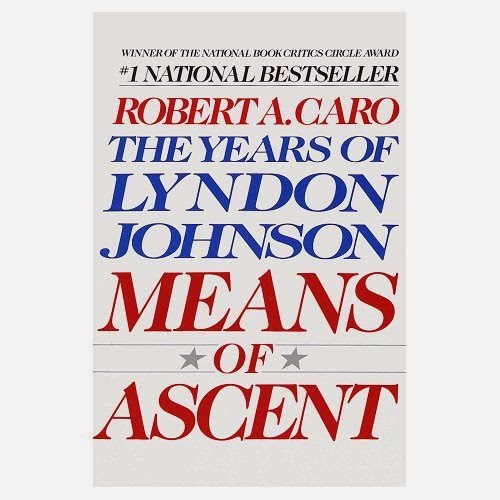
 
            Volume Two of Robert Caro’s The Years of Lyndon Johnson: The Means of Ascent(Albert A. Knopf, 1990; ISBN # 0-394-49973-5) was the first book of the biography series that I purchased. It was in the bargain bin of the Wal-Mart in Murphysboro, Illinoisduring the spring of 1992. I took it with me to read in the lobby of one of the law firms with which I interviewed (and got the job). It was snowing heavily and I dropped the book in my driveway when I got home. The dust-jacket was off (I always take off the dust jacket) and the black cover bled onto my hands and shirt. Good thing it happened after the interview.
            It is the shortest of the four volumes published to date – 412 pages not counting index, bibliographies and annotations – just over half the page-count of the previous volume (and the fourth) and 2/5th the length of Master of the Senate.
            That is because it covers the nadir of LBJ’s political career. It begins just after his defeat at the hands of Governor Pappy O’Daniel for Texas’ open US Senate seat and concludes with his successful second Senate run – from 1941 to 1948.
            The introduction is a masterful retelling of LBJ’s call to arms for civil rights as president in the 1960s.  The author tells us he intends to take us back to show the means that led to this noble end; means which were far from noble. We see a Lyndon Johnson beginning to amass his fortune, his ruthless style of running his Congressional office, and his do-or-die attitude in his second bid for the Senate. This is not the Lyndon Johnson of the introduction; this is a vicious opportunist at the start of his climb to power.
            What changed? Future volumes will show. In the meantime we the readers can watch his climb – and watch as he uses everyone he meets as an expendable rung.
            He had his plan to power: the House of Representatives to the Senate to the Presidency. He made no bones about the desire to become a Senator, but more-or-less kept his presidential ambitions secret. Occasionally the plan would slip out. The book mentions LBJ looking upon the House gallery muttering, “too slow, too slow…” Because of the unbreakable tradition of seniority of House committee chairmanships, he would be an old man before he achieved anything close to power in the House. And Congressmen rarely made it directly to the White House. He needed, NEEDED, to go to the Senate.            
            Challenging incumbents were futile; he had to wait for an opening as was the case in 1941 (and as was the case for his House seat in 1937). So what to do in the meantime?
            Amass his fortune.
            The introduction of Path to Power revealed the beginnings of his association with Brown & Root, a Texascorporation that helped finance his elections and begin his financial career in exchange for votes favoring their schemes. They were involved in construction, engineering and military contracts. LBJ’s influence in the House helped them get their contracts, and in exchange … well, LBJ didn’t get a kickback, but did get to ride their coattails in B&R’s financial ventures. Eventually Johnson bought a radio station where his new friends would advertise. In later volumes, we discovered that if anyone – anyone – wanted a political favor from the Congressman-then-Senator would require they buy advertising on his now-network of Texas stations. Even if the business was an insurance firm in North Carolina– they advertised in Texas in exchange for favorable passage of their pet projects.
            During WWII he finagles a commission in the Navy and, during a House junket, sees genuine combat, from which he was awarded the Silver Star.
            The other two-thirds of the book show the details of his 1948 Senate run.
            The author gives us a biography of his opponent – then-Governor Coke Stevenson. His last Senate run was against a sitting governor as well, showing the reader the importance of the seat.
            Coke Stevenson, Mr. Texas, is given all the respect that was his due (supposedly, he was a raging bigot). Caro also shows Johnson slowly, ever so slowly, chipping away at his huge lead.
            LBJ campaign used modern technology – using a helicopter to enter towns and villages in the most dramatic fashion, and using telephone solicitations and polls.
            And he cheats.
            Oh how he cheats.
            His moniker “Landslide Lyndon” came from this campaign and election. Caro vividly explains how politics work in the most southern counties in Texas. We learn about Alice, Texasand Jim Hogg County as well as short bios of “The Duke of Duval County”, his ilk and their fiefdoms. Caro shows how they work, and decide, elections.
            Johnson lost his last run for Senate by reporting their returns first. His opponent then reported their returns – not coincidentally reporting more votes for their candidate.
            He would not make that mistake in this election. He won by 47 votes. Some people voted in their precincts in alphabetical order.
            Caro discusses Stevenson’s challenge and his dislike of LBJ for the rest of his life (he supported Goldwater in 1964). But in the meantime Stevenson found the love of his life and retired from public life as a rancher. It was, after all, a happy ending for Mr.Texas.
            And a happy ending for LBJ. He was a Senator now, on the second rung of his ultimate plan for power. He was happy and rich. The scorched bodies he left behind are irrelevant.
            Aren’t they?
            Master of the Senate (2002, USBN # 0-394-52836-0) picks up immediately after the second volume. First, though, Caro gives us a superb history of the US Senate and its role in UShistory through its legislation as well as its lack of legislation. Caro shows us a history of the radical House as well as the Executive Branch proposing bill after bill reflecting the changing attitudes of the country. Civil rights, labor reform, environmentalism, care for the poor and aged. Wave after wave of legislation smashing against the unmovable dam of the US Senate – the keeper of the status quo – all to no affect.
            You shall not pass.
            Attaining power in the Senate would take almost as long as in the House, despite there being only 95 men to leap-frog on the way to power. Johnson would have to suck up to the committee chairmen; some of which had been chairmen for decades (during the times while the Democrats held the majority). Fortunately Johnson had a leg up here – most of the chairmanships belonged to the longest-serving senators. And all of them were from the south. They belonged in what was called the Southern Caucus – fiscally and culturally conservative Democrats. Put another way – the only black they like is the color of ink on a ledger; as opposed to the color of one’s skin.
            In Means of Ascent, Caro provided a thorough biography of Sam Rayburn – the Speaker of the House. Here are meet Richard Russell – the “head” of the Southern Caucus. Russell did not have a title equal to Rayburn, but he had equal power. Johnson sucked up to Russell in the same way he had Rayburn. LBJ became his sycophant; and then his second-in-command. Russell was priming Johnson to become the leader of the Southern Caucus. This was as high a position as a senator from the south can become.
            Right?
            So other than an informal position with nose firmly implanted in Richard Russell’s bottom, how can LBJ gain power not just over the Southern Caucus, but the rest of the Senate? How will that help him with his ultimate goal? Caro marks the parallels with Johnson’s first days in the Senate with his days in the House and before that as a Congressional aide. He takes a little-used office – Minority Whip – and transforms it into a title that brings him power; just as he did in college and in the “Little Congress”.
            He took command of the disbursement of funds for election campaigns. Those he instinctually knew would lose their seat either in a primary or general election got little money. Those who would win got more. Those who begged – those who kissed ass – got even more. He wielded his power with the strict purpose of gathering more power.
            He transformed the post of Minority Leader and, soon, Majority Leader. He brought the Senate to a level of power not seen since before FDR’s presidency. And with the rise in the power of the Senate, came a rise in his power and influence.  No bill passed that he did not want passed; no bill failed that he wanted to fail.
***
            Before becoming the second most powerful man in Washington, though, we learn about Johnson’s rise in the Senate. He firmly planted himself with the Southern Caucus with his “We of the South” speech. Before the senate and the nation he explained the unwritten mandate of the Caucus and showed that he firmly stood with them.
            And yet in the presence of northern liberals he stated he was in favor of their policies, too. All things to all people; keeping all options open; keeping your political aspirations multiple choice.  
            He enmeshed himself with his Texas oil benefactors by destroying the career of Leland Olds – painting him as a communist with a McCarthy-like precision. Caro spends more time than was probably necessary focusing on LBJ’s hatchet job. I became bored with it after a while.
            Speaking of McCarthy, Caro shows us an LBJ conspicuously silent during Tailgunner Joe’s red-baiting rampage. Johnson said he would wait to allow the Wisconsin Senator to self-implode. This would keep Johnson from taking sides. History proved LBJ right, fortunately for him.
***
            We focus next on LBJ’s 1955 near-fatal heart attack and recovery. Johnson lies to the press about relaxing at the Ranch and finally sitting back and reading books. He still controlled the Senate from his swimming pool.
***
            Johnson tried late in the campaign to run for president in 1956. He was soundly trounced.  But this paved the way for a possible run in 1960. He learned in 1956 that he must prevail over his magnolia taint. How can he as a southerner overcome (no pun intended) his segregationist associations? Did his “We of the South” speech doom his presidential aspirations?
            By passing a civil rights bill for the first time in 80 years.
            When it was time to finally address civil rights and pass the Civil Rights Act of 1957, Caro shows us how LBJ did it against all odds.
            So why, after thousands of pages of ruthless exploitation of some and the crushing of others for his own advancement (and seeming amusement), did LBJ support a civil rights bill?
            As mentioned in the prior blog, Robert Caro is the wonderful writer.  He has a novelist’s skill in inserting drama, cliffhangers and foreshadowing/foreboding in his work.  In addition his books are thoroughly researched and he uses direct quotes as much as possible.
            That being said, Master of the Senate is my least favorite book of this series. Here LBJ is still a ruthless opportunist. He’s still a sycophant, too; but that fades when he becomes Majority Leader. He is the Master now. He still needs the support of Russell and the Southern Caucus – the men that made him Leader. Although he is not as harsh to them as he is to the “northern liberals” – demanding they kowtow to him and treat him deferentially almost to the point of ludicrousness – he no longer completely demurs to them.
            Caro so succinctly shows us LBJ’s use of power offensively that when Masterfocuses on the passage of the first real Civil Rights bill since Reconstruction, I find LBJ’s support of the bill unconvincing and artificial.
            LBJ seemed so villainous and Machiavellian that his concern for passage of the bill rang false. What was his motive? Altruism? Surely not, how will the passage of the bill line his pocket or aid his career in any way?
            We discover it was a way to break out of his “We of the South” mold. How can he have a chance to become president by being associated with the Southern Caucus? Richard Russell’s run for the Democratic nomination in 1952 proved the futility of such hopes.
            LBJ hoped to show that although he may be southern; he was no Southerner. However, Caro’s skill at portraying Johnson made this reader not believe a word of it! If the phrase was around at the time, any speech or quote by LBJ in support of civil rights would have been met with a “Yeah, Right…” by this reader.  The “northern liberals” at the time agreed with me. Caro would change my mind in the fourth book.
            Regardless of his reason why LBJ supported the civil rights bill; we see how masterfully LBJ got the votes to pass it – by co-opting western conservatives into the fight by promising dams, water projects and other programs and by gutting parts of the bill that were found “offensive” by the Southern Caucus. The right to trial by jury was cut – effectively making it unenforceable by federal prosecutors trying to make their case in front of white southern judges.
            So now LBJ can claim to be a champion for civil rights while still being “of the South” – paving a path to a presidential run in 1960. He kept all his options open.
            To repeat: throughout Master, Caro showed LBJ’s ruthless, unquenchable desire for power as well as his ability destroy the lives of anyone in his way with such efficiency that it is hard to believe this is the same Johnson involved in Civil Rights during his presidency. I truly disliked LBJ at the end of this volume. Why did such a self-centered power-grubber later become the champion of civil rights? How is that possible?
            Caro will explain that in his next volume …
            The book more or less ends at the passage of the Civil Rights Act of 1957. The next three years are covered by a small chapter and sets the stage for the 1960 presidential campaign. There is also a small addendum of LBJ trying to transform his position as President of the Senate into something more powerful – as he had done with “useless” offices throughout his career. He fails. Senators no longer fawned over him as he entered the cloak room. They have no need to fear him now. 
            More power was yet to come thanks to scheming back-room negotiations during a party convention and, three years later, an assassin’s bullet.
           
Original material copyright 2014 Michael G Curry


(adsbygoogle = window.adsbygoogle || []).push({});
Years of Robert Caro – A review of his Lyndon Johnson biographies Part One

Years of Robert Caro – A review of his Lyndon Johnson biographies
Part One
            Lyndon Baines Johnson won the 1964 presidential election of the United States on November 3, 1964; two days before my birth.  Both events mark their 50thanniversary in 2014.
            Last night, March 22, 2014, I finished Robert Caro’s fourth volume of his masterful biography of the man who was president on the day I was born. The book, The Years of Lyndon Johnson: The Passage of Power (2012, Alfred A Knopf – all the books are by Alfred A. Knopf; the hardback volumes that I own at any rate), ISBN # 978-0-679-40507-8 covers his time as Vice-President until the passage of he Civil Rights Act of 1964 in July of that year. The book touches on later events, but more as a precursor of the fifth (and presumably final) book of the series.
            As with the prior volume, just before The Passage of Power (as with all his LBJ books, they are titles The Years of Lyndon Johnson: …; I will refer to the four books by their secondary title to avoid writer’s cramp), I read the previous books to get back into the subject and the writer’s style. I doubt I will do that with the fifth volume. Mr. Caro is already at, by my poor estimation, over 1.1 millions words. I may not live long enough to read through them again, particularly considering the Trollope-an lengths of most of the series.
            The first book was released in 1982 and the author’s style has not changed in the past 32 years. Robert Caro writes as a novelist – dramatic retelling of events and people that figure most prominently in LBJ’s life and surroundings. He quotes directly as often as possible. Although this “leads to … some” creative “sentence (structure) throughout … the book(s)” it does not distract. His chapters and sections sometimes end on the type of cliffhangers or ominous forebodings that would make Dan Brown jealous. That may annoy some people; I find it nail-biting fun! I am sucked into the drama Caro produces.
            An internet search shows Mr. Caro has written only one book other than his Years of Lyndon Johnson series – The Power Broker: Robert Moses and the Fall of New York – so I do not know if the author’s talent for drama (sometimes melodrama) is a talent of his own or based on his subject. Regardless, the style fits in perfectly with his subject. There are not many politicians and no presidents known more for their melodramatics than the 36thPresident. At least, according to this series.
            John Connally, LBJ’s key aide in the Senate, Governor of Texas (he was in the front seat of Kennedy’s limousine on that day in Dallas– he died with shrapnel from the assassin’s bullet still in his wrist, supposedly) and was in the field of Republican nominees for president in 1980, said LBJ …
… was generous and he was selfish, he was kind and at other times he was cruel; at times he was an earthy, crude, active fellow; at other times he was incredibly charming. He could be whatever he wanted to be.  He was a strange complex man who had basically almost a Jekyll-and-Hyde existence.  He was two different people.
(from the PBS program “The American Experience:  LBJ by David Grubin, 1991)
George Reedy, LBJ’s aide and press secretary, said;
What was it that would send him into those fantastic rages where he could be one of the nastiest, one of the most insufferable, sadistic, SOBs that ever lived; then a few minutes later really be a big, magnificent, inspiring leader? 
(ibid)
            Robert Caro’s one million words show us the answer by giving us glimpses of his family, the land that family came from, his triumphs and tragedies, and his public and private face.
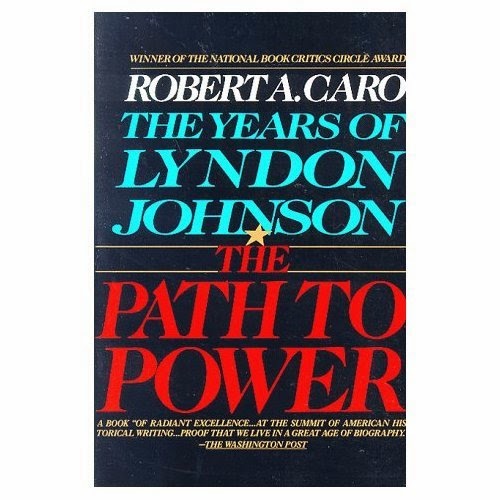
            1982’s The Path to Power (USBN # 0-394-49973-5) is, to me, the most interesting of the volumes to date; if only because it covers the part of LBJ’s life of which I know the least: his upbringing and childhood.
            The book sets the tone for the rest of the series. It contains mini-biographies of the people and places that were vital to his life at the time; or in this case, to the development of his personality.
            The book begins with the “settlement” of the Hill County of Texas and the hard-scrabble life of anyone foolish enough to believe one could prosper there. The book looks at LBJ’s Bunton ancestry – the “Bunton strain” – the fierce eyes, the temper, the ambition, the shrewdness and toughness. But when Johnson blood was mixed with the Buntons, with the Johnson’s unrealistic idealism and dreams of success without the Bunton pragmatism, the family’s life slid into poverty and humiliation.
            In the fourth volume the author surmises this is the base for LBJ’s attitude on fighting war and poverty. He knew what it was like to have no money at hand; to have no credit with the local stores. In current terms he knew the sound of the collection agencies rap at the door and ring on the phone. He knew the neighbor’s disdain of those lazy, no-account, good-for-nothings, despite his father’s success in the Texaslegislature. His father was, by this account, a great man; a progressive visionary. But in the Hill Country, visions don’t feed the family. He had nothing to show for his success at the end of his political career. He was trapped and tricked into get-rich-quick schemes that always failed. He failed. LBJ never forgot – probably never forgave – that. Caro examines the father’s rise and fall politically, socially and economically.
            He also examines LBJ’s mother. By today’s standards she would be prissy and likely would have wanted to belong in the same circles as other presidential mothers Mittie Roosevelt and her distant cousin-in-law Sara Roosevelt. Her devotion to her eldest son is thoroughly verified.
            Thus, LBJ had to work on road crews – back-breaking work paving roads and leading mule teams in sweltering heat. He had to attend a small teacher’s college instead of the more prestigious universities in Austin. He taught the poorest of the poor children in the southern tip of Mexico– the vast majority Mexican children living in the kind of squalor he recognized. He helped them, and their parents, as best he could – such as teaching them English.
            But we also see the Bunton Strain reestablish itself in the family line. If he wasn’t loved by his college classmates, he was determined to make himself respected. In a trait repeated through his life, he ingratiated himself to the powers-that-be in the school. He took a useless elected position in school government and transformed it into a position of great power and influence. Barred from the influential clique of the college? He formed his own and quickly out-cliqued the clique.
            He considered becoming a lawyer and worked in a law firm. He did not like the slow pace to power and respect a career in the law parceled out.
            He was right about that. Trust me.
            He also took a mostly ceremonial group (the “Little Congress”) and transformed into a mover and shaker in Washington – with himself as its head.
            The index says it best: Under Johnson, Character the headings include “need for affection”, “need for attention/prominence”, “need for respect, need to win”, “pragmatism/practicality/realism”, “secrecy”, “self-criticism”, “sensitivity to criticism”, “story-telling ability”, “thoroughness” and “viciousness”.
            The Bunton Strain is strong in this one …
            We see LBJ enter politics as a congressional aide for a man in the next district. We see his election as a member of the House of Representatives for his own district (he had never ran against an incumbent – political suicide in those days (and usually these days, too), bringing electricity to the Hill Country. Along the way we view, for the first time, his absolute tyranny and cruelty to his underlings: the legend of his spouting orders while sitting on the toilet begins here. He would walk past an aid and bark, “I hope your mind isn’t as cluttered as the top of your desk.” When the aide caught up on his work the insult would change to “I hope your mind isn’t as empty as the top of your desk.”
            His mantra of “if you do everything, EVERYTHING, you will win” was proven.
            Until he tried to run for Senate.
            He ran against Pappy O’Daniel, a popular radio personality and current governor, and was taught a lesson of Texaspolitics. His people called in the votes too early – early enough for O’Daniel to call in HIS numbers – just high enough to overcome Johnson’s. It was a bitter defeat – one he vowed never to repeat. EVERYTHING also included out-cheating your opponent.
            The book ends with that defeat, but along the way we are provided biographies of O’Daniel, LBJ’s Texas and Washington benefactors – including Sam Rayburn and various Texas oilmen and, of course, Claudia Alta Taylor – Lady Bird.
            Caro sets the stage for the events of the rest of LBJ’s life – his gruffness and sincerity mentioned by Reedy and Connally above. Most of the history he researches has dimmed with time and LBJ’s own desire to mythologize his past. Caro chips and brushes the small fossils to reveal the truth –a little boy humiliated by his poverty and his father’s (perceived) failures determined – by any means – to do better than him. To show the people of the Hill Country that he will NOT be a failure just like his father. In the meantime, if he can help others in similar situations (in a later campaign speech he referred to the meek, the weak, the poor and the suffering) to “lift them up” and give them a chance to better themselves.
            As long as that “chance” did not conflict with his personal ambitions for wealth and power. For now they did. For the first twenty years of his political career it did. That was to come later. For now, he was still on the path to power.
Original material copyright 2014 Michael G Curry
 

(adsbygoogle = window.adsbygoogle || []).push({});
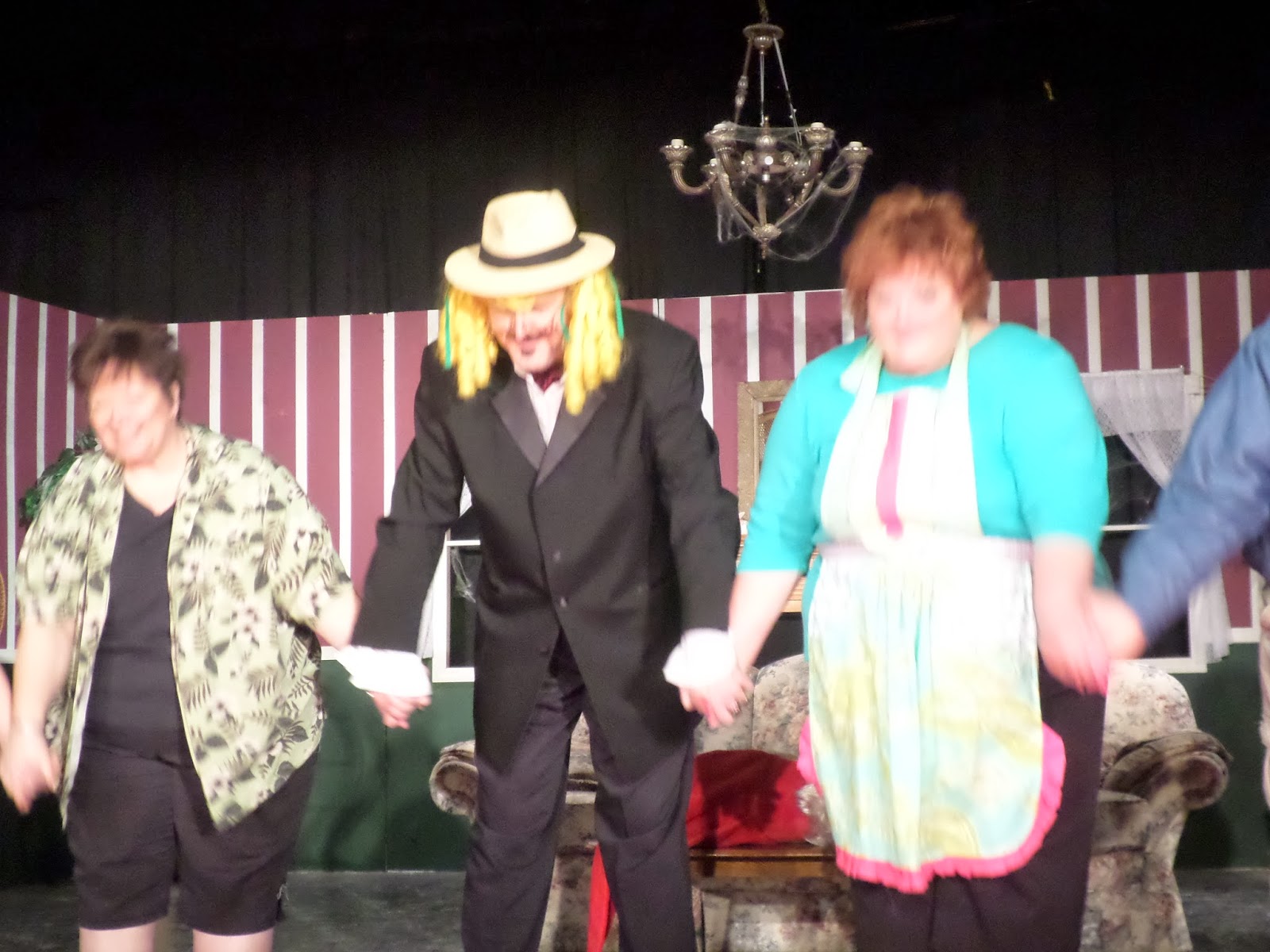

Oh God! Body Grease! Murder in the Magnolias Act Six

Oh God! Body Grease! Murder in the Magnolias Act Six
             I’m very sad that it is over. I’m very glad that it is over.
 
           The final performance on March 2, 2014 was canceled due to this season’s monthly snowpocalypse. We ended up getting less than an inch of ice, but I’m glad they canceled – it was not worth taking the chance in case the weather was worse. It was only the second time a production by the Sparta Community Chorus was canceled. The other time was the December 2013’s Christmas production during the first major snow of the season. Only two cancellations ever; and both during the same period.
            The director and I joked about the play being “cursed”! It was canceled en toto back in 1981 and now again! It was the culmination of curses throughout – my forgetting my shoes on the first Saturday performance; the actress playing Lorraine forgetting her shoes on the second Saturday (forcing both of us to hie to the Wal-Mart across the street for shoes. I only found one pair large enough for me and it was still half-a-size too small. They had men’s shoes there size seven. Seven. The WIDTH of my foot is wider than that. Lorraine found lots of shoes for 1/3rd the price I paid…).
            The actor playing Pete Bogg cut his finger on a glass figurine that shattered on the floor (the shattering was part of the play, the cut finger was not). It wasn’t a bad cut and a Band-Aid and some anti-septic took care of it, but at the time he bled quite a bit! Blood was dripping on him, the furniture and the gold coins his character discovered.
            It was always freezing cold backstage.
            Lines were also a problem. There were so many similar lines and even repeated lines throughout the play. My characters used the words “rapscallion” twice. Two separate characters repeated “over here, dear” to Amanda and “are you trying to be amusing” to Pete Bogg. The sheriff had two similar lines when he entered a scene and said the buried treasure was separately a story for children and a myth. Listening backstage, I was unsure which line went where. Blanche had to watch her finances and a few lines later had to watch her pennies. It was confusing and you couldn’t blame anyone for switching lines. During the first weekend, we skipped over the lines about state authorities doing some drainage work. My response was “to dig or not to dig, that is the question”. The lines were lost that first weekend, but said during the second weekend’s performances.
            Some of the cast apologized for missing their lines that first weekend. The rest of us assured them it was fine – we worked around it and ad-libbed our way back to the script. The performances were marvelous! The audience loved them!
            The hoop skirts were a hassle at first – it was hard for any of us to tie it firmly enough to prevent it from falling off.
            There was hardly enough time for me to change from the Colonel to Thornbird between acts without missing my cue. Fortunately the rest of the cast helped me change, put on my spats, touch up my moustache and beard and put up my first costume so that, during the performances, I had plenty of time.
            The stage and auditorium is haunted by a ghost or gremlin, so I was told. It would flicker lights and otherwise disrupt the show. I only saw one example of this: while discussing the Colonel’s portrait that hung over the mantel, it fell with a crash and cracked the frame as we watched it. Other than that, no ghost or gremlin. I once showed up for rehearsal very early. Some patrons were in the auditorium preparing for a children’s show in March and let me in as they left. I spent 20 minutes in the auditorium waiting for other cast members. If there was a ghost, I would have been a tempting target that evening. Nothing. In fact, it was nice to relax and listen to some music on my ipad.
            A rehearsal was cancelled due to bad weather. It wasn’t until the week of opening night that we had rehearsals with the entire cast present.
            One cast member left the show in the first week and was replaced quickly. His replacement was one of the people I auditioned for.
            None of these were long-term problems and all were resolved quickly. If these were curses I could live with them!
            In fact the play could not have gone better. The audiences for each of the five performances were wonderful and receptive. Each audience laughed at different parts of the show, it seemed. There were more children in the audience that first Friday and Saturday night and their laughter was louder than the others. They also laughed at the more silly/slapstick parts. We had an older audience the final Friday and Saturday and they laughed less at the modern references to “twerking” and “Dancing with the Stars”.
            I had to ask the director if the last Friday audience was laughing. They sounded dead from the stage, but she assured me they were laughing.
            And laughing at all the right places.
            Lines we thought were funny barely got a titter. Lines we thought weren’t all that funny got howls from the crowd. Blanche’s line “Gone with the first wind that …” the rest of the line was lost to the laughter. Every time. Blanche’s deliver was spot-on.
            My favorite line from the whole play, also a Blanche line, was “I’m a friend to all animals. I want to be your friend, Stanley,” got no reaction from the crowd. None. Haha.
 
 
            At intermission of the last performance we had the cast thank-yous. I did not know what that was and thought it was something we did onstage to the audience. But we gathered backstage to thank the director, the assistant director, the light and sound people, and each other. The director Stephanie told the story of why the play was never done back in 1981 and we all gave our appreciation to each other for a wonderful show.
            I posted this on Facebook on Sunday March 2nd. I posted it about two in the afternoon – the time we were to begin what would have been the final show:
I’m very sad it’s over; I’m very glad it’s over. I auditioned more or less on a whim and, to be frank, if Stephanie had not directed I probably wouldn’t have. I am so glad and grateful you took a chance and allowed me to play not one, but two roles on someone whose only real experience was during the last days of the Carter Administration. The cast and crew were at all times friendly, helpful and kind to me and made me feel quite welcome! It encourages me to try out again in future productions! Thank you to all my new friends and have a wonderful rest of the year! Thank you for wonderful new memories!
            And it is all true! It was a wonderful two months ending in a fun and entertaining time for us and our audience.
            Oh, and the title to this blog? The Voodoo Woman’s opening line for each appearance is an invocation of the Voodoo male fertility god Ogoun Bodagris. In 1981 that was transliterated to “Oh God, Body Grease”. I knew it was gnawing at you!


Copyright 2014 Michael G Curry


(adsbygoogle = window.adsbygoogle || []).push({});
Oh God, Body Grease! Murder in the Magnolias Act Five

Oh God, Body Grease! Murder in the Magnolias Act Five
   

         Ten days before the first performance I was hit by a particularly virulent sinus infection. I gave it to my wife, my daughter and my secretary – who in turn gave it to her family. It was something out of Stephen King’s “The Stand”. Fortunately there were no more rehearsals for that week and I had seven days to recover.

            And recover I did, although my voice was still scratchy and hoarse from the drainage and coughing. At all times I had cough drops and taffy in my mouth to keep it moist.
            Fortunately my years as a radio announcer taught me how to care for my voice. When I speak to you it may sound raspy, but when performing you can’t tell.
            The Tuesday we returned from our week-long break we had our first dress rehearsal. I switch characters and costumes between the Prologue and Act One, Scene one.  I couldn’t change in time. I was still dressing when my cue came.
            We had it figured out by the next rehearsal and had it down pat by the first weekend performance: Put on my ascot and button the shirt to my neck to hide it. Put on my string tie over the ascot. Put on my black pants, roll the pant legs up and put on my white pants and white suit coat. Buttoning the top two buttons hide the black pants. Put on my black moustache and soul patch and glue/tape the white beard and moustache over it.
            Between acts I peel off the white beard and mustache, the string tie and the white suit and pants. A fellow actor touches up the black mustache and goatee, another helps with the spats. I switch glasses, fluff up my ascot, put on my Panama hat and I have been on time every since.
            I have plenty of time for the other costume changes between the other acts.


             The performances have been wonderful. We hope for an audience of fifty for each performance and the first weekend beat that! I’ve seen lots of family and old friends each night – or the parents of old friends! My sister and two of her sons went the first night. My nephews, 10 and 6, enjoyed the show. The six-year-old couldn’t stop giggling at the slapstick. My father, sister and her new boyfriend were there Saturday night and my cousins attended the Sunday matinee. This Saturday my wife and other cousins will watch the show and my sister will be back Sunday.
            The three audiences have all enjoyed the show. Funny how each audience laughed at different jokes. Some routines fell flat one night and then met with laughs and applause the next. Lines that I did not think were that funny are getting the biggest laughs of the night. This is why I’m not a playwright…
 
            We have a “brush up” rehearsal this Thursday and then another weekend of performances before it is all over. Some cast members were upset over missing or misreading lines. I think we’ve all been doing fine. We cover for each other and if a line is missed we move on! We’re doing splendidly and I hope the local papers give us good reviews.
            I introduced my sister to Heidi, who plays the Voodoo Woman. If we had performed the play in high school my sister was to have also played the Voodoo Woman. At one performance, I talked with the mother of the girl who was to have played Lorraine Caruthers.  I had not seen her mother in 33-plus years. I think the boy who was to play Billy Jerk will be there Friday.
            It is tremendous fun and I am so happy to have screwed up my courage and auditioned.
            The only real problem is the befuddlement of my daughter. She saw the photos of me as Thornbird’s sister and has asked six times this evening why I wore a dress. “Boys don’t wear dresses! Boys don’t wear wigs! Why do you wear a dress in your play?” I guess I should be grateful we’re not doing “Some Like it Hot” …
            Hopefully some reviews and more photos in Act Six!
 

                                                                                                 Copyright 2014 Michael G Curry


(adsbygoogle = window.adsbygoogle || []).push({});
A Night of the Most Excellent Order – a review of “The Beatles – a Night that Changed America, a Grammy Salute

A Night of the Most Excellent Order
A review of “The Beatles – a Night that Changed America, a Grammy Salute”.
            Popular music and I have not said a kind word to each other in over twenty years. That is why, up until the afternoon of February 9, 2014, I had no plans to watch the CBS Special “The Beatles – a Night that Changed America, a Grammy Salute”. It was taped some weeks ago, but it aired 50 years to the day – to the hour – that the Beatles appeared on Ed Sullivan. It was the most-watched television program up to that time.
            Reading through the list of scheduled performers – the ones hyped, that is – was akin to reading “Entertainment Weekly”. Page after page of people I don’t know starring in TV shows and movies I don’t care to see. The only group I had heard of was the reunion of The Eurythmics. Oh joy. A combo I didn’t like 30 years ago are reuniting so I can dislike them all over again.
            But it was necessary to get the public to pry themselves away from reality shows to watch musicians play songs from fifty years before.
            It wasn’t until previews were available on Youtube that I decided to watch it. Well, Tivo it. Stevie Wonder performed. Okay, so it’s not just “American Idol” rejects wailing their way through the Beatle catalog. There was some talent involved.
            Fortunately, instead of a parade of the latest talent-less celebrities known more for their tongue and twerks, we saw some fine performances!
           
            And it was a great show! The performers – all of them – did an excellent job! The bits in between the songs were of more interest to me, but I was not disappointed by the performances. The ones I knew, the ones I only heard of and the ones I never heard of – all did superbly. I have no desire to run out and get their latest albums, but …
            I had to look up the spelling of some of the performers on Google, I apologize if I didn’t get them right…
            The show started with the original intro tag. Coming up next on the “The Ed Sullivan Show” … a great way to start it.
            LL Cool J gave us an introduction to the reason for the special and introduced a clip from the “The Ed Sullivan Show” – the Beatles performing “All My Loving”. It segued into Maroon 5 finishing the song and they then performed “Ticket to Ride”.
            Throughout the show shots of audience members peppered the performances. Mostly they concentrated on Paul and Ringo and their wives in the front row; but occasionally we saw Yoko and Sean and George’s widow Olivia as well as other stars. I only recognized a few of them.
            Next came Stevie Wonder with his hit “We Can Work It Out”. Rumor is he did it twice because he did not like the first take. “Fire me, sue me,” he told the audience. It’s Stevie Wonder. He could have done a dozen more…
            And now we get to see the house band – Peter Frampton doing his usual excellent guitar work. He was an uncredited guitarist on George Harrison’s “All Things Must Pass” album. Steve Lukather, a touring member of Ringo’s All Starr Band also played guitar excellently. Had he played this well with Toto they might not have sucked. Kenny Aaronson played thunderous drums. He played with everyone – EVERYONE – in the 1980s and I know him from the woefully underappreciated album “HSAS” with Sammy Hagar and Neil Schon. The director apparently loved Kenny too – they cut to him playing every six seconds or so.
            Johnny Depp introduced the song “Something” performed by rock veterans Joe Walsh and Jeff Lynne. They were joined by George’s son Dhani. It was the only stage appearance by a Beatle-spawn. Sean Lennon was in the audience but did not perform. Why didn’t he?
            Eric Idle appeared next, reprising his role as the narrator/TV journalist from his “Rutles” specials. They gave his character a name – Nigel Spasm (although his name was never given in the original Rutles programs). He mentioned the Rutles performing that night 50 years ago. He was hilarious.
            He introduced (and narrated) short biographies of the Beatles beginning with John Lennon. John’s was the most effective. It ended with the death of his mother and the line “… the love of music his mother shared … would … transport him our of Liverpool and across the universe.” Lovely.
            Why did they decide to colorize part of the black and white photos in these biographies? We the People do not need big, bright and loud colors to keep our attention; we can handle black and white photos, thank you. Treat us like adults and we will start acting like adults. Deal?
            Next began a series of excellent, excellent, walk-throughs and interviews with Paul, Ringo and David Letterman. They discussed the studio, the set list, their choice of name, etc. It was usually done after the commercial break and was one of the highlights of the show.
            Some of my favorite bits throughout were interviews from women (girls) who were in the audience 50 years before. This was peppered with Ed Sullivan performances of “I Want to Hold Your Hand” and “I Saw Her Standing There.”
            Kate Beckinsale (someone who starred in movies I’ve not seen) introduced Ed Sheeran (a singer I’ve never heard of) doing “In My Life”. He did an excellent job! Wonderful guitar work – I’d like to learn his version of this song (which was performed at my wedding).
            More audience shots. Ah, I recognize someone – Tom Hanks! Tom Hanks was in an audience that had camera shots and this was the first time he managed to get his mug in front one? Wow.
            They showed a clip from “Let It Be”. They got the rights to show a clip from “Let It Be”. This is akin to showing footage of Bigfoot. It was the rooftop concert version of “Don’t Bring Me Down”.
            In the middle of the song it segued into two singers named John Mayer and Keith Urban singing the song (ala “All My Loving” at the beginning of the show). They cut off a clip of “Let It Be”. THEY CUT OFF A CLIP OF “LET IT BE”. To use the previous analogy – is would be the same as showing ten seconds of authenticated proof of Bigfoot then airing a bit from “Harry and the Hendersons”.
            Katy Perry managed to cover her cleavage long enough to sing “Yesterday”. There was some controversy when she changed the lyrics by switching gender (“I’m not half the girl I used to be”). Oh, get over it. Happens all the time. That is no controversy; leave her alone. 
            Then came the Beatles’ Ed Sullivan performance of “She Loves You”.
            An aside: strange that the two songs most associated with the Beatles – not the most popular but the most iconic – “I Want to Hold Your Hand” and “She Loves You” are the two least-covered songs in their repertoire. They did not cut away to anyone “taking over” “She Loves You” from the Ed Sullivan clip – whereas they did twice earlier in the show.
            At this point, and peppered throughout the rest of the show, were my favorite bits. Interviews with the crew of the “Ed Sullivan Show” on that day 50 years ago. Bill Bohnert, art director/set designer, John Moffett, associate director, and Vince Calandra Sr, production assistant and George’s stand-in during rehearsal were interviewed about their work on the show that day and during rehearsals. Bill tells the story that Paul said, “We’ve always wanted to do ‘The Ed Sullivan Show’.”  Funny, not a half-hour ago Paul said they had never heard of “The Ed Sullivan Show” until they were booked on it. No one else seemed to care …
            There was a moving story of John Lennon’s awe at standing in the same spot as Buddy Holly when he did Sullivan a few years before.
            LL Cool J introduced the song “Revolution” performed by Imagine Dragons. “What!?” says I. “The kid’s band? Disney’s version of the Wiggles?”  No, that was Imagination Movers – this is Imagine Dragon. They did a very good acoustic version of the song.
            Dave Grohl was next. He was in the Foo Fighters and Nirvana with Kurt “what a weird bong” Cobain. He gave a moving tribute, saying his mother had always been a fan of the Beatles; saying his daughter is a fan of the Beatles; and lying about HE always being a fan of the Beatles. I recall 22 years ago he and his fellow grungy ilk saying they don’t like music by dead people.
            They stopped saying that when Cobain showed us what his brains looked like.
            I guess being invited to a Beatles tribute helped his love of the group along a bit.
            That being said, he and Jeff Lynne did a superb version of one of the Beatles’ best and least-known songs. “Hey Bulldog”.
            Back to Kate Beckinsale introducing The Eurythmics. There is no “The” in their official name. When they were popular they insisted that DJs NOT call them The Eurythmics, just Eurythmics.
            So THE Eurythmics played “Fool on the Hill”. I said that correctly – they PLAYED “Fool on the Hill”. If you recall The Eurythmics were a purely electronic band; all computerized. Yet, when they performed they had drums, back-up singers and guitars. “If they were true to their art,” I said on the radio back in 1985 or so, “they would set up a computer on stage, put in a floppy disk, press play and tell the audience to enjoy the show.”
            Annie Lennox has a lovely voice and is a powerful singer, but I’ve never liked it personally – oil to my water. Dave Stewart was once in a band in the 1970s called Longdancer. It was an EXCELLENT group. And some of his post-The Eurythmics bands harkens back to those rock ‘n roll days. So The Eurythmics reunite. From the hype you’d think this was the highlight of the show. It wasn’t. It was GOOD, mind you, but not the highlight of the show.
            Alicia Keys andf John Legend gave testimonials and then gave their rendition of “Let It Be”.  I had heard of them both but never heard their music. I only knew of John Legend when I would joke about (ironically) him being in the Beatles with Paul McKenzie.
            John Legend has an excellent voice! Alicia Keys … well, it’s like the issue I have with anyone – ANYONE – on “American Idol”. I would have more respect for her talent if she could sustain a solid note for more than two seconds. Was someone shaking her seat or does she cover the entire musical scale with every note?
            More bits with audience members and crew members. Here they included reminiscings from Mitzie McCall and Charlie Brill – a comedy duo who also performed on “The Ed Sullivan Show” that night! I wanted more of this – I wanted to know who else was on the show as well as what else was on that night? What did NBC and ABC air? This show’s main focus was on the Beatles, true, but it was also focused on “The Ed Sullivan Show”, too. I have the Beatles’ appearances on Sullivan on DVD, so I know who else was on the show, but a few clips of the other performers wouldn’t have taken up much time.
            Actress Anna Kendrick, who starred in movies and TV shows I’ve never seen, introduced the song “Here Comes the Sun” and gave us a history of its writing. Would it have violated some law to mention it was a hit for Richie Havens, who died last year? Pharrell Williams and Brad Paisley, whom I have not heard of, performed the song with members of Cirque du Freaks, er, Soleil pole dancing above them. Other members of the circus troupe sat in front of them holding dolls. This circus troupe is popular why?
            Gary Clark Jr., Dave Grohl and Joe Walsh did a rousing rendition of “While My Guitar Gently Weeps”. A fun moment was the camera cutting away to Ringo who was miming Grohls’s drums. I love Joe Walsh. He is an excellent guitar player and even shared some vocals here (not his strongpoint one must admit). He, as well as the other two, was wonderful, but … would it have been so hard to get Clapton? Really?
            Jeff Bridges gave a wonderful testimonial and introduced Ringo. Ringo then made us forget the past hour and a half and stole the show. He perfomed “Matchbox”, “Boys” and got the audience involved in “Yellow Submarine”. Musically, it was the highlight of the show. And kudos to Ringo for introducing at least one member of the house band – sometimes All-Starr Peter Frampton. Ringo gave a shout-out to Grohl and his daughter. You could tell Ringo was impressed with his drumming.
            Sean Penn, who is looking more and more like DeNiro, introduced Paul McCartney. After Ringo’s funfest this seemed almost anti-climactic. Paul went through rote versions of “Birthday”, “Get Back” and “I Saw Her Standing There”. The house band left and Paul performed with his group. By now Paul could do these songs in his sleep. He nearly did. Too bad. He had nothing to prove, true, but it was almost as if we were supposed to enjoy McCartney being McCartney and not enjoying his performance.
            Case in point: Paul did “Sgt. Pepper”. He would have been forgiven if he changed the lyrics to “50 years ago today…” The press would get on Kate Perry but not HIM. Just before Ringo joined him onstage, Paul sang “Billy Shears”. He could have said “Ringo Starr”. The audience would have loved it. I would have loved it! To me this shows how Paul was going through the motions rather than relishing the moment.
            Paul and Ringo have only performed together (post-Beatles) once in 2010. So their “With a Little Help From My Friends” was momentous and fun. Ringo brought back the enthusiasm he apparently took with him from his previous set.
            For the finale, “Hey Jude” they were joined by the house band and the other performers and producers.
            Yoko, Sean and Olivia never took the stage. I think that was a wise move. They would have been given a standing ovation, to be sure. But they were there to honor their husbands and father.
            It was a wonderful program and I enjoyed it very much. Probably not enough to rush out to get the DVD, but I liked it and was glad I saw it.
            I did have some problems with it: as I said earlier, this was about the Beatles, but there was enough about “The Ed Sullivan Show” to wonder why they didn’t talk about who else was on that “America-changing” day” Why not show a clip of Frank Gorshin’s hilarious stand-up from that night? Or a bit from Sophie Tucker?
            Would it have hurt to have Mickey Dolenz give a two-minute tribute to fellow-Monkee Davy Jones? He was on the show too that night, doing a song from “Oliver” as the Artful Dodger.
            Also, perhaps after two-and-a-half hours the powers-that-be were afraid We the People would not have the attention-span for another 50 minutes; but why not SHOW the entire Ed Sullivan program from February 9, 1964. It couldn’t have been a question of acquiring the rights – they showed a clip from “Let It Be” for god’s sake!
            And where the hell was George Martin?
Copyright 2014 Michael G Curry


(adsbygoogle = window.adsbygoogle || []).push({});
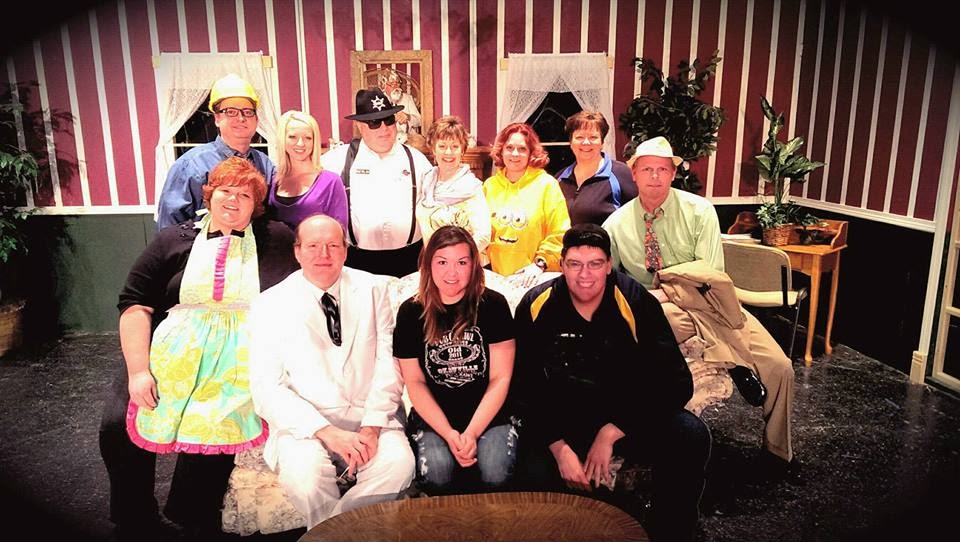
Oh God, Body Grease! Murder in the Magnolias Act Four

Oh God, Body Grease! Murder in the Magnolias, Act Four
 
                We are in our fifth of seven weeks of rehearsals. Starting next week we add Monday practices to our Tuesday and Thursday schedule.
                Stephanie, our fearless leader and director, gave us until February 1st to learn out lines. I think we have, for the most part. The cast at the least now know their characters and have a feel for what they would say, if not what they should say.
                It’s tough. Erika, who plays the lead Amanda, said on her Facebook page how strange the lines are. Very true. “Murder in the Magnolias” is a broad spoof filled with cracked characters. To say the bulk of the lines, especially in the first two acts when the characters are being introduced, are off-beat non-sequiturs is being kind.
                It is not until the third act that there is anything resembling realistic conversation. It’s easier to memorize lines when there is a flow to them. If one line is “How are you?” and the next “Fine, thank you, yourself?” – that has a flow and makes sense. If nothing else you can wing it.
                But “Murder in the Magnolias?” Yeek…
                The opening scene has the Colonel complaining about his sister Amanda’s botanical garden. He says a few lines about vicious and despicable weeds. Amanda tells him to hush, now. The Colonel says the plants are the unnatural and morbid. Amanda talks about how hot it is this evening. This at least feeds me the line about favoring prickly heat; but it’s a strange path. Perhaps as we practice it will seem more natural.
                Another great example is with my other character Thornbird. In between an argument between Amanda and Pete Bogg about excavating around the house I mention there is something odd about the “O” on my typewriter: a line completely out of the blue with no relation to the current conversation. It defines the character, sure, but I have to remember where it fits – what is my cue line? I’ve missed it a few times now during rehearsal. There’s not much cadence to dig into.
                Odd and obtuse lines – we have to memorize our cues and then get the cadence right to make it funny.
                As I said, it’s tough.
                In the third act is gets better. Most of the lines (mine anyway, I pity the actress (Britney) who plays Blanche – her non-sequiturs never seem to end. At one point her character literally stands up, holds up her hand and says “I would like to stop the drift of this conversation.” (I paraphrase) Talk about left field.
                But the lines and character quirks are starting to gel. Now that the lines are down we are working on the physical part of the show and blocking more effectively. You stand there. When he says this, you move over there. We’ve added some physical comedy during segments where characters are otherwise simply talking to one another. One cute segment between Blanche and Bubba: Blanche is demonstrating how she trains dogs; Bubba thinks he is talking to him. “Sit up!” He stops slouching. “Off the table!” He moves his leg from the coffee table. “Play dead!” Umm, what?
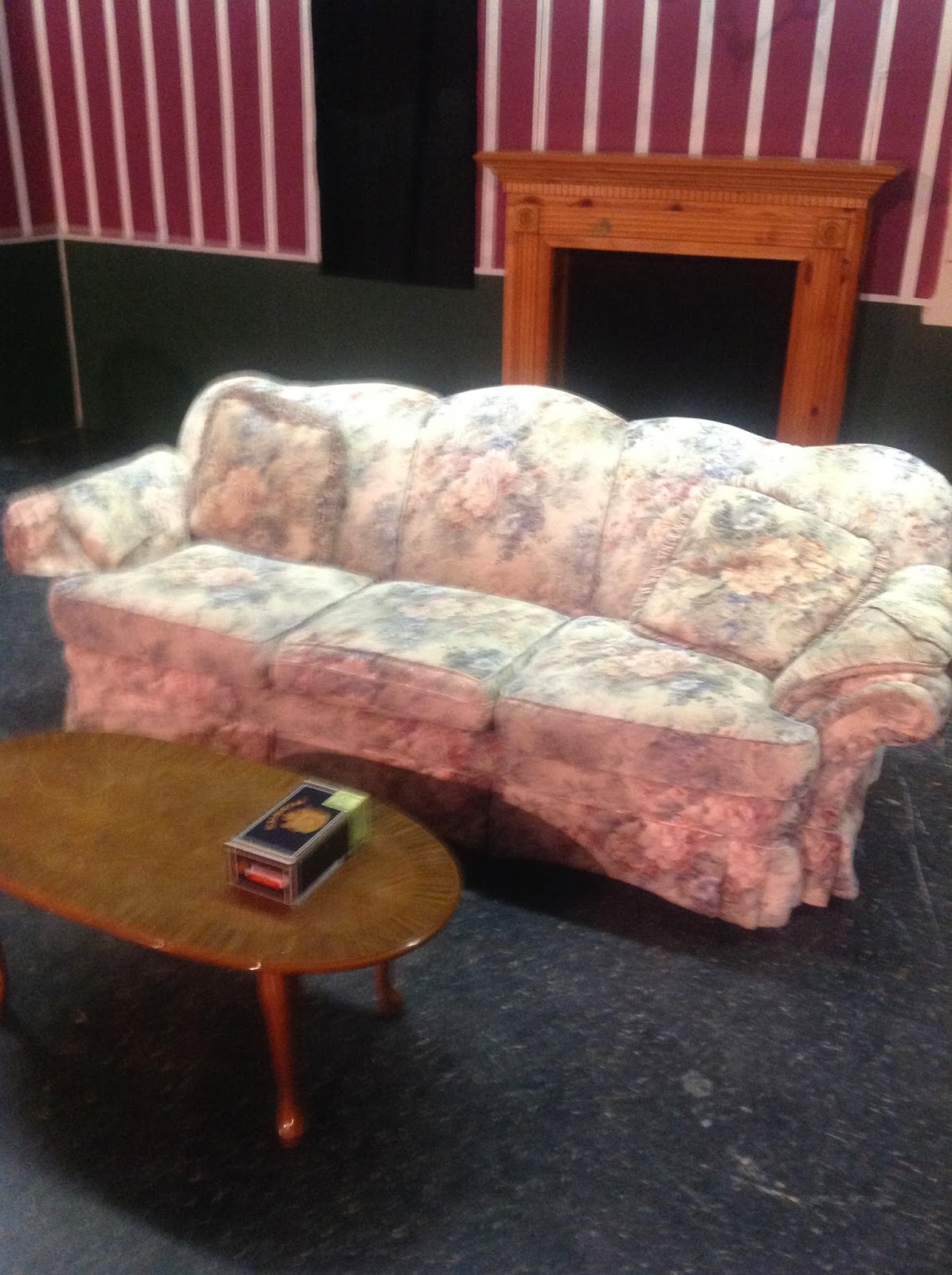
                The set is coming along nicely, too. Most of the walls are painted and the windows and doors are in. Over the mantel is a painting of the Colonel. Stephanie took my photo in almost-costume a few weeks ago and will print it out using a photoshop program that makes it look like a painting with brush strokes, etc. It will hang with pride on the stage wall!
                Here is a photo:


                  On Thursday, January 30th I was in court most of the day and still had my briefcase in the car along with my I-Pad. I was the first one at practice and shot a few photos of the set.

    
            I also took some pictures of rehearsal, but I do not want to show them right now in case any of the actors object. When we start releasing any “official” cast photos I may post them in a future blog.


               The costumes for the play are mainly street clothes. Pete and Bubba can wear blue jeans; Bubba could wear a t-shirt with a pack of cigarettes rolled up in the sleeve. Lawyer Possum could wear a sports coat. Pete Bogg, a construction vest and a utility belt. Sheriff Billy Jerk could get away with street clothes and a badge and a brimmed hat – a full uniform would not be necessary. Facial hair for these male rolls is completely optional.
                Lorraine, Lotta and Blanche can be dressed business-casual.  Blanche later appears in a Southern-Belle-like dress, though. So does Amanda. “Cousin ‘Manda” also has a scene in which she comes straight from her disgusting mess of a weed pile. She decided to dress in boots, gloves and an apron.
                But the Colonel and Thornbird, my characters, are the exception. That hadn’t occurred to me when I auditioned. Oh the pain…
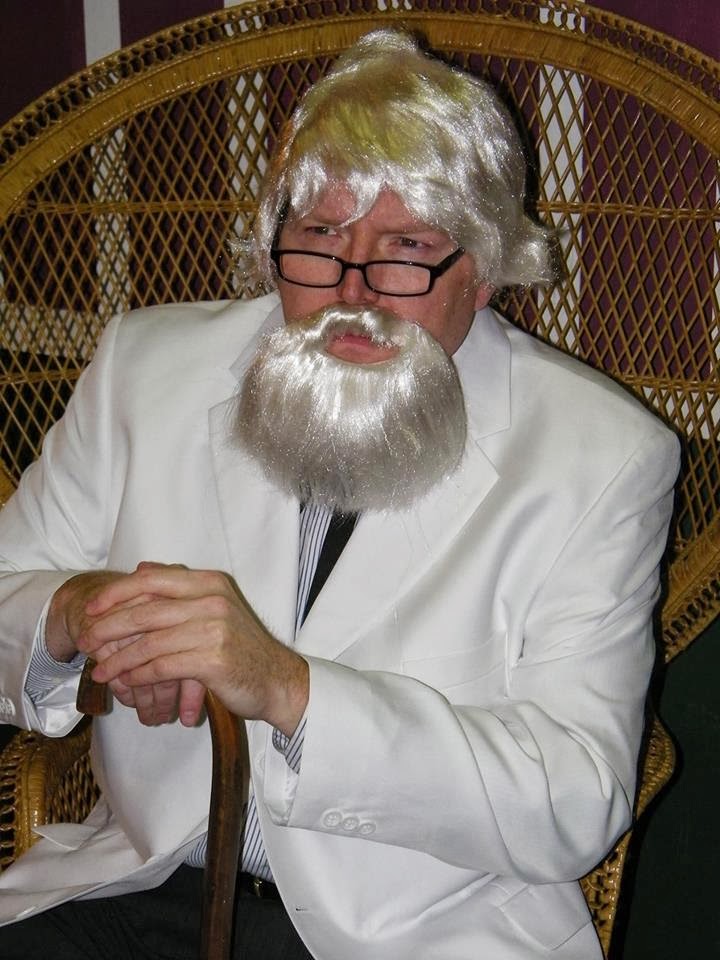
                Colonel Rance Chickenwing is (obviously) a spoof of southern colonels and our director wants him to look like Colonel Sanders. White suit, mustache and beard. Black-rimmed glasses and black string tie. He’ll wield a cane. I have the white suit – all the better to cosplay John Lennon – and other than the string tie his costume is complete – and a long, thick black ribbon can be used for the tie.
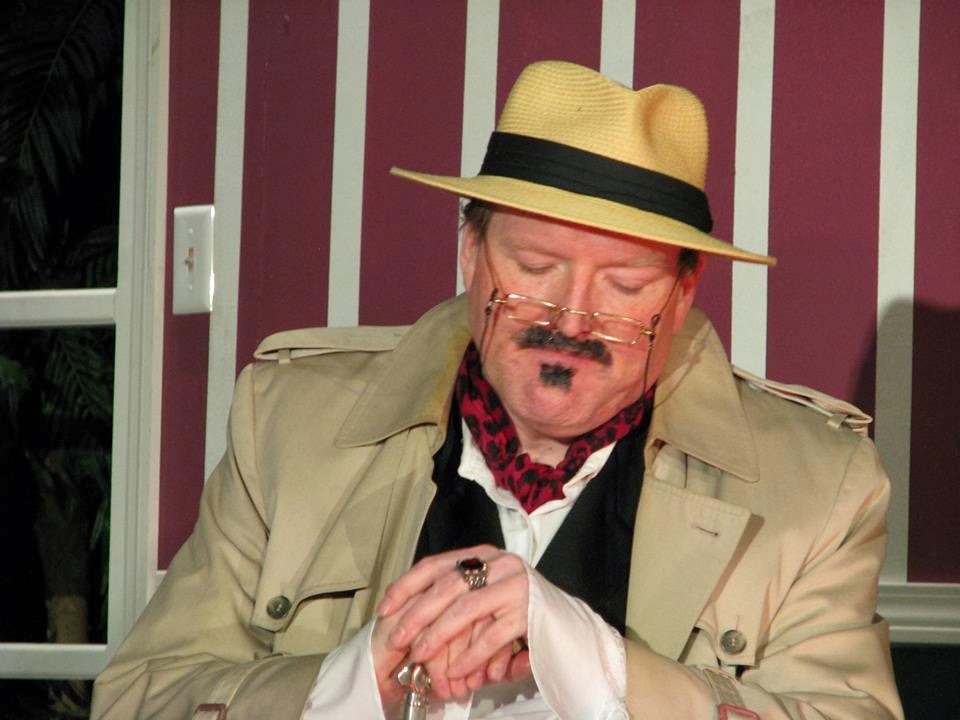
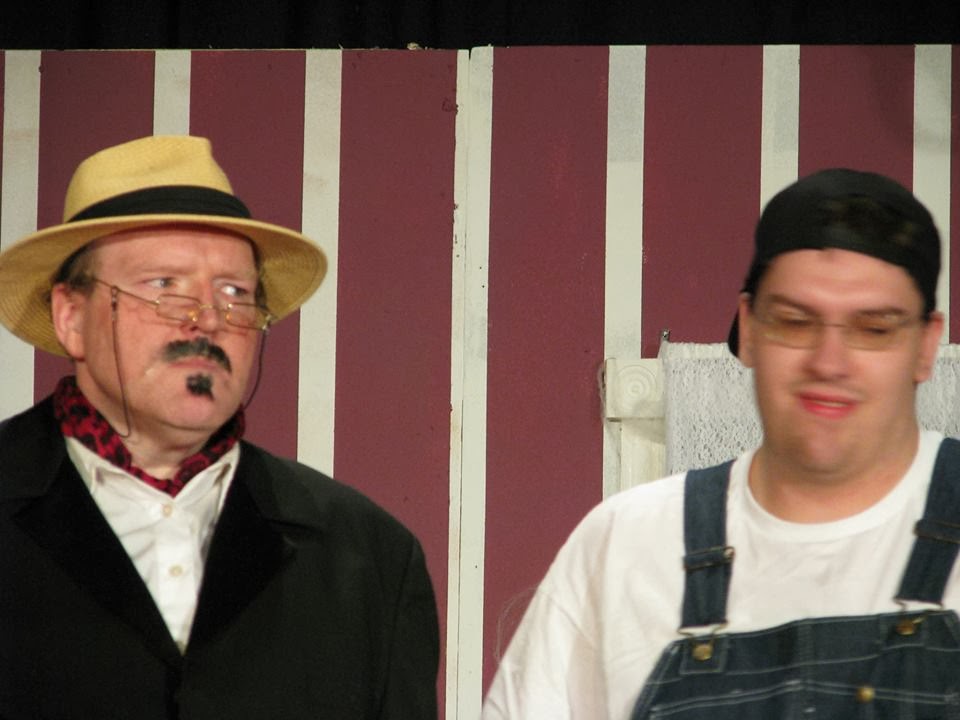
                Thornbird will wear a frock coat with a frilly shirt and ascot/cravat. I have those, except the cravat, but a fru-fru lady’s scarf will do for that. He’ll have a dark mustache and soul patch under his bottom lip – which will remain on for all three of his personalities. I see Thornbird wearing spats (he and the Colonel will wear the same dress shoes and socks, I’m afraid), gaudy rings, Panama hat, granny glasses and a cane – different from the Colonel’s cane.
                I hope to avoid anyone thinking Thornbird is the Colonel in disguise – ready to pounce on his greedy relatives. I’m trying to keep their mannerisms and voice different. The Colonel has a throaty growl and Thornbird a higher-pitched smoother voice (having sinus trouble over the past month makes it hard to avoid the rumbly growl, but now that it has somewhat passed I will try to pull it off).
                They have Thornbird’s sister’s dress ready: a dark-green-hooped skirt with mid-sleeve blouse. I presume I will still be wearing my frilly shirt underneath. They have a pig-tailed blond wig and a pink parasol for me. The theater isn’t heated well, so the warm wig feels nice, haha!
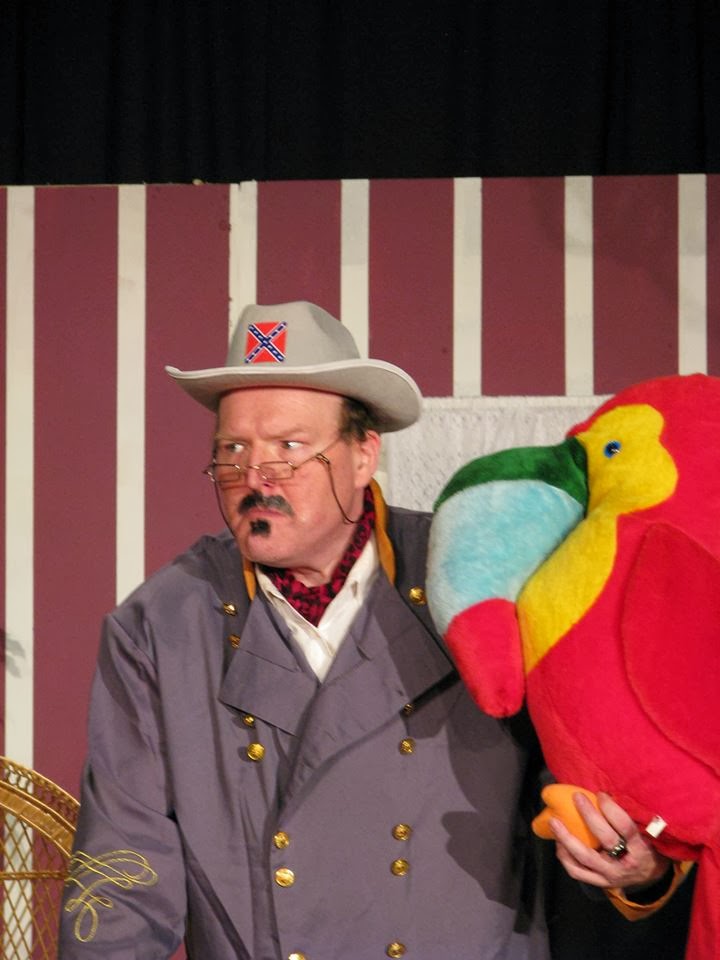
                Rufus T. Chickenwing’s costume is complete at well: a Confederate officer’s uniform, hat and saber. Esther has kindly lent me her toy plush parrot for the bird scene. Here’s the bird with my Panama hat (actually a wide-brimmed trilby, but it still looks the part).


                I should have enough time in between scenes to change. Going from the Colonel to Thornbird then Thornbird to his sister will be a rush; but if I get changed right away and don’t fool around watching the other performances, I should be okay. We only have one or two dress rehearsals to practice my quick-change-act. I will certainly let the director know if time is my enemy.
***
                It’s evolving into a fun show – the cast seems to like it and laugh at its silliness. We get along – or at least the people that DON’T get along are keeping it to themselves – a nice change of pace from 1981, I must say.
                Because of snow/sleet we had to cancel our practice on the 4th, which leaves only seven more rehearsals left.
                Seven.
                I think I’m going to be sick…


Copyright 2014 Michael G Curry                


(adsbygoogle = window.adsbygoogle || []).push({});

My Favorite Horror Films, or Why I Can’t Sleep at Night

MY FAVORITE HORROR FILMS
or, Why I Can’t Sleep at Night
                There is an interesting article in a recent Entertainment Weekly stating that January and February are now the prime time for horror movies to show in theaters.
                This is a complete reversal of the usual trope from decades before – horror movies belonged in October. January was the dumping grounds for trash on which the Oscar contenders and leftover holiday blockbusters sat.
                I suspect one or two horror movies made a splash in January and the trend caught on. October is now the dumping ground – a metaphoric breathing-in between summer and holiday blockbusters.
                I have been thinking about horror movies lately. I Tivoed a cheesy program called Monsters and Mysteries in America from the Destination America network. It is a step-child of the Discovery Channel family and airs mainly white-trashy reality shows. But amongst the Cracker TV fare are a few cheesy gems: UFOs over Earth, When Ghosts Attack and Alien Mysteries.
                Yes, these shows are mainly about rednecks discussing being anally probed by aliens after their sister/wives ran off with Bigfoot, but they also feature authors and … um … “scientists” taking this schlock seriously.
                I admit to being a sucker for anything about Bigfoot or aliens. I consume any book by Zechariah Sitchin or Erich von Daniken. I am a faithful viewer of Ancient Aliens on the “History” Channel.
                This episode of Monsters and Mysteries in Americafeatured Momo the Missouri Monster. I’ve heard of and read about Momo, so I wanted to watch the show. Momo was the first feature. The third (last) feature was about a bat-creature that terrorized a mining town in Iowa in the early 1900s. The middle feature was about the Shadow People in Maryville, Missouri.
                Here’s a good blog about the show: http://vulpesffb.wordpress.com/2013/12/30/momo-shadow-people-and-the-van-meter-monster/
                The Shadow People segment pushed all my buttons. Dark figures with glowing eyes standing next to your bed as you sleep; whispering …
                I was awake until two that morning afraid to open my eyes. I knew; I KNEW I would see one standing next to my bed. A “real” one? No, but my active imagination was going on all cylinders that night.
                I see figures standing in my room or next to my bed quite often. That’s been the case since I was a kid living with my parents. I frequently saw a lady in a red dress sitting in a chair across the room from my bed; I saw a winged creature hovering over my bed. The latter was my hat collection and other wall-hangings through my still-bleary-myopic eyes – my mind making sense of a blurred shape. The former … well, where did the lady in the red dress come from? A teenager with raging hormones imagining a woman in his room? Oh my goodness, someone call Dr. Freud…
                Just a few weeks ago I dreamt someone was grabbing me while I was in bed. I screamed so loud my wife was afraid I would scare our daughter in her bedroom. She slept through it. Once I dreamt I was lying in bed next to my wife as a vampire stood over me; keeping me hypnotically frozen. My wife said I was saying, very calmly, “Esther wake me up, Esther wake me up,” as I slept. When she nudged me I jumped up and out of the nightmare.
                It reminded me of a post-college nightmare when my roommate ran into my room after I screamed bloody murder when a vampire at the foot of my bed leapt at me. It was the ceiling fan.
                Before that, in college, I saw a man in a blue-and-red-striped shirt walking through my room. I called out the name of my roommate – “Scott, what are you doing?” – and the figure turned and walked toward me. By now my roommate (Scott) walked into my room. He heard me call his name and woke me up by asking me what I wanted. The figure disappeared as I gained consciousness.
                So the Shadow People were right up my fearful alley, if you know what I mean. Add to this my love of horror movies and stories and you can see why I was up most of the night. I could start quite a cause-and-effect argument here.
                My reading and viewing of all things horror have been curtailed by my marriage and my daughter. I don’t want either of them walking in during The Exorcist, for example.
                My wife is getting more accustomed to it: she’s become a fan of Sleepy Hollow … fairly light-weight in the horror department (although they’ve had some good shows) and just about at her tolerance-level.
                So I’ve missed out on a lot of horror-themed TV series and movies in the past decade.
                During my sleepless evening I compiled a list of my favorite horror movies. These aren’t the critically best (although some are) and not the most financially successful (although some are); these are mine. To repeat the phrase – the ones that press the right buttons; sometimes much to my regret.
                Except for the first on the list, these are on no particular order:
1.       The Haunting (1963). It’s a black-and-white movie with a plot that in these “modern” times is something out of Scooby-Doo (spending the night in a haunted house to see if it really IS haunted), but this fifty-one-year-old flick is the scariest thing I have ever seen. The scene in the girls’ bedroom where the ghost (or whatever it is) pounds on the walls, making pictures and plaster fly, and watching it head to the door that pulses and creaks … I get chills down my back just thinking about it.
2.       The Exorcist (1973). A very canny choice, I know, but that doesn’t mean it’s not a genuinely terrifying movie. The movie went straight for the throat (or vagina if we’re talking crucifix) – there was no doubt little Regan was possessed by the devil. If they remake it they should do more of the book – we were never sure if she was possessed or had a psychotic breakdown while the terror was merely a ruse by the housekeeper to cover up a murder.
3.       Prince of Darkness (1987). John Carpenter movies make up a quarter of this list. A priest finds a cylinder of swirling green liquid in the basement of an abandoned church. He brings in a team of scientists to examine the cylinder. The liquid is the anti-Christ’s ectoplasmic form. It squirts at the scientists one by one causing them to go insane in beautiful Lovecraftian fashion. It awoke in time to summon its father – the anti-god. A movie that includes scientific method, intergalactic elder things and Alice Cooper? How can it be bad?
4.       In the Mouth of Madness (1995). John Carpenter takes on an even more Lovecraftian-themed work. An insurance investigator looks into the disappearance of horror author Sutter Cane (a very thinly veiled Stephen King) and tracks him to a town that appears in one of the author’s horror books – a place that should not exist. Ends up the author was channeling real horrors from eldritch dimensions who are ready to take over the earth. Can Sam Neill (the investigator) stop the coming apocalypse? Are you kidding?
5.       Halloween (1978). Another John Carpenter movie. Another canny choice. But this is one of the scariest flicks ever made. Carpenter’s soundtrack alone brings chills – I usually cringe in horror when I hear cheap Casio music anyway, but this is genuinely scary music! And there’s not one startling moment in the movie – we see Michael approaching and stalking Lady Hadin-Guest (Jamie Lee Curtis) and we know where he is and what he will do at all times – it is all suspense in the best Hitchcockian style.
6.       Blair Witch Project (1999). Not the first movie of the “found footage” genre, but the one that put the genre on the map. A lot of people hate this movie, but I am a big fan. Creepy, scary and realistic. Movies like this HAVE to be realistic. The more founded it is in reality the scarier it is. I would put this movie above Cloverfield (2008) another found-footage movie only in a science-fiction vein based on a what-if-a giant-Godzilla-like-thing-REALLY-attacked-New-York story.  I think Blair Witch has aged well (as all of these movies have) and Cloverfield was creepy even on cable in between long commercial breaks and watched over three days (when the wife and daughter were elsewhere).
7.       Evil Dead (1981). Evil Dead II is one of my favorite movies, period. II combined spooky stuff with humor – humor and horror go VERY well together when done right – but the original was cheaper and scarier. This movie put Sam Raimi and Bruce Campbell on the movie map and rightly so. Very Lovecraftian – it includes an appearance by the Necronomicon – and the fact that it was made on a small budget only adds to the realism. True story: I saw this in college with assorted roommates, friends and girlfriends. Being college cool cats, we had our TV set up through the stereophonic hi-fi. In one scene a rescued victim (who had been maniacally giggling throughout a scene) stopped giggling. The surviving cast look at her. She looks up and sings “We’re going to get you; we’re going to get you…” We screamed and shuddered. I had enough and jumped up to turn the TV off. Trouble was, it was on VHS. I turned off the picture, but the tape was still rolling and the speakers were still playing. “We’re going to get you; we’re going to get you…” If the neighbors weren’t in the house watching with us, they would have called the police.
8.       Night of the Living Dead (1968). Speaking of small budgets adding to the realism … Do you REALLY need me to describe this movie? And its impact on the genre? Really? Turn on the TV or scroll through your Facebook wall for about two minutes. Did you NOT see something about zombies? You’re lying …
9.       Pandorum (2009). I saw this movie on the SciFi Channel and loved it so much I bought the DVD. You‘ve might not have heard of it. I’ve discussed the synergy between science fiction and horror in prior blog (http://michaelgcurry.blogspot.com/2013/06/thesynergy-of-science-fiction-and.html) and this one, to me, hits all the right notes. Something that Event Horizonsomehow missed.  The premise was a great one and almost made it. A two-man (originally three-man) crew was revived from their deep-space hibernation to take their shift in a generational/colony ship. We learn that in the meantime earth had been destroyed and these colonists are all that is left of humanity. Trouble is, our crew is revived to find their ship lost and out of power. Making their way out of their assigned department, they discover the ship is overrun with flesh-eating superhuman humanoids. Where did they come from? Is there anyone else alive on the ship? Can they escape or at least get the ship up and running so they can defend themselves? It is a claustrophobic and intense thrill-ride. I think the secret of the Hunters is disappointing when finally revealed. But the final twist at the end more than made up for it. The ending and final solution took me completely by surprise. It was meant to be a trilogy but was unsuccessful at the box office – although it has gained quite a cult following. Myself included.
10.   Alien (1979). Speaking of science fiction and horror … I go into a lengthy discussion of how this movie works so well in my blog about Event Horizon (hyperlink is above). I won’t repeat it here.
11.   The Thing (1951 & 1982). Both the Howard Hawks and John Carpenter versions are included here. The original is more cerebral and the horror is left off-screen. Carpenter’s gore is front and center. Both are excellent in their own way and both are scary-scary. Arctic scientists find a spaceship with a frozen alien inside. The alien thaws out and chaos ensues. Great stuff!
                Honorable Mention: Silence of the Lambs (1991). This could be better described as a police thriller rather than horror, but there are parts that are intense as hell and it won an Oscar for chriss’ sake! The early scene where Clarisse is walking past the inmates (including one played by the actor who also played Chef Brockett on Mister Rogers’ Neighborhood) until we see Hannibal Lecter for the first time – standing quietly and politely in the center of his cell; watching, as if he knew she were coming. Anthony Hopkins deserved his Oscar. He stole every scene he was in and his character cast his shadow over every scene in which he was not.  The serial killer Buffalo Bill was creepy; Lecter was creepier – and all he did (until his gruesome escape scene) was talk quietly. And stare blankly. And smile sweetly. And suck air between his teeth. The sequels lessened his impact. Forget them.
                Se7en (1995) compares favorably to Silence … it ups the gruesomeness ante, making it more horror than police thriller. A great cast helps – Kevin Spacey hasn’t been this sinister since he played Sonny Steelgrave.
                Movies I have not seen, but probably would be on the list include The Ring (2002) and Paranormal Activity(2007). I’ve heard lots of good stuff about these two in particular. Someday when I have three hours of uninterrupted TV or online-video-streaming time I will give these a chance.
                I feel bad not listing 28 Days Later (2002) and the classic Phantasm (1979), but the former and its sequel I consider more action films (great as they are) dressed as horror and the latter just weird, weird fun! “BOY!!!!”
                Then there are the classics – not as heart-pounding as those on my list, but classics! Without these movies, most of which have aged quite well, I wouldn’t have a subject to discuss. I’m talking about the Universal Monster movies (I include The Black Cat (1934) and White Zombie (1932) here), the American/International Poe pictures (and their ilk) and of course movies from the Hammer Studio. God love you, Hammer Studio.
               
                These movies are not the horror vein, but are damn scary and want to mention them: Jaws (1975) makes the list of course – you KNOW the plot to Jaws, come on…
                Look for Dead Again (1991) a Hitchcockian thriller that will keep you guessing until the end. I went with my friend Jon (who accompanied me to Event Horizon – see the aforesaid blog about that film) and Peyton to see Dead Again. Here were three fairly seasoned horror/thriller movie goers. Yet one scene was so intense I turned my head and lifted my legs from the theater floor. Jon did a face-palm and said, “Oh God.” Peyton said, “Jeee-sus” and gripped the arms of his seat. The rest of the theater shouted or gasped. It wasn’t gory, but it was the most intense part of the movie – you’ll know it when you see it. That single scene put the movie on this list.
                Some television shows have given me “the creepies” – to quote the character I play in the Sparta Community Chorus’ latest production “Murder in the Magnolias”. Doctor Who’s “Blink” won a Hugo. They don’t give Hugo’s to television shows (do they?). Aliens shaped like angel statues can only move (and attack you) while you are not looking at them. If you turn your head, you’re dead. Blink. The statues come closer. Blink. Closer. Blink. Closer. Absolutely creepy.
                Night Gallery’s “The Cemetery” scared me as a youngster and thrills me to this day. A man murders another to inherit his mansion. On a wall in the mansion is a painting of the house complete with cemetery next door. The killer (Roddy McDowell) walks past the painting (on the staircase landing) – the grave of the man he killed is open. Later, a figure is sitting in the open grave. He walks past the painting later – the figure is climbing out of the grave. Then it is standing next to the grave. Then it walks to the house. It is on the steps. It is at the door. It is knocking on the door. There is a real knock at the door. Is it…? I don’t know if this is intentionally based on a short story by M.R. James – but he wrote a similar tale seventy years before.
                The X-Files’ “Beyond the Sea”. Scully’s father dies and (in an unrelated matter) a shyster-medium is caught. He claims to be able to channel her father. Is he for real? The scene where Scully’s father appears in her house, staring into space and moving his mouth is quite creepy. She gets a phone call that he had died. “But he’s right here sitting on my …” but he is gone. X-Files has a lot of creepy moments like that.
***
                Maybe I can finally get some sleep tonight. But with all these movies and TV shows running through my head … I can expect another night where I don’t want to open my eyes.
Copyright 2014 Michael G Curry


(adsbygoogle = window.adsbygoogle || []).push({});
Oh God, Body Grease! Murder in the Magnolias Act Three

Oh God, Body Grease! Murder in the Magnolias, Act Three

                Some bad news this early in – the actor playing Lawyer Possum (Ernie) has left the show. Our director has replaced him – David will be our new Lawyer Possum (I am avoiding last names). I only saw Ernie at the block rehearsal for Act One, Scene Two and never got to meet him or introduce myself.
                Lawyer Possum is the smallest role in the play other than Colonel Rance Chickenwing; but as with the Colonel, it is an important one. They are both the first two victims of this murder mystery. Don’t be upset that I spoiled a “surprise”, c’mon, we’re adults here. It’s a murder mystery – people get murdered. And it is not as if I am telling you who did it. Please remember this is a spoof – even if I did tell you who did it, how and why; it wouldn’t make any sense. And it wouldn’t spoil the enjoyment of a very silly show.
                There is one victim whose death is unexpected, though; I won’t reveal that one. It would spoil some of the fun!
                The two blocking rehearsals went very well. The actors are still learning their lines and cues, but it is coming together. The nuances and ebb and flow of the conversations, arguments and (mostly) non-sequiturs are starting to gel. The physical cues will come after the dialogue is set in our minds. In other words, it’s hard to remember to walk to the fireplace mantel when you are still reading lines from the playbook.
***
                Let’s meet my characters. I am playing two separate people, one of which has split personalities. So I am playing two characters and four personalities. I believe I will be the only actor or actress in the play that will have a costume change – at least three! I haven’t spoken to the director about a possible fourth costume change for the fourth personality. I think it’s appropriate and I do not mind doing it – there will certainly be enough time in between my scenes to change – I just hope there is a place other than the public bathroom to change!
                Colonel Rance Chickenwing: the patriarch of this little group of misfits. By the time of the play he is seventy-six years old and appears to have emphysema, tuberculosis or some kind of breathing trouble. So far I have not done his voice with a wheeze – I shall have to discuss if the director even cares about that. He is from old antebellum money; but that money seems to have run out some time ago. His father grew lilacs. He was a US Senator for a very brief time. Whether he won an election or was appointed to replace a vacancy is unknown. I would guess the latter. The Colonel seems the type to keep to his friends and family – rarely if ever leaving his home or grounds. He doesn’t seem the type to want to travel the state meeting the great unwashed and kissing their babies.
                If his term was any shorter he would be in the Guinness Book of World Records, Jezebel the housekeeper said. His only activity in the Senate was his bill to make his home, Belle Acres, its own state. If he ran for the seat in an election, he would have made no bones about this being his primary aim. He would not stump about protecting and serving his constituents. He would not have been elected. Not back then anyway, nowadays …
                When his only piece of legislature failed he likely decided not to run for re-election or resigned from the Senate. At least he has his lifetime pension and insurance.
                He drinks at least once per day and chews tobacco.
                By now (and likely as a young man) he is crotchety and angry when not getting his way. He neither suffers fools nor does he like anyone speaking to him as if he were their equal. I doubt he considers very few people his equal.
                He is the lord of his manor and they are a reflection of each other. In these later days he and his manor are crumbling and fading toward its end.
                He loves and cares for his ditsy sister – his closest relative – although he can’t stand to be around her for very long. Jezebel is the only character that stands up to him and matches his wits, so obvious he cannot stand her. If she were a better housekeeper he may have a grudging respect for her and even secretly like her – but I am putting way too much depth in these characters.
                Although the script calls for him to be weak and wrapped in a shawl, I would rather play him as the snappy and snarling lion in winter – still able to slap down foolishness or anyone being too uppity for their station. He dies at the end of the prologue; and it is not until Act One we find out he was murdered.
                He looks like Colonel Sanders. I have the white suit for it and the thick reading glasses. I’ll likely be wearing a string bow tie or bolo and white wig, mustache and goatee. He also wields a cane.
                Thornbird Chickenwing III: a poet in the Tennessee Williams mold. The playbook says he is weak, frail and slightly effeminate. At six-foot-three and over two hundred and fifty pounds I doubt I can play weak and frail. I can do effeminate, but to play full-blown camp doesn’t fit. I think the director agrees with me. At least so far she hasn’t asked me to go all Waylon Flowers …
                He is a poet. Whether he is successful or not is unknown. He doesn’t do anything else for a living so he is either living off his family’s old money or able to live on his writing. How he developed his split personalities is unknown. The play does not say whether he is even aware of his mental illness, so I am playing as if he has no idea. He may be aware of the events witnessed by his “sister” and “great-great-grandfather” when his Thornbird personality returns, but that is unknown. Did he remember his “sister” learning about his inheritance or did he learn it from, say, Bubba? There are no lines in the play indicating what happens when Thornbird transitions from one personality to the next – and I realize I am putting WAY too much thought into this silliest of parts in the silliest of spoofs – but it’s important to me to know how Thornbird would react to things happening to his other personalities.
                Thornbird (mine at least) is dressed in a frock coat – I have a nice tuxedo coat that looks old-fashioned and with some pinning could be very Victorian/steampunk, black pants, spats, and my straw trilby (too big to be a real trilby/too small to be a panama hat). He will have a cane, too. It will have to be different from the Colonel’s. He will also have gold granny glasses with the small rope-like holder going around my neck. 
                I would like a mustache and a small patch betwixt lower lip and chin.
                Thornbird’s sister: They never give her name and she has only 5 lines. She’s done purely for shock value and the playbook says to use a deep (normal) voice. It’s hard not to do a high breathy voice in the scene. I always imagined those Benny Hill skits when he played the Southern Belle.
                I’ll wear a loud dress and carry a parasol and wear a wig. I’ll keep the mustache and beard patch. I hope I can still wear my pants, shoes and spats underneath.  They will be obvious from the audience, but it will work – Thornbird is supposed to be crazy, after all.
                Rufus T. Chickenwing: Amanda and the Colonel’s great-great-grandfather. We only know that Thornbird, Bubba and Blanche are distant, distant, distant cousins of Amanda and Rance. Whether they are all first cousins or some generations removed is unclear and intentionally so. I would guess the younger characters – Thornbird, Bubba & Blanche – are cousins or second cousins to each other, while the older folk – Amanda and Rance – are cousins to the younger set’s parents.
                Rufus is 205 years old and is a poet. One poem was written one line per year and is now up to 183 lines. If using modern dates (as opposed to 1980, when the play was written), this means he started his poem during the presidency of Andrew Jackson.
                Whether Thornbird actually had a sister is unknown, but Rufus was “real” and Thornbird is assuming his persona – as in the great tradition of Teddy from “Arsenic and Old Lace”. Is it normal to assume both real and non-existent people in a multiple personality case?  I’ll let the psychiatrists argue about that one…
                I don’t know what to wear as Rufus yet. Should I put back on the white suit coat of the Colonel’s? Keep the black pants and spats? Using the Colonel’s white wig would be funny – especially making sure it isn’t on correctly and twists and turns throughout the scene.
                Rufus carries, and is attacked by, a bird on his arm. My wife won a giant plush parrot some twenty years ago and we had it displayed in our house. I took it to the first blocking rehearsal as a prop. The director said it was perfect and we can use it in the play. At one point I am behind the couch being attacked by it. This is where twisting the wig around would work.
                But will I look too much like the Colonel? Will anyone think I am the same character but “in disguise”?
                Remember the great movie “Sleuth”? Michael Caine played a detective investigating the disappearance of the main character played by Michael Caine. It was obviously the first character in disguise. His moment of truth was not so thrilling. “Wyke, it is … ME!! Milo Trindle!!”
                “No. It. Cannot. Be. Say. It. Isn’t. So,” chews Laurence Olivier.
                You knew the detective was Michael Caine – you explain it by saying it’s a two-man show, so of course they play separate parts.
                So will people say, “It’s the Colonel” when Thornbird walks on?
                Yes, but I will try to make them separate people – their voices will be different. The Colonel’s voice will be a big-mouthed gruff mountain bark; Thornbird’s a tight-lipped Virginian drawl.
                Fortunately the Colonel does his entire scene sitting, so I don’t have to worry about how they walk or move about.
                I won’t worry about that if no one else does. If anyone says, “I was expecting you to take off your hat and say ‘I was the Colonel all along!’ we can rethink it in later performances.
                After the costumes are firmed up and the blocking done I hope to get some pictures here and on my Facebook page. More news as it develops!
Copyright 2014 Michael G Curry


(adsbygoogle = window.adsbygoogle || []).push({});
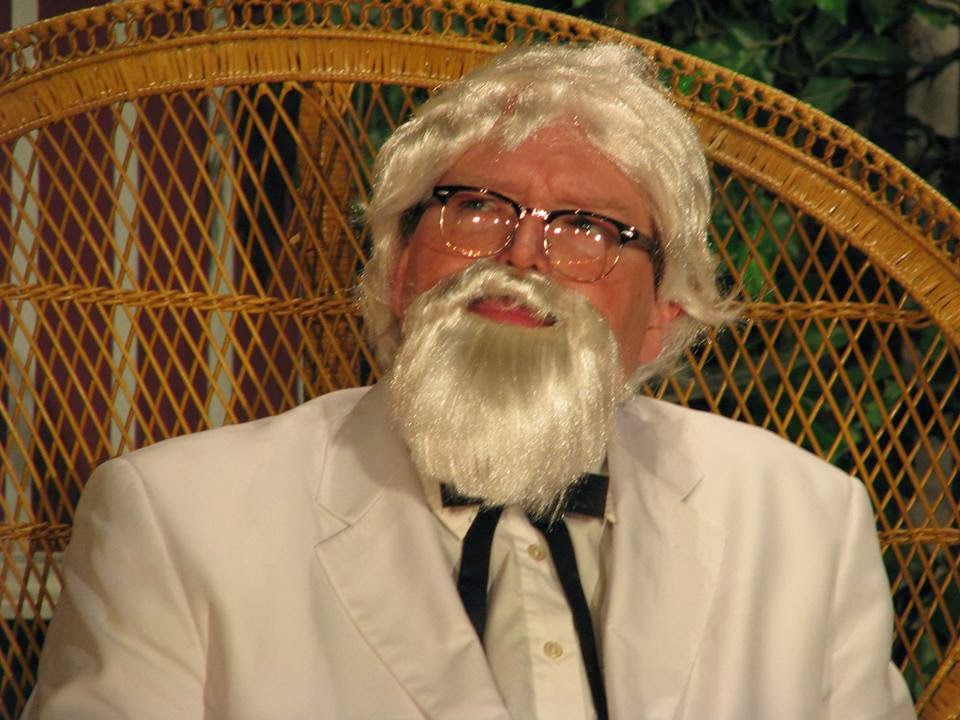
Oh God, Body Grease! Murder in the Magnolias Act Two

Oh God, Body Grease: Murder in the Magnolias, Act Two
            I was cast to play two roles in the Sparta (IL) Community Chorus’s production of “Murder in the Magnolias”, performed the weekends of February 21st and 28th. On January 2nd we had our first read-through. It was our first chance to meet each other and know who was playing what part.
            Well, first chance I had to meet each other. The rest of the cast knew each other from prior plays and musicals. I met all but two of the cast for the first time.
            There were a lot of chuckles during the read-through. Some of us were looking through the script for the first time – well, if not the first time, it was pretty close – and some of us knew our lines very well.
            I hope I knew most of my lines. I had been reading the script since Christmas day and have been memorizing the ebb and flow of my lines since then. The lines, particularly the Colonel’s, are repetitive. I am either calling something vicious, evil or nasty in every line. I tell my “sister Amanda” to hush up, shut her mouth and listen at various times.  It can be very easy to skip lines.
            When I was in “The Odd Couple” in 1982, we had similar problems. At the end of an act our director told us we were all over the script – even doing lines from other acts yet to come.  It sounded great and no one noticed the repeat performance some minutes later. I’d like to avoid that.
            For example: the Colonel has a line “there’s something in the night air” and later “I have a premonition that something is hovering over my head”. Not identical and barely similar – but the feeling is the same. I could easily get these mixed up.
            The character of Thornbird only has two small soliloquies and his other lines are comments and reactions to other characters. The play is full of things like that – one-up zingers. “Shut my mouth.” “Wish I could.”
            But Thornbird (and others) also have lines like “Are you ailing?” “What’s so unusual about that?”  These require learning the lines before mine to set up verbal cues. “I’ll move the stuffed pig” (don’t ask) is said before my line “what time is Lawyer Possum getting here?” The prior line has nothing to do with mine, so I have to remember when I hear “pig” to ask about Lawyer Possum.
            The insults and zingers are easier to remember because (1) those kinds of lines have a cadence and (2) I enjoy that kind of humor anyway – so the lines are natural to me. “Only a moron would consider that a compliment.” “I ain’t no moron.” “Then it ain’t no compliment.” Or “Black Widow spiders are deadly aren’t they?” “Only when they kill someone.”
            I try to remember certain mnemonics. One of my first lines contained “Whipped ‘em” or WPDM – “That weed pile of yours is a disgusting mess!” VD is vicious and despicable and “Sumsog” is “there’s something unnatural and morbid in that smelly old garden of yours.” I enjoy these memory exercises.
***
            This is the advertising copy of the play. Oddly, it contains some spoilers but they are necessary to describe the remaining play. Kind of like spoiling the beginning of”Citizen Kane” by saying Kane dies at the beginning.
            Yes, I just compared “Murder in the Magnolias” to “Citizen Kane” …
            What happens when you parody characters and plots from almost every Southern play imaginable, and sprinkle them with the flavor of Gone With the Wind? You get the hilarious Murder in the Magnolias. Colonel Rance Chickenwing has kicked the bucket, leaving the secret of his buried treasure for a houseful of demented relatives to discover. There’s Bubba Kamrowski, who juggles bowling balls in a luncheonette; the delicate Blanche De Blank, whose fiancé drowned in the quarry behind the Veronica Lake Casino; Thornbird, the flaky poet, whose personality is split so many ways, he’s fractured; the cartoonish Lawyer Possum whose only paying client is an alligator. There’s the movie queen, Princess Lotta Kargo, who claims she’s the Colonel’s wife. And Amanda Chickenwing, who attempts to sell subscriptions to the Tudball Tattler. Soon, there’s another death and the mystery at Belle Acres must be solved by Sheriff Billy Jerk. Toss in a prehistoric garden complete with murderous honeysuckle vines, yapping hound dogs, a Voodoo Woman, a menacing hurricane, a suspicious state engineer and a series of devastatingly hilarious “monologues,” and you’ve got a pretty good idea of the fun in this off-the-wall spoof.
“A funny and clever spoof.” – Texas Theatre Week
That’s the party line – er – official description from the playbook and the advertisements.
***
Some quick written thumbnails of the cast were also found online:
Colonel Rance Chickenwing: Once a US Senator, now aged and difficult
Amanda Chickenwing: His younger sister, daffy & devoted to her strange botanical garden
Jezebel: The housekeeper; slovenly, lazy, inept, outspoken
Voodoo Woman: The local witch
Pet Bogg: A state engineer who must dig up the old plantation
Thornbird Chickenwing III: A Southern writer whose personality is split so many ways he’s fractured.
Bubba Kamrowski: Juggles bowling balls in a luncheonette; en expert in Napoleonic law
Lorraine Carruthers: Social secretary to Princess Kargo; an intelligent young woman
Lawyer Possum: Has an alligator for a client
Princess Lotta Kargo: Flamboyant, theatrical and, maybe, off her rocker
Sheriff Billy Jerk: The biggest man in TudballCounty
Blanche Du Blank: A Southern belle, slightly cracked.

***
And now the cast – from the Facebook page of the director … (no last names ere used to protect the innocent – I know eventually our last names will be in programs and – hopefully – favorable reviews; but for now … )
Colonel Rance Chickenwing  – Mike (me)
Amanda Chickenwing – Erica

Jezebel – Mary 

Voodoo Woman – Heidi 

Pete Bogg – Brad

Thornbird Chickenwing III – Mike (me) 
Bubba Kamrowski – Ryan
Lorraine Carruthers – Amy  
Lawyer Possum – Ernest
Princess Lotta Kargo – Debbie
Sheriff Billy Jerk – John

Blanche Du Blank – Britney
 
            At the first read-through, some of the cast were absent either by permission or with the pandemic flu going around. I, Erica, Mary, Heidi, Brad, Ryan and Amy were there. Everyone read through their lines splendidly.
            Erica is the big kahuna of the Sparta Community Chorus – the president or board chairman, I can’t remember specifically. We have the most lines together.
            Mary was going to try out for a role in the 1982 production of “Oklahoma” I was in, but she was expecting a child at the time. She said she gave birth to her daughter on one of the performance dates. I said that was too bad. Imagine the laughs of a nine-month pregnant Ado Annie singing “I’m Just a Girl Who Can’t Say No”.
            Debbie was in “Oklahoma” with me back in 1982. Well, she didn’t perform, but did play the piano during rehearsals and was the “orchestra leader”. I recognized her and remembered her as the evening wore on. She’s already playing her part with hilarious zeal.
            Heidi and Amy are going to be an excellent Voodoo Woman and Lorraine. Heidi enjoyed the over-the-top cackling and Lorraine (if the read-through is any indication) will play it with a nervous fluster. She and the character Pete Bogg are the only sane characters in the play.
            Ryan is taller than I am (and I’m 6’3”) and will make a fine Bubba. I suspect he is less than half my age – a man young enough to be my son is playing my childhood bully…
            Brad grew up a few blocks north of me. I am older than him by four years – a geologic time when it comes to childhood. It was the first time I got to meet him as an adult. It was nice catching up with him even for only a few minutes before the read-through. Who would have thought three kids from the Cobbler’s Knob section of Coulterville would be part of a play thirty-plus years later? Must be something in the water.
            Fifteen more rehearsals to go. More news as it develops…
 
Original Material Copyright 2013 Michael G Curry


(adsbygoogle = window.adsbygoogle || []).push({});

Oh God, Body Grease! Murder in the Magnolias, Act One

Oh God, Body Grease! “Murder in the Magnolias”, Act One
 
 
                In 1981 our high school drama club selected “Murder in the Magnolias” as their spring play. It was written in 1980 by Tim Kelly and is a spoof of “Southern plays” – Tennessee Williams and his ilk.
                I tried out for and was cast as Thornbird Chickenwing III, a Tennessee Williams-like poet who has multiple personalities. It is recommended by the author that he is played slightly effeminate. In one scene he is in drag, playing his own sister; and in another his grandfather’s grandfather.
                “Murder in the Magnolias” is appropriately silly with lots of caricatures insulting each other. The humor is broad and slapstick is present but fitting – hopefully it won’t be too over-the-top. Most of the humor comes from the characters verbally one-upping each other (“…any fool knows that.” “You know it…”). Very few characters possess any reason or common sense.
                It is a murder mystery. The mystery is not only who did it, but also is how can this motley crew of morons and locos identify the killer before anyone else drops off. And bodies drop in every act. Part of the fun in being in the audience is guessing who is next as well as who dunnit.
                We never got to perform the play in 1981. Our director, the art teacher, was fresh out of college and only about four years younger than the oldest of us. She was a very sweet lady but unable to handle the rougher students. She didn’t know how to crack the whip. That’s important when trying to herd students.
                But the students in the drama club weren’t the ones taking advantage of her meekness. The students who really gave her trouble were the ones waiting for our sixteenth birthday so we could leave school and get working at jobs we’d have the rest of our lives. You could do that back then.
                There was another problem that finally put the fatal wound in our production.
                Being of that age, the student cast had hormones a-ragin’. When one cast member was done with his part, he whisked himself away to his girlfriend’s house in another town. More than once the director wanted to rehearse the scene again, but the principal player of the scene was basking in the glow of love.
                The lead was replaced with another girl (I’m not being a pig here – we’re dealing with fifteen and sixteen-year-olds – hence “girls” and “boys”…). Why she left I do not remember. Trouble was the replacement had just won a fierce battle with the other female lead over rightful possession of a boyfriend. The two former female leads were best friends. The replacement not only “stole” the boyfriend of one cast member, but replaced that cast member’s friend in the play. Fur flew.
                And our meek director was powerless to knock heads together and douse everyone with cold water. With less than a month to go half the cast walked out. We remaining cast discussed putting on a play of small skits we would write ourselves. I didn’t think it would be very successful or funny so I left too. A few of the walk-outs were sitting on some sidewalk steps near the school and I congratulated them on their courage – they left the sinking ship just in time.
                No play that year.
                Flash forward almost 33 years. My friend Stephanie announced on her Facebook page that the Sparta (Illinois) Community Chorus was putting on “Murder in the Magnolias” as their spring play and they were holding open auditions December 14th.
                “I still have the playbook,” I posted.
                “You should try out,” Stephanie said.
                “I don’t think the dress in Act Two would fit me anymore,” I said.
                I thought seriously about it, talked it over with my wife and decided to try out for a part. A small part.
                After high school the only acting I did was for a local children’s program produced by the PBS affiliate. I wrote for the show and was asked to play the part of the evil Count Puzzleton during the show’s pledge-break extravaganza. I agreed. As was the case with most local PBS productions – it was cheesy and over-acted. But I had a lot of fun!
                I was a DJ for ten years and did some stand-up in Springfield, IL. The little stand-up I did in Carbondale was from introducing the main act at the city’s “comedy club” (read: bar with a stage and microphone – I think the biggest talent we got to perform there was Emo Phillips. No slight to Emo, he’s very funny, but that was the biggest name we drew).
                So aside from a few personas, imitations and performances of “skits” during commercials (“Gee, Jane, this coffee tastes like shit.” “He never talks about my coffee that way at home…” “Then try new Folger’s Carcinogenic…”); I haven’t acted since 1986. And even that was on television where I could do it take after take if we goofed up.
                As a lawyer I “act” in court, I suppose. Sometimes a bit of faux outrage or an ad-libbed quip can save the day (this bit is part of a legal record of a case; I am quite proud of it: Judge: “This was filed last night at 8:00, (turns to me) Counsel have you had a chance to review this?” Me: “Your honor, I have a ten-month old baby at home, I was asleep by eight – I was in bed by ten…”).
                The last time I trod the boards was in 1982 as Felix Unger in “The Odd Couple” – my senior year with the Coulterville High School Drama Club.
                At that same time I played an extra (George) in the SpartaCommunity Chorus (it was called something else back then) in “Oklahoma”. I had one line – “sounded like a shot” and danced in the fantasy sequence. OK! Yow!
                December 14th was the day of my family’s Christmas party. That evening my wife and I went to Powell Symphony Hall in St. Louis to watch the Symphony perform Mannheim Steamroller’s Christmas. I wouldn’t be able to sneak in an audition that day.
                No problem, said Stephanie, you can audition the next day, the 15th. There are a few others auditioning that day as well. And so I agreed to audition. My daughter stayed overnight at my sister’s while we went to the concert; and Sunday morning it was back to Coulterville to pick her up; then to Sparta to audition.
                I last saw Stephanie in 1996 at the hospital at which she worked when my father was admitted there – otherwise I had not seen her since 1982 (Facebook pics aside). She is a year younger than I and we lived across the street from one another. I’ve known her since our toddlerdom. It was wonderful to see her again.
                At the audition, I tried out for two of the smaller parts – Colonel Rance Chickenwing – the Big Daddy of the play and its first victim – and Thornbird. When I was done reading, my daughter piped out from the audience in her four-year-old voice, “Are you done, Daddy?”
                “Everyone’s a critic,” I told the four judges, two of whom were Stephanie and her adult daughter. They all laughed. When I was done they asked if I was willing to do two roles, as the number of men auditioning was small.
                “Sure,” I said with more confidence that I would have had if I thought about it. They gave me a copy of the playbook – in much better shape than my original – and thanked me. I was hopeful – they wouldn’t give me a playbook if they didn’t intend for me to be in it, would they?
                We drove seventy miles to our house; my wife put my daughter down for her nap and I stayed outside to repair the Christmas lights that had been savaged by a snowstorm of a few days before. When I went inside my wife said Stephanie had called – I had been cast as Rance AND Thornbird!
                Why? Why do I want to do this? Why drive seventy miles one-way two or three times a week and leave my wife and four-year-old alone all evening?
                I could be cavalier and say it is because I am a big ham and love the sounds of applause, but it is more than that.
                Perhaps it is a bit of mid-life crisis. Instead of buying a Harley or a canoe, I perform in a play.
Perhaps it is something from my past that was left incomplete and I want closure. But it’s not as if cancelling the play in 1981 scarred me for life.
                Perhaps it is a little of both… plus …
                I’m doing it to give me something fun to do. To meet some old friends and make some new ones.
                My work is challenging – I’m not doing this to escape work drudgery – but there is a sameness to it and being in a silly play will help me escape that a while. For the past four years it has been me, my wife and the baby. The baby is starting to get older and has her little friends at the day care; my wife sings in the choir in church and during Christmas and Easter practices with them. This would be … my thing to do.
                I knew I would have sympathetic audition judges – I had practiced these lines during the first few months of the Reagan administration and knew the play – and that gave me the courage to want to do it. I don’t jump into anything with both feet – I’m definitely the kind to stick my toe in first.
                Will this lead to more? If it works out, I hope so. It would be fun to be in more plays and musicals. Either in Sparta or (gasp) locally. It could be the start of a fun hobby.
                Future blogs in the next few months will review the characters and update on how rehearsals are going, etc.
                When I first considered trying out and performing in the play; I said it could be a lot of fun.
                Or it could be murder…
Copyright 2014 Michael G Curry


(adsbygoogle = window.adsbygoogle || []).push({});