GEORGE HARRISON DISCOGRAPHY (Intro)

GEORGE HARRISON DISCOGRAPHY (Intro)
            George Harrison died on November 29, 2001 at 1:30 am of the cancer that he had been fighting for years. Ironically, the first photograph of George in the commemorative issue of People magazine shows him with cigarette in hand, the drug that ultimately caused his cancer.
Harrison’s last days seemed peppered with bad news. Remember the maniac who attacked him with a knife on New Year’s Eve of 1999? But for his wife beating the attacker senseless with a lamp we would have lost George then. This led to several public court appearances, but before that he was last seen at Linda McCartney’s funeral, herself a victim of cancer.
            Cynically, George got more publicity after he died than before. Even if he released an album, I doubt he’d have made the cover of TV Guide or People. George only appeared on the cover of Rolling Stone magazine three times before his death. To their credit, Rolling Stone magazine put out a special commemorative issue for him — something they have never done for anyone, even Lennon. It is a great issue — pick it up if you can find it. Rolling Stone releasing a high quality issue instead of following the flavor of the week (as they have done for several decades now) should be encouraged.
            Some would know George as much for his movies as his music. When the Monty Python troop lost their funding for “Life of Brian”, George stepped in. After its success, George decided to form a production company (the fact that his musical career was not doing well also helped the decision). He formed British Handmade Films, and changed it to Handmade Films after the British government said he couldn’t use their name. He produced “Time Bandits” and Michael Palin movies “The Missionary” and “Water”. For a time he had cameo appearances in all his films, ala Hitchcock. I have yet to find him in the Madonna folly “Shanghai Surprise”.
            George’s sister Louise, now in her seventies, lived about twenty-five miles from me. She moved to Macedonia in the 1950s and George came to America in 1963 to visit. He had plenty of Beatle singles in tow, but no radio station in St. Louis or in local Benton would play. The broadcast booth in which he sat while visiting the station is still intact and sitting in the Franklin County museum’s George Harrison room. His sister’s house (in which he stayed in 1963) is now a bed and breakfast.
            While in southern Illinois George listened to and (supposedly) sat in with some dance bands at the American Legion Hall in West Frankfort. He promised that when the Beatles came to America they would play there. It was the Beatles first American booking. Naturally by the time they came to America the idea was nixed.
            I’ve never met his sister, although in college I met a man whose older sister was friends with Louise. They went up to Chicago in 1964 to meet with Louise’s younger brother. I was enthralled to be even this close to someone who knew someone who met a Beatle. “What did she tell you about it?” I asked him. “Well, she remembered that John Lennon had tight brown hair and George had really bad teeth.” Well, he was British after all.
                                    GEORGE HARRISON DISCOGRAPHY (Beatle Years)
            John Lennon (life’s little ironies — beginning a George Harrison discography with a quote from Lennon…) would always say it was the music that mattered — that’s what told the story. I agree — all of the Beatles, even as solo artists, told their stories through their music. Listening to the songs reveals where the artists were and what they felt at a particular time,
            George Harrison is no exception. His songs as a Beatle reflect his attitude (and eventual resentment) toward being a supposed second-tiered member, his frustration of supposed success and his eagerness to leave the Fab Four. His solo outings showed his eagerness to spread his religious beliefs, his anger over his Beatle past, his frustration over the “My Sweet Lord” lawsuit,   and finally his pleas for tolerance and understanding.
When George was eulogized, his friends were frequently asked how he would like to be remembered. Almost all of them said, “Musician.” Not Beatle, not ex-Beatle, not Wilbury, just musician.
            I’d like to take some time to remember George the musician throughout his musical career:
***
BEATLE GEORGE: The Beatles would release singles and EP (singles with four songs) that would not normally appear on subsequent albums. This was normal for the time. I have listed the Beatles albums in order and only mention singles on which George sang (or wrote) that did not appear on a Beatle album.
            “Cry for a Shadow” performed by the Beatles on Tony Sheridan’s album, now famous for its role in Beatle lore, as opposed to the musicianship. The only tune cited to “Lennon-Harrison” ever, it is a rollicking instrumental typical at the time — jangly guitars with lots of energy and a memorable tune. The sheer joy of recording it comes through.
            Please Please Me album (1963): George and Ringo were typically “allowed” to sing a few songs on each album. George’s contributions on the first Beatle album were “Chains”, originally performed by the Cookies and written by Goffin & King (Lennon’s writing style compares very favorably to Carol King — consciously or subconsciously, she was a great influence on him). The song basically enforces the band’s one-time belief that they are a girl group with guitars.
            “Do You Want to Know a Secret” was written by Lennon and inspired by the wishing well scene from Disney’s “Snow White” movie. The song gets a lot of airplay and fits George’s voice well — and it’s not a simple song to sing. The main verse/chorus is based on an upward scale and the middle twelve is a growling rock counterpoint to the light poppiness of the song.
            With the Beatles album (1963): “Don’t Bother Me” is George’s first composition to appear on a Beatle (or any) album. It was written while he was in the hospital and the nurses wouldn’t leave him alone! It’s an excellent first effort: the music flows and connects to the words effortlessly. Here the vocal range is fairly simple. I have always enjoyed this song and say it is why I admire George Harrison so.  Only he would have a debut song with the lyric “Just go away, leave me alone, don’t bother me…”
            “Roll Over Beethoven”, a song George would sing for the next thirty years, is a Chuck Berry staple. Originally John sang the song in their live shows. Why did they have George sing on the album? Why not? He did an excellent job.
            “Devil in Her Heart” is another pseudo-girl-group song, and a bit of a throwaway. As is typical of even the Beatles’ second-string songs, it has a masterful hook and wonderful musical arrangements. If a girl group or teen idol crooner took it, the song would have been a big hit in the early 60’s. Probably given to George to sing because Lennon and McCartney didn’t want to.
            Hard Day’s Night album (1964): “I’m Happy Just to Dance With You” is another often-played song on the radio. Good thing too: it’s a great, catchy song. The lyrics -fit the music snugly and you can dance to it (the latter being much more important in those days). George sings the song prettily, giving Lennon and McCartney the harder job of singing the high-noted back up.
            Beatles for Sale album (1964): “Everybody’s Trying to Be My Baby”. One of three Carl Perkins song the Beatles sang in their career. A good solid, canny version.
            Helpalbum (1965): “I Need You”, George’s second song he wrote to be on a Beatle album is a lovely song. The musicianship and the background chorus make it a pleasant sounding song – despite its very sad lyrics.  “Please remember how I feel about you, I could never really live without you.”
            “You Like Me Too Much”, also written by George, is awkward and rushed to fill in some songs on side two. Despite experimenting with the electric organ, the song never takes off (Paul does much better with his electric organ attempt in “The Night Before”, but it’s unfair to compare anyone’s writing talents to McCartney in late 1965.). Although the verses are interesting lyrically, the middle eight (“I really do…”) sounds tacked on. George should have tinkered with it some more.
            Rubber Soul album (1965): “Norwegian Wood”, although written and sung by John, deserves a mention as it features George’s first attempts to play the sitar on record. Indeed, it is the first sitar played on any serious commercial record (the soundtrack to “Road to Morocco” aside…)
            “If I Needed Someone” is flawless. The lyrics, background vocals and musicianship raise this song to the equal of any on the album (which is saying much), The Hollies took this song and raised the harmonies to the stratosphere. George’s gimmick on this song would serve him well for years to come — lyrics and main guitar licks on the upbeat rather than the downbeat (“Here Comes the Sun” and “Love Comes to Everyone” immediately spring to mind). If this represents George’s writing talent, he deserves more than one song per album!
            Revolveralbum (1966): the other Beatles and George Martin must have agreed with that: George has three songs on the album, all self-penned. One of his songs leads off the album, a great compliment and honor to Beatle #3 (in those days artists were concerned about the order and propriety of songs — there were as yet no CDs to scramble the order randomly).
            “Taxman” starts off the album; reflecting George’s supposed skinflint attitude.
So if he’s one of the most popular rockers of all time, where is his money? A fun rocking tune, with a good guitar solo. George would play this live in Japan in 1992,
            “Love You To” is George’s first foray into Indian music. He is the only Beatle to play an instrument on the track, the rest of the instruments played by professional easterners. The lyrics have a strong pop structure (unlike his later attempts), and the song moves along forcefully. Likeable and listenable.
            “I Want to Tell You” is another of George’s best songs. It almost reflects what must have been his attitude toward his song writing ability (“… my head is filled with things to say…”) and perhaps his discontent as a Beatle is showing through as well (-…I don’t mind, all those words they seem to slip away…). Great guitar riff, perfect background vocals.
            Sgt Pepper’s Lonely Heart’s Club Band  album (1967): “Within You Without You”. Some people despise this song (it is frequently voted among the Beatle’s worst). It’s not as bad as all that — the instrumental middle is actually quite good, in fact. The song ebbs and flows like the mantra it aspires to be. The lyrics are Hindu-tinged hippie, and it is one of the few Beatles tracks on which none of the four play instruments (oddly, Paul’s “She’s Leaving Home”, also from Sgt. Pepper, is another).
            Magical Mystery Tour album/EP (1967); “Blue Jay Way”. This is almost a rewrite of “Within You…” — odd lyrics backed by some fine Hindu music, but after the first minute we get the point. The Beatles were known for not going into formula — when they have mastered one type of song (girl group, folkie, etc.) they move forward into something else. George proved with      “Love To You” he can mix pop structure with eastern influence. But can we move on now?
            “Lady Madonna” single (1968): Nope. George’s first appearance on a Beatle single was the “B” side to Paul’s “Lady Madonna”, “The Inner Light” is George’s last attempt as a Beatle to eastern music. It has no pop structure (verse, chorus) and supposedly the lyrics are taken straight from the Gita. Paul calls it one of the most lovely songs he had ever heard. One then supposes that the acid wore off.
            The song finally appeared on an album — “Beatles Rarities” — in 1979.
            Was George’s first single evidence of the other’s confidence in his ability? Likely, not, Lennon hated “Lady Madonna” so much he wanted nothing to do with the single. By this point he was accusing McCartney of stifling his creativity.
            The Beatles (the White Album) album (1968): “While My Guitar Gently Weeps”, with Eric Clapton on guitar, sides with “Something” as George’s masterwork. After putting down the sitar and picking up the guitar, George writes a powerful rock song about the condition of the world, The lyrics boil down to basically, “J’Accuse”, but the musicianship throughout is masterful.
            “Piggies” — what pissed George off during this album? In a theme later adopted by Pink Floyd in “Animals”, George this time points at the elite upper crust of the world (… in their mind is something lacking, what they need’s a damn good whacking …). This from the vanguard of the love generation? Good song though, George Martin’s arrangements throughout the album is impeccable. Unfortunately the song will be forever linked with Charles Manson and his killing spree.
            “Long Long Long” a very quiet and pretty acoustic tune. It’s been a long long long time since we’ve heard this kind of song from George.
            “Savoy Truffle” is a great fun tune, with a rollicking beat of guitar and horns – (George Martin’s maestro hand shows again). Written when George and Eric Clapton ate an entire box of chocolates, (enough to make Clapton sick) the lyrics were a word-for-word description of the candy found in the box.
            Yellow Submarine (album) 1968: “Only a Northern Song” is good album filler. George is once again angry — this time at the Beatles own song distributing company. The lyrics and notes are not quite right, but it’s intentional. Interesting listening.
            “It’s All Too Much” is better, a good mid-tempo rocking song. The horns at the end add a nice touch. A decade later, Journey would do an excellent cover of the song.
            “The Ballad of John & Yoko” (single) 1969: George’s second Original “B”-side was “Old Brown Shoe”, a good fast-moving rock song. Ringo is featured strongly on the backing vocals and John’s thundering backup on the middle eight is just stunning in its force and effect. Unfortunately, the mix is very thick and sometimes it is hard to make out the lyrics.  The song is found on the American “Hey Jude” album and the Beatles (“Blue”) 1967-1970 album.
            Abbey Road album 1969: Well, here we are. George would never top the two pop classics on these albums.
            Frank Sinatra called “Something” the most beautiful song ever written. Quite a compliment from someone who hated rock music so much he retired (for a short time). And it is a beautiful song — the organ makes for a “smoky” sound — very wispy and not easy to access, (much like the qualities George is trying to describe in song). Excellent combination of words and music — there is definitely a tone and a feel to the song.
            George’s guitar (which excels throughout the album) now has the slide work that would be his signature for the rest of his career.
            “Something” also became George’s first (and only) “A”-side single as a Beatle.
            “Here Comes the Sun” is my personal favorite. Once again the lyrics and music fold perfectly into one another. During the musical break, you can feel the sun rising and warming your face, The catchy-ness of the tune is supernatural. This song was written while sitting in Eric Clapton’s garden. Considering how much inspiration Clapton has had on George’s music lately, I’m surprised George didn’t have Clapton surgically joined to his hip!
N’ do N’ do-do.
            Let It Be album 1970: “I Me Mine” harkens back to “Northern Song”, “Taxman”, etc. in reflecting George’s materialistic side. Played in ‘A time, it’s an interesting sounding song about love fading away. The fact that is was written about his band mates makes the lyrics add to the pain he feels. George is tired of Beatling and wants to move on.
            “For You Blue” is a great song. Catchy and with fine lyrics and great musicianship. Why didn’t the Beatles do more blues? Oddly, despite George’s master musicianship, it is John who plays the slide guitar on the song. Can you blame George for handing the solo to John? Lennon plays perfectly! Although the blues were not part of their background (being more the bailiwick of the Stones and the Who), based on their performances here and on the White Album one shudders at the thought of a strong blues album from the Fabs.
Next: Solo Work
Copyright 2013 Michael G. Curry

 

ONE LITTLE TRUMPET RIFF

ONE LITTLE TRUMPET RIFF
            I subscribe to an APA – Wikipedia calls it “a group of people who produce individual pages or magazines that are sent to a Central mailer for collation and distribution to all members of the group.  APAs were a way for widely distributed groups of people to discuss a common interest together in a single forum before the advent of electronic bulletin boards or the internet.
            In 2001 the subject of the APA I belong to, called WAPA (standing for “Western” and later “Wacky” and then, simply, “W”) was Beatlemania. I kept my contribution (or “zine”) for that WAPA and thought I would share it here.
           Ye Gods, I could fill volumes with musings over the Beatles. Fortunately, volumes have already been written about them – from their music to their movies to their life stories to their children and brothers and sisters’ life stories to their affect on popular culture. This is my take on things…
            The Beatles had an absolute impact on my life and my taste in music. When John Lennon was killed one classmate was surprised I went to school that next day instead of staying home mourning (much like Harrison’s recent death, I didn’t hear about it until the next morning in the car).
            The first song I remember hearing and enjoying distinctly was Paul McCartney’s “Uncle Albert/Admiral Halsey”. I was hypnotized by the trumpet riff in the middle of the song.
            Some years later my brother went into the Air Force. He decided to give me his old albums – including the soundtrack to “Jesus Christ Superstar” and some Richard Pryor albums. Included in the stack were four Beatle albums – the greatest hits packages from 1973 (“Beatles 1962-1966” and “Beatles 1967-1970” known as the Beatles Red & Blue), “The Beatles” (known as the White Album – Red, White & Blue, get it?), and “Alpha & Omega”.
            Alpha & Omega was a bootleg greatest hits package covering their career and included some solo work. The mixing was horrible (although I didn’t notice at the time), but it was a big enough seller that the Beatles decided they were missing the gravy train and released their own “best of’ – the aforementioned Red & Blue.
            At that age I mostly enjoyed their work before 1967 – I have since grown to love their later experiments. Those four albums (ten disks in all) was quite a primer.
Alpha & Omega had a lot of album cuts you didn’t hear much on the radio. The solo works included “Imagine”, “Bangladesh” and “Uncle Albert/Admiral Halsey” – “There’s that song!” I exclaimed. Oh how wonderful, I played it and played it, loving every second of it.
            The tune probably influenced my decision to learn to play the trumpet beginning at age 11. The first thing I did when I got it home was practice the notes. I managed to finger the right notes for the trumpet interlude to “Admiral Halsey” and had it written out and played it well by the time of my first lesson.
            The tune therefore led a life devoted to music – collecting albums, learning to play piano and guitar, and ten years as a DJ. All because of one little trumpet riff on a song by an ex-Beatle.
            Album collecting in the 1980s was a passion for me. It was a rush to find some rare out­of-print piece of vinyl — McCartney’s “Thrillington”, the various 1960’s soundtracks by Harrison & McCartney, etc. Plus bootleg LPs of concerts and outtakes.
            One triumphant purchase I especially remember: I saved and saved and spent $40.00 for Paul McCartney’s “Back in the USSR”, released only in the Soviet Union. I got my copy from someone who smuggled it into the free world. I had a friend in law school, whose parents were Russian, read the album to me. I played tracks from it on the radio proudly boasting about its rarity. It was later released in the USon CD, complete with English translation of the liner notes. I still mope.
            I had most of the tracks from the “Beatles Anthology” series on record almost a decade before their official release. It was one of the few times I wished I were still a DJ — I would have loved to have played “Some Other Guy” or “Mailman Bring me No More Blues” officially instead of tucking them between two other Beatle tunes (“We have this on a reel to reel, I have no idea where this came from.”).
           As a teenager, I asked for the Beatles albums for Christmas and birthday gifts. My love of the Beatles naturally (okay, obsessively) led to my enjoying other rock groups — the Moody Blues, Rolling Stones and the Who, solo Beatle projects, etc. The radio would play Yes and the Eagles in between the sacred Beatles hymns. My life was listening to (and playing) rock and roll anthems.
            In high school I started reading my first books about the Beatles — their lives and music. I realized we Americans had been shafted! In England, they would release an album with fourteen songs or so. In the US, they would take about six or seven of those songs, pad it with released singles and “B”-sides and make a new own album. In England, they released “Rubber Soul” and “Revolver” while the USreleased “Rubber Soul”, “Yesterday and Today”, and “Revolver”.
            The Beatles didn’t like that arrangement — they spent long hours arguing over the position of the songs — to give the album an ebb and flow (a lost art nowadays). I wanted to hear the songs the way nature intended as well, and my quest for only the British releases ensued for the next several months. Everyone else in the country must have realized the same thing — suddenly British editions of the albums were (thankfully) easy to find. A record store next to a Panterra’s Pizza restaurant in Belleville, Illinoissold the British releases. Note this was decades before ebay. After several months and lots of pizza I completed by collection.
            When the Beatle albums were released on compact disks, it was the British versions. The only exception was “Magical Mystery Tour”, this was the American version, with some added singles from the same time period.
            Some years later “Yellow Submarine” was released. Side Two contained other previously-released Beatle songs from the movie instead of the original instrumental soundtrack music.  The album is better for it. It was the last cassette tape I bought – excellent music to listen to in the car!
            With the CD’s “Past Masters Vol. I & II” all of the Beatles officially released output are available on CD. With “Live at the BBC” and “Anthology I — III”, most of the unreleased work is available as well. Now the rarities are the old American albums we tossed aside in the mid-1980s — like “Something New” and “Hey Jude”.
            To me Beatlemania describes the maelstrom of publicity surrounding the group. As much as the members griped about it later in life, they certainly enjoyed it at the time. Their arguments that the mania was horrific are hard to fathom — their interviews take place in a limo heading to a private jet to take them to their mansion in the Bahamas. Old joke: Fame is a curse, “I should be so cursed”.
            In truth, one thing bad about the mania was it detracted from the music. It is obvious nowadays that talent has little to do with fame — as long as you smile for the camera and be seen with the right people at the right places you don’t have to worry about the music: let the producers and the A&R Men worry about selling records.
            One forgets the most important part of the Beatles — they weren’t lovable mop tops, they were musicians and composers, damn good musicians and composers. The Beatles were not the first superstars to cash in on their success through marketing — Elvis, Johnny Ray, Sinatra and Valentino all graced covers of “teeny-bopper” mags — but the Beatles’ publicity machine certainly went to extremes. In Americathe machine was headed by, of all people, Pat Boone. He obtained the license to sell official Beatle items. “Black market” items were rife just as it is today (as all those parking lot T-shirt and shoe salesmen will deny).
            Yes there were public appearances on variety shows and special magazine supplements, plush pillows, salt-and-pepper shakers, cake toppers, TV dinner trays, jigsaw puzzles; the list goes on and on. Books have been dedicated solely to Beatle collectibles.
            Currently, it is almost expected for stars to grace shirts and throw rugs, have dolls made of them, and even al Saturday morning cartoon, but the Beatles were the first. Folkie-rock star Jewel wrote a book of poetry — John Lennon’s second book of poetry was released before she was born. Child actresses Mary Kate and Ashley Olsen had a syndicated cartoon. Ringo’s grandson watched reruns of the Beatles’ animated TV show long before. Singer Marian Carey’s movie flopped. “Magical Mystery Tour” flopped, but do you think “Glitter” will be called an “amazing portrayal of the times” thirty years from now (actually it is a portrayal of the times — plotless, soulless and very boring)?
            And the comic books (you don’t think I could go this long without mentioning comics books do you?). The Beatles had an “official” comic in 1964 published by Dell illustrating their rise to fame. Later Dell published the comic version of “Yellow Submarine”. In the 1990s Revolutionary Comics did an eight-part series on the lives of the Beatles as a group and as individuals. It’s very hard to find, but worth it. Marvel Comics in the 1970s released a Beatle comic — no, they didn’t fight Galactus; it was another history of the group.
            Otherwise the Beatles appeared as themselves only as an incidental part of the plot: they appeared in Laugh (Archie), Jimmy Olsen, Jerry Lewis and teen romance comics. Mostly comic book writers (fearing having to pay a royalty), just had four or five long hairs calling themselves all kinds of insectoid names — the Mosquitoes, the Roaches, the Bugs, etc.
            The mania surrounding the Beatles was overboard even by today’s standards. But now it is, like the music and movies, also part of Beatle lore. We can either shake our heads or join in on the frenzy. See you at the flea markets!
Copyright 2013 Michael G. Curry
 

A Late Review of the Latest Superman Movie

            This is the last review you will read of “The Man of Steel”, I would guess. It has been out for several weeks, but I saw it during the July 4th week. And yes this contains spoilers. If you haven’t seen this movie yet and are still concerned about reviewers ruining the movie for you … then go see the damn thing before reading any more reviews.
            I was off work; the wife was not. So I spent the day shopping and thought an afternoon in a theater would be nice.
            But what to watch? “Giant Whoredog Corporate Blockbuster CGI Slagheap 3” (to quote artist Stephen Bissette on the latest batch of pornographically violent films)? There was not much else to select at the nearby multi-temple.
            I decided on the new Superman movie, called “The Man of Steel”. I’ve read many reviews raving for it and ranting against it. Most of the people whose opinions I trust did not like it.
            I expected to hate the movie. I even brought a pen and paper to write down my thoughts while watching; not having my lovely wife next to me to act as Crow to my Tom Servo.
            I liked it very much. I didn’t love it.  I wasn’t gaga and oohed and aahed at the prospect of this igniting a multi-movie franchise. But it wasn’t as bad as I expected.
            Comparisons to previous Supermovies is not fair, but it IS expected nowadays. I liked MoS (as it shall be hereinafter called in this little treatise) as much as I hoped to have liked “Superman Returns” from 2006 – the last big-screen treatment of the character. I was so hoping that movie would do well and be a wonderful experience. “Returns” had its moments – some wonderful moments – but it ended up being a forgettable movie. What was considered a “sequel” to the first two Christopher Reeve-Superman movies ended up being a rehash of the first Reeves movie.
            Before seeing MoS, I considered it a rehash of the second Reeves movie. Zod and his gang of Kryptonian thugs are bent on conquering the earth. MoS was a little more than that, but that is the plot in a nutshell.
            In the meantime we get a retelling of Krypton’s last days, Zod’s relationship with Jor-El, Kal-El’s life as a youngster on earth and his first few experiences as Superman.
            Reviews of MoS said the flick was dark and brooding, Batman-ifying the Big Red “S”. I bristled at the thought. I still bristle at the thought of Batman being turned into Brooding Sociopath Man. I didn’t want to see Superman turn into a dick.
            One of the first lines in the film has Jor-El speaking to Zod, who was leading a Kryptonian coup d’etat. “I will honor the man you were, not the monster you have become.” I wrote that down. What a perfect line to describe the dark Superdick I will spend the next two hours with…
            But I was happily surprised. Is the film dark? Yes. Is Superman himself dark? No. Here is Superman the way he should be, and the way he has always been portrayed on film so far – our honest and noble protector.
            When Zod threatened the earth with destruction if Superman (at that time a mysterious super-powered benefactor) did not reveal himself, Superman did so.
            When he protected the soldiers who were firing at not only him but Zod’s militant thugs, Colonel Hardy (played by Christopher Maloni with the same unlikeableness with which he infused Detective (un)Stabler in Law & Order: SUV (sic) said “this man is not our enemy”. Superman was grateful.
            (Incidentally, Maloni’s best moment was the look on his face when he realized he was getting in a knife-fight with a Kryptonian but still did not back down. His sacrifice to destroy the terraforming machine was canny. Well done, but expected. I was saddened that the sacrifice also had to include the woefully underutilized Richard Schiff. I would have loved to see him as a regular in the franchise.)
            In between all the explosions and CGI destruction were Superman’s relationships with both sets of parents. His birth-mother Lara was given more lines and emotions than in any previous movie or even the comics. She came this close to refusing to allow Kal-El to go to earth. It was very moving, especially to this new parent. I can barely imagine what she must have gone through.
            Superman got to speak to a simulacrum of his birth father Jor-El, rather than a pre-recorded Marlon Brando made up to look like Charlie Rich. Superman got to actually speak with his birth father.
            For the past two decades Jor-El was portrayed as cold, emotionless and on the cusp of evil – all of Krypton was. This Jor-El, played by Russell Crowe, was noble – a hero that a son could emulate.
            And although this Krypton was portrayed as a dystopia, it was still sad to see its inevitable end. It’s message of conservation seemed forced; although the skyline view of Krypton’s moon in pieces was, well, kinda cool.
            In the Bronze Age of comics (and before) – Superman’s adoptive parents, the Kents, were dead by the time he became Superman. It was a sober moment and reflected in Superman’s persona. “Despite all my powers, I couldn’t save them.” Superman will do his best to protect us, but there are times when he cannot. It is a basic tenant of his personality.
            Since 1985, when the Modern Age began, comic lore has ordained that his mother has survived. In MoS, Martha Kent has also survived to see his son become Superman. I have mentioned in previous blogs this is not necessarily a bad thing, but his moral compass is now external, not internal. Why would you need a Fortress of Solitude when you can go to Mom’s house for a slice of sympathy and apple pie after defeating Throgg the Omnipotent?
            His relationship with Jonathan Kent was more complex here – Kentwas played quite well by Kevin Costner. Rather than encourage Kal-El (or ClarkKent) to use his powers nobly for the benefit of mankind, Kenttells his son to be wary – people will be afraid of him. This is more a reflection of today’s society, I think. During the Reeve’s movies and before, Jonathan Kent and Jor-El would be in agreement: you have tremendous powers, you must prepare yourself to use those powers to benefit mankind. This Jonathan Kent would have preferred Clark wear a mask and hide his tracks. I was pleased to see him proven wrong. “This man is not our enemy.”
            Jonathan Kent’s death was the second most controversial part of MoS. My impression from other reviews fed into the “dark” Superman – callously allowing his father to die to prove a point. It wasn’t that way – Jonathan Kent prevented his son from saving him. Kent knew his son was not ready to reveal himself. It was a powerful scene and well done – it showed Superman doing what a superhero is supposed to do. He obeyed his father.
            This led to a period of wandering – I was led to believe this; I don’t know if that is the case or not. Wouldn’t that make a wonderful TV series? Sort of like the 1970s “Incredible Hulk” – a lone stranger wanders into town, resolves a crisis and wanders off again. A “Smallville” on the road…
            I expect he came home frequently. His mother’s reaction to seeing him is hardly that of a mother who has not seen her son in 15 years. She was almost casual about him walking down their driveway. “Why didn’t you tell me, you could have picked up a gallon of milk on your way…”
            There were a few undeniable religious symbolisms and comparisons. Superman-Moses parallels are something of a joke nowadays, but MoS” went a bit further.
            Superman was 33 years old during the film. Like Jesus, he spent 30+ years in the world as one of us before revealing himself. When Zod makes his threat to destroy the world unless the son of Jor-El surrenders, Clark takes solace and advice from a minister in a church. Presumably this was the church he went to in Smallville. As he talks to the minister, his headshot is framed with Jesus to his right facing away from him slightly above and praying with his face and arms pointing upwards. It makes a stair-step: right to left going up – Superman, Jesus, God. If you’re going to do a shot like that – that is the way to do it. Any other way would be awkward or raise eyebrows and create a controversy Warner Brothers did not need. What if Jesus was “below” Superman? What if he was above but praying in the direction over Superman’s head – making a strange triangle (Superman directly below God and Jesus off to the side?).
            My friend Clyde, whose blog about recent superhero movies can be read here, http://playmst3kforme.blogspot.com/, told me WB sent MoS study guides to churches. It would be interesting to see them. I googled the subject and found a few …
            The most controversial part of the movie came at the end in the final confrontation with Zod. Superman had to break the general’s neck to stop his killing civilians with his heat vision. Superman begged Zod to stop (I don’t recall if he used the magic words “please”) and screamed in frustration when the deed was done. It was overlong – to show us how much Superman agonized over the decision. I didn’t mind that – if the scene was done quickly one could argue Supes’ callousness in killing. The argument came anyway, but at least the callousness wasn’t obvious. Batdick, Punisher or Lobo would have snapped his neck an hour ago…
            “Superman doesn’t kill,” critics of the scene wrote. True. Very true. As with the death of Jonathan Kent, I was expecting Superman to be indifferent or even gleeful as shown by the brooding sociopathic “heroes” mentioned above and other so-called “heroes” DC, Marvel and independent comics have been vomiting up since the 1990s.
            Superman could have thrown Zod into the Phantom Zone or tricked Zod into entering the Zone or destroying himself or his powers (remember how that was resolved in Reeve’s Superman II?), but that is not the way for the fans of “Giant Slagbag Bucket of CGI Ticks 6” (another Bisette-ism) who the producers of MOS need to attract to make money.
            A few minutes showing Superman’s regret would have resolved this. The trouble is, the filmmakers couldn’t linger on such regret. They would need to balance Superman’s facing his decision with his wallowing in pathos. “Oh woe is me.” Rend, rend…
            Perhaps a short scene with General Swanwick … “Have you ever had to kill?”
            “Yes, many times…”
            “How do you think about that?”
            “I don’t think about the people I had to kill, I think about the people I protected.”
            Or something like that.
            Or a brief flashback with his father. Jonathan Kent would have been old enough to serve during Viet Nam (Costner was born in 1955, just a bit too young, but his character could have been five years older…). Perhaps his war experience is what infused his fear of humanity.
            So that is my view of the film. I liked MOS as much as I was hoping to like “Superman Returns”. I was as disappointed in “Superman Returns” as I was expecting to be disappointed in MoS. Will it be as iconic as the Reeve’s movies? No, but that is hardly fair to compare it to those films. Well, the first two at any rate.
            Now, what about a sequel?
            I hope to god they stop with Reeve’s “Superman II”. If “…Returns” was a remake of Reeve’s I and MoS was a rehash of II … well, let’s stop there. Let’s get some new ideas, shall we?
            “Luthor in the sequel! Luthor in the sequel!” So scream the corporate-boot-licking-uberwonks from their parents’ basements.
            No. Luthor is as overused as the Joker.
            The trouble is, who else is there? Braniac? All during the CGI destruction shown in MoS I imagined how these effects could have also been used to show Braniac trying to shrink and “steal” Metropolis. The Lovecraftian-mechanical tentacles would have fit Braniac’s machinations too. A pity. The last thing a franchise needs is such repetition for its second film.
            Clyde came up with a wonderful idea. Bizarro. And in between slugfests we could see ClarkKent interact with his coworkers. We’ll get to know and understand the cast. Perhaps empathize with them.
            What am I saying …
            Some final thoughts:
            1) I like the idea of Lois Lane knowing Clark is Superman from the beginning. She could even help protect his identity. I got tired of the constant toying around with this even as a kid reading the comics. She’s an investigative reporter. She should know. I always felt that way about Commissioner Gordan and Batman.
            “How did you find out I was Bruce Wayne?”
“I’m a detective, too. A good one.”
            “Obviously…” 
            “Are you going to use your Bat-Amnesia Spray on me?”
            “I’m not that Batman; I’m the Batman that will break every finger until you swear not to tell anyone.”
            “I’ve known for years and haven’t told anyone yet … OW! You dick! OW! Stop it! Ow! Shouldn’t you be killing off another Robin? Ow!”
            2) Perry White is now a black man?  “What’s his middle name – ‘Ain’t’?”
            Well, why not? Lawrence Fishburne did a wonderful job and fits the role well. As with most comics, especially those created in the Golden and Silver Age, the lack of non-caucasian characters is embarrassing… Comparisons with Samuel L. Jackson’s Nick Fury are unavoidable. Tokenism?  Maybe, but as with Fury, it didn’t seem to be a case of “Quick, Africanize someone! Anyone!” Perry White is black. Okay, let’s move on…
            3) Near the end we saw a flashback of a young Clark Kentplaying along the laundry-line posing in a cape.  Um, who was he supposed to be emulating?
            In this Superman-less world without superheroes, who was there to pretend to be? I imagine a “Watchmen”-like world where comic books were horror, war, teen and funny animal books only.
            Where else would he turn for imaginary heroes?
            Comic strips? The Phantom? He didn’t wear a cape.
            Pulps? Doc Savage? Ditto. Crime-fighters who wore capes were of the Shadow and the Spider mold – and they were hardly Good Guys. I doubt young Clarkstood there, puffed out his chest and said “The seed of crime bears bitter fruit…”
            I avoided getting into arguments about this issue on Facebook with children born after the Modern Age in 1985. DC declared that Superman had only been around ten years while the other heroes of WWII (and before) existed before. The Golden Age Wonder Woman and Black Canary were the mothers of the “current” heroines.
            “He could have been pretending to be members of the Justice Society of Americaor All-Star Squadron.” They forget their history – if not for Superman, there would have been no JSA or, um, ASS.
            Besides, if there WERE superheroes in this MoS continuity; then why was Superman’s existence such a surprise?  “Who saved the children in the school bus?” “It was probably Hourman passing by.”  “Who was the mysterious stranger at the oil rig?” “Neptune Perkins, I guess.” “Oh, okay, case closed.”
            Now that Superman “exists” in this MoS world, it will be interesting to see how his presence affects this world. Which of Superman’s fathers will be proved right? It will make the upcoming sequels interesting.  In between scenes of CGI Pop Slough (thank you again Mr. Bissette …)
Original material copyright 2013 Michael G Curry


The Synergy of Science Fiction and Horror: the lost potential of “Event Horizon”.

The Synergy of Science Fiction and Horror: the lost potential of “Event Horizon”.
                The film “Event Horizon” was on television over the weekend. I saw it in the theater when released in 1997 and I wondered if it was really as laughably bad as I remembered it.
                Time has mellowed my opinion of it. It wasn’t bad.  It wasn’t good either, but it wasn’t bad.
                Some of the movie’s worst crimes mellowed on the small screen; by that I mean the cheap scare tactics weren’t as bad when not amplified. When I left the theater in 1997 I told my friend (and fellow movie-attendee) Jon, “Next time let’s save some money. Instead of paying to see this movie, we should just randomly startle each other every two or three minutes and achieve the same effect.”
                This led throughout the night and the next week or so with our conversations peppered with the following routine.
                “Jon?”
                “Yes?”
                “BOO!!”
                That was the total sum of the scariness of “Event Horizon” – build-up, build-up, build-up, soundtrack getting more and more ominous … and then … and then …
                The music stopped, the character’s fear was unfounded. The strange thingie he thought was approaching him was … nothing. Sigh of relief.
                Boo!  Oh no! The thingie attacks!
                Actual scene – Sam Neil hears his dead wife’s voice. The lights fade in and out. “Sara?” Lights on, Sam is on the right of the screen. Lights go out. Lights go on. Sam is still alone. Music swells.
                “Get it over with!” I shouted.
                Lights go up. Nothing. He turns to his right. Oh no! The ghost of his dead wife is to his right, not left! Music swells! He screams! The horror! The horror!
                A member of an as-yet-undiscovered tribe in the Amazon would see that coming. And the movie is filled with this tactic.
                I still dislike the movie despite the amazing cast. Sam Neill, Lawrence Fishburne, Kathleen Quinlin, Joely Richardson, Sean Pertwee (the son of Doctor Who’s Jon Pertwee) and a pre-Draco Malfoy Jason Isaacs.  Richard Jones overplays the black crewmember in all his token glory. He was the first one I wanted to go… Of all the shortcuts taken in this movie his was the worst. The other characters at least TRIED to appear three-dimensional. It was obvious the writers, producers and directors could not handle horror. They apparently can’t handle a black character that possesses dignity and self-respect either. The film made LL Cool J from “Deep Blue Sea” seem like Poitier…
                I was (and am) disappointed. With the right tweeking here and there it could have been a horror masterpiece up there with 1963’s “The Haunting” and perhaps even passing that OTHER famous scary sci-fi movie … the mother of them all … but more on “Alien” in a moment.
                Horror and science fiction fit very well together. It’s like peanut butter and jelly. Some like peanut butter with other things, some like jelly with other things, some like only one and not the other, some like neither. But you cannot deny their popularity as a team.
                Or compare it to two brothers who are identical yet a decade apart in age.  They go together even though at times they are vastly different.
                “Frankenstein” is arguably the first science fiction novel. If so it is definitely the first science fiction/horror novel.
                Of course, a movie or a book with science fiction elements doesn’t make it science fiction; no more than a book or movie with scary moments makes it a horror flick.
                If that were the case “Godzilla” and almost every monster movie would be labeled “sci-fi/horror”. They are monster movies. Some are very good monster movies, but not sci-fi/horror.     (“Deep Blue Sea” could be considered a sci-fi/horror film, but it was more of a monster flick…)
                Any sci-fi/horror blend has to be compared to the movie “Alien”. Isn’t that a monster movie too? In a way, but only in the way that a serial-killer movie is a monster movie. If “Alien” is a monster movie, then so is “Silence of the Lambs”.
                “Alien” had horrific situations folded in science fiction trappings. Want an easy way to describe it? “Jaws” in space. Or better – “Halloween” in space.
                But making it that simple misses the greatness of the movie. In “Alien” we have solid characters (not necessarily likeable one, which is important) and truly frightening and/or intense scenes. Hitchcock would have approved of the monitor scene. The alien is shown as an electronic blip slowly approaching the captain in an access crawl space. We see it coming and all we can do is what Ripley did, “Run! He’s getting closer!”
                It is good science fiction and scary as hell. The sequel “Aliens” is also a good movie, but it is works better as an action movie than a horror movie. That’s not a bad thing, but it does make a difference. You watch “Aliens” to be thrilled and cheer on the good guys, not to be scared or creeped out.
                The bad guys in “Event Horizon” were originally written to be an alien race. The movie-makers wanted to wisely avoid the “Alien” comparison and decided to get their horror from another vein. They went Lovecraftian.  The pitched it as “The Shining” in space.
                This is why I had such high hopes for the film. The few moments of true creepiness were overshadowed by “the startle” – the cheap way to get a scare (“Boo!”).  They should have let a horror writer come up with ideas.
                Ironically, Sam Neil appeared in one of the most genuinely scary movies out there – “In the Mouth of Madness”. A flick firmly ensconced in the Lovecraft/Stephen King mold. Plus it was directed by John Carpenter. That kind of fear-making should have been incorporated into “Event Horizon”.
                I’m reminded of an episode of “Star Trek: The Next Generation” called “Night Terrors”. The crew finds a missing Federation starship as a derelict with the crew missing (except one). They discovered that the crew of the missing ship killed each other and the Enterprise crew starts exhibiting the same symptoms – paranoia, violence and hostility. That’s the plot of “Event Horizon” too…
                There are moments when the “Star Trek” could have been horrifying. When Dr. Crusher was in the morgue with the dead crew of the missing ship, she hallucinated the bodies had sat up (the audience never sees the bodies move). She clenched her eyes shut and the scene pans out to show the bodies lying on their slabs again.  I waited for the next inevitable moment, but it never happened. The show moved on to the next scene.
                The bodies should have flailed.  They should have thrashed around while the doctor screamed her pretty red head off. A scary moment missed.
                That was “Event Horizon” – the scary moments were right there. Right. There. Ready to be exploited. But it went for the “Boo!”
                Or it went for the gore. Evisceration is not scary. The before and after, if done right, can be.
                A shame, really. Such potential. That’s why I still don’t like “Event Horizon”.
Copyright 2013 Michael G. Curry

Cover Charges: My favorite comic book covers…

Cover Charges: My favorite comic book covers…
               Recently Facebook pages and groups devoted to comic books have listed “Top Ten Comic Book covers” from professionals and fans.
               My friend Clyde and I discussed this topic one Saturday night and resulted in his blog post that you can view here. http://playmst3kforme.blogspot.com/2013/06/weve-got-you-covered-10-great-comic.html
               I stand by what I said. It would be very hard to do. But as I flogged my memory it became easier. I ended up with quite a long list. I could either go with comic book covers that have become iconic – Brave & Bold #28, Amazing Fantasy #16 and Action Comics #1 …

I could have gone with comics that I love as a work of art, such as this beauty – Batman #241 with
art by Neal Adams. It’s a comic I do not own, but is definitely one of my favorite covers. Wow!

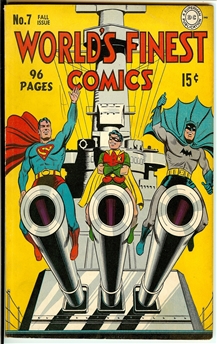
               Or this famous cover from World’s Finest #7 from the 1940s. It’s another comic I do not own, but it IS one of my favorite covers. If only because it never fails to elicit a sophomoric giggle. Hee-heehee-

hee…

               Robin does look quite proud, doesn’t he?


               I wanted to do something more personal. These are ten comic book covers that made me want to buy the comics. Something about the cover attracted me enough to say, “Oh I’ve got to get that.” Some are iconic, some are beautiful pieces of art; some just pressed my buttons (in a good way). If a comic book cover is supposed to entice you to purchase and/or read it, these worked … for me …
               You may notice the distinct lack of Marvel comics. This is because I did not read much Marvel growing up. I got most of my comics for free from Sparta Printing – who printed National Comics (they officially changed their name to DC Comics in 1976), Harvey and Archie. So Marvel comics were only picked up in the grocery store.
               And all of the comics were from the 1970s. This was when I was a boy into my very early teens; comic book covers mattered more to me than they do now. I haven’t been excited by a comic book cover in many decades. Maybe older and wise, maybe not.  A cover may intrigue me but it is the interior art or story that catches my imagination. That is too bad, I suppose, but it helps keep impulse buying in check…
                Someone might say, “How could this cover excite you? It’s silly! Now Spiderman #28 – THAT gave me the willies!”  Really? Tell me more about it! I’d love to read your lists!
               So these are personal favorites only. Maybe someday I’ll do my favorite list of “iconic” or “classic” covers, but for now, this is all about me! Haha!
               These are in no particular order:
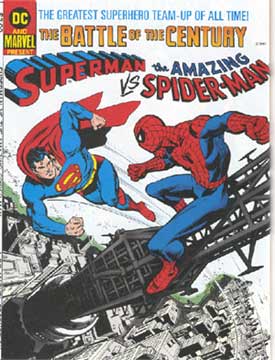
Superman vs Spider-Man: the Battle of the Century. 1976.  What comic book fan did not soil themselves upon seeing this cover? Even the house ads in other DC and Marvel comics brought a chill. It was this iconic cover with the words, “THIS … SAYS IT ALL!!” It helped that it was a rollicking good read that lived up to the hype! The cover was by Carmine Infantino (layout), Ross Andru (finishing and pencils) and inked by Dick Giordano – all hall-of-famers.
               Occasionally a comic cover lives up to its hype. This is one of them.


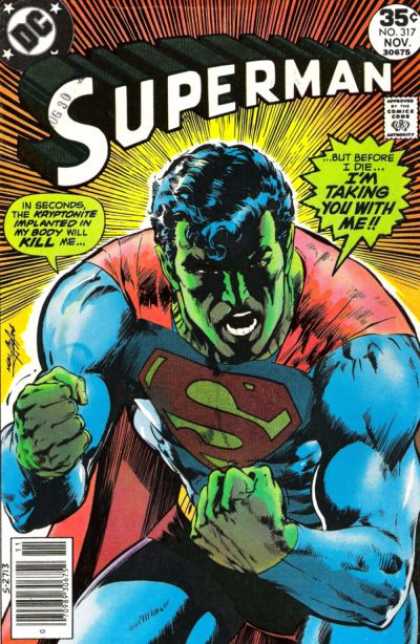
Superman #317. 1977? Neal Adams art. A later part of a multi-part issue, which was a better-than average story; so I would have gotten the issue anyway.  , but I was so wooed by the cover! An angry Superman!?  Wouldn’t you run away, too?
               Adams is a wonderful artist. Look at those muscles.  You can almost hear the cords creak as Superman flexes…
Superman vs. Muhammad Ali (All-New Collectors’ Edition #C-56). 1978. How can you look at this and NOT say, “Oh, I’ve got to see what the hell this is about…”. Iconic cover by Neal Adams. He was asked to redo this for a millennial-end issue of “Sports Illustrated” with the 20th century’s greatest sports legends. Muhammad Ali and Michael Jordan boxed in that one. Babe Ruth was in the forefront. In the audience were Sandy Koufax and a legion of others.
 
 
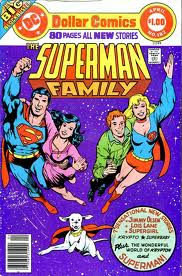
Superman Family #182, 1978? Neal Adams art. Are you sensing a theme here? This was DC’s first “Dollar Comic”. A dollar? For a comic book? Yeek! It would blow the budget of any teenager, but I couldn’t resist the cover. The stories inside ranged from great to mediocre. Neal Adams draws Supergirl.  Ooo-la-la. Plus it had Krypto on the cover.
               You gotta love Krypto!


Marvel Team-Up #74. 1978. “Is this a joke?” Talk about a cover that

screams “I’ve GOT to get this one.” Art by Dave Cockrum & Marie Severin. A fun issue that never wallowed in silliness.

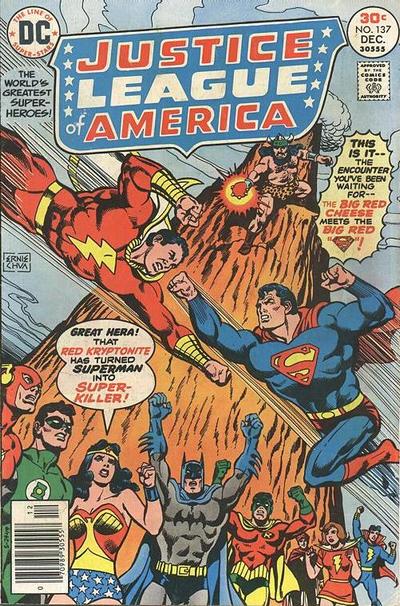
Justice League of America #137. 1977. Ernie Chua (Chan) pencils and Frank McLaughlin inks.
               Nowadays Superman and Captain Marvel (Shazam) fight each other annually. But this was the first time they shared a story – how could I resist it? It was also the first time they “really” shared a cover (earlier comics had Supes “introducing” Cap or their posters were hanging side-by-side, that sort of thing…).
This was part 3 of the traditional JLA/JSA team-up with Cap and other Fawcett characters appearing and fighting alongside our favorite heroes. It was the first time I had heard of or read about Spy Smasher and Ibis the Invincible – who have gone on to become two of my favorite comic book characters!

Batman #253. 1973
Oh.
My.
GOD!!!
Mike Kaluta art (no one – NO ONE – would have been able to do this better).


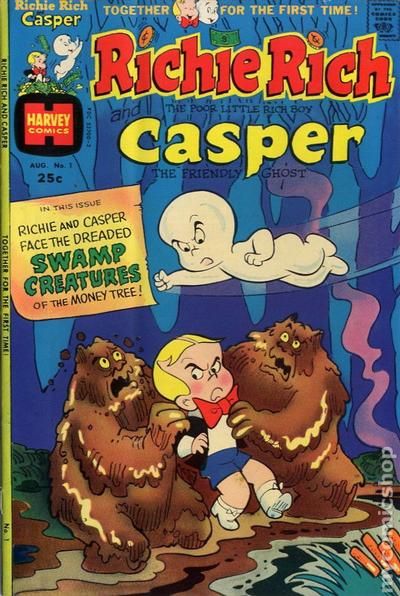
Richie Rich and Casper #1. 1974. Artist unknown. Oh, wow! Together! Oh, WOW, said my nine-year-old self!
               The story was fun and the artwork well done. Surprised to see a non-superhero comic on the list? Me too. But I still remember how thrilled I was seeing this and reading it. Forty years later I still remember the entire series with fondness.
 
 
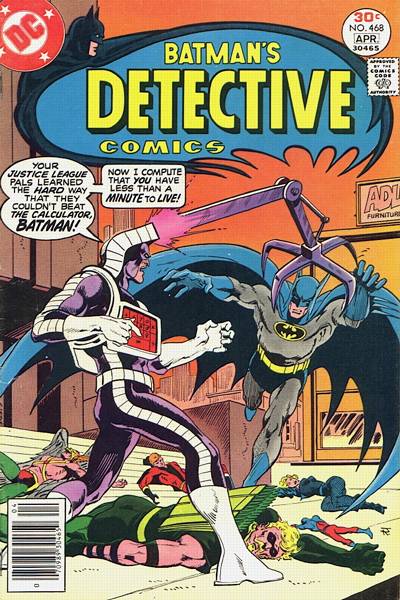
Detective Comics #468. 1978? It’s hard to believe this is the only comic on this list drawn by my beloved Jim Aparo, inked by Tatjana Wood.
               The Calculator! Over the past five issues this villain fought other DC heroes in the back-up feature (Green Arrow, Hawkman, etc. – all of them beaten and lying unconscious on the cover) and NOW he’s fighting Batman in a book-length battle! I was so excited seeing this cover when it came out! Great conclusion to a fun story line! It is in no way an iconic cover or a legendary story – but this youngster loved it!


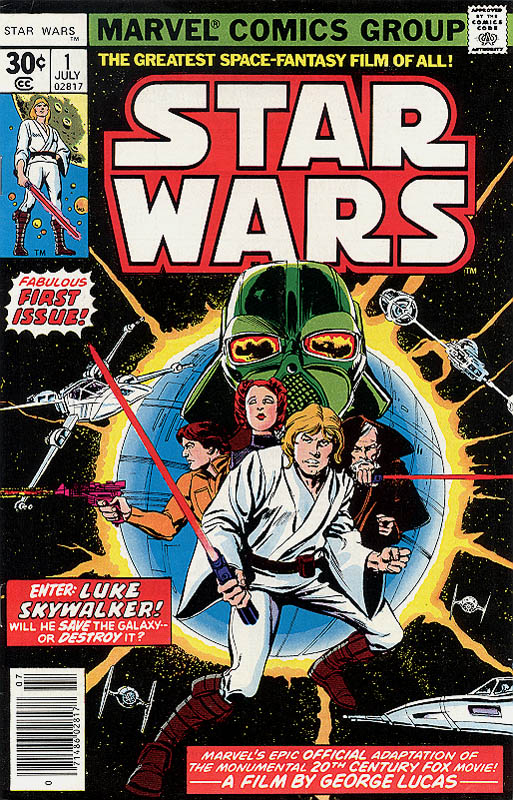
Star Wars #1. 1977. Cover by the legendary Howard Chaykin, inked by Tom Palmer.
               Great cover as always by Chaykin, especially considering the flood of Star Wars comic art to come. But imagine the impact of this cover on this 12 year old kid …
               Star Wars? As a comic book? Star Wars! As a comic book! STARWARSASACOMICBOOK!! “Earl to Aisle 3, Earl to Aisle 3. We have another boy passed out in front of the book stand. Earl to Aisle 3.”
Oh, ok, one more.


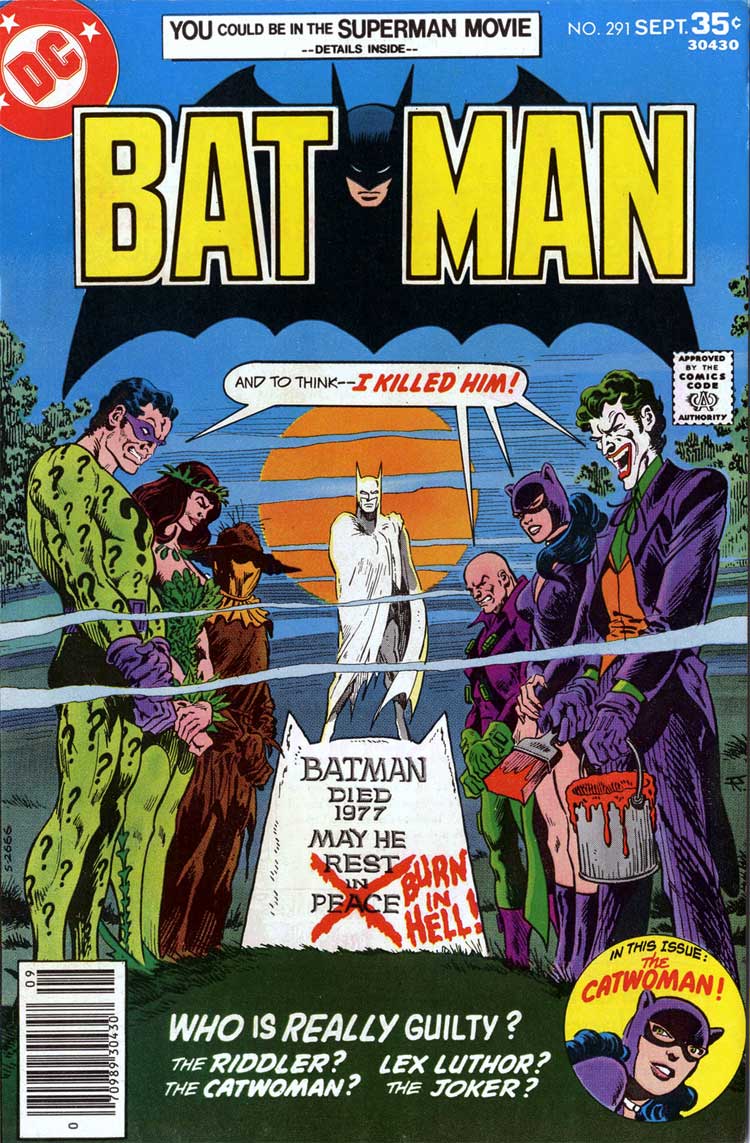
Batman #291. 1979 or 1980? Look at this beautiful Jim Aparo art (I felt bad about only having one other Aparo cover on the list and this issue immediately sprang to mind…). Tatjana Wood again inked.

               The cover made me snap this up – only to find out it was part one of four! Rats! Even so, it was a great story arc. I wish it would be released in a graphic novel. The Bronze Age gets a bad rap nowadays and that is too bad. There were some wonderful stories that a lot of fans missed during that late-1970s era. This is one of them!
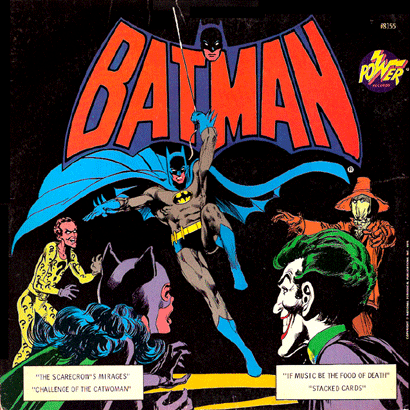
Honorable Mention:  Power Records, 1975. This is not a comic book, but dig the cover! Another Neal Adams classic. When I saw this album I had to have it! It took the Beatles (or my discovery of them in 1979) to knock this off of my record player once and for all. I still have it!
                If this were a comic book cover it would rank in any Top Ten!
 Honorable Mention #2 – the entire run of Marvel’s “What If…” 1978?  The whole point of this comic series – tales of alternate endings to the various Marvel Universe mythos – was to goad the reader into buying this anthology series. “Ooh, aah,” was often heard at the newstands when a new issue came out – What if Spider-Man joined the Fantastic Four? What if Captain Ameria had not “disappeared” after WWII? What if Shang Chi served Fu Manchu? What if Bruce Banner had always kept Bruce Banner’s intelligence? What if the New X-Men never formed? What if someone else had been bitten by that radioactive spider?
               Others will muse over “great” covers and “iconic” covers, but these captured by heart and imagination more than the others. There have been better covers – there have certainly been better stories on the inside. But just looking at the covers on my list brings back good memories.
               Isn’t that the whole point?

Hey Comics! Kids!

Hey Comics! Kids!
  d113b-batslap-bmp
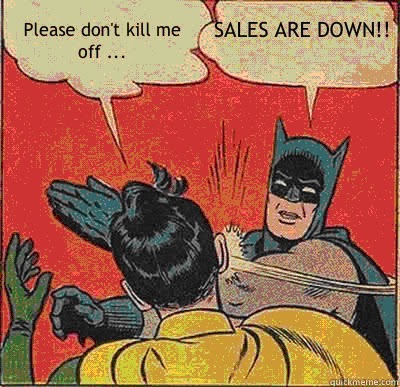
              The recent death of Robin the Boy Wonder got me thinking about superheroes and children. This Robin was the illegitimate love child of Batman/Bruce Wayne and Talia al-Ghul, the daughter of his enemy Ras Al-Ghul.
                My favorite comic book eras were the Silver Age and the Bronze Age, roughly comics released from 1956 – 1985.  During those eras, superheroes did not have children; with only two exceptions. The end of the Bronze Age saw the end of that – but more of that later. “World’s Finest” brought us the sons of Superman and Batman; and Superman and Lois seemed to have a super-powered kid every few issues; but these were imaginary stories (as opposed to the “real” stories), not canonical progeny.
                And during those years we had the adventures of Superbaby and Wondertot (no lie), but those were our beloved heroes as toddlers, not the children of an existing superhero.
                Why no kids?  It was probably because of the readership – oh, yes, some comic book readers enjoyed romance comics. Also, at this time Archie was always pining over Betty or Veronica. But to actually marry? And have a baby?
                No. Keep your reality out of my fantasy.
                Did we want to see Superman changing a diaper? Did we want to see Flash literally racing to the store to buy more formula? Probably not.
                The two exceptions signify the two extremes why such things did not happen otherwise in those eras…
                In the “Fantastic Four”, Reed Richards (Mr. Fantastic) married Sue Storm (Invisible Girl/Woman). An entire special issue (an Annual) was made of their wedding. The birth of their first baby, Franklin, was on the blurb of their comic a few years later. It wasn’t an event on par with Lucy and Ricky’s on early television, but in comicbookdom it was big stuff. It was a superhero’s (and thus comic books) first baby. Every few issues the child was threatened; or he and his babysitter were kidnapped or disappeared. The stories always turned out well, but the easy plot devise was used again and again.
                Aquaman was not so lucky.
                He married Mera and had Arthur Jr. Sometimes Junior would be called Aquababy.
                 In the mid-1970s, some years after the cancellation of his own title, Aquaman was revived in “Adventure Comics”. The creators kept the cast intact: Mera, Vulko, and Arthur Junior.
                 Like Franklin Richards, Arthur Junior was shown at the beginning and ending of most tales playing with Mommy and Daddy or their friends/partners/sidekicks. But Aquaman wasn’t the Fantastic Four. He was a secondary character in a low-selling magazine. Writers could get away with things here they couldn’t elsewhere.
                Baby Arthur was kidnapped. Ho-hum. Aquaman vows vengeance. Yeah yeah.
                Aquaman smacks the shit out of Black Manta and opens up the pod in which Manta put Arthur.
                He was too late. Arthur Jr. was dead.
                Whoa.
                What? He’s a baby! Well, a toddler. That can’t be. This is a comic book for chrissakes!
                That’s the trouble with children in comics even today.  I’ll be frank: putting children in life-threatening jeopardy should be off-limits. Isn’t it bad enough I have to see talking heads blather about the children of Sandy Hook on the idiot box? I don’t want to read about this stuff in my comics.
                Maybe I’m just turning into a crabby old man, but that’s my stand on that subject. Superheroes having kids can make for wonderful stories and great personal drama – but once born, leave them alone.
                Was the death of Arthur Junior done for shock value or publicity or a sales boost? Probably not. It was a second-string character in a second-tier comic book. The cover gave no indication as to what would happen. It wasn’t hyped in other comics in the line or other media (such hype was non-existent then anyway…). The next issue’s cover showed Aquaman in mourning at the gravesite of his son with a furious Mera in the background.
                As mentioned in a previous blog, death in a comic book is not always a bad thing. Most of the time, yes, but occasionally it can make for a great story. Arthur Junior’s death shadowed Aquaman for the next thirty years. It was even part of Aquaman’s legacy in the Batman TV cartoon “The Brave and The Bold”.
***
                By 1980 or so – the end of the Bronze Age – a child of a superhero was not such a rare thing.
                The Batman from the 1940s had a daughter. By the time we meet her she was a grown woman and fighting crime on her own as the Huntress. We saw more and more children of superheroes, but not as infants ripe for kidnapping. These were adults fighting crime on their own. Either flesh-and blood progeny, step-children or foster kids put on the cowl and became the next generation of crime-fighters.
                Green Lantern, Wonder Woman, Hawkman, even the Atom all had kids. They formed their own group called Infinity Inc.
                This was all DC Comics. The other big comic book producer took a different tact.
                Their children came from the future – alternate futures. The comic book based on the upcoming X-Men movie “Days of Future Past” featured a grown Franklin Richards. Scott Summer/Cyclops has so many children-from-alternate-futures-who-now-live-in-the-present they could form their own comic book line.  He has five at last count – if you count the clone of one of his sons.  And why wouldn’t you count the clone of one of your sons as your own?  I managed to say that with a straight face…
***
                In the Modern Age – the past twenty-plus years – our comic book heroes have lots of babies. Franklin Richards has a sister. “Astro City” featured a story arc with superhero Jack-in-the-Box and his pregnant wife. And more and more superheroes find their children taking up the trade – the aforementioned Robin, Green Arrow has a son in spandex, so does Plastic Man.
                Yes, Plastic Man … I expect that was one satisfied woman…
***
                Looking back at the later Bronze Age, I wonder why they didn’t tinker more with the caped ones having children? Especially so-called second-stringers?  Hawkman and Hawkgirl/woman were one of the few married comic book characters around. They were married when introduced! Why didn’t they have a baby? Granted they didn’t have a regular feature of their own at the time, but it could have been done in the pages of “Justice League of America” or “Detective”.
                Same with the Flash. He and his wife Iris exemplified the white-picket-fence existence. Their parents appeared frequently, as did other family members. Kid Flash was Iris’ nephew. A child would have been a perfect fit in that book. Then again, they did (temporarily) kill off Iris at the end of the Bronze Age … I wouldn’t expect a comic book editor to be merciful to their child …
                I am surprised a young man didn’t walk up to the Silver-Age Green Lantern and say, “Hi, I’m your son.”  It could have been from the days Hal Jordan was a truck driver or an insurance salesman when he and his original/current paramour Carol Farris were broken up.
                I think they would have made for some great stories. But with “The New 52” rebooting the entire line, the Silver Age/Bronze Age characters and their characteristics are gone, perhaps for good.
                A son for Hal Jordan would still make a good story though – make him a late teen or older. The power ring could check his DNA.  The son could be the reader’s link to GL’s world. We could see it through his eyes.
                Jordan would have to hide his identity again. The son would look for him in the months GL was away on a space mission. Jordan could start to feel … worried? Is that the phrase? Fear? Me?
                The conversation with Batman would make for an iconic scene, especially with the slight animosity between the two (which is getting better – the subject of another blog):
                This could take place in Justice League HQ.
“Are you sure he’s yours?”
                “Yes, the ring (taps at his ring) and Clark verified it.  Well, see you at the next meeting, Batman.”
                “Jordan…”
                “Here we go”, GL thinks. “Yeah?”
                “Hal.  Don’t give him a ring. Don’t let him put on a mask. Make him go to school, go to work. Make him get married, give you a grandson or granddaughter. Don’t turn him into one of us.”
                Trouble is, nowadays, within three or four years someone would kill him off. Or make him yet another Green Lantern. Or a different hero altogether. But it would make for some fine issues if done well; if they respected the characters and the genre.
                Aye, there’s the rub.
Copyright 2013 Michael G. Curry
The Pros and Cons

The Pros and Cons
                In April St. Louis held its first Wizard Con.
                In all my years as a science fiction and comic book nerd I have never been to a convention of any sort. A few years back there was a “convention” in a meeting room in a Holiday Inn in Chesterfield, Missouri; but it was just dealers and individuals selling comic book and related items. I found some good stuff, but it wasn’t a convention in the … er … conventional sense.
                But THIS was Wizard Con. One of the biggest convention companies around. My friends were eager to go and, since this would not involve a long trip and a motel stay, I wanted to go too!
                Not being a major con, and being the first in a new city, the guest list was not too impressive.  Philadelphia gets William Shatner; we get a wrestler and a Power Ranger.  Stan Lee was the biggie. The fact that he and the other media guests charged for autographs and photos riled me a bit. It’s one of those things that I suppose I will have to accept as “the way things are nowadays”.
                None of the media guests impressed me that much. I didn’t really feel like paying $80.00 to Lee and stand there smiling while he pontificated …
                “You know, I created the comic book convention!  I helped arrange the very first one in New York.  Well, by “helped arrange” I mean I did it all myself…”
                “There are a lot of folks in line, Mr. Lee, could you just sign the comic?”
“You know, I created the Sharpie…”
                Most of the other guests I flat-out didn’t know. The prostitute from “Firefly”, Lou Ferrigno (was it worth getting his autograph … nah … now if Bill Bixby was still around…), Henry Winkler (the Fonz charging for an autograph? I thought he was supposed to be cool…), James Hong (“Seinfeld, four!”), Juliet Landau (I remembered her from “Ed Wood” – others know her from “Buffy”), professional wrestlers and the like.
                I was much more excited to meet the writers and artists scheduled to be there:
                Gary Friedrich – creator of Ghost Rider (Marvel barred him from stating that but they didn’t bar me…), Michael Golden (artist who drew the best “Star Wars” issue in its run, he also drew “Micronauts”, “Marvel Premiere” and the Marvel poster I had on my college dorm wall for years. I bet I threw it away…) and Neal Adams.
                Yes, Neal Adams.
                My backpack was loaded with comics to sign and my wish list of comics to purchase.  Neal Adams’ booth was near the entrance with no line. I went there first. He autographed the postcard I brought with his Green Lantern stamp and my copy of “Superman vs. Muhammad Ali” (if you don’t know, don’t ask). He showed me the special “Sports Illustrated” cover he did as homage to that comic featuring the “Greatest Athletes of the Twentieth Century” with Michael Jordan replacing Superman. I asked if he knew of Ali read and enjoyed the original comic. “Yes, he loved it. I met with him while I was drawing it.” It was a thrill to talk to him!
                Overwhelming is putting it simply. It was very crowded at the con and at times the crowds moved like cattle past the exhibitors. I ran into the friends I intended to go with (I had missed the turn to the meeting place and ended up taking the train into downtown St. Louis alone) but was very pleased to see my sister, her husband and my nephew there! I spent the rest of the day with them.
                THEY were please to see the guests from Buffy and Power Rangers and others. By now I had bought my comics and had by belongings signed and saw the convention through my nephew’s eyes. He pored over the Doctor Who exhibits and we discussed our individual favorite Doctors (mine had died before he was even born…).
                I had a wonderful time but left disappointed. Wizard Con St. Louis was, basically, a large and expensive flea market. Very crowded and not very organized. At the time I doubted I would go back. I can get the comics I need on ebay.
                For example: there was no information kiosk. Apparently Gary Friedrich had canceled. He was nowhere on the information map (he has health problems – were he allowed to hype himself as the creator of Ghost Rider he might attract some work without Marvel losing a penny of their billions … but no).
                The point is if there was a kiosk I could have asked if Friedrich was there or not.
                Another example: the next day Neal Adams told his Facebook fans what a great time he had. He even got to talk about some movie deals he is working on at the panel at which he was featured.
                Panel?
                Panel!?
                There were panels?
                Oh yes, there were panels, movies, seminars, all kinds of things!
                There were?  Nowhere on their website did they mention panels – let along tell the public what they were about and where they were. I looked and looked before going. I would have loved to watch panels on artists, upcoming events and the like.
                I hear from my friends who go to bigger conventions (even the granddaddy-of-all-conventions at San Diego) talking about seeing previews to new movies, TV shows, guest speakers hyping their latest books and films. Sometimes there are seminars on writing and publishing.
                But I had no idea such things were at Wizard Con St. Louis.
                But this was the first and was quite a success. They are already hyping next year’s con. They already have a line-up – more actors I don’t recognize from shows I don’t watch … with the exception of Peter Mayhew (Chewbacca). Him I know.  I don’t want his autograph – my sister already got me his autograph at another convention in 2011 – so I’ll once again look forward to meeting the artists and writers I have loved in the comics!
                Perhaps they will strive to improve the Con next year and in following years. A bigger venue is a start – or at least open up more space. An information kiosk. A list of events – preferably online so we plebs can plan our day (“Sorry, Chewie, I gotta head for the panel on writing short stories in the digital age.”)
                “You know, I created the short story …”
                “Shut up, Lee.”
                I’ll go next year now that I know how it works.  It’s just too bad this one left a bad taste in my mouth.  
Copyright 2013 Michael G. Curry
 

Fall of the Titans

Fall of the Titans
 
            In the last two months we’ve lost some giants. They were icons of their individual fields that were imitated and emulated but stood alone on their own shelves – no one coming close to their level.
***
            Ray Harryhausen died in May at the age of 92. His stop-motion animation made the fantasy sequences of his movies real, especially to an impressionable youngster with a love of fantasy and monster movies. The Beast from 20,000 Fathoms was real. Mighty Joe Young was real. The skeletons that fought Jason – real. The Kraken, Medusa and Pegasus from “Clash of the Titans” were better actors than Olivier.
            And “The Valley of Gwangi”. Ray assured himself a special place in heaven with “The Valley of Gwangi”.
            Without him I would be taking Jean-Luc Godard and Dziga Vertov seriously.
            A friend’s mother went to high school with him. Her mother still has the year book. Isn’t that cool?
            It’s very easy in this cynical age to look back and say how cheesy his artistry was. “Look at Lord of the Rings,” one would say, “how can any of his work compare to that?” The answer is simple – the son always strives to be better than the father. Peter Jackson would be the first to agree.
            Watch the battle between Jason of “…and the Argonauts” and the undead skeletons near the end of the movie. Imagine you are eight years old. Did you fold your legs under you on your seat?  Were you afraid of a boney hand brushing your ankle from under the sofa? No? You are lying.
            He made me believe in monsters said “Shaun of the Deaddirector Edgar Wright in a memoriam.  Thank you, Ray, for making us believe.
***
            George Jones died in April at age 81. He was one of the last great country singers of his era. For almost sixty years he ruled the country music roost. If there was an award, he won it. His music was of a kind only imitated now.
            His signature tune, “He Stopped Loving Her Today” has been called the greatest country song of all time. It is certainly one of the saddest songs of all time. But that is saying the same thing, isn’t it?
***
            Jonathan Winters died in April at the age of 88. He was a comedian. No one, no one, has been able to match his styling. He didn’t do stand up, he didn’t do monologues, he didn’t do wry political commentary. He did one-man acts; skits with his own sound effects.
            Some comedians start with, “two Jews walk into a bar…”  Winters started with “Colonel, the Apaches are lining the hills…”, or
            “(affecting an elderly lady’s voice) Oh, what a lovely day for a drive…”, or
            “Did you ever undress in front of your dog?”  I laugh out loud still thinking of this bit. I smiled while typing it.
            “Are you queer?” “No, I’m homosexual. My little brother’s queer. He collects little bugs.”
            Marvin Kaplan, his co-star in “It’s a Mad Mad Mad Mad World” said he worked with two geniuses in his life – Charlie Chaplin and Jonathan Winters. Watch him discuss his time in that movie with Winters giggling alongside at http://www.youtube.com/watch?v=JD5WeFCcu68.
            Jonathan Winters was on Scooby-Doo, he was Papa Smurf, and he was on the Muppet Show. You can see the exact moment Frank Oz as Fozzy Bear gave up trying to improvise with him. The crew’s laughter drowned out the laugh track.
            Robin Williams is the only comedian who has come close to the weird and manic ways of Winters comedy-style; and even he admits he didn’t come close.
            Was he insane? He spent time in a mental institution. But he channeled any mental illness he suffered into a useful and beneficial way. He made us laugh. He made us laugh until our bellies hurt.  Goodbye old friend.
***
            We’ve lost two other artists who I will miss as well. Not the titans of their genre, but I was still saddened by their deaths.
            Richie Havens was a folk artist with a very unique guitar playing style. He died in April at age 72. He will be renowned for being the opening act at Woodstock, but he should also be known for his music. Among his accomplishments include something extremely rare: He remade “Here Comes the Sun” in a version more beautiful that the Beatles’ version.
            Ray Manzarek died at 74 in May. If he had not founded the Doors with Jim Morrison, he would have been known as a great keyboardist – either in rock or jazz. If he would not have stayed in the music business he probably would have been a professor of music at a distinguished university.  I interviewed him in the late 1980s and he was extremely intelligent and funny. He talked about the influence for his opening riff on “Light My Fire” and his relationship with Jim Morrison. He sang on a few Doors song – notably “Close To You”. 
Copyright 2013 Michael G. Curry
RIP Allen Arbus/Dr. Sydney Freedman – Goodbye, Farewell and Amen.

RIP Allen Arbus/Dr. Sydney Freedman – Goodbye, Farewell and Amen.
               Allan Arbus died this week at the age of 95. He was an excellent actor and known by most for his role on MASH as Major Sidney Freedman, an Army psychiatrist.
                I am a fan of MASH and would place it in any Top Ten list of best TV shows. Others disagree of course. My father, a Korean War veteran, hated the show. Just hated it. He insisted the Scooby Doo cartoons I watched were more realistic.
                On a whim I got on International Movie Data Base and looked at the episodes Allan Arbus was on. Twelve. Only twelve episodes. Hard to believe. I went down the list and looked at the episode descriptions. “Oh, I loved that one.” “That’s one of my favorites.” …and on and on.
                All twelve shows were excellent. Was it luck? Was Allan Arbus that great an actor that the shows in which he appeared rose above the others? Were the writers so inspired by the actor and character the shows were synergistically better than any others? I suspect it is a little of each.
                Here were his twelve episodes:
                Radar’s Report, Season 2: Dr. Freedman goes to the 4077 to evaluate Klinger and to decide if he should be discharged. It includes the immortal line, “So, what’s your name, honey?”
                Deal Me Out, Season 2: This is the legendary episode featuring a never-ending poker game. It features John Ritter as a shell shocked soldier, Pat Morita as Captain Pak, the character Whiplash Wang and the debut of Colonel Flagg. This is my favorite episode of MASH.
                O.R., Season 3: Another poker game interrupted by heavy casualties. This was the episode featuring Dr. Freedman’s famous line repeated on the series finale, “Ladies and gentlemen, take my advice, pull down your pants and slide on the ice.”
                Quo Vadis, Captain Chandler?, Season 4: another Top Ten individual episode. A wounded soldier thinks he’s Jesus Christ. It’s the episode in which we learn Radar’s first name and one of the few shows with no laugh track. And again Freedman clashes wits – so to speak – with Colonel Flagg. Flagg appeared in seven MASH episodes. All of which are in my Top Seven MASH episodes … hee hee …
                Dear Sigmund, Season 5: MASH was good at epistolary episodes – shows narrated by someone while writing in a letter. A staple in fiction, I think MASHwas the first TV show to do it regularly. Here, the narrator/letter-writer was Freedman, writing a “Lincoln Letter” to Sigmund Freud (as opposed to an actual letter to Sigmund Freud…) as a catharsis from his depression. This is the episode that reveals BJ as a practical joker.
                Hawk’s Nightmare, Season 5: Hawkeye is having night terrors and walking and playing basketball in his sleep.
                War of Nerves, Season 6: An injured Freedman is sent to the 4077th to treat his minor head wound. Morale is especially bad at the camp and Potter asks Freedman to help.
                The Billfold Syndrome, Season 7: A soldier is sent to the 4077th with a loss of memory. Freedman and the MASH crew re-enact the soldier’s last battle. In it, his little brother is killed, hence the memory loss. Very sad ending – I think some of tears from the cast members were real. A great episode.
                Goodbye, Cruel World, Season 8: another favorite of mine. An Asian-American war hero tries to commit suicide. Why?
                Bless You, Hawkeye, Season 9: Hawkeye can’t stop sneezing.
                Pressure Points, Season 10: Potter calls in Freedman to see a special patient – Colonel Potter.
                Goodbye, Farewell, and Amen, Season 11. The last show. Sydney helps Hawkeye get back to the 4077th after a mental meltdown. The finale has its problems, but Arbus was excellent in it.
***
                I would like to quote artist/illustrator Stephen Bissette’s Facebook post to tell us about Arbus’ other work:
       
                R.I.P. Allan Arbus, who I first “met” onscreen playing Mr. Bad News in Robert Downey’s incredible PUTNEY SWOPE (1969) and “Jesse” (aka Jesus Christ) in Downey’s even-more-incredible GREASER’S PALACE (1972), with “the boogie in my fingers/the hubba-hubba in my soul,” and he was forever in my heart thereafter. He was on the drive-in screens in VT in my youth: Sim Valensi in CISCO PIKE (1972), Arturo in Jack Hill’s COFFY (1973), Greg LaCava in W.C. FIELDS AND ME (1976), and once I was at the Kubert School, he was the corporate visionary (Pasarian) who explained to us all, in one succinct blink-or-sneeze-and-you’d-miss-it bit of dialogue, precisely what and where real-world Monsanto was heading in DAMIEN: OMEN II (1978): corporate control of the world’s food supply. From Christ to serving the Anti-Christ, Arbus did it all BEFORE his plethora of TV character roles made him a fixture in the pop pantheon.”     
                          
Any applicable copyright to the preceding paragraph is owned by Stephen Bissette.
Reprinted here with permission of the author.
You can follow his blog posts here: http://srbissette.com 
 
***
                He died at age 95. This means through most of MASHhe was in his late fifties and sixty-six when the show ended. Incredible. He lived a long life, had a distinguished career of which anyone would be proud, and (from what I have read) was a very nice man.
                Rest in Peace, Mr.Arbus, and thank you for your twelve wonderful episodes.

Superman turns 75 …

Superman turns 75 …
Happy Birthday to comic book’s greatest creation and to one of comic book’s greatest creators…
            Seventy-five years ago today thousands of children (the vast majority of them boys) went with their parents (the vast majority of them the mothers) to drug stores, to grocery stores and past magazine stands.  There they spotted a new magazine, published on that very day (the vast majority on the northern east coast of the United States).
            It wasn’t a new type of magazine – it was a comic magazine. There have been magazines featuring comic strips as long as there have been magazines and comic strips.
            This one featured new comic strips – never published anywhere else. This WAS fairly new. Comic magazines featuring new material had only been around a few years. Most of them were comical, had funny animals or reprinted adventure strips – retreads of the popular pulps of the day.
            On the cover of this magazine was a man in blue tights and a red cape lifting a car over his head and smashing it to the ground while other men ran in panic. He was called Superman and his 14-page story was the first feature.
            Other stories in Action Comics #1 were boxer Pep Morgan, Marco Polo, ace reporter Scoop Scanlon, two stories of crime-fighting cowboys – one set in the Wild West and one in modern times in England, and master magician and crime fighter Zatarra – whose daughter is still around in the comics.
            Nearly all the stories were serials – part one of who-knows-how-many.
            The comic book was a hit. It marked the birth of the superhero.
            Happy 75thbirthday to Superman.
            Superman was created by Jerry Siegel and Joe Shuster. In their mind they created a comic strip along the lines of pulp hero Doc Savage; they had similar powers and even a Fortress of Solitude. An early advertisement for Doc Savage called him a “superman”.
            They did not know they created an new literary archetype.
            The superhero is one of only two purely American archetypes – the other being the cowboy. The superhero is also the last archetype to have been created. Well, with any lasting power, that is. You could argue the hippie was also a lasting archetype. At one time it was, true, but now the hippie is used for laughs or otherwise has a negative connotation.
            Look at the upcoming summer movie schedule to see what affect Superman has had on our culture. Look at the cartoons on television; even sit-coms. Do you think there would have been a “Big Bang Theory” without him?
            I have written in a previous blog about the rotten treatment of Siegel and Shuster and their heirs – receiving hardly a penny from the Superman franchise. Many comic book professionals are making very valid points about this on their blogs and on their Facebook pages today. I join in their chorus. But I still wish Superman a happy birthday.
***
            It is also Carl Burgos’ birthday. 75 years ago he turned 22. At this time he was drawing backgrounds and panel borders while working for Harry Chesler, a comic book magazine publisher. Did he pick up a copy of Action Comics #1 on his birthday? Probably not. Did he ever read Superman comics? I don’t know for sure, but I would suspect the answer is “Oh yes!”
            Some time before October 1939 Burgos sold a character he created to Timely Comics, a rival of National Comics – Superman’s company. It was another superhero of the Superman archetype, but different enough to avoid being a mere copy of Superman
            The character was the Human Torch. While not as popular as Superman at the time, it was still a success.
            So much so that there is still a Human Torch (albeit with a different origin and identity) to this day.
            So much so that the company, Timely, is still around (albeit with a different name – Marvel Comics, home of Spider-Man and the Avengers; you might have heard of them…).
            Except for the 1950s, the Human Torch has been a published character since its creation. Only Batman, Wonder Woman and, oh yes, Superman, have been published longer and/or more continuously.
            75 years ago a character was published that created an industry and through it America’s last great literary archetype.  97 years ago a man was born who would help launch one of that industry’s biggest publishers.
            And on a personal note, happy birthday to my friend Don – born some time after Burgos and Superman – whose infectious love of comics and pulp magazines is greater than anyone I know!
            Happy Birthday to them all!