Diabolical Diabetes, Part One

Diabolical Diabetes Part One

chocolate

            Let’s talk about my fight with diabetes. Here’s how it came about.

The next few pages are excerpted and edited for content from my upcoming book, Abby’s Road; the Long and Winding Road to Adoption, and How Facebook, Aquaman and Theodore Roosevelt Helped available at i-tunes and next week at Barnes & Noble for your Nook. It will be available for Kindle and as a paperback by August 1st.

***

Both my grandmothers had diabetes and my mother was probably on the cusp of it in the years before she died. So I was a good candidate.

I was diagnosed with diabetes while my wife and I were trying to have a child through infertility treatments.

We were not having much luck with the intrauterine inseminations and the in-vitro fertilizations, so my wife and I both had our tunnels checked, if you know what I mean. She had fibroids, which out-patient surgery resolved.

I had some blockage in my passageways, too. Not enough to be dangerous, but enough to affect the amount and quality of sperm getting through. Clearing this up would help my sperm count and their motility. The more unweary the soldiers, the better chance the fertilized eggs would develop and grow. Then the IVF would “take”. I didn’t like the idea of surgery, but if Esther could do it, I could too.

Some weeks later I went to a St. Louis hospital for my pre-operation work. I sat in a small room where I was poked and prodded by an otherwise friendly nurse. In the course of the 12-point inspection she said, “Your blood sugar is very high.”

“Oh,” I said.

“We can’t do the operation while your blood sugar is this high.”

“No?” I said. She couldn’t explain to my satisfaction why not (of course to be fair, I was not in a very understanding mood) – an operation is an operation. If I had appendicitis or were in a car crash and needed surgery I doubt the doctor would shout out, “Hold on! This guy’s blood sugar is too high, nothing we can do! Call the widow – er – the wife!”

But Nurse Ratchet was unmovable. So, I have to lower my blood sugar to have the operation to clear out the tunnels to allow more active sperm to end up in the cup to be washed and inseminated into my wife so that we may have a litter of kids. OK, fine. I’ll do it.

Esther’s blood doctor is near Carbondale, a university town in southern Illinois. We made an appointment with him and I was again poked, pricked and prodded.

I had diabetes. All those years of savoring M&Ms had come home to roost.

I don’t do shots; I cannot do shots. I couldn’t give Esther her shots and I certainly wasn’t going to give myself shots.

Fortunately, my new doctor said, my diabetes could be controlled with pills.

Pills? Pills I can do. As long as there are no shots involved, I could take enough pills to choke Elvis.

And I was given enough pills to do just that. Metformin and Glipizide for the blood sugar, but those would raise my cholesterol; so another prescription to lower my cholesterol. Plus an aspirin regimen to thin the blood – blood clots may become an issue. Plus, I still took the vitamins and supplements from the beginning of this quest.

Then came the diet. My beloved M&Ms were out. So were raisins. We cut back on anything with enriched flour (white bread). This I didn’t mind. I like my bread dark. Really dark. So dark it absorbs the light from the refrigerator (and I always keep bread in the refrigerator…). But even then very little bread. I can still eat my fish and chicken slathered in hot sauce – just not as a sandwich. I can accept that.

Most pasta was out – spaghetti, ziti, lo mein, SpaghettiOs.

No. Absolutely not. I may go blind, I may lose all feeling in my feet, the hair may drop off my legs, but I will not abandon that neat round spaghetti you can eat with a spoon. I will not let go of my childhood friend. I ate a can a day as a youngster; well, it seemed like it.

We compromised and allowed SpaghettiOs in moderation – and I would eat the kind with meatballs or franks for the protein. As I understand it, the protein counters the starch. Hey, I may be wrong, I’m a lawyer not a doctor, and my world had turned upside down; cut me some slack…

So O’s once every few weeks as a snack. Weeks later I realized I had not eaten any at all. If they had not mentioned pasta, I probably would not have noticed I hardly ate O’s anymore. I guess it was the principle – wanting to have some kind of control or to be able to rebel at some part of this process.

Peanut butter was okay (in moderation) and nuts were fine, too.

I went to a free dietary class for diabetics at the hospital. Unfortunately I was the only one there. Ick, I was hoping to be a face in the crowd; now I am in for a one-on-one conversation. The fellow who taught the class was very nice and had plenty of visual aids – lots of plastic food. We discussed what was good to eat – “vegetables are free,’ he said.

“Tell that to the security guard at the grocery store,” said I.

“No, that means you can eat as many vegetables as you want…” said he.

“Ah!” said I. “That’s great!  I could eat potatoes and corn all day!”

“…except potatoes and corn,” said he.

He meant green vegetables – broccoli, Brussels sprouts, celery. Well, all right – I can eat those, too. That’s why God made Velveeta, butter and peanut butter respectively…

I was missing the point of all this.

He brought out a brown rectangular piece of plastic and put it on the table in front of me. “This is one serving of meat. It’s about the size of a deck of cards.”

A serving of meat? That’s a serving of meat? That’s a forkful of meat. I find bigger pieces of meat when I floss.

I also got back on the treadmill. I had been using it off and on for years but I was determined to exhaust and sweat down my blood sugar. I hated it. I much prefer a brisk walk outside, but I would only have a short amount of time to walk in the evenings when I get home before bed. Plus I am not an outdoor guy. There is about a two-week window in the spring and fall when the weather is neither too hot nor too cold to run outside. And it would be embarrassing and humiliating, let’s be honest. I’m not exactly the athletic type. Neighbors would see me out there and laugh. I should know – I laugh at them. Old men would pass me, so would children on tricycles. No, best to keep my dignity by staying inside.

I got up a half-hour earlier in the morning to go to the basement and … um … treaded.

It did the trick – running in place while munching rabbit food, nibbling on the one serving of meat dangling off my fork and taking so many pills Judy Garland would be jealous – and my blood sugar was down from the six hundreds to double digits.


But all things must pass… The Carbondale doctor stopped taking my insurance and I found another in Mount Vernon, where I live, who was a bit … um … lax. He would renew my medication but otherwise wouldn’t care too much. He has that reputation.

Fine by me.

Slowly sweets would creep back into my diet. I was eating a cookie or two just before bed.

After a few years that doctor stopped taking my insurance, too. I had switched jobs and had different insurance – both sucked. Insurance coverage, not the job.

I found yet another new doctor. She is very nice and I enjoy visiting: the place is clean, not crowded and I can get in quickly. But she put the fear of blood sugar back into me. I am turning 50 this year and, she said, if I don’t get my diabetes under control the next ten years will see my kidneys and other organs start to break down. I already admit to having not much feeling in my feet and have lost a lot of hair down there – a result of constricting blood vessels.

More importantly, I now have a daughter I would like to see graduate high school. So I agreed.

The new doctor renewed my medication – gave me instructions on when specifically to take them (my Metformin before I eat, not at bedtime, for example) and recommended I read a book.

A book? Me read a book? Mwah-hah-hah! That’s one of my favorite activities. I can read a book with my eyes closed!

The results were stunning…


To Be Continued

         Copyright 2014 Michael Curry


Abby’s Road available as an ebook!

Abby’s Road, the Long and Winding Road to Adoption is now available as an ebook at the Smashwords store! Unfortunately, it will be 24 hours or so until it is available on Barnes & Noble and Apple books. Kindle and paperback through Amazon will still be a few weeks – although Smashwords DOES have a Kindle button … hmmm … In the meantime, download a sample and enjoy it while you wait for your preferred format! Thanks everyone for their encouragement and support. I hope you enjoy it!

https://www.smashwords.com/books/view/457270

frontcover

Abby’s Road leads a couple through their days of infertility treatments and adoption. It is told with gentle (and sometimes not-so-gentle) humor from the perspective of a nerdy father and his loving and understanding wife.  Join Mike and Esther as they go through IUIs and IFVs, as they search for an adoption agency, are selected by a birth mother, prepare their house, prepare their family, prepare themselves and then wait for their daughter to be born a thousand miles from home.

backcover

“Once upon a time, there was a mommy and a daddy who loved each other very much. And they wanted to have a baby of their very own, but they couldn’t even though they tried and they tried.

“So they decided to adopt a baby. They talked to some very nice people who help mommies and daddies like them.

“And they met a very nice man and woman named Valerie and David who were having a baby but couldn’t be the baby’s mommy and daddy. So they picked Mommy and Daddy to be their baby’s mommy and daddy.

“So when it came time for the baby to be born, the mommy and daddy took a long plane ride to Long Island, New York where they waited and waited, and they waited and waited, and they waited and waited until finally the baby was born.

“The next day they went to the hospital to see the baby, but they couldn’t hold her. They could only look at her through the nursery window lying in her teeny tiny little baby bed. But the day after that they got to go back.

“They got to hold the baby. They got to dress the baby. They got to name the baby Abigail, put her in a car seat, put her in the car and take her back to the hotel where they were staying.

“And after a few more days they took a long train ride home where they lived happily ever after.  The End.”

Thanks everyone for their encouragement and support. I hope you enjoy it!

Copyright 2014 Michael Curry

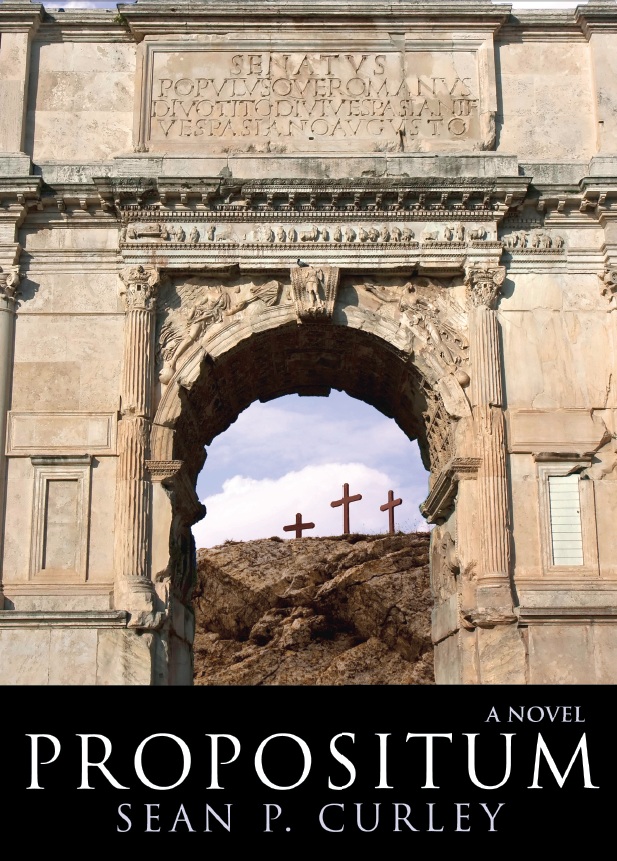
What am I Reading? Propositum by Sean P. Curley

What am I Reading? Propositum by Sean P. Curley


peopositum

Propositum by Sean P. Curley ISBN Paperback: 978-1-60047-762-1; Digital: 9781301786299 was released in 2007. I purchased it in 2013 but did not read it until summer of 2014.

The author describes the book on his web page and Facebook page: “A rich landscape of characters with ambition and guile who conspire to form Christianity. They manipulate the Jewish High Council, the Roman Senate, Caesars, and history to create a new religion. But why did they do it? http://curley.me/propositum

“If Jesus did not exist, then how did Christianity form?

“Inside a rich landscape of the failing Roman Republic and a tumultuous Jewish population is an ambitious and visionary ex-Senator who conspires with Paul of Tarsus to create something… better.
This provocative historical novel melds the birth of Christianity with recent scholarly works and delivers a shocking, but plausible, story of Christianity’s formation and the Christ myth.”

The Christ Myth Theory has been postulated since the late 1700s. Its Wikipedia entry is: http://en.wikipedia.org/wiki/Christ_myth_theory

SOME SPOILERS

Propositum is a dramatization of the Christ Myth Theory. Proculus, a retired Senator living in Judea with his Jewish wife June, is the author of the theory. He believes the RomanRepublic is dying and very quickly turning into an empire. As such, they will be a danger to his beloved Judea – who, as a people, will not accept Rome (or anyone) as their despotic rulers. Eventually an Emperor will not tolerate the Jews being exempt from taxes every seven years; and with emperors proclaiming themselves and their kin gods … well, the whole “Thou shalt have no other gods before me” thing will make life in Judea a little awkward.

Awkward is putting it mildly. Proculus believes the disputes will lead to outright war; a war that will not go well for Judea.

How will he save his wife’s people? His friends? If he can spread Judaism through the empire- inculcate it so thoroughly that it supercedes the other religions – including the emperors’ self-created deities – that a war or conflict would be impossible.

But how can that be done, Proculus thinks. The tenants of Judaism do not easily lend themselves to proselytizing. Dietary restrictions. Clothing restrictions. Laws about what to do and not to do on the Sabbath.

Circumcision.

Yea, that might be a problem … “We have to lop off what now? Umm, thanks, but I’d rather not…”

Proculus sees the problem. Not only will he need to find a way to get permission to convert Gentiles (a big enough hurdle), but to allow the converted Gentiles to eschew some of the more draconian and undesirable rules of Judaism. The more desirable it is, the more converts there will be. The more converts there will be, the less likely a Roman Empire would desire a civil war.

It may not restore the Republic, but it will save Judea from destruction because they wish to follow dogma.

He enlists the aid of his friend Maximus, a retired general. With both their contacts still in Rome, they hope to be able to manipulate and cajole enough politicians and power brokers to allow them to continue to spread their new and improved version of Judaism.

But neither of them would be taken seriously as ministers of this Jewish reboot. They need a more believable figurehead.

Proculus’ friends in Tarus have a son named Saul. Saul spent most of his childhood preparing to study and become a Pharisee. Unfortunately, he flunked out. Fortunately, it instilled in him not a hatred, but a bitterness of all things Pharisaic.

Saul recommends emulating the beliefs of the Essenes. Proculus assigns Saul to find out as much as he can about the sect and report back to him. Saul learns of the Teacher, who espoused what Proculus is planning one hundred years before. Saul jots down the sayings and beliefs of the Essenes and their Teacher in what he calls the Book of Q.

Meanwhile, Emperor Tiberius dies and Proculus and Maximus go to Rome to suss out the two new possible emperors. They decide Caligula would be the less tolerant of the two and help manipulate his way to the throne.

When Caligula becomes emperor, Proculus convinces him that, since he is a god, his likeness should be in every temple. Even Jewish temples. But that is strictly forbidden by the Jews. Caligula doesn’t care. Proculus is pleased. The threat of war with Rome will goad the higher Jewish counsels to approve Proculus’ plans to convert the Gentiles.

Saul finds a perfect personification of their beliefs in John the Baptist and listens to him preach, but he is killed before Saul can actually meet him.

They decide to make the Teacher a more modern figure rather than someone who died in the previous century. They name him Jesus – a common and untraceable name.

Saul takes Proculus’ suggestion to change his name to Paul and his home from Tarus to Tarsus to avoid questions about his true past. He finds others who embrace his beliefs – Silas, Barsabbas, James, Cephas also called Peter, and small, wiry John.

Whole families are brought into the new religion. One baby, Theophorus, was the first generation to learn about the new way from the crib. I had to look him up on Wikipedia to discover who he was.

A new emperor, Claudius, ascends the throne. He will be much more tolerant of the Jews. This will not do. By now Maximus and Proculus are joined by Maximus’ daughter Curia who keeps the leaders apprised of events in Rome. We read as she marries and has two children.

The religion continues to grow. Paul writes epistles to the leaders and the communities that have established temples and churches. Proculus grows older, but more confident that his plan will succeed.


A new emperor, Nero, ascends the throne. He will be much less tolerable of the Jews. Proculus visits him and is worried – perhaps he will go too far.

The Pharisees start to push back. They allowed the conversions of the Gentiles, but not all of the changes to their sacrosanct laws. Paul and his followers are arrested. Some are killed. Paul adds details to the life of Jesus – he was killed by the Pharisees. This turns the crowds against their mockers and in their corner.

More friends and followers are made; some friends and followers die.

Rome attacks Judea. Well, that may eliminate the threat of the Pharisees. Paul is in jail? Well, after he finishes a few more letters … they NEED a good martyr…

END OF SPOILERS


Propositum is a thoroughly researched and very entertaining historical novel. You get the feel of what life was like at the time – how someone from the era lived, what they ate, how they traveled, etc. In most respects the characters are realistic and likable. Yes, Proculus is a likeable fellow despite what he hath wrought. You want to dine with him and his wife. You admire Maximus’ strength and courage. You even root for Paul to succeed after his first faltering attempts at public speaking.

The few action scenes are very well done and usually involve Maximus: his thwarting assassination attempts on the emperors, his leading troops during the sack of Jerusalem (including some wonderfully written spy work).

But the book usually consists of meetings. Paul reports and updates Proculus and Maximus on the goings on in the soon-to-be Holy Land. Curia reports on the goings on in the Senate and the dealings of the Emperor. This leads to one of the flaws of the book.

I’m the last person who should be critiquing a book – but Propositum sometimes suffers from the old writer’s trope “show – don’t tell”. The book has a LOT of “tells”. Paul discusses people he meets – friends and foes – his ideas to move the propositum forward. That sort of thing.

The “shows” are done quite well – Paul’s first attempts at preaching, Maximus going with him on one journey and arranging a few miracles credited to Paul, Peter’s ministry and its results, Proculus’ meetings with Senators and Emperors, the aforesaid sacking of Jerusalem, the burning of Rome and its effect on the cast, Paul’s vision on the road to Damascus (side note – it was fun reading and second-guessing what the author decided “really” happened and who “really” existed – John the Baptist was a great example) . All well done.

If the “tells” were turned into “shows” it would have doubled the length of the book. That would not be a bad thing – I would have loved to have spent more time in this world with these characters. Why not show us Paul in the crowd listening to John the Baptist and his thoughts about him rather than have us sit with Proculus as Paul tells us about hearing John minister?  Do you see the difference?

One great thing about the book is that during it all we still root for Proculus even thought some of his decisions cause some horrific results. He single-handedly caused strife between Rome under Caligula and Judea. He fomented anti-Jewish fervor during the Roman fire in the time of Nero.

There were other, smaller, moments that I truly enjoyed. Paul’s misogyny was present from the beginning, and his growing dislike of Curia was fun to read. Curia’s growth from a reluctant participant to the head of the order was well done.

My favorite moments involve Paul – his first poorly-done ministries, his growth as an apostle, the slow realization that he is a tool being manipulated and his inevitable acceptance that his usefulness is finally over.

One review mildly critiques the book: “Nearly every plan is executed perfectly”. Although we are shown Paul’s tough time with his first attempts at ministering and we see some disastrous results with Paul and Peter against pro-Pharisee groups; that is true. Proculus’ manipulation of the Roman government and particularly the Emperors and wanna-be emperors would make the Illuminati and Bilderburg Group members jealous.

The book spans 40 years. Perhaps this criticism could be avoided by showing us how long this timespan is. Perhaps Proculus is frustrated at times – he realizes he will not live to see his plan in complete fruition, but he can still regret it not going faster. Common history tells us Constantine was the first Christian Roman Emperor, so Proculus’ plan (let’s pretend for a moment Propositum’s story is true) about 250 years to complete. It took Islam only 100 years to take firm root throughout Arabia.

This would add more pages to this lovely book. Add to that the “shows” mentioned earlier and Propositum could clock in at 400 to 500 pages instead of 270. Fine by me. The author may groan, though!

The book should get as much attention as Dan Brown’s DaVinci Code. Even more so. There should be publicity galore for this book and the subject getting the attention it deserves. There is no subject so controversial it should not be discussed. So-called Christians should be damning Sean to hell and in the very next breath saying they will pray for his soul. All while burning the book.

Christians whose faith is strong will not have that faith shaken by reading Propositum, and they will get to read a good “what if” historical novel, get a scholarly feel for what life was like in the middle and near east two millennia ago, and – if they choose to ignore the basic premise of the book – get a realistic idea of what the early church must have been like. Premise or not, Paul and the earliest Christians probably went through exactly what is told (not always shown) by the author: hostile crowds, argumentative authorities and occasionally a convert.

I bought my copy through Apple’s I-Store. It was my first fiction novel e-book. It is available in paperback and hardback directly from the author’s website and Amazon. Buy it, read it, enjoy it, discuss it.

The author promises a sequel this year – with Curia and her by-now grown son at the helm of a new religion. An aging Proculus will undoubted have something to say! I can’t wait to read it!

 Paul

            Here is the opening chapter of the book: http://curley.me/propositum/sample.html#.U7ndiUC4O8A


            Copyright 2014 Michael G Curry

What am I Reading? Flight of the Piasa by Raymond Edge

What Am I Reading? Flight of the Piasa by Raymond Scott Edge


piasa_bird

Dr. Raymond Scott Edge runs a booth near the Knight’s Pub at the St. Louis Renaissance Faire.  The Knight’s Pub is where by brother-in-law’s group 3 Pints Gone performs. While waiting for their set, I checked out Dr. Edge’s booth. One of his more fun items for sale (I presume it is for sale) is a water basin with bronze handles. If you vibrate the handles with your palms, the water “dances” in the bowl. I’ve managed to do it once. It is fun to watch people try it out.

This past summer I noticed something different at his booth. Books. Three books. Dr. Edge wrote them and sold them along with his usual fare. His fare at the Faire, get it?

I was intrigued by the titles of his second and third books concerning the native mounds of Cahokia. I love learning about the Mound People and theories about their lives.

His books concerned a modern archeologist in the present investigating mysteries from the Mound People’s past. We talked for some time – I am also a writer, I said, and I also have a story in the horror vein about a modern man investigating a mystery from the Mount People’s past. His stories are not horror, but more in the “DaVinci Code” genre. Not an action thriller with exploding vehicles and nipples, but more of a modern and historical novel.

I bought all three books. He gave me a synopsis of his fourth. I can’t wait. In the meantime, I’m enjoying his releases.

As I finish a book, I’ll review it here. First up is “Flight of the Piasa” (ISBN 978-0-9794737-0-8; Redoubt Books)

book cover

SOME SPOILERS:

“Flight of the Piasa” weaves together two stories. The first deals with Daniel French, a graduate student in archaeology. We meet him as he tries to hold together his first class under the watchful eye of stern professor Eldredge. Daniel does a fair job but is frustrated by the professor’s criticism. He and his girlfriend Donna spend some time wandering the cliffs near Alton, IL – where Daniel was raised – to take his mind off his educational woes. The see the Piasa – the pre-Columbian Native American dragon painted on the cliff face. He theorizes it may be of Chinese origin – a theory his professor rebuffs. While they explore a cave – they find a skeleton and an ancient coin with Chinese markings on it.

He shows the coin to a Chinese friend and fellow student for his opinion. Coincidentally, another Chinese graduate student gives Daniel a manuscript translated from a 500-year-old text that was itself translated from an even older text.
The text makes up the bulk of the book. It is an epistolary biography of Sun Kai, childhood friend and general (more or less) for Lord Chin – we in the “real world” call him Zheng of Qin or Qin Shi Huang, the first emperor of the Qin (Chin) Dynasty that ruled from 220 – 210 BCE. Sun helps Chin/Zheng/Qin conquer the last province not under his control to unify the country that still bears his (Chin’s)name.
Sun rules a city in a far province and falls in love with Snow Pine – a slave taken as a child from a nomadic people who, we later learn, may be the descendants of an ancient Greek-era people. A very famous ancient Greek-era people. They still use Greek fire; they still sing of Zeus – they are now called the Praxans.
“Meanwhile”, if such a term is appropriate, Daniel’s relationship with Donna fades and he falls for Laura, a fellow archaeology graduate student and expert on these certain ancient Greek-era people. Don’t take that to be snarky – Daniel and Laura’s meeting, and their affection, is canny and realistic.
The Praxans nearly conquer Sun’s troops and his land, but Sun finds the encampment of the Praxan women and children in a fun and well-written bit of espionage.
Sun is later commanded by the emperor to sail the seas to find the home of the Praxan gods – who will bestow upon the now-mad emperor the secret of immortality. Sun agrees, if only so he can escape his and Snow Pine’s certain death at the hands of Zheng and his Legalist toadies.
They sail to India and Africa and eventually end up in the Americas, where the explorers are killed – Sun being the only survivor, or so he believes. While he recuperates in a cave he writes the manuscript that we and Daniel now read.
Sun’s search for Snow Pine’s killers takes him along the coast and upstream of a great river. Eventually he finds a large village and discovers that Snow Pine may be alive. He waits in a cave above the river-side village to find his love.
When he is nearly discovered he creates the ruse of a demonic bird to scare away the curious. He even paints a huge portrait of the winged creature on the cliff face…
The rest will reveal the ending. Daniel and Laura take this manuscript to their professor for his thoughts. He is skeptical.
The book does not seem to end on a cliff-hanger, but the preview of his next book reveals that the stories of the characters from both eras will continue.

END OF SPOILERS

What a fun book, well-researched and a quick cliff-hanging read. We care about Sun more so than Daniel, I think. I also think that is intentional – Daniel is our host in introducing Sun and Snow Pine’s world; a world excellently realized. The author wrote two more – continuing both stories. I look forward to them both.

The book is available at Amazon. Get it, share it, buy more copies, gift them.

MICHAEL G CURRY


The Years of Robert Caro – A review of his Lyndon Johnson biographies Part Three

The Years of Robert Caro – A review of his Lyndon Johnson biographies
Part Three
 
           The Passage of Power is Robert Caro’s fourth book in his Years of Lyndon Johnson series (Alfred A.Knopf, 2012; ISBN # 978-0-679-40507-8). This volume covers the 1960 presidential campaign to the passage of the Civil Rights Act of 1964.
            By now Caro’s style is firmly enmeshed:
            The book opens with a tease of things to come. In previous volumes it was the beginnings of his quest for financial stability or his speech on civil rights legislation. Here we are on Air Force One in the late afternoon on November 22, 1963 after …
            The next 20 (or so) pages of its 805 pages (not counting index, bibliographies and end notes) repeats the relevant facts from the previous three books – LBJ’s desire to be president since his hard-scrabble teens, his election to the House and the Senate and his rise to power to become the most powerful man in Washington second only to President Eisenhower.
            These recaps are necessary for new readers. It is possible to read one of the four books without the others. If one is only interested in LBJ’s time in the Senate, you can skip the first two volumes. Caro recaps enough information and provides enough back-story to avoid confusing the readers with Johnson’s motives. Reading the books together can make that redundant. But for a reader like me, who would put each of the books down for several weeks (or months) before resuming, the recaps are helpful.
            I must admit Caro cheats a bit in Passage of Power. He hypes his previous work in footnotes (“for an example of how Johnson could ruin another politician’s career, see Master of the Senate, pages x-xx”). Having read through the previous Years… series I remember the reference. Someone picking up Passage as the first book of the series may be frustrated. I advise the new reader go to the library and read the selected passage. If he or she is intrigued enough – check out the book and then buy your own copy!
***
            After the “In our last episode” reminders the biography describes Johnson’s desire to run for president in 1960. Most of the candidates were other senators – senators who were beneath him during the past decade. He wielded more power, and could call in more favors, than they. The power brokers planned how he would get the votes – mostly from the south, the west and the big city bosses. There were only 16 primaries at that time and some of them – such as conservative Indiana and states promised to him (Robert Byrd’s West Virginia, for example) – he likely would have won the nomination.
            (I enjoyed reading this section and noting how alien the nomination process was compared to “modern times”.)
            Caro ignores speculation how he would have done against a Republican nominee. How would he have faired against Nixon?
            But Johnson delayed and delayed running for the Democratic nomination until it was time for the convention. Why?
            Caro is as confused as Johnson’s aids. Was Johnson so scared of losing – as he did in 1956 – that he did nothing? That doesn’t sound like the opportunistic LBJ we’ve come to know in the past three books.
            In the end, LBJ hoped for a deadlocked convention and for the “smoke-filled room” to give the nomination to him as a dark horse candidate. That way he could avoid the campaign trail against the charm of Kennedy and the oratorical skill of Hubert Humphries – both traits he distinctly lacked. 
***
            After the intro and recap, we watch the race for the 1960 Democratic presidential nomination.
            But first, as with the prior volumes, we read a short but thorough biography of people important to this volume’s narrative. Previously we read about Sam Rayburn, Richard Russell, the Hill Country of Texas, LBJ’s father and Lady Bird. Here Caro gives us bios of John F. Kennedy. Not a complete bio – books on Kennedys could fill the libraries of an entire state – but on JFK’s political career and his history of poor health. Caro says if Johnson had known of Kennedy’s health struggles and determination to rise above his constant chronic pain, Johnson would have taken the scrawny playboy more seriously as a competing candidate for the presidential nomination.
            Caro also gives us a brief bio of Robert Kennedy. His and LBJ’s hatred of each other permeate the book as it permeated LBJ’s life and career throughout the 1960s. Ironically before Passagecame out I read Jeff Shesol’s Mutual Contempt (1998, Norton paperback, ISBN # 0-393-04078) – the only book I could find that dealt exclusively with the Johnson-Kennedy feud. I disagree to Shesol’s critics that it is Kennedy-leaning. I find it even-handed. It enjoyed reading another view of the feud along with Caro’s in Passage – Robert Kennedy and LBJ’s convention fight, their interaction during JFK’s presidency, the assassination, the first year of LBJ’s presidency, etc.  I recommend it, not as a companion to Passage of Power but on its own merits.
            The LBJ-RFK feud hit critical mass at the convention – neither man forgave the other after their actions during the primaries and the convention. Robert Kennedy’s threats warning Johnson not to accept the vice-presidential nomination was wonderfully portrayed in both books.
***
            Caro reminds us of LBJ’s knack for taking a small, ineffectual position or office and turning it into a seat of power. He did it in college with fraternal organizations and with a small student body job. He did it as a congressional aide in the “Little Congress”. He did it with the Minority Whip, Minority Leader and Majority Leader positions in the Senate.  LBJ tried to do the same with the Vice-Presidency, but this time without success.
            Passage shows us Johnson going through the few duties, assignments and positions given as vice-president; but focuses mainly on LBJ’s dislike of the job. He went from being the second most powerful man in Washington to the least (to paraphrase the author) in a town where power means everything.
***
            Little was said of Lady Bird. Perhaps this was an unintentional allegory: this volume had as much to do with Lady Bird as LBJ had. One passage was telling – when the secret service met with her at the White House to discuss the needs of the First Family in the private quarters, Lady Bird said Lyndon’s needs come first (in this case it was about the size of their bed), then the children, then hers. Other than quotes from Lady Bird about Jackie Kennedy and other events, she was no more present in this biography than, say, Bobby Baker.
***
            I looked forward to Caro’s take on the assassination. There has been more written about the events of November 22, 1963 than any other – perhaps with the exception of Lincoln’s assassination – from the technically detailed to the laughingly paranoiac to politically-motivated hack jobs. I wasn’t disappointed here.
            We are shown LBJ’s and JFK’s Texas trip – speeches given, banquets attended and people met. We learn about the feud between Texas’ governor and one of its senators; who wanted to ride with LBJ; who refused to ride with LBJ.
            We are with LBJ in the motorcade.
            We are standing with LBJ in the hospital as he grimly awaits the news.
            We walk with him through the bowels of the hospital to his limousine and to Air Force One.
            More importantly, we see LBJ’s transformation from the sulky moping vice-president to the firm, decisive President of the United States.
            Bravo to Caro for his portrayal of this magnificent transformation.
            Caro doesn’t come right out and say it, but it is obvious Johnson had planned this moment from the minute he agreed to be the vice presidential candidate.
            Neither I nor Caro are implying Johnson had a hand in the assassination – the author strongly states that in all his research he found NOTHING to imply LBJ’s knowledge or involvement. The only acknowledgement the author gives to any conspiracy is to name Jim Garrison, author of On the Trail of the Assassins, a publicity hunter.  I must admit to being a fan of assassination conspiracy theories and Caro’s opinion on it was short and brief – LBJ was not involved. The author stopped his inquiry there. Any other opinion would be his alone and is not a part of this book. Good for him, I say. Caro does state that both Robert Kennedy and Johnson believed the assassination was a conspiracy and the Warren Commission Report was wrong, but went no further than that; because Johnson went no further than that.
            Back to the point – it is obvious Johnson knew what he would do the moment he became president should it happen. Perhaps JFK would die from his various illnesses or drown or be in a plane or automobile accident. An assassin’s bullet was likely the last scenario on LBJ’s list. But it happened. Johnson was president. What would he do first?
            He met with the country’s leaders; he begged, cajoled and pleaded with Kennedy’s staff and cabinet to stay on. He had to pass a budget and decide whether to run in his own presidential election less than one year away (not counting the convention only ten-or-so months away).
            He had to keep the Kennedy people – even Robert – as allies and in his White House. He did not want to ostracize or anger them lest they form their own kingdom in exile. Robert Kennedy had already made noises about running on his own after his brother’s presidency ended. LBJ’s spoke his famous phrase “my worst fear was Robert Kennedy running for president against me” from Day One. Johnson did NOT want to be known as “the mistake between the Kennedys”.
            And he kept the staff and cabinet. Well, the essentials: Salinger, MacNamara, Sorenson, even Robert Kennedy. By the time they did leave Johnson had shown enough muscle in the office to make it his own. The rest of Passage shows how he did it.
            He broke the logjam in the Senate – first with a small bill involving sending wheat to Russia, then his tax bill, then, finally, the Civil Rights Act of 1964.
            LBJ made sure to have the other bills passed before the Southern Caucus could filibuster Civil Rights – thus the Caucus’ extortion or holding hostage of the tax and budget bills until the civil rights legislation was withdrawn. LBJ called it getting all the kids into the basement before the storm hits.
            He did it through a series cajoling and influence-peddling that is alien to us now. “NASA is looking for a place to build”, “You want that water works, don’t ya?”
            He reminded the Republicans they were the party of Lincoln – that gave great weight during the Civil Rights Act debate. One of the Act’s most ardent opponents was the Republican from Illinois Everett Dirksen. A Republican. From Illinois. Dirksen didn’t stand a chance.
            At this point Passage of Powerbecomes glorious reading. The author himself beams with pride and admiration at Johnson’s accomplishments.
            The book leaves us with an LBJ nearing the peak of his power and influence. The election of 1964 will validate that. At the end of the book Johnson has a 77% approval rating. He was at the very top.
            … and when you are at the top there is only one place left to go.
           
***
            Passage of Power finally solves the mystery brewing over the previous million words. Well, a mystery at least to me: why was such a cruel, Machiavellian autocrat so concerned about civil rights, about educating and feeding the poor and providing them health care?
            Caro points to a few phrases: LBJ’s aids at the beginning of his presidency advised how difficult passing a Civil Rights Act would be. Should he waste his time on it? “What is the Presidency for?” he said. In another (and to me, more telling) he said he wanted to help the blacks of Mississippi and the Mexicans in California and the Johnsons of Johnson City.
            Johnsons of Johnson City? He was comparing his perceived shame in growing up destitute thanks to a “failure” of a father with the plight of the oppressed lower classes in America.  He saw the lower class’ humiliation and lack of respect and dignity mirrored in his own. Robert Caro makes us believe LBJ wanted sincerely to help – a sincerity that this reader did not believe existed in the prior volume.
            But LBJ was president now. Before, he cajoled his way to the top. He did EVERYTHING to reach his goal; and now that it was reached, he could afford to be munificent as well as magnificent.
            Some criticize Caro’s earlier books saying that Johnson was portrayed as a villain. That is because he was, in fact, a villain. With rare exception LBJ was unlikeable. If you could benefit him in some way (financially or politically), he could be your best friend. If you were a detriment, you were removed. If you were neither, you were ignored.
            But Caro transforms Johnson into a magnanimous champion of civil rights in a matter of a dozen pages. He compares LBJ to Lincoln. No president, Caro says, none of the 17 men between Lincoln and Johnson did as much for civil rights as Johnson. He was the 20th-century Lincoln, Caro concludes.
            Shocking hyperbole, but after reading Caro’s defense of the statement, I am inclined to agree. LBJ finally becomes the man he claimed to be in his campaign speeches. The author raises LBJ up to almost Kennedy-esque idealism. I happily joined the ride.
            Caro mentioned that the cruelty would return during his full term as president – the belittling of staff, the crushing of opponents and the ignoring of anyone else. He foreshadows Viet Nam withering the advancements made in civil and social rights; almost as if he were preparing us in case Volume Five is not finished.
            This book ends at Johnson’s height of power and popularity. It would make a good place to end the series if required. Fortunately, Caro promises a fifth volume.
***
            Robert Caro’s first book in The Years of Lyndon Johnson was released in 1982, the second in 1990, the third in 2002 and the fourth in 2012. Despite this once-every-decade schedule, he says he will publish the fifth and final volume in two or three years.
            I hope so. I’m looking forward to it. I also hope it will be in three years and not in the 2020s.
            Caro turns 79 this October: that he will be around to publish the fifth book after a decade-long wait is … well … unlikely.
            Can he finish the fifth book in one-third of the time it took him to finish the others?  To answer yes is not necessarily being optimistic.
            Most of the people he interviewed for the series are gone now – Connally, McNamara, Sallinger, Lady Bird – and he plumbed as much as he could from them. Bill Moyers still refuses to be interviewed, but Caro does a splendid job without Moyers’ input. Imagine the flavor of the book with Moyer’s viewpoint.
            Surely Robert Caro is smart enough to have asked McNamara, for example, all he wanted to know about Viet Nam and Johnson’s involvement before McNamara’s death in 2009.
            Additionally, of Johnson’s entire career, the topics fifth and final book has already been covered extensively by others. He can justifiably rely on secondary sources. I doubt there will be any surprises or bombshells.
            What there will be is the story of Johnson’s full term as President of the United States; the Great Society and Viet Nam told in Caro’s style. That is something to look forward to.
            But a personal plea, Mr. Caro – make copious notes of how you want this book to be. Have your estate ready to pick the person to complete the book if your health demands you cannot finish it. Find someone who can emulate your style – make sure it reflects your voice.
            With the fifth book we will say goodbye to Lyndon Baines Johnson; but also goodbye to you as his biographer. Thank you for 32 years of an excellent series. Thank you for helping us know our 27th President.
Original material copyright 2014 Michael G Curry


(adsbygoogle = window.adsbygoogle || []).push({});

The Years of Robert Caro – A review of his Lyndon Johnson biographies Part Two

The Years of Robert Caro – A review of his Lyndon Johnson biographies
Part Two
 
            Volume Two of Robert Caro’s The Years of Lyndon Johnson: The Means of Ascent(Albert A. Knopf, 1990; ISBN # 0-394-49973-5) was the first book of the biography series that I purchased. It was in the bargain bin of the Wal-Mart in Murphysboro, Illinoisduring the spring of 1992. I took it with me to read in the lobby of one of the law firms with which I interviewed (and got the job). It was snowing heavily and I dropped the book in my driveway when I got home. The dust-jacket was off (I always take off the dust jacket) and the black cover bled onto my hands and shirt. Good thing it happened after the interview.
            It is the shortest of the four volumes published to date – 412 pages not counting index, bibliographies and annotations – just over half the page-count of the previous volume (and the fourth) and 2/5th the length of Master of the Senate.
            That is because it covers the nadir of LBJ’s political career. It begins just after his defeat at the hands of Governor Pappy O’Daniel for Texas’ open US Senate seat and concludes with his successful second Senate run – from 1941 to 1948.
            The introduction is a masterful retelling of LBJ’s call to arms for civil rights as president in the 1960s.  The author tells us he intends to take us back to show the means that led to this noble end; means which were far from noble. We see a Lyndon Johnson beginning to amass his fortune, his ruthless style of running his Congressional office, and his do-or-die attitude in his second bid for the Senate. This is not the Lyndon Johnson of the introduction; this is a vicious opportunist at the start of his climb to power.
            What changed? Future volumes will show. In the meantime we the readers can watch his climb – and watch as he uses everyone he meets as an expendable rung.
            He had his plan to power: the House of Representatives to the Senate to the Presidency. He made no bones about the desire to become a Senator, but more-or-less kept his presidential ambitions secret. Occasionally the plan would slip out. The book mentions LBJ looking upon the House gallery muttering, “too slow, too slow…” Because of the unbreakable tradition of seniority of House committee chairmanships, he would be an old man before he achieved anything close to power in the House. And Congressmen rarely made it directly to the White House. He needed, NEEDED, to go to the Senate.            
            Challenging incumbents were futile; he had to wait for an opening as was the case in 1941 (and as was the case for his House seat in 1937). So what to do in the meantime?
            Amass his fortune.
            The introduction of Path to Power revealed the beginnings of his association with Brown & Root, a Texascorporation that helped finance his elections and begin his financial career in exchange for votes favoring their schemes. They were involved in construction, engineering and military contracts. LBJ’s influence in the House helped them get their contracts, and in exchange … well, LBJ didn’t get a kickback, but did get to ride their coattails in B&R’s financial ventures. Eventually Johnson bought a radio station where his new friends would advertise. In later volumes, we discovered that if anyone – anyone – wanted a political favor from the Congressman-then-Senator would require they buy advertising on his now-network of Texas stations. Even if the business was an insurance firm in North Carolina– they advertised in Texas in exchange for favorable passage of their pet projects.
            During WWII he finagles a commission in the Navy and, during a House junket, sees genuine combat, from which he was awarded the Silver Star.
            The other two-thirds of the book show the details of his 1948 Senate run.
            The author gives us a biography of his opponent – then-Governor Coke Stevenson. His last Senate run was against a sitting governor as well, showing the reader the importance of the seat.
            Coke Stevenson, Mr. Texas, is given all the respect that was his due (supposedly, he was a raging bigot). Caro also shows Johnson slowly, ever so slowly, chipping away at his huge lead.
            LBJ campaign used modern technology – using a helicopter to enter towns and villages in the most dramatic fashion, and using telephone solicitations and polls.
            And he cheats.
            Oh how he cheats.
            His moniker “Landslide Lyndon” came from this campaign and election. Caro vividly explains how politics work in the most southern counties in Texas. We learn about Alice, Texasand Jim Hogg County as well as short bios of “The Duke of Duval County”, his ilk and their fiefdoms. Caro shows how they work, and decide, elections.
            Johnson lost his last run for Senate by reporting their returns first. His opponent then reported their returns – not coincidentally reporting more votes for their candidate.
            He would not make that mistake in this election. He won by 47 votes. Some people voted in their precincts in alphabetical order.
            Caro discusses Stevenson’s challenge and his dislike of LBJ for the rest of his life (he supported Goldwater in 1964). But in the meantime Stevenson found the love of his life and retired from public life as a rancher. It was, after all, a happy ending for Mr.Texas.
            And a happy ending for LBJ. He was a Senator now, on the second rung of his ultimate plan for power. He was happy and rich. The scorched bodies he left behind are irrelevant.
            Aren’t they?
            Master of the Senate (2002, USBN # 0-394-52836-0) picks up immediately after the second volume. First, though, Caro gives us a superb history of the US Senate and its role in UShistory through its legislation as well as its lack of legislation. Caro shows us a history of the radical House as well as the Executive Branch proposing bill after bill reflecting the changing attitudes of the country. Civil rights, labor reform, environmentalism, care for the poor and aged. Wave after wave of legislation smashing against the unmovable dam of the US Senate – the keeper of the status quo – all to no affect.
            You shall not pass.
            Attaining power in the Senate would take almost as long as in the House, despite there being only 95 men to leap-frog on the way to power. Johnson would have to suck up to the committee chairmen; some of which had been chairmen for decades (during the times while the Democrats held the majority). Fortunately Johnson had a leg up here – most of the chairmanships belonged to the longest-serving senators. And all of them were from the south. They belonged in what was called the Southern Caucus – fiscally and culturally conservative Democrats. Put another way – the only black they like is the color of ink on a ledger; as opposed to the color of one’s skin.
            In Means of Ascent, Caro provided a thorough biography of Sam Rayburn – the Speaker of the House. Here are meet Richard Russell – the “head” of the Southern Caucus. Russell did not have a title equal to Rayburn, but he had equal power. Johnson sucked up to Russell in the same way he had Rayburn. LBJ became his sycophant; and then his second-in-command. Russell was priming Johnson to become the leader of the Southern Caucus. This was as high a position as a senator from the south can become.
            Right?
            So other than an informal position with nose firmly implanted in Richard Russell’s bottom, how can LBJ gain power not just over the Southern Caucus, but the rest of the Senate? How will that help him with his ultimate goal? Caro marks the parallels with Johnson’s first days in the Senate with his days in the House and before that as a Congressional aide. He takes a little-used office – Minority Whip – and transforms it into a title that brings him power; just as he did in college and in the “Little Congress”.
            He took command of the disbursement of funds for election campaigns. Those he instinctually knew would lose their seat either in a primary or general election got little money. Those who would win got more. Those who begged – those who kissed ass – got even more. He wielded his power with the strict purpose of gathering more power.
            He transformed the post of Minority Leader and, soon, Majority Leader. He brought the Senate to a level of power not seen since before FDR’s presidency. And with the rise in the power of the Senate, came a rise in his power and influence.  No bill passed that he did not want passed; no bill failed that he wanted to fail.
***
            Before becoming the second most powerful man in Washington, though, we learn about Johnson’s rise in the Senate. He firmly planted himself with the Southern Caucus with his “We of the South” speech. Before the senate and the nation he explained the unwritten mandate of the Caucus and showed that he firmly stood with them.
            And yet in the presence of northern liberals he stated he was in favor of their policies, too. All things to all people; keeping all options open; keeping your political aspirations multiple choice.  
            He enmeshed himself with his Texas oil benefactors by destroying the career of Leland Olds – painting him as a communist with a McCarthy-like precision. Caro spends more time than was probably necessary focusing on LBJ’s hatchet job. I became bored with it after a while.
            Speaking of McCarthy, Caro shows us an LBJ conspicuously silent during Tailgunner Joe’s red-baiting rampage. Johnson said he would wait to allow the Wisconsin Senator to self-implode. This would keep Johnson from taking sides. History proved LBJ right, fortunately for him.
***
            We focus next on LBJ’s 1955 near-fatal heart attack and recovery. Johnson lies to the press about relaxing at the Ranch and finally sitting back and reading books. He still controlled the Senate from his swimming pool.
***
            Johnson tried late in the campaign to run for president in 1956. He was soundly trounced.  But this paved the way for a possible run in 1960. He learned in 1956 that he must prevail over his magnolia taint. How can he as a southerner overcome (no pun intended) his segregationist associations? Did his “We of the South” speech doom his presidential aspirations?
            By passing a civil rights bill for the first time in 80 years.
            When it was time to finally address civil rights and pass the Civil Rights Act of 1957, Caro shows us how LBJ did it against all odds.
            So why, after thousands of pages of ruthless exploitation of some and the crushing of others for his own advancement (and seeming amusement), did LBJ support a civil rights bill?
            As mentioned in the prior blog, Robert Caro is the wonderful writer.  He has a novelist’s skill in inserting drama, cliffhangers and foreshadowing/foreboding in his work.  In addition his books are thoroughly researched and he uses direct quotes as much as possible.
            That being said, Master of the Senate is my least favorite book of this series. Here LBJ is still a ruthless opportunist. He’s still a sycophant, too; but that fades when he becomes Majority Leader. He is the Master now. He still needs the support of Russell and the Southern Caucus – the men that made him Leader. Although he is not as harsh to them as he is to the “northern liberals” – demanding they kowtow to him and treat him deferentially almost to the point of ludicrousness – he no longer completely demurs to them.
            Caro so succinctly shows us LBJ’s use of power offensively that when Masterfocuses on the passage of the first real Civil Rights bill since Reconstruction, I find LBJ’s support of the bill unconvincing and artificial.
            LBJ seemed so villainous and Machiavellian that his concern for passage of the bill rang false. What was his motive? Altruism? Surely not, how will the passage of the bill line his pocket or aid his career in any way?
            We discover it was a way to break out of his “We of the South” mold. How can he have a chance to become president by being associated with the Southern Caucus? Richard Russell’s run for the Democratic nomination in 1952 proved the futility of such hopes.
            LBJ hoped to show that although he may be southern; he was no Southerner. However, Caro’s skill at portraying Johnson made this reader not believe a word of it! If the phrase was around at the time, any speech or quote by LBJ in support of civil rights would have been met with a “Yeah, Right…” by this reader.  The “northern liberals” at the time agreed with me. Caro would change my mind in the fourth book.
            Regardless of his reason why LBJ supported the civil rights bill; we see how masterfully LBJ got the votes to pass it – by co-opting western conservatives into the fight by promising dams, water projects and other programs and by gutting parts of the bill that were found “offensive” by the Southern Caucus. The right to trial by jury was cut – effectively making it unenforceable by federal prosecutors trying to make their case in front of white southern judges.
            So now LBJ can claim to be a champion for civil rights while still being “of the South” – paving a path to a presidential run in 1960. He kept all his options open.
            To repeat: throughout Master, Caro showed LBJ’s ruthless, unquenchable desire for power as well as his ability destroy the lives of anyone in his way with such efficiency that it is hard to believe this is the same Johnson involved in Civil Rights during his presidency. I truly disliked LBJ at the end of this volume. Why did such a self-centered power-grubber later become the champion of civil rights? How is that possible?
            Caro will explain that in his next volume …
            The book more or less ends at the passage of the Civil Rights Act of 1957. The next three years are covered by a small chapter and sets the stage for the 1960 presidential campaign. There is also a small addendum of LBJ trying to transform his position as President of the Senate into something more powerful – as he had done with “useless” offices throughout his career. He fails. Senators no longer fawned over him as he entered the cloak room. They have no need to fear him now. 
            More power was yet to come thanks to scheming back-room negotiations during a party convention and, three years later, an assassin’s bullet.
           
Original material copyright 2014 Michael G Curry


(adsbygoogle = window.adsbygoogle || []).push({});

Years of Robert Caro – A review of his Lyndon Johnson biographies Part One

Years of Robert Caro – A review of his Lyndon Johnson biographies
Part One
            Lyndon Baines Johnson won the 1964 presidential election of the United States on November 3, 1964; two days before my birth.  Both events mark their 50thanniversary in 2014.
            Last night, March 22, 2014, I finished Robert Caro’s fourth volume of his masterful biography of the man who was president on the day I was born. The book, The Years of Lyndon Johnson: The Passage of Power (2012, Alfred A Knopf – all the books are by Alfred A. Knopf; the hardback volumes that I own at any rate), ISBN # 978-0-679-40507-8 covers his time as Vice-President until the passage of he Civil Rights Act of 1964 in July of that year. The book touches on later events, but more as a precursor of the fifth (and presumably final) book of the series.
            As with the prior volume, just before The Passage of Power (as with all his LBJ books, they are titles The Years of Lyndon Johnson: …; I will refer to the four books by their secondary title to avoid writer’s cramp), I read the previous books to get back into the subject and the writer’s style. I doubt I will do that with the fifth volume. Mr. Caro is already at, by my poor estimation, over 1.1 millions words. I may not live long enough to read through them again, particularly considering the Trollope-an lengths of most of the series.
            The first book was released in 1982 and the author’s style has not changed in the past 32 years. Robert Caro writes as a novelist – dramatic retelling of events and people that figure most prominently in LBJ’s life and surroundings. He quotes directly as often as possible. Although this “leads to … some” creative “sentence (structure) throughout … the book(s)” it does not distract. His chapters and sections sometimes end on the type of cliffhangers or ominous forebodings that would make Dan Brown jealous. That may annoy some people; I find it nail-biting fun! I am sucked into the drama Caro produces.
            An internet search shows Mr. Caro has written only one book other than his Years of Lyndon Johnson series – The Power Broker: Robert Moses and the Fall of New York – so I do not know if the author’s talent for drama (sometimes melodrama) is a talent of his own or based on his subject. Regardless, the style fits in perfectly with his subject. There are not many politicians and no presidents known more for their melodramatics than the 36thPresident. At least, according to this series.
            John Connally, LBJ’s key aide in the Senate, Governor of Texas (he was in the front seat of Kennedy’s limousine on that day in Dallas– he died with shrapnel from the assassin’s bullet still in his wrist, supposedly) and was in the field of Republican nominees for president in 1980, said LBJ …
… was generous and he was selfish, he was kind and at other times he was cruel; at times he was an earthy, crude, active fellow; at other times he was incredibly charming. He could be whatever he wanted to be.  He was a strange complex man who had basically almost a Jekyll-and-Hyde existence.  He was two different people.
(from the PBS program “The American Experience:  LBJ by David Grubin, 1991)
George Reedy, LBJ’s aide and press secretary, said;
What was it that would send him into those fantastic rages where he could be one of the nastiest, one of the most insufferable, sadistic, SOBs that ever lived; then a few minutes later really be a big, magnificent, inspiring leader? 
(ibid)
            Robert Caro’s one million words show us the answer by giving us glimpses of his family, the land that family came from, his triumphs and tragedies, and his public and private face.
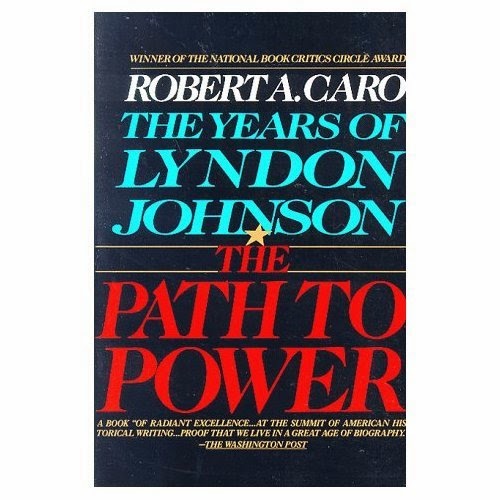
            1982’s The Path to Power (USBN # 0-394-49973-5) is, to me, the most interesting of the volumes to date; if only because it covers the part of LBJ’s life of which I know the least: his upbringing and childhood.
            The book sets the tone for the rest of the series. It contains mini-biographies of the people and places that were vital to his life at the time; or in this case, to the development of his personality.
            The book begins with the “settlement” of the Hill County of Texas and the hard-scrabble life of anyone foolish enough to believe one could prosper there. The book looks at LBJ’s Bunton ancestry – the “Bunton strain” – the fierce eyes, the temper, the ambition, the shrewdness and toughness. But when Johnson blood was mixed with the Buntons, with the Johnson’s unrealistic idealism and dreams of success without the Bunton pragmatism, the family’s life slid into poverty and humiliation.
            In the fourth volume the author surmises this is the base for LBJ’s attitude on fighting war and poverty. He knew what it was like to have no money at hand; to have no credit with the local stores. In current terms he knew the sound of the collection agencies rap at the door and ring on the phone. He knew the neighbor’s disdain of those lazy, no-account, good-for-nothings, despite his father’s success in the Texaslegislature. His father was, by this account, a great man; a progressive visionary. But in the Hill Country, visions don’t feed the family. He had nothing to show for his success at the end of his political career. He was trapped and tricked into get-rich-quick schemes that always failed. He failed. LBJ never forgot – probably never forgave – that. Caro examines the father’s rise and fall politically, socially and economically.
            He also examines LBJ’s mother. By today’s standards she would be prissy and likely would have wanted to belong in the same circles as other presidential mothers Mittie Roosevelt and her distant cousin-in-law Sara Roosevelt. Her devotion to her eldest son is thoroughly verified.
            Thus, LBJ had to work on road crews – back-breaking work paving roads and leading mule teams in sweltering heat. He had to attend a small teacher’s college instead of the more prestigious universities in Austin. He taught the poorest of the poor children in the southern tip of Mexico– the vast majority Mexican children living in the kind of squalor he recognized. He helped them, and their parents, as best he could – such as teaching them English.
            But we also see the Bunton Strain reestablish itself in the family line. If he wasn’t loved by his college classmates, he was determined to make himself respected. In a trait repeated through his life, he ingratiated himself to the powers-that-be in the school. He took a useless elected position in school government and transformed it into a position of great power and influence. Barred from the influential clique of the college? He formed his own and quickly out-cliqued the clique.
            He considered becoming a lawyer and worked in a law firm. He did not like the slow pace to power and respect a career in the law parceled out.
            He was right about that. Trust me.
            He also took a mostly ceremonial group (the “Little Congress”) and transformed into a mover and shaker in Washington – with himself as its head.
            The index says it best: Under Johnson, Character the headings include “need for affection”, “need for attention/prominence”, “need for respect, need to win”, “pragmatism/practicality/realism”, “secrecy”, “self-criticism”, “sensitivity to criticism”, “story-telling ability”, “thoroughness” and “viciousness”.
            The Bunton Strain is strong in this one …
            We see LBJ enter politics as a congressional aide for a man in the next district. We see his election as a member of the House of Representatives for his own district (he had never ran against an incumbent – political suicide in those days (and usually these days, too), bringing electricity to the Hill Country. Along the way we view, for the first time, his absolute tyranny and cruelty to his underlings: the legend of his spouting orders while sitting on the toilet begins here. He would walk past an aid and bark, “I hope your mind isn’t as cluttered as the top of your desk.” When the aide caught up on his work the insult would change to “I hope your mind isn’t as empty as the top of your desk.”
            His mantra of “if you do everything, EVERYTHING, you will win” was proven.
            Until he tried to run for Senate.
            He ran against Pappy O’Daniel, a popular radio personality and current governor, and was taught a lesson of Texaspolitics. His people called in the votes too early – early enough for O’Daniel to call in HIS numbers – just high enough to overcome Johnson’s. It was a bitter defeat – one he vowed never to repeat. EVERYTHING also included out-cheating your opponent.
            The book ends with that defeat, but along the way we are provided biographies of O’Daniel, LBJ’s Texas and Washington benefactors – including Sam Rayburn and various Texas oilmen and, of course, Claudia Alta Taylor – Lady Bird.
            Caro sets the stage for the events of the rest of LBJ’s life – his gruffness and sincerity mentioned by Reedy and Connally above. Most of the history he researches has dimmed with time and LBJ’s own desire to mythologize his past. Caro chips and brushes the small fossils to reveal the truth –a little boy humiliated by his poverty and his father’s (perceived) failures determined – by any means – to do better than him. To show the people of the Hill Country that he will NOT be a failure just like his father. In the meantime, if he can help others in similar situations (in a later campaign speech he referred to the meek, the weak, the poor and the suffering) to “lift them up” and give them a chance to better themselves.
            As long as that “chance” did not conflict with his personal ambitions for wealth and power. For now they did. For the first twenty years of his political career it did. That was to come later. For now, he was still on the path to power.
Original material copyright 2014 Michael G Curry
 

(adsbygoogle = window.adsbygoogle || []).push({});

Three Scrooges, Part 12 (the last): Leftovers, a potpourri of Carol adaptations and one final thought…

Three Scrooges, Part 12 (the last): Leftovers, a potpourri of Carol adaptations and one final thought…
                I was lucky to have caught “Carol for Another Christmas” when it aired on TCM. It had only aired once before on ABC in late December of 1964. It was a politically-charged version of Carol starring Sterling Hayden as Scrooge (he played the police chief Michael Corleone shot in “Godfather”).  He played the Scrooge-ish Daniel Grudge – a multi-millionaire whose son was killed on Christmas Eve during WWII.  He was against all foreign entanglements (paraphrase: every twenty years or so we send our boys ten thousand miles across the planet to help solve other people’s problems”) as well as any aid to the poor and oppressed (“tell the poor and oppressed that the hand-out box is closed for good and you’ll see less poor and oppressed” – paraphrasing again). His son, named Marley, appears but does not speak.
                Grudge is visited by the Ghosts of Christmas Past (played amazingly well by Steve Lawrence), Present (Pat Hingle – I remember him as Commissioner Gordon in the 80s and 90s Batman movies) and Yet to Come (played by Robert Shaw, who as usual steals every scene he is in).
                Directed by Joseph Mankiewicz, it was his only television work, and written with Rod Serling’s usual heavy hand; the movie is a 90-minute lecture against isolationism. In a post-apocalyptic future, Grudge’s Butler Charles was put on trial for “treasonous Involvement” by Imperial Me (played with sinister glee by Peter Sellers).
                Probably the rarest “Christmas Carol” adaptation of all! And no wonder – it was hard to sit through even with the objective eye of looking at rare television. In today’s politically charged air it is almost unwatchable.
 
***
 
                “Bah, Humbug! The Story of Charles Dickens’ A Christmas Carol” from 1994, This was a dramatic reading based on Dickens’ own scripts ala Patrick Stewart’s one-man shows. This was performed at the Pierpont Morgan Library in New York. Ironically named after JP Morgan – the very embodiment of Scrooge later in the century.
                Robert MacNeil introduced the reading. James Earl Jones performed all of Scrooge’s lines and Sheen all others. Very commendable job by both actors – I think both would make great Scrooges in their own productions. I chanced upon this on PBS one afternoon and had not seen it since.
***
                Laurence Olivier’s reading of “A Christmas Carol” aired on the radio in the early 1950s. It is not a reading – the consummate actor plays every part except the ladies (Mrs. Cratchet) and Tiny Tim. Echo chambers are used for the ghosts.
                Scrooge is played straight, but the ghosts, particularly the Ghost of Christmas Past, bring out the old ham in Lord Olivier…
                It lasts 30 minutes and races through the story. Nothing is added and much omitted (youthful Scrooge, Belle, Fred’s party, etc.), but it’s Laurence Olivier! A good, quick listen.  Available on CD, I found it on YouTube.
 
***
 
                Thought of the blog: So whatever happened to Tiny Tim. I have a theory; stay with me here.
                Despite his salvation, Scrooge likely had about ten years left to live. During that time, his financial support nursed Tim to health. Tim’s gentle nature and history led him to wish to work with children or even aspire to be a physician.  His second father would have encouraged it.
                Unfortunately, when Scrooge died, all his estate would have gone to Fred. Scrooge would have made some provision for the Cratchets, which makes sense. But Bob isn’t known for his financial acuity. Likely by the time Tim comes of age the money is long gone to establish Peter and provide dowries for his sisters.
                Tim takes his fate with stoic grace and takes a job at a local clerk or shopkeeper.
                By the 1870s Tim will have lost his parents. The charitable giving of Fred has likely stopped – he supported the Cratchets but now it is their descendents and extended family. Fred helps when asked, but not to his detriment. Fred has a kind soul, but money only goes so far. Tim hears that a lot lately, especially from Peter and his brothers-in-law.
                Tim is alone. He remains unmarried – potential brides are put off by his poverty and his physical condition.  Although cured, he still walks with a cane and his hand is still withered. The local east-end streetwalkers have sympathy on his sweet nature and offer him solace. “I do declare, there were times when I was so lonesome I took some comfort there.” 
                That is how he caught syphilis.
                Tim was nearly fifty when the last stages of the STD rampaged through his system – a system still weak from the malady of his youth. Like his second father, a cold bitterness set in. Added to his coldness came the mental imbalance from the STD.
                At least Scrooge had the solace of being a “good man of business” and sat on a sufficient, albeit unused, accumulation of wealth. Tim had no such solace. His financial future was taken by his many sisters four decades ago, just as his health was taken by fallen women. What does his Bible, his only refuge, say? “…the men of her city shall stone her to death because she has committed an act of folly in Israel by playing the harlot in her father’s house; thus you shall purge the evil from among you. “
                His father’s house is gone. His second father’s house is gone. All that are left are the harlots…
                Purge the evil, he thinks, yes, they must die. This is why in the late 1880s, Tiny Tim, his senses marred and warped by his bitterness and disease, committed some of the most heinous crimes still reviewed and examined to this day.
                Thus, it is my belief that Tim Cratchet was, in fact, Jack the Ripper.
Copyright 2012 Michael G. Curry

Three Scrooges, Part 11: Personal Best (my favorite versions)

Three Scrooges, Part 11: Personal Best (my favorite versions)
               Thought of the blog: How much do you think Scrooge donated to the solicitors that Christmas morning? In George C. Scott’s Carol movie, it is obvious they are mouthing “a thousand pounds” that would more than likely have been just over $150,000 US. Back payments indeed!
WELL KNOWN SCROOGES
               “A Christmas Carol” starring George C. Scott as Scrooge was a made-for-television film shown on CBS in 1984. It was the first serious attempt at a Carol movie in thirty-three years. All previous adaptations were animated features, musicals or a spoof/homage from current television programs.  As such it was the first serious adaptation to be filmed in color.
               This is without question my favorite version. The acting and characters are superb. The scenery is beautiful. Its flaws are small and insignificant compared to the majesty of the film.
               Uniqueness: it’s loyalty to the original story makes for very few scenes that are not in the book, but they exist. Changes were had because of Scott’s tinkering with the character to reflect his “motivation”. They make sense: borrowing from 1951’s “Scrooge”, he was the younger child, Fen the older (Scrooge’s mother died in childbirth and his father holds him a-grudge).  We get to see Scrooge’s father for the only time in any other adaptation (Scott standing defiantly behind his younger self sends a shiver down the spine – staring down at the man who made him what he was.
               Missing: not much. No trip to the miners/lighthouse/ship is the only part I can recall missing other than Dickens’ asides. The debate between Scrooge and the Ghost of Christmas Present about closing the bakeries on the Sabbath is missing (only “Disney’s …” includes it to date). Too bad, it would have given the Ghost played by Edward Woodward another reason to snarl at Scrooge.
               There is so much to love about the movie – not just the beauty of the settings. The Ghost of Christmas Present’s verbal bitch-slapping of Scrooge to mind his tongue when discussing the poor and destitute was the dramatic highlight. Rather than cringe, Scrooge smirked and nodded, conceding the point.
               Scrooge meeting Fred’s wife for the first time says, “I was in love once, can you imagine that?” “Yes, yes I can,” she says quietly. Scrooge then addresses his nephew, “You will forgive me but I see the shadow of my sister in my face.  … God forgive me for the time I’ve wasted.” A moving scene.
                Cratchet, mourning Tiny Tim, holds his youngest daughter and cries, “my child; my little, little child”. If that does not bring a tear to your eye, you have no soul.
               Scenes of poor families living under a bridge and cooking scraps found on the street is not from the novel, but aptly placed.
               His descent into coldness was realistic; his conversion was realistic. That was Scott’s point in tinkering with the “motivation” of Scrooge – these were not caricatures or archetypes, these are (or at least should be) real people.
               The book says Scrooge was not a man of humor, but Scott imbues Scrooge with a sharp intelligence and humor, wicked though it may be. “You’re devilishly hard to have a conversation with,” he tells Ghost of Christmas Yet to Come.
               The cast is perfect – although Bob Cratchet could have looked a bit less robust. Tiny Tim looked, well, tiny. And cute as a button.
               The film is a joy to watch. A joy.
RARE SCROOGES
                The television show “WKRP in Cincinnati” aired for three years on CBS. It was a documentary about the inner workings of a radio station disguised as a sit-com.  IMHO it was the best thing ever to air on TV.
               They did two Christmas shows – one was a Carol spoof. Mr. Carlson played the Scrooge character refusing to give out Christmas bonuses. He is visited by cast members Jennifer (Loni Anderson never looked more beautiful than in this episode), Venus Flytrap (Tim Reid having contagious fun) and Johnny Fever (Howard Hesseman’s genuinely creepy Ghost of Christmas Yet To Come).
               The humor was, as always, character-driven, well-written and funny.
               Ironically I find the third visit the most melancholy. Fever shows Carlson the future of the radio station. There was Herb Tarlek sitting at a desk while the automated computer behind him broadcasting generic music (Christmas music) with presumably generic DJs.
               If you’ve listened to the radio lately, you’ll know that despite Carlson’s conversion, the dark future happened anyway. Most radio stations nowadays are composed of the sales staff and a computer tech.  It was the only Christmas Carol in which Scrooge did NOT change the future…
UNSEEN SCROOGES (version I have not seen but will review anyway, oh like that’s never been done by professional critics…)
               “A Christmas Carol” – an Australian 1982 animated feature. I have not yet seen the movie, but it received glowing reviews. It is called the most complete and accurate depiction of the novel done to date. Wow! I’ve got to YouTube THIS…
Next: Leftovers (a potpourri of Carols that didn’t quite fit…)
Copyright 2012 Michael G. Curry

Three Scrooges, Part 10 (of 12): The Big Guns

Three Scrooges, Part 10 (of 12): The Big Guns
               What would Scrooge’s reaction had been if it were August and Fred invited him to church instead of a Christmas party? Would he have still called it a “humbug”? Would he consider church an excuse for picking a man’s pocket every week?  He attended a church service on Christmas morning after his conversion, but would he have been so vitriolic to Fred’s invitation?
WELL KNOWN SCROOGES
               “Scrooge” was released in 1951 by a British company named Renown Pictures. The milestone. The one all Carol adaptations before and after are compared. It was so influential and successful it was 33 years before another serious movie was made of the novel – others being cartoons, spoofs and TV episodes adapting the plot.
               How I disliked this film for many years. Overly dramatic; Scrooge mumbled his lines so quickly as to be inaudible. Over the years I have warmed up to the film and, although not my favorite, it’s not so bad.
               It includes most of the standard Carol scenes. Scrooge states that swallowing a toothpick would haunt him with goblins for the rest of his days. When showing the toothpick, Scrooge says “you are not looking at it”. Marley says, “but I see it nonetheless.”  Those lines have not appeared in any other version of the tale I have seen.  The miners are shown during the Ghost of Christmas Present’s visit, but not the lighthouse keepers or the ship at sea.
               What makes this movie unique is what it adds: a long and very interesting segment showing Scrooge (and Marley’s) financial rise; the death of Scrooge’s sister giving birth to Fred; Scrooge’s fiancé Alice (Belle in the novel) working at a home for poor children; Scrooge at Marley’s deathbed; and a comic scene during Scrooge’s redemption with the charwoman Mrs. Dilber (in the novel Dilber was the laundress).
               The effects are standard – lots of double exposures to make for see-through ghosts.
               Despite my warming to the movie, I still laugh at an obviously health Tiny Tim. I can’t help but think of the great quote for “Black Adder’s Christmas Carol”: “Tiny Tim is 15 stone and built like a brick privy.”
               A nice bit is Scrooge’s genuine scream of terror on meeting the Ghost of Christmas Yet to Come.  It is a little harsher than the MGM 1938 film, but still a good movie to watch with plenty of popcorn and family.
               Note that I do not go on too much about this (and the 1938 version) if only because by the time you read this you will likely have seen it already this season – or will find it and watch it yourself.  I enjoy discussing some of the more obscure adaptations and encourage you to find them online or (rarely) on cable.
RARE SCROOGES
               Actor Fredrick March has appeared in two TV versions of Carol.  One was under the umbrella of his own show “Tales from Dickens” from 1958 and the other a musical version in 1954.
               1958 version stars Basil Rathbone as Scrooge with March narrating. Rathbone’s profile under his long white wig makes him look like an elderly Geddy Lee.
               Despite its running time of twenty-five minutes, it packs in scenes usually excluded from other short productions. It does omit the solicitors and the married-with-children Belle discussing Scrooge with her husband.
               The special effects are nearly non-existent with the exception of Marley’s double-exposure-produced etherealness.  Otherwise the only other effect was dry-ice mist on the floor of most scenes. It does not lessen the production.
               I was tickled to see they added the line about (I paraphrase) Scrooge expecting anything from a baby to a rhinoceros for his second ghostly visit. I have never seen or heard that in any other version.
               The 1954 version starred Frederick March as Scrooge and Basil Rathbone, this time, as Marley.  Fred was played by Ray Middleton, who played Col. McKean in “1776”, a Cardinal on MASH and Ted Knight’s father in the sitcom “Too Close for Comfort”. He doubled as the Ghost of Christmas Present.
               Although called a musical, the “music” was mainly choirs singing between scenes. Belle and the young Scrooge do sing, as does the Ghost of Christmas Past & Present. Tiny Tim sings. Tiny Tim always sings. But it does not deter from the plot (ie – “oh another song, time to get some more Fritos…”)
               This was produced for the anthology series Shower of Stars. March received an Emmy nomination and the show was filmed in color, although only the black and white version are known to still exist.
               Coming in at under 60 minutes it includes all of the standard scenes except for Fred’s party (the ghostly visit and the actual visit).
               The Ghost of Christmas Yet to Come is never shown, and they imply he is played by a crow barking over Scrooge’s grave. That’s never been done before. Nice touch. One other VERY commendable casting was making the other ghosts people from Scrooge past and present. The same actor plays Fred and the Ghost of Christmas Present.
               The same actress plays the Ghost of Christmas Past and Belle. Scrooge comments on it to the Ghost when they meet – “You look so like …” She was played by the fall-on-my-knees beautiful Sally Fraser. I looked her up on IMBD, but did not recognize her other roles than a bit part on “North by Northwest”. I think if I ever did a version of Carol, I would make Belle the Ghost of Christmas Past, too. I would have added much more pathos to the encounter than they did here.  Another nice touch!
               The effects were good for its time – double exposed see-through ghosts. Rathbone makes a better Marley than Scrooge; his final lament of “Oh God, oh God, there is so little help for me…” as he leaves the scene was spooky…
               Scrooge was missing a front tooth – upper left side just before the canine. Yet another nice touch – one of many for this version of the novel. This has become one of my favorites.
UNSEEN SCROOGES (version I have not seen but will review anyway, oh like that’s never been done by professional critics…)
               “A Diva’s Christmas”, “A Carol Christmas”, “It’s Christmas, Carol” and “It Happened One Christmas” – I have never seen either of these movies – the twist being the Scrooge character was played by a female lead (Vanessa Williams, Tori Spelling, Marlo Thomas, etc.). I saw about ten minutes of “A Carol Christmas” and may have seen “Happened” when it first came out, but I have no memory of that movie. I wasn’t too impressed with “A Carol Christmas”. Are the others any good?
NEXT: Personal Best
Copyright 2012 Michael G. Curry