Oh Mighty Isis #1: DC-TV

Isis #1. November 1976.
Cover by: Kurt Schaffenberger
“Scarab – the Man Who Would Destroy!”
Story/Editor: Denny O’Neil; Art: Ric Estrada and Wally Wood

Logo Isis
From DC Wikia:
An ancient Egyptian pyramid is being erected in the town square, as Andrea, Cindy, Rick and Doctor Joshua Barnes, the High School Principal, watch. From the pyramid emerges Scarab, an evil sorcerer who was imprisoned inside. As he uses his magic to capture the others, Andrea transforms herself into The Mighty Isis and saves her friends. Scarab then attacks Isis with a lightning bolt and she deflects it with one of her spells. Scarab takes to the air to get away and Isis follows him. To distract her, Scarab causes an airplane to disintegrate while airborne and Isis has to rescue the passengers. Scarab gets away and Isis returns to the high school to become Andrea.
She is met by Cindy, who asks Andrea about the time she helped in finding a pyramid. Andrea’s mind then wanders back to the time she found the amulet that gave her the powers of Isis. As Andrea looks through magic books to find a way to defeat Scarab, he roams the streets. He uses his telepathy to locate Isis but finds Andrea instead. He uses her to set a trap for Isis by creating a magic aura around her that destroys anyone with magical powers. He sets fire to Andrea’s house, then flies to the White House to capture the President. Meanwhile, Andrea’s pet bird, a crow named Tut, unties the gag in her mouth. Andrea quickly says, “Mighty Isis!” As she is transformed into the Goddess, the aura that surrounded her is destroyed instantly. She commands the fire to go out, then takes to the sky to go after Scarab. On the way to the White House, Isis uses her powers to transport the pyramid to the White House grounds. She creates oak trees to camouflage it. Isis challenges Scarab to face her. As Scarab attacks Isis, she lowers the pyramid and traps him inside. Afterward, Andrea explains to her friends that when Scarab was forced to reenter the pyramid, he would be imprisoned there forever.

***

The text page provides a brief history of the goddess.

***

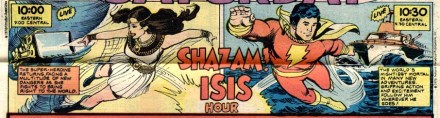
Shazam Isis Hour

This comic was on the shelves in July 1976. By this time the TV show Isis was completed her first season. In September, season two, comprising seven new shows, would debut.
A great beginning. The art is wonderful – Wally Wood’s inks dominates Estradas’ pencils – who is himself a great artist – with a very clean and (otherwise) identifiable style.
The story was NOT aimed at children. Adult comic book fans would find the story and art enjoyable, too. Like the TV show, there was a lesson, of sorts, at the end; but it was in the context of character conversation as opposed to Isis speaking directly into the screen (as was done in her first appearance in Shazam #25).
Isis’ incantations are wordy, but never annoying (compared to, say, Zatanna, where one needs a pocket mirror to read her spells). At one point in their battle Scarab calls her “noisome”, which means smelly, not noisy.
I’d bet she smells nice … more flowery and earthy than perfume-y … I don’t know why …

logo

***

About the author: Michael Curry is the author of the Brave & Bold: From Silent Knight to Dark Knight, The Day John F Kennedy Met the Beatles and the award-winning Abby’s Road, the Long and Winding Road to Adoption and How Facebook, Aquaman and Theodore Roosevelt Helped. Check his website for more releases! Thanks for reading!

DC’s version of the Prince of Power!

Behold!

Bronze age

Hercules Unbound #1, November 1975

“Hercules Unbound!”

Cover: José Luis García-López, Editor: Joe Orlando

Writer: Gerry Conway; Penciler: José Luis García-López; Inker: Wally Wood

Hercules awakes four weeks after World War III. He broke free of his enchanted bonds to rescue a blind teenager, Kevin, and his dog Basil, who were being terrorized by an enraged sea creature.

Kevin tells Hercules about the nuclear devastation of Greece, the death of his brother and his and Basil’s escape in their family sloop. Hercules decides to accompany Kevin to Rome to find Kevin’s father.

Ares, meanwhile, looks upon the fighting in Rome and laughs. He then commands the military forces back into a hopeless battle.

Hercules and Kevin make it to Rome. Hercules recounts his capture and imprisonment by Ares in aulden days. They fight off minotaur-like demons and battle-crazed citizens. He spots Ares and challenges him to battle. Ares responds by siccing the red-hued Smasher on Herc. Kevin and Basil help Hercules defeat the monster that Ares created.

After the battle – Kevin recognized Smasher as his own father.

***

The letter column gives a brief origin to the classical Hercules and introduces us to Gerry Conway, Jose Luis Garcia Lopez and Wally Wood. It also hypes Claw the Unconquered #4 and Stalker #3.

***

An interesting beginning leaving many questions – which entices us to keep reading obviously… So far we see only a bit of Hercules’ famed strength and not much of his personality (by this time his Marvel doppelganger’s braggadocio is legend). Perhaps DC is avoiding the obvious comparison by pulling back the man-god’s traditional vanity. His shock at being in the modern world is non-existent – perhaps the post-apocalyptic world is more familiar to him.

The mystery of Kevin’s powers is canny for comics of the time (not meant as a criticism). He brings us the only real emotion of the comic – it’s only been a month since nukes flew and destroyed everything! Plus his brother was killed and he discovered his father was made into a nuclear monster! He MUST have great inner strength to handle this!

The art is fabulous – but even Lopez’ art is nearly swallowed by Wally Wood’s stylish inks. Regardless, every page is beautiful.

***

About the author: Michael Curry is the author of the Brave & Bold: From Silent Knight to Dark Knight, The Day John F Kennedy Met the Beatles and the award-winning Abby’s Road, the Long and Winding Road to Adoption and How Facebook, Aquaman and Theodore Roosevelt Helped.  Check his website for more releases! Thanks for reading!


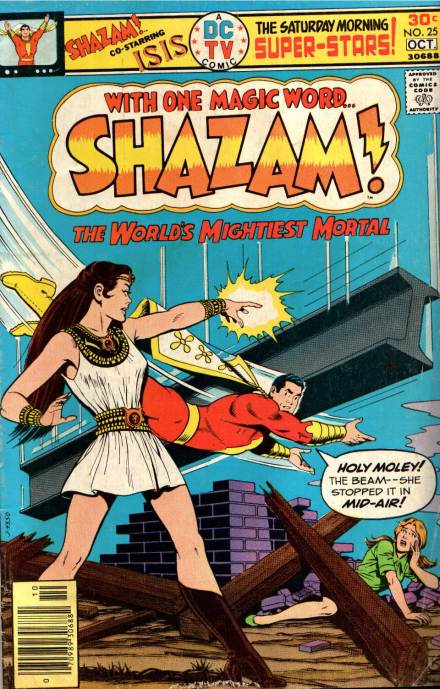
Shazam #25: Saturday Mornings on CBS


Shazam #25. October 1976.

Cover: Kurt Shaffenberger

Isis: “Isis … as in Crisis”

Writer: Denny O’Neil, Art: Dick Giordano, Editor: Julie Schwartz

An old school building is being demolished. Student Cindy Lee is trapped in the rubble as a huge chunk of wall is about to crush her! Andrea Thomas changes to Isis and magically saves her. Captain Marvel swoops down to introduce himself – he was going to save Cindy until Isis intervened. Cindy was tracking two suspicious characters when she became trapped.

We get a brief origin of Isis: while on an Egyptian expedition, Andrea finds a scroll and amulet once owned by Queen Hatshepsut –  the only female pharaoh. She is compelled to put on the amulet and read the scroll. “With this, you shall have the power of the goddess Isis…”. Andrea calls out the name “Isis” and transforms for the first time.

Cindy spots the crooks again – they were retrieving stolen gold coins they had buried on the demolition site. The crooks catch Cindy after a car chase. They put Cindy back in her car and send it careening down a cliff!

Isis rescues Cindy and captures the gold coin thieves.

***

Captain Marvel: “The Bicentennial Villain”

Story: E. Nelsen Bridwell, Art: Kurt Shaffenberger, Editor: Joe Orlando

Through a riddle, the old wizard Shazam warns Captain Marvel about great danger to the country: Listen for a laugh that can bring tears to millions!

Someone is sabotaging Billy’s documentary of young people’s contributions to history. He hears a sinister laugh aboard a sailing ship and runs afoul of Dr. Sivana! Sivana gags Billy and scuttles the ship. Billy works off the gag and says the magic word to turn into Captain Marvel. Marvel saves the ship from sinking, but Sivana gets away.

Sivana leaves a note saying he is going to destroy America city by city! How can Cap stop him when he (Billy Batson) has to work in New York? To be continued!

***

 Letters comment on Shazam #23 (by then a quarterly reprint) and explains the new direction of the comic including a change in editors.

***

logo

Thus began the DC-TV line of comics. It was published June 29, 1976, with a cover date October 1976. By June the show had been on for 22 months and was about to start its third season as the Shazam/Isis Hour with only six new Shazam episodes (in addition to repeating Season One’s 15 shows and Season Two’s 7 episodes).

The Captain Marvel tale is a lead-in to eventually change its format to more closely reflect the show. So far there is no big camper or mentor, but it is implied they are coming in the next issue.

The Isis story fits snugly into the television show style. She even gives us a “lesson” at the end of the story as per the TV show – seeking danger to impress someone is just as dangerous: “We should each do what we can as well as we can.”

Plus the art on both stories are wonderful. Shaffenberger has always been a favorite – clean, solid art and very accessible to the young reader.

Giordano’s art on Isis is beautiful – he really brings the characters to life.

The DC-TV imprint is off to a good start!

Shazam Isis Hour

***

About the author: Michael Curry is the author of the Brave & Bold: From Silent Knight to Dark Knight, The Day John F Kennedy Met the Beatles and the award-winning Abby’s Road, the Long and Winding Road to Adoption and How Facebook, Aquaman and Theodore Roosevelt Helped.  Check his website for more releases! Thanks for reading!

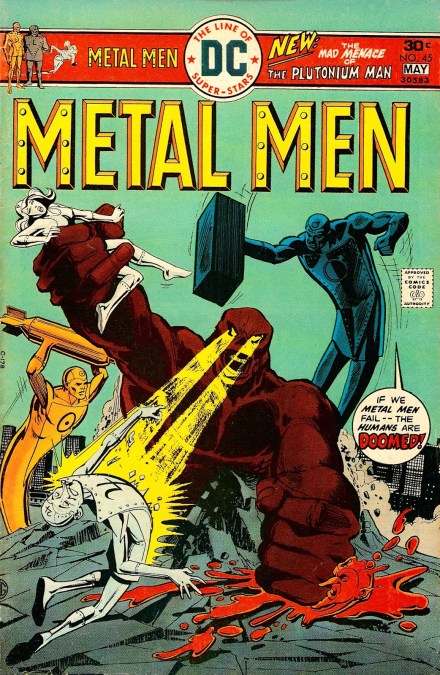
Metal Men #45, May 1976: Welcome Back!

Behold!

Bronze age

Metal Men #45, May 1976

“Evil is in the Eye of the Beholder”

Cover: Dick Giordano; Editor: Gerry Conway

Writer: Steve Skeates; Penciler/Inker/Colorist: Walt Simonson

The Metal Men tour the country’s colleges displaying their powers. This allows new readers some exposition as to who the Metal Men are. Doc Magnus, meanwhile, is held for mental examination after being rescued from Karnia.

To aid in his recuperation, the Feds allow Doc time and equipment to make another Metal Man. He creates Plutonium Man. PM escapes and leaves a trail of mayhem behind. A Karnian spy is exposed among Magnus’ keepers. Magnus and the surviving military hunt down Plutonium Man.

But the Metal Men get their first. Despite all their efforts, nothing works and member after member meet their doom … until Platinum wraps herself around Plutonium Man to cause a mini-China Syndrome, destroying them both.

Magnus, seemingly all better, vows to rebuild the Metal Men.

***

Metal Men’s history by this point is very strange, stranger than you expect from this group: even Gerry Conway admitted so in the letter column. And if the man who brought you Conway’s Corner’s stable of comic books thinks something is strange …

In brief: by 1968 the original Metal Men creative team moved on to other things and the new team made the Metal Men fugitives from justice and hunted by the law. The robots created secret human identities and fought supernatural enemies. Doc Magnus was kidnapped by the dictator of Karnia and brainwashed to evil and hatred as to his creations. The comic ended with a cliffhanger, of sorts, with #42, January 1970.

Three reprint issues in 1973 failed to gain traction. The magazine was revived again in 1976 with this issue.

Rather than start anew, this new creative team wrapped up the storyline from six years before. Perhaps they should have restarted the comic and pretend 1968 – 1970 never happened! If only because it gives the series an awkward grittiness.

But if this comics’ creators insist on grittiness, it picked the perfect team. Walt Simonson’s art (his first DC work since Manhunter) fits in perfectly. His workman-like style is instantly recognizable even at this “early on” stage. It fits well.

And Gerry Conway’s obvious love for the characters is evident. He does a Red Adair-like job of putting out the continuity fires and inevitable clean-up!

Welcome back, guys!

***

About the author: Michael Curry is the author of the Brave & Bold: From Silent Knight to Dark Knight, The Day John F Kennedy Met the Beatles and the award-winning Abby’s Road, the Long and Winding Road to Adoption and How Facebook, Aquaman and Theodore Roosevelt Helped.  Check his website for more releases! Thanks for reading!

DC-TV: Saturday Morning comics…

DC-TV

When most people think of DC television … well … nothing pops into mind.

When most fans of DC comics think of DC television, their minds go to the live-action shows such as Arrow, Legends of Tomorrow, Gotham, or the upcoming Black Lightning.

Some comics fans may think of excellent animated series like Batman: TAS, Batman Beyond and Justice League Unlimited.

house ad (October 1976)

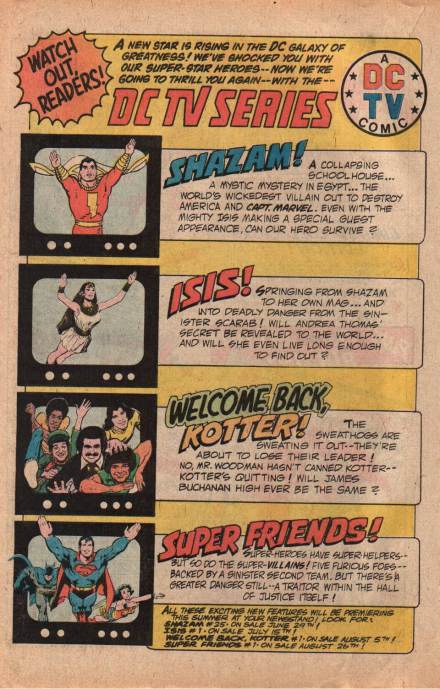
But for some of us the phrase “DC-TV” takes us back to 1976 and 1977 and four comic books published by DC but put under a different banner (now we would call it an “imprint”): the DC-TV Series of comics!

Logo Superfriends

Superfriends originally aired in 1973 and 1974, lasting only one season. It was revived as a mid-season replacement in 1976 and one version or the other continue to air into the mid-1980s. The comic Superfriends (TV shows are italicized, comics underlined) was published starting November 1976 until August of 1981, lasting 47 issues. The Saturday morning cartoon still being popular, the comic used the DC-TV logo through its entire run.

Logo Shazam

Shazam (Captain Marvel) debuted in September 1974 for two seasons with a third as part of the Shazam/Isis Hour in late 1976 – coinciding with the DC/TV comic books debut. The comic book published its first DC issue in 1973 and was suspended in early 1976 – despite the still-popular TV show. It was revived as a DC-TV comic and lasted for 11 more issues (until June 1978), the last two issues without the DC-TV logo. The comic book lasted longer than the TV show, but to be fair it started before the show as well …

Logo Isis

Isis debuted in September 1975 and lasted for 2 years and 22 episodes. She was never actually given her own program, but linked with Captain Marvel in the Shazam/Isis Hour. Her comic lasted 8 issues until January 1978, lasting longer than the television show – athough the character appeared in animated form in other Filmation shows (such as Freedom Force in 1980).

Logo Kotter

Welcome Back Kotter also debuted in September 1975 and lasted until May of 1979. Its comic lasted ten issues until May 1978. An unpublished story and other features were printed in a tabloid-size special edition.

Rumors abound of negotiations of a MASH comic book. If true, it did not go far.

Shazam #25, with an October 1976 cover date, introduced us not only to Isis, but the DC-TV series. The other three comic books debuted in November 1976, but available on the newsstands (as per the house ad) June, July and August of 1976.

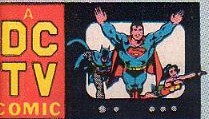
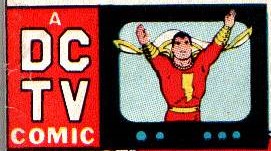
For only the second time in its history, National/DC changed its logo to accommodate this special series of comics. The first issues had a simple DC-TV logo attached to a console television showing us the star of the magazine. This was during their “cigar-band” logo period. When the publisher went back to the logo in the upper-left corner, it added a square-shaped “TV” to its circular starred “DC”.

I’ll review most of the DC-TV line-up in this blog. I’ll stop with Super Friends #13 (July 1978) when it became the last title of the line.

I hope you enjoy the blog series and I look forward to your comments.

***

About the author: Michael Curry is the author of the Brave & Bold: From Silent Knight to Dark Knight, The Day John F Kennedy Met the Beatles and the award-winning Abby’s Road, the Long and Winding Road to Adoption and How Facebook, Aquaman and Theodore Roosevelt Helped.  Check his website for more releases! Thanks for reading!

Kobra #1: Kirby’s DC leftovers, but great pulpy fun!

Behold!

Bronze age

Kobra # 1, March 1976 (remember the cover date of comics is about three months ahead of the actual publication date, blah blah blah…)

“Fangs of the Kobra” written by Martin Pasko and Jack Kirby, art by Kirby and Pablo Marcus. Editor: Gerry Conway, Inkers: D. Bruce Berry and Pablo Marcos, Colorist: Carl Gafford, Letterer: Ben Oda

Cover by: Ernie Chua (Chan)

Synopsis: (why type it all out when someone else has done it for me?)

(the following paragraph courtesy of ReadComicsOnline):

Deep beneath the streets of Manhattan, assassin-for-hire, Horst Buchner, along with two associates, are ushered through secret tunnels, to keep a prearranged rendezvous with Kobra. At the first sign of insult, Buchner’s men draw on Kobra. Put off by Kobra’s arrogance, Buchner declines his offer of employment, deciding, instead, to rob Kobra of several intriguing artifacts. Still held at gunpoint, Kobra leads Buchner and his gunsels into another chamber, one that holds Kobra’s most unique artifact, the Ovoid. Within the confines of the still shimmering meteoroid, Kobra reveals an enormous alien robot, he calls the Servitor. At Kobra’s command, the Servitor steps forward, then murders Horst and his associates, pummeling them to death with its giant metal fists. Sensing that his brother, Jason Burr, is soon to learn of Kobra’s existence, and whereabouts, Kobra sends the Servitor up to the streets, on a mission to slay Burr. The Servitor leaves a swath of destruction in its path, as it makes its way to Columbia university. Despite opposition from New York’s finest, the Servitor moves inexorably to the student union building. Inside, Lieutenant Perez is interviewing Jason Burr. Just as Perez is about to reveal to Burr the existence and identity of his brother, the Servitor crashes through the wall. Lifting Burr up in one of its gargantuan hands, the Servitor, at Kobra’s command, begins crushing him. Suddenly, Kobra, too, feels the crushing force of the Servitor’s grip compressing his own chest. Realizing that he and Burr share a sympathetic bond, Kobra orders the Servitor to release him. The countermand causes the Servitor to self-destruct…

Jason meets Lt. Perez who tells Jason the secret origin of Kobra …

(from Wikipedia): (Kobra) “… was born part of a set of Siamese twins, but was stolen at birth by the Cult of the Kobra god, since a prophecy claimed he would lead them to rule the world. Under their teaching, he became a dangerous warrior and a sadistic criminal mastermind. He led the cult into using advanced technology to menace the world.  … However, unknown to the cult, he had a psychic link to his twin brother, Jason, who knew nothing of Kobra. As a result, one felt what the other felt, including pain. Because of this, his brother was recruited by an international agency to help them combat Kobra.”

Perez convinces Jason to injure himself (holding his hand over a candle flame. Kobra cannot stand the pain any further and confronts Jason for the first time). Perez and his men try to capture Kobra, who slithers through their trap. The police shoot at the terrorist. “No guns!” shouts Jason to no avail. Were they trying to kill Kobra? IF they do, he will be collateral damage! Kobra escapes unharmed …

***

(from Wikipedia):

(Kobra was) “… created by Jack Kirby for a proposed DC Comics series called King Kobra, the first issue of which was both written and drawn by Kirby (the letter column discussed Infantino and Kirby wanting to do a take on the Corsican Brothers). This first issue then sat in DC inventory for over a year, during which time Kirby left the publisher to return to Marvel Comics.  Eventually the concept was handed over to writer Martin Pasko with orders to make a series out of it. Pasko was unimpressed with King Kobra, feeling it to be a throwaway idea churned out by Kirby as he was preparing to leave DC, and tried to make the best of the assignment by whiting out all of Kirby’s original dialogue, rescripting the issue, and having Pablo Marcos redraw some of the art (and re-)titled simply Kobra. … Pasko later reflected, “I wrote all of Kobra with my tongue firmly planted in my cheek—it was a preposterous exercise dumped in my lap, and it helped pay the rent on a very nice place in the Village.”

Dumped? Even the letter column introducing the comic said the title was “thrown” into Conway’s Corner. It seemed no in at DC gave much of a damn about the comic.

Pasko was correct about this preposterous exercise, but THIS pre-teen loved every issue of it! I still have every issue of the original run. The comic is great fun straight from the pulps – not a caped crime-fighter in sight! It was akin to Dr. Yen Sin or the Mysterious Wu Fang.  DC did something it did not do often – it took a chance! An unknown villain in the lead and an unknown cast! Very shortly it would launch another villain-led comic: the beloved Secret Society of Super-Villains, firmly entrenched in the DC’s superhero world.

Kirby’s art by the mid-1970s was an acquired taste: exaggerated physiologies, gaping mouths, fingers the size of Snickers bars, women whose eyes were set below the center horizontal line of their faces, etc. Marcos did his best redrawing Jason and Perez, but the redo was glaring and obvious. I would have loved cringing at Kirby’s original dialogue, but Pasko did a fine rewrite with what he had (I kept expecting one of the Cobra Cult to say, in Kirby’s typical expositional shorthanded way, “We must obey!”).

Not an auspicious beginning to only the second DC title to headline a villain (The Joker was first by less than a year). Villains starring in comics was a rarity (and was to remain so for the next several years – nowadays it is somewhat common): the Golden Age had its Yellow Claw and the Sub-Mariner (who was more of an anti-hero than an outright villain). The Silver Age, with its Comics Code, was more cautious about villain-led features. Even the House of Ideas itself – Marvel in the Silver Age – only gave Doctor Doom the lead in an anthology without giving him his own title.

The comic got better in later issues … much better …

***

 About the author: Michael Curry is the author of the Brave & Bold: From Silent Knight to Dark Knight, The Day John F Kennedy Met the Beatles and the award-winning Abby’s Road, the Long and Winding Road to Adoption and How Facebook, Aquaman and Theodore Roosevelt Helped.  Check his website for more releases! Thanks for reading!

Adventure Comics #425: a new, less super direction…

Behold!

Bronze age

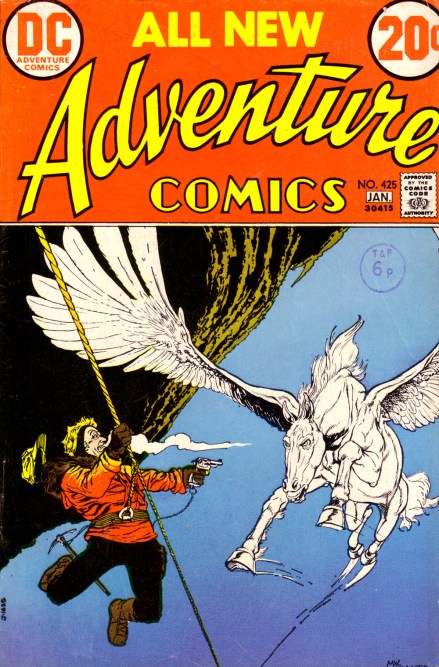
Adventure Comics #425. January 1973.

Joe Orlando: editor. Mike Kaluta: cover artist.

***

“The Wings of Jealous Gods”

Writer: Lynn Marron; Penciler/Inker/Letterer: Alex Toth

Rodeo showman Chad L. Hammond is in the Himalayas, where he hears rumors of “hawkhorses”. His guides say they are a myth, but he wants to hunt them anyway! In a snow-less grassy valley, he captures a foal and kills its winged mother. His guides accuse him of killing a sacred god and desert him.

While descending with the foal, he is attacked by pegusi, but managed to take the foal (now named “Cloud”) to the US and enters her into the racing circuit until its wings sprout. It wins, often, making Hammond a rich man.

Cloud’s wings begin to grow much to Hammond’s ire – he can’t race it if it has wings! He orders the wings removed. Cloud’s handler (who came with Hammond from the Himalayas) tries to stop Hammond but is killed for his concern over the sacred animal. Hammond sets the barn on fire – hiding the evidence of his murder.

After Cloud’s wings sprouted, Hammond rides the skies – only to be held hostage as Cloud joins the white Pegasus. They make it back to the sacred mountain and drop Hammond into a nest of hungry, sharp-toothed foals!

***

“Prior Warning” Writer: unknown. Penciler/Inker/Letterer: Frank Redondo

Aliens come to earth claiming to be peaceful. They think they are tricking the earthlings and actually plan to attack. But earth attacks them first and drive them off! The aliens have no idea what made the earthlings know they were, in fact, aggressors. Maybe the fact they dressed like Nazis and their leader is a dead ringer for Hitler!

***

“Sword of the Dead” Writer/ Penciler/Inker/Letterer: Gil Kane

Evlig, the renegade knight, slaughters a woman and her children, not knowing it was the family of John the Gaunt, retired champion of the kingdom. John comes out of retirement to hunt down the killer and both fight to the death … and beyond!

***

“Captain Fear”

Writer: Robert Kanigher; Penciler/Inker/Letterer: Alex Nino

A native Carib tribe in Haiti are attacked by Spaniards in search of slaves. Fero, the son of the chief, and others are captured and put to work in the mines. They revolt and escape in a Spanish ship; only to have the ship destroyed in a storm.

Rescued by other pirates, Fero fights for the command of the ship and kills the Asian captain. He renames himself Captain Fear – for that is what he will put in the hearts of every white devil he will meet! This he vows to the cheers of his bloodthirsty crew!

***

In a short letter column Joe Orlando explains the change in the magazine’s format from Supergirl to high adventure: fantasy, science fiction, mystery and/or horror!

***

Until its first cancellation in 1982, Adventure Comics was the oldest continually running comic book on the stands (back when there were stands…). Its first issue was called New Comics dated December 1935 by someone calling themselves National Allied Publications. It changed its title with issue #12 (January 1937) to New Adventure Comics. The “New” was removed in November 1938 and remained that way until its cancellation (although during the Spectre’s run in the early 1970s it was called Weird Adventure Comics, to cash in on the horror trend: Weird Mystery, Weird War, Weird Western, etc.

With its change to New Adventure Comics, it changed formats from humorous stories to action/adventure tales – some stories were written and drawn by future-Superman creators Joe Shuster and Jerry Seigel.

At the dawn of the superhero age Adventure dove right in with the debut of the Sandman with issue #40, Hourman (#48, March 1940), Starman (#61, April, 1941) and Simon & Kirby’s Manhunter (#73, April 1942).

When More Fun Comics changed formats to humor stories, its characters moved to Adventure, including Superboy, as of issue #103 (April 1946).

Issue #247 (April 1958) the Legion of Superheroes debuted. They eventually shared billing with Superboy during their classic run.

They were replaced by a solo Supergirl lead as of issue #381 (June 1969). She starred in the comic until #424 (October 1972). The letter column of her last issue explains she will get her own book but says the editors do not yet know the next issue’s new format. It only says to be back for a “new line-up of fantastic features!”

With #425 Adventure went back 35 years to focus on … well … adventures! Why? A search of the internet does not say specifically, but I can guess. At this point both DC and Marvel were making good money with their non-superhero lines – horror comics weren’t outselling Superman, but by gum the sales figures weren’t bad! With the Legion safely ensconced in Superboy and the Maid of Steel getting her own magazine, maybe it was time to add another non-superhero anthology … perhaps a repository for some not-quite-horror-themed tales …

(For more on Adventure Comics history AFTER issue #425, click here … or watch this blog for future issues!)

***

Captain Fear is the only feature of this short-lived era of Adventure with any legs. He had back-up stories in later issues of Adventure and in the Unknown Soldier.  He is given pages in Who’s Who and the History of the DC Universe.

***

About the author: Michael Curry is the author of the Brave & Bold: From Silent Knight to Dark Knight, The Day John F Kennedy Met the Beatles and the award-winning Abby’s Road, the Long and Winding Road to Adoption and How Facebook, Aquaman and Theodore Roosevelt Helped.  Check his website for more releases! Thanks for reading!


Behold! The Bronze Age! A new series

Regular readers of Curry Takeaways know of my many loves; including the Bronze Age of comic books.

What is the Bronze Age? It is a vague time period of comic book publishing. Most ages are determined by fixed events or dates in the history of comic book publishing – although even those are debated.

Only a contrarian disagrees that the Golden Age of comics began with the publication of Action Comics #1 and the debut of Superman (June 1938 – let’s please stop discussing cover date vs actual date; if you don’t know by now …).

There are more arguments over the beginning of the Silver Age, but the majority still believe it began with the publication of Showcase #4 and the (what we would now call) reboot of the Flash (October 1956).

The Bronze Age beginnings are more arguable. Was it when the price of comics went to fifteen cents? Was it when Jack Kirby left Marvel for DC? Some simply say 1970. This was when Kirby left for DC, Green Lantern became Green Lantern/Green Arrow and symbolized DC’s going “relevant” and growing up, many old-time writers and artists retired and were replaced by fans-turned-pros, Marvel published Conan the Barbarian, etc.

I do not really have a preference, although I lean more to the fifteen-cents-theory (early 1969).

The theories as to the date of the end of the Bronze Age is almost universal – the Crisis on Infinite Earths and the deaths of Flash, Supergirl and others in 1985.

Ages since have been of little interest to me – I just call anything since the Modern Age (some have coined post-Bronze Ages as the Copper Age and the Modern Age …).

I love comics in all of the various Ages, but the Bronze Age was when I first really read and paid attention to the comics I was getting (and saving).

Over the next few years on this blog I will share my favorite Bronze Age comics – sometimes going through entire series or a specific run. It will focus mainly on DC versus Marvel, Atlas, Harvey or Archie – but that’s because that is what I read.

They will be similar to other specific runs in the past (what I call the Adventure Line imprint, the Bicentennial issues and a few others) and may repeat some blogs. Forgive the reruns – I’ll keep them to a minimum.

I’d like to hear your opinions. Keep up the comments.

Enjoy.

Michael Curry


About the author: Michael Curry is the author of the Brave & Bold: From Silent Knight to Dark Knight, The Day John F Kennedy Met the Beatles and the award-winning Abby’s Road, the Long and Winding Road to Adoption and How Facebook, Aquaman and Theodore Roosevelt Helped.  Check his website for more releases! Thanks for reading!


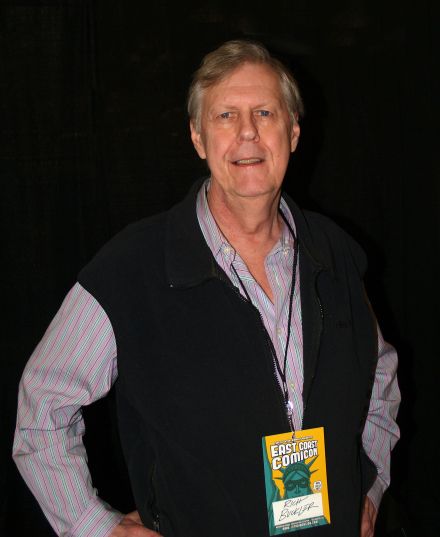
Rich Buckler – RIP to a comic book great!

… and on Gardner Fox’s 106th birthday, I also honor a Golden & Silver Age great!

***

I was very sad to hear of the death of comic book artist Rich Buckler today.  Here is his Wikipedia entry (note his death had yet to make the page):

Rich Buckler (born February 6, 1949) is an American comic book artist and penciller, best known for his work on Marvel Comics’ Fantastic Four in the mid-1970s and for creating the character Deathlok in Astonishing Tales #25. Buckler has drawn virtually every major character at Marvel and DC, often as a cover artist.

As a teenager in Detroit, Buckler attended the initial iterations of the Detroit Triple Fan Fair, eventually running the convention along with originator Robert Brosch in 1969–1970.

Buckler’s first comics work was as a teenager with the four-page historical story “Freedom Fighters: Washington Attacks Trenton” in the King Features comic book Flash Gordon #10 (cover-dated Nov. 1967). At DC Comics, he drew the “Rose and the Thorn” backup stories in Superman’s Girl Friend, Lois Lane #117-121 (Dec. 1971 – April 1972).

Buckler drew the first three issues of writer Don McGregor’s Black Panther series in Jungle Action vol. 2, #6-8 (Sept. 1973 – Jan. 1974), a run that Comics Bulletin in 2010 ranked third on its list of the “Top 10 1970s Marvels”. He fulfilled a decade-long dream in 1974 when assigned to draw Marvel’s flagship series, Fantastic Four, on which he stayed for two years.  During this period, Buckler created the cyborg antihero Deathlok, which starred in an ongoing feature debuting in Astonishing Tales #25 (Aug. 1974). Also during this period, Buckler hired the young George Pérez as his studio assistant.

Buckler collaborated with writer Gerry Conway on a “Superman vs. Shazam!” story published in All-New Collectors’ Edition #C-58 (April 1978). He drew the newspaper comic strip The Incredible Hulk for approximately six months in 1979. A Justice League story by Conway and Buckler originally intended for All-New Collectors’ Edition saw print in Justice League of America #210-212 (Jan.-Mach 1983). Buckler and Roy Thomas then created the World War II superhero team the All-Star Squadron in a special insert in Justice League of America #193 (Aug. 1981) which led to the team’s own title the following month.

Buckler worked for Archie Comics in 1983 and 1984, when that publisher briefly revived its Red Circle Comics superhero line, and he recruited Cary Burkett to write the Mighty Crusaders title. In 1985, Buckler returned to Marvel and briefly drew The Spectacular Spider-Man with writer Peter David, where they produced the storyline “The Death of Jean DeWolff”. He also served as editor for a short-lived line of comics by Solson Publications, where in 1987 he created Reagan’s Raiders.

He is the author of two books: How to Become a Comic Book Artist and How to Draw Superheroes. In 2015, he became an Inkwell Awards Ambassador.


I remember his covers of the comic books I collected during the Bronze Age, but as I searched for his comic book covers on the internet I was stunned at how prolific he was; at least with the comics I collected. He was everywhere! He, Jim Aparo and Ernie Chua seemingly accounted for 75% of DC covers in the 1970s! I may only slightly be exaggerating! Here are some examples of the man’s work. I still have all these issues …

***

Today also marks the 106th birthday of Gardner Fox, prolific comic book author whose writing helped create the Golden Age and whose creations still exist in one form or another. He was the creator or “… co-creator of DC Comics heroes the Flash, Hawkman, Doctor Fate and the original Sandman, and was the writer who first teamed those and other heroes as the Justice Society of America. Fox introduced the concept of the Multiverse to DC Comics in the 1961 story “Flash of Two Worlds!” …” (from Wikipedia).


Two comic book great are being remembered today. Thank you both for your wonderful bodies of work. You and your talent are both missed very much!


DC’s Legends of Tomorrow – a look back on Season Two

DC’s Legends of Tomorrow just completed Season Two. And it will have a Season Three – something that was in doubt this time last year.

Season One was savaged by the critics and all but the most trollish of DC trolls. I liked it, I did. But I wasn’t as giddy about its first season as I was about the first season of Arrow or Flash … read my review by clicking on the link above.

This second season was better, per the critics and the trolls. And indeed it was.

I liked Season Two as well, but I still didn’t love it.

Why?

I have a hard time putting my finger on the why. And I figured out why while writing this review – which was partly my goal.

It was a better show than the prior season– they pruned the cast; the remaining members grew and the new ones were allowed more depth (a smaller cast allows that). They had a variety of Big Bads instead of one. The stories were fair despite the Pez-dispenser-like lessons of history.

Maybe it is unfair to compare it to the joy of watching Flash and Supergirl, where the glee (pardon the pun) of the cast and writers warm the viewers like the sun in spring. However, the show is better than the brooding and plodding Season Five of Arrow, which unfortunately followed its brooding and plodding Season Four.

Put it this way: I watch Flash and Supergirl as soon as I can (I tivo all my shows and watch them later) – usually the next day; with LoT I sometimes wait until the weekend; Arrow and some others (Agents of Shield, as another example) are watched in bundles of two or three episodes at a time because of their glacial story progression.

So LoT came in a distant third this year. The other CW shows have about six more episodes this season, so it is possible for them to blow it and make LoT look like the Mary Tyler Moore Show, but that is doubtful.

Let’s look at the hows and whys this season was better – or worse – than the first:

The cast was trimmed this season. Hawkgirl is gone.  Too bad. Perhaps with this “new” setting of Season Two the character would have been able to do more than mourn the death of Carter Hall and be the constant captive of Vandal Savage. The actress Ciara Renée deserved better.

Arthur Darvill had other commitments during the season so Rip Hunter was written out of most of the show. I thought it would be the death knell but it actually helped. Sara Lance grew into the role of the captain of our crew. Rip’s eventual return just showed us how crowded the cast was – we and Rip realized he was … well … not needed anymore. I hope he pops up from time to time.

The loss of Wentworth Miller as Leonard Snart/Captain Cold was also a blow, or so I thought. Here was the best character of Season One (Mick Rory, now no longer Snart’s sidekick, steals every scene like the thief he is. The only good thing about Wentworth Miller leaving the show was Dominic Purcell’s ascendancy. He is wonderful – Rory was meant to be two-dimensional and ends up being the most well-rounded character of the show!).

Snart, Hunter and Hawkgirl were replaced by Steel and Vixen – two characters who started off in comics of the 1970s but did not really come into their own popularity until the 1980s. They helped provide some missing muscle and exposition (Steel was an historian and Vixen knew where to find this Season’s MacGuffin). They began a more believable romance than last year’s Atom-Hawkgirl coupling.

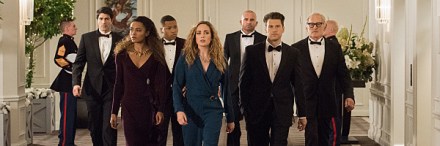
The Season starts out promising: the Legends’ job is to find time aberrations and set things straight: zombies in the Civil War, Albert Einstein kidnapped by Nazis. They confront the Justice Society (the handling of their roster caused quite a kerfuffle amongst the DC purists). Then the Big Bads and this season’s major MacGuffin are introduced:

The Legion of Doom consists of past bad guys from the Arrowverse – Eobard Thawn, trying to save his existence from being destroyed; Malcolm Merlyn – John Barrowman sleepwalking through this worn-out character; Damien Darhke, the Big Bad from Arrow Season 4, again played by Neal McDonough who smirked and smarmed as thoroughly as he did in Arrow. After 20 episodes there and 10 here, I think the audience has been sated with Darkhe, thank you. Wentworth Miller was touted as a member of the Legion, but he was only in the last three episodes or so.

legends-of-tomorrow-season-2-episode-8-the-chicago-way

The MacGuffin was the Spear of Destiny – a major prop in the DC comic book universe and a nice addition here – the spear the Roman soldier used to pierce the side of Jesus. In the comics, whosoever held the spear would rule the world. Hitler possessed it and prevented Superman and the other Justice Society members from going to Europe and kicking his ass (hence the reasoning behind why Superman, Dr. Fate, Green Lantern and others didn’t simply … go to Europe and kick his ass).

In LoT the Spear of Destiny can alter reality – Thawne wants it to create a universe in which his ancestor lived and thus he continued to exist. The Justice Society took the Spear and hid it throughout history. Thus creating the plot thread throughout the rest of the show, leading to a final big battle at the season’s end.

The season finale seemed almost tacked on. They go back to a previous adventure in World War One to change their eventual defeat that allows the Legion to take the spear – thus breaking the #1 temporal law – don’t go back and meet yourself (which some of the members had already done in Season One, but I assume, like Star Trek 5, we are to pretend that never happened).

Odd that Season Two only lasted 17 episodes instead of the usual 22 or 23, which may explain why the season finale seemed so “tacked on” – now that I bring it up, this plot thread could have been completed two or three shows before even that … heaven forfend they do some done-in-one episodes as filler. Subtract the obvious filler – the Jonah Hex redo and the cross-over with the other Arrowverse shows and we have only 15 episodes. Couldn’t the other 7 shows simply be well-done stand-alone episodes to finish out the season and prepare us for any changes in Season Three?

They COULD have done some fun single-episode time-travel shows. In my primer (the link is above) I mentioned they were entering into Doctor Who territory: going to different times and meeting the famous and infamous. They did that (George Washington, etc.), but it didn’t quite click.

The budget is tight on the show, I know. Which is why Firestorm rarely appears (and why wasn’t Victor Garber given more to do? After he revealed his daughter as a time aberration and turned over command to Sara Lance, he practically disappeared. Fortunately, he was excellent in the Flash’s musical episode!).

Brandon Routh was demoted from the eccentric he played in Flash down to the flightiness of last season to now being an idiotic man-child. Brandon Routh and Ray Palmer deserve better. He and Stein should be the geniuses of the series; like Cisco and Winn, creating the weekly MacGuffins to help defeat the bad guy.

On the other hand, Franz Drameh’s Jefferson Jackson was promoted from last season’s wise-ass kid to the engineer. He should be helping the geniuses Palmer and Stein with the mechanical side of the MacGuffin-making.

***

OK, so what was it about Season Two that I did not like? While I still haven’t quite put my finger on it, I do have some ideas to heal the show’s ills:

The Berlanti method is growing thin. After five seasons of Arrow, three in Flash, and one in LoT, the Season-long Big Bad story arc is an idea whose time is over. Do what is being done in Supergirl and make the Big Bad only a major recurring (not constant) villain – as they did with Lillian Luthor/Argus and Rhea (Mon-El’s mother). Weren’t you tired of Thawne snatching victory away from the Legends at the end of every episode?

Go back to fixing time aberrations. Not just on earth but through the universe. If you are going to emulate a TV show, you can do worse than Doctor Who. Introduce Kanjar Ro as an intergalactic tyrant. Introduce Krona as a time-meddler (he would make a good Big Bad AND be a nice way to FINALLY introduce the Green Lantern Corps into the Arrowverse)

Make “small” story arcs. The only good thing Agents of Shield has done in three years is having two separate story arcs this season – Ghost Rider for the fall and LMD for the spring.

And although the budget is not huge, PLEASE hire an historian. A real one. Nothing ruins a good story when you know the very premise is wrong. I realize this isn’t PBS, but stop using a paragraph or two from Wikipedia to get the gist of your background material.

For example: In one episode they had to find JRR Tolkien in the trenches of World War One. Tolkien knew a possible location to the tomb of Sir Gawain that could lead the Legends to a vial of the Jesus’ blood which could be used to destroy the Spear of Destiny … that lived in the house that Jack built. The Legends knew this because of a book Tolkien wrote about Sir Gawain. No such book exists – he wrote a translation of a lay of Sir Gawain, but not a treatise. And not during/before WWII…

While searching for him, they overheard a sergeant yelled “Fool of a Tolkien” to a sick soldier. Aha! This must be JRR! And sure enough …

The line was an homage to the line “Fool of a Took!” from Fellowship of the Ring. I bristled when I heard the line. It took away from Tolkien’s ability as a writer. It implied that he did not create the line – he just used what other people did. He did not. That is wrong.

“Lighten up,” you might say, “it was just a fun line.”

No it wasn’t. It was disrespectful. Same as when the Legends met George Lucas and the characters ended up in a pre-replica of the trash compactor scene. As with the Tolkien quotes, it diminished the genius and the originality of Lucas’ idea – a young lad and some friends are whisked away from their home by a quirky wizard to go fight a dark lord and his minions who are bent on ruling the … oh…

Never mind …

But it insults our intelligence as it insults the creativity of the historical guests (this is the same problem I have with Forest Gump or the “Marvin Berry” scene in Back to the Future).

Knock it off. It turns idols into thieves and it’s a short-cut by piss-pour writers for a cheap laugh.

***legends-of-tomorrow-season-2-aruba-slice-600x200

As I hoped, writing this little opinion piece has revealed what nags me about the show: if Legends of Tomorrow weren’t connected to the comic book characters I read and loved as a kid, I would not be interested in watching this show.

Compare that to, say, the superb first season of Arrow. I’d have loved that season even without the superhero lineage.

(Whereas Flash and Supergirl are too inextractibly linked to their comic books to say that. Were anyone to make those two shows renaming their leads they would face a copyright lawsuit faster than you can say “Shazam”. That’s a great line if you know the history of comic book litigation…)

But I repeat – I would likely not watch LoT if not for the DC roster. The stories and characters may not be great – but it’s the Atom! And the Justice Society! It may insult my intelligence – but there’s Jonah Hex!

***

So I still like the show. Perhaps the reason it gets under my skin so is that with some really simple (and inexpensive) tweaks it could be so much better. Instead of being fun in a frat-boy-“that-was-cool-wasn’t-it” way it could be fun AND thrilling. Season Two was an improvement over Season One. Season Three could be better still!

I cheer for the show – I really am rooting for it to do well; to be better! Stop emulating the storytelling-style of Arrow and Flash. You don’t need to. Do shorter story arcs! Do solo stories focusing on only one or two characters! When they meet real life legends – let them remain legends, not accidents.

Don’t emulate others. Be different.

Most legends are…


Original Material Copyright 2017 Michael Curry


Characters mentioned and their images are copyright their respective holders.  Thanks to DC Comics, the CW Network and Berlanti Productions and the actors portrayed for the use of their images.


I also thank the original creators of all characters mentioned, whether or not they have been properly compensated (gratmens during the credits aside).