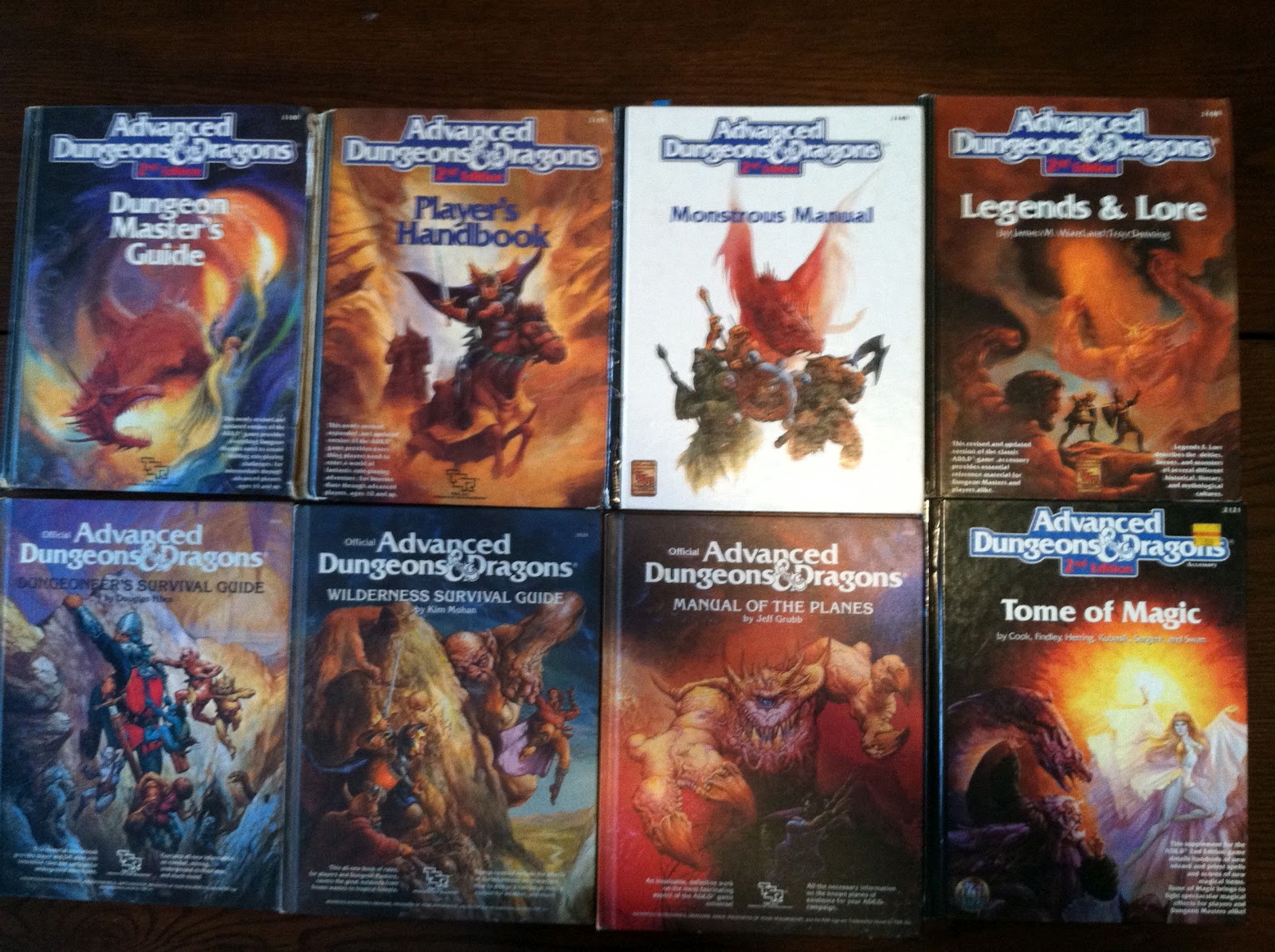
Dungeons and Dragons 5th Edition: The Apology

What Am I Reading: Dungeon & Dragons Player’s Handbook, 5th edition

Part Five: Now, where were we?


                I started to write a simple review of Dungeon & Dragons Player’s Handbook, 5th edition, but it grew into a series of blogs about the history of the game itself! Refer to my previous blogs for some of the terms if you are confused.

                We’re sorry, really really sorry. We won’t do it again. Can we go back to being friends?

                This is what WotC seems to be saying with its 5th edition. The Player’s Handbook is out now and the Dungeon Master’s Guide and Monster Manual are coming in the next few months.

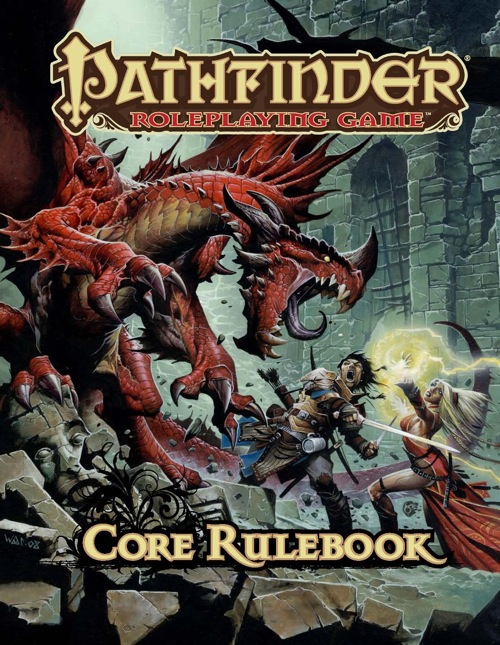
                When they realized that, good or bad system notwithstanding, their 4th edition was failing, they had to decide what to do. Should they scrap everything they have done? Yes. Should they just go back to 3.5? That wouldn’t be a bad idea, but Pathfinder has filled that niche now. Not only as a game, but their Pathfinder Societies has created gaming communities. Not only is Pathfinder a game, but it is something like a club – GMs and players can accumulate points as they play. They can get free stuff. It’s like the Boy Scouts or the Illuminati.

                Let’s go way back, they may have said, go back to first edition – really make it rules light. No, there are plenty of companies that do that already. Pits and Perils (http://www.oldehouserules.com/), Labyrinth Lord (http://www.goblinoidgames.com/labyrinthlord.html), and (my favorite) Basic Fantasy Roleplaying (http://www.basicfantasy.org/).

                Let’s keep the d20 system, WotC said, but make it lighter than Pathfinder. We’ll find our niche there. Something for the non-number crunchers. We’ll streamline 3.5 and they’ll forget all about 4th edition.

                They’re off to a good start.
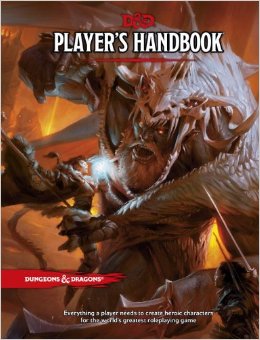
5th ed players handbook


                Now I can finally begin my review of Dungeon & Dragon Player’s Handbook for 5th Edition. It’s a beautiful book solidly bound – beautiful art, excellent layout and easy to navigate. I would expect nothing less from D&D – the bar is raised higher for them than, say, an upstart retro-clone. There I expect cheap …  and am usually not disappointed.

                The book starts with a lovely explanation of role playing – what it is and how it works. I usually skip over this part – the necessary intro to any RPG. It’s boring and repetitive to me (“…this is a movie in your mind … you help write the script…”), but if this is your first foray into tabletop role-playing, this has a solid intro.

                The races are more or less back to the basics – Dwarf, Elf, Halfling, Human, Gnome, Half-Elf, Half-Orc. From 4th edition they kept the Dragonborn (the whiners who demand to be able to play a dragon as a player-character is too large a lobby group to ignore) and the Tiefling.

                The classes are back to those listed in 1st edition AD&D with some Unearthed Arcana thrown in (although the revised names are used): barbarian, bard, cleric, druid, fighter, monk, paladin, ranger, rogue and wizard. They also added sorcerer and warlock.

                Backgrounds are added – you could call these character kits harkening back to the class kits of 2nd edition. Did your character start his adulthood as a soldier, an urchin, a sage, an artisan? If you do, you have some ready-made skills, tools, and traits and flaws. I like the traits and flaws – it helps with role play, not roll play. It’s there for flare.

                The usual equipment lists are canny and necessary for any game. I skimmed through that part.

                The combat hearkens back to oulden times. Nothing new here – I mean that in a pleasant way.

                Skills are down to 18 in number. Wow, 18 – and each are limited to certain classes. If you are proficient in a skill, you get +2. No slots, no purchases, +2. The idea of a proficiency bonus is a nice, slimmed-down touch. If you do anything well, if it is your proficiency, you get +2. Class or race attributes (Rogues use Dexterity, Warlocks use Charisma – smart move there. Unless you played a Paladin Charisma was always the low-roll dump of attributes) or skills – +2. Simple enough.

                Feats are down to 42 in number. Still too much, but at least it’s lost some weight. As with 3.5 you only gain a feat every three levels. A player is given an interesting choice – every third level you can either pick a feat OR increase an attribute by one. Hmm … some of the feats are pretty tough – you can reroll damage and pick the higher roll, you can increase your hit points to the same number as twice your level. Some of these feats will be huge at higher levels!

                A minor quibble: the XP needed to level is ridiculously low. 300 points to make second level?  The XP value of creatures and monsters must have suffered quite a bit of deflation since 3.5…

                WotC did a smart move by frothing up support and buzz for 5th edition through their Adventurer’s League: a structure of organized, public play sessions. Encounters is a short, weekly session at local game stores, Expeditions is for regional conventions – usually an all-afternoon event and Epic for major cons lasting days. For Encounters players meet at a game store and play a pre-set module sent to the DM directly from WotC. Both the DM and the players receive points for their play. Eventually, the gamers will run through the entire adventure path (another name for long module that will get you to the highest levels). Pathfinder has the same thing with their Pathfinder Society. The exact same thing. I wish WotC luck in this – but it seems no business gets ahead by copying its competitors. Pathfinder copied 3.5, true, but only after WotC abandoned it.

                The expunging of all things 4th edition is underway. The gaming community is starting to forgive them.

                I’m too far away from any game store to do the Adventure group thing. And with my baby girl I doubt my wife would let me run off once a week to play anyway. Maybe when she is old enough to entertain herself.

                To say that 5th edition is weighed down by what has gone on before is an understatement. But they should look on it as a legacy, not a burden. Embrace and respect the past. But note the future. Right now they are copying Pathfinder – with their lighter version of the rules and their Society-like Adventure teams. When you are in a parade – you never march behind the horses. But D&D is in a position it had never been in before – an upstart follower instead of a leader. They may still claim to be the premier world leader of RPGs, but the Sumerians were the premier world leader of … um … world leaders. You see where Sumer is now … or isn’t. As with any upstart, they’ll have to fight their way up. They may never make it back on top, but at least they are on their way to giving it a good try!

                And I think they are on their way. If Player’s Handbook is any indication, they can create their own niche of a Rules-Light d20 game. They are already past the point of being completely “rules light” with their skills and feats – diminished as those are. Leave that to the retro-clones (and I hate that phrase as being too negative, but it seems to have caught on without a taint. Those companies use the phrase as a badge of honor).

                I’m already looking forward to playing a Tiefling Warlock with the Great Old One patron…

                Happy gaming!

Cthulhu DM shit

Copyright 2014 Michael Curry
A History of D&D: 4th Edition – Wow, Just … WOW…

What Am I Reading: Dungeon & Dragons Player’s Handbook, 5th edition

Part Four: WOW…

5th ed 1

I started to write a simple review of Dungeon & Dragons Player’s Handbook, 5th edition, but it grew into a series of blogs about the history of the game itself! Refer to my previous blogs for some of the terms if you are confused.

Just like everything else in the world, D&D was suffering from poor sales during the economic depression of the mid-2000s. Gamers were leaving the tabletop games in droves to play online. Neverwinter and World or Warcraft (WOW) were the dominant games in the sword-and-sorcery genres. This fit into the isolationist mode most of us were going into with the invention of smart phones. Instead of rows and rows of kids sitting on the benches in malls, now there are rows and rows of kids sitting in coffee shops texting. Probably texting the kids sitting right next to them. Zombie apocalypse indeed…

Sitting at a table with dice and paper was passé; why imagine attacking an orc compound when you can see it in 3D on your computer screen? Wizards of the Coast realized they were losing their gamers. So in 2007 it was time for a new edition of D&D. A version that would attract those gamers back! They couldn’t beat the electronic games … so what do you do if you can’t beat ‘em?

4th edition gets a lot of bad press – has ever since it came out. Once something is pronounced a bomb – whether it be a movie, a TV show or a game system – it cannot recover even if it really isn’t so bad. Go to your favorite browser and type “4th edition D&D criticism” and look at the topics: link titles include “What Went Wrong” and “It’s Awful” -and these are dated 2008 and 2009 when the game had only been out a year or less! I won’t add to the chorus of contempt except to reflect what I have already blogged before.

4th ed 2

                4th edition isn’t a bad system. Some bloggers said if it wasn’t called D&D it would not have lasted. That’s true, but that is the case with MOST non-D&D RPGS.

If done correctly and with players acclimated to the system, 4th edition might even be fun. But it was so vastly different from anything before it … it was hardly D&D at all! It was a table-top version of a video game. WOW on paper. Ironically, WOW had its own tabletop version of itself – with a hardback guide, etc. Its tabletop version of D&D did just about as well as D&D’s tabletop version of WOW.

The basic classes and races are the same – although it took three Player’s Handbooks to get all the classes listed (Barbarians, Monks, etc.). Later Player’s Handbooks added tieflings (a race with a demonic taint), dragonmen, crystaline beings, angelic Devas, etc. It kept the 3rd edition’s Prestige Classes but called them Paragon Paths.

And the role-playing aspect of the game is still there, albeit it is made secondary to combat. From the few modules I read, role-playing is set way back on the list of things to do while playing the game. Way way back.

The biggest changes are in the way 4th edition handles combat. Remember, we’re talking about a table-top MMORP (massively multi-player online role-playing game).

Play with miniatures is encouraged. Some scenarios/modules seem to require it. For the first time since the D&D Basic Set, back when it was a spin-off of Chainmail, players are encouraged to dig out their miniature figures and terrain, whip out their tape measures and roll play. Miniatures never went away, strictly speaking. Gamers could use miniatures throughout all the editions – but 4th edition made it a necessary part of combat. Without miniatures – using a power that pushed back an opponent one square made no real sense without something on the table to help visualize it. How can we know if the push-back pushed the orc back into the waiting arms of an assassin’s blade? Make a luck roll? Miniatures take the guess work out of it. And takes the imagination out of it, too.

Powers? Oh yes, perhaps the biggest change in 4th edition, and the one that makes it seem more like a table top MMORP than anything else.

Each class and race was given powers. These are abilities one can use in combat. At-will powers could be used every round (portion of combat) – Healing Surge can heal you for 6 points – keeping you alive to swing your mace at least one last time. Per-encounter powers can be used only once during combat – and you cannot use it again until the next mob of bad guys come around the corner – Flurry of Blows might give you two chances to hit in a round. Per-day is just that. Until you sleep and recover, you can only do this power once per day – Knock throws everyone to the ground.

It’s like the cool-down period for abilities in WOW – you have some buttons to click that gives you an arcane blast or sword swipe every few seconds, some you cannot use for ten or more seconds, come only once every few minutes.

Even the terminology and class “assignments” come straight out of a MMORP. Rogues are attack dogs – nicking and cutting opponents. Fighters are referred to as “tanks”. There’s a Warlord class that gives other characters plusses just by standing in the midst of combat – there’s no other real reason for the class. Combat combat combat.

With this, were I to play 4th edition, I would like to have all my powers laid out before me on cards. My at-wills to the left, per-encounters in the middle and per-day on the right. Other stats would also be available. That way I can keep track of what I used and when it will be available again. Just like on my computer screen. I go from playing on my desktop to playing on my desk top.

Stats for abilities became uniform. Before, if you had 14 Strength, it would give you a +1 on “to hit” rolls, damage, opening doors, etc.  A 14 Dexterity gave you +1 on initiative, “to hit” rolls for ranged weapons. Now a 14 in any stat gives you a +1 benefit on anything involving that stat. No more lists – if it involved Strength, you get +1 to your roll. I like that. (remember that I am winging it on the numbers here – don’t tell me “a 13 gives you +1, a 14 is +2. Cool, but regardless, if you get my point, let’s move on…).

With 4th edition, Wizards of the Coast (WotC) went with the nuclear option. It stopped producing anything remotely to do with 3.5. It left that to Piazo. Piazo was the company that published Dragon and Dungeon magazine. WotC cancelled both magazines – no one will care about 3.5 once 4th edition debuts!

“Um,” Piazo said, “would you mind if we continue with the 3.5-style game system? We’ll call it Pathfinder and it will be completely different from your new edition.”

“Of course you can, you little upstart, we’re too big to worry about such small potatoes as you…”

pathfinder

                I usually end these blogs with our little troop of characters trying to swing over a chasm. Just use the same ending as my last blog. Since it has nothing to do with combat combat combat, the roll play of swinging over a chasm is unchanged.

But that brings up one of my biggest criticisms – roll play vs. role play. In previous editions, I am a thief named Visilai; in 4th edition, I am a rogue/assassin hybrid with the invisibility character build!

Pathfinder started beating D&D in sales. Bad. Then the Star Wars Role Playing game started beating D&D in sales.  D&D was third overall. From the only game in town to third place. Something had to be done.

They quickly created a 5th edition.

They called it D&D Next. I call it D&D: The Apology.

TO BE CONCLUDED…

Copyright 2014 Michael Curry

Continuing my history of D&D with 3rd edition – this changes EVERYTHING!

What Am I Reading: Dungeon & Dragons Player’s Handbook, 5th edition

Part Three: You Turned My Game Upside Down …


I started to write a simple review of Dungeon & Dragons Player’s Handbook, 5th edition, but it grew into a series of blogs about the history of the game itself! Refer to my previous blogs for some of the terms if you are confused.

In 2000, Dungeons and Dragons, now owned by Wizards of the Coast, released a 3rd edition of the game. They referred to the “core books” – Player’s Handbook, Dungeon Master’s Guide and Monster Manual but over the next seven years added dozens upon dozens of supplemental books and modules.

The biggest change was the d20 system.

3rd ed

                The d20 system turned dice rolling on its head. Instead of rolling lower, I had to roll higher! Not necessarily higher than my Dex, but higher than a fixed number that was based on what I wanted to accomplish. 10 is an easy task, 15 more difficult, 20 still more difficult. Tasks were given a Difficulty Class (DC). Remember the scenario from prior blogs…?

“I try to grab the vine and swing over the chasm.”

“That has a DC of 15,” says the DM.

{Roll} “8!! Finally! I beat my Dex! It’s about frickin time – after twenty years! Woohoo!”

“No, this is 3rd edition, you have to roll higher than the DC now. You fail. Your character plummets to his death. Mage?”

{Rolls} “I got an 18,” says the mage.

“You swing across safely,” says the DM.

“I hate this game…” mumbles the poor roller.

The people I have gamed with for nearly twenty years had a very hard time adjusting to d20. My wife suggested we look at it as an entirely new game system. We are no longer playing D&D; we are playing something like Rolemaster or Chill. That helped a little. Switching to Pathfinder definitely helped with the “it’s a different game system” mentality – primarily because it WAS a different game. But I am getting ahead of myself.

“Remember – roll higher,” is the 3rd edition mantra. Armor Class and Difficulty Class are similar. Before, the lower the Armor Class the harder it was to hit it. Now … roll higher. Someone with an AC of 18 is harder to hit than someone with an AC of 12 – in the older editions there was no such thing as AC 12. The limit was 10 going down to negative infinity, presumably … although negative five and lower were usually reserved for gods and unbeatable demons…

Classes and races remained unchanged. Thieves were now called Rogues. Bards were given their own class instead of a Thief sub-class. Half-orcs, removed from 2nd edition to appease the Bible thumpers, returned. Sorcerers were mages who cast spells without the aid of studying spellbooks were added as a class. That always smelled like an appeasement for whiners to me (“Why do I hafta study?” “That may work on your mommy, but not the DM! Study!”).

Experience points (XP) changed. As a character wins battles, solves puzzles and gets treasure, he gains experience. After gaining so much experience, he gains a level. This adds to his hit points, increases his ability to hit or avoid magical damage (called saving throws) and otherwise makes him more powerful. Different classes had different XP – a first-level fighter became a second-level fighter after accumulating 1000 XP. Magic User’s had to get 2000 XP to level up. Now it is all uniform – no matter what class 2000 got you to second level, 4000 to third, etc. (those may not be the exact numbers, but you get the idea)

Initiative was changed. Initiative is the term used to determine who goes first. “I hack at the ogre with my sword!” “Sorry, the ogre goes first.” “Who says?” “The initiative roll.” At the beginning of combat, each player rolled initiative on a dice (some used d6, some d10); the DM rolled for the bad guys. In the old system players or the DM who rolled 1s went first, all the way to 10. If you had a high Dex score you could subtract from that roll. If you were dexterous, you could go faster you see. When everyone was done, everyone rolled again.

3rd edition changed that. Those who rolled HIGHER went first. Once you roll, that was it until you were done with combat. “I go last AGAIN!?” “You rolled a 3; you go last until combat is done.”

Now there are Prestige Classes. These are class kits you can take at higher levels to make your specific character different from other players of the same class. Instead of just a cleric, you can be an undead slayer. Instead of a thief – er – rouge, you can become an assassin (brought back from 1st edition) or a dragon-horde stealer. As you go up in levels, you must pick certain skills and feats to give you the abilities to become a prestige class.

Leveling causes quite a bit of rule-hunting. In 1st edition, if you went up a level, you’d role more hp and find some new spells and that was it. In 2nd edition, you have more non-weapon proficiency points to increase your ability to Jump or Appraise. Now, along with the above, you may also get to increase a stat, or gain a skill or feat.

There I go again with the skills and feats, what are they? Oy. The optional non-weapon proficiencies of 2nd edition are the mandatory skills of 3rd edition. But now skills include, for example, what was once the domain only of thieves. If your wizard wants to learn pick-pocketing, he can get that skill. If he wants to wear heavy armor and use a sword, he can get that skill. Some skills have prerequisites (the wizard will have to learn the light armor skill first, for example). As with 2nd edition, some skills have levels, or slots. You get points to spend on skills when you create your character and when you level up. If I have two slots in the Jump skill, I can add +2 to your jump roll. At least they whittled the skill list down to 47 skills. Some of the rest were turned into feats.

Feats? They are harder to explain. These are bonuses you can choose to improve a character’s abilities and stats. These are real bonuses – not just for flare and role playing like a white scar down the cheek. A Feat can be, for example, Toughness, giving you two extra hit points; or Quickness, giving you +1 on initiative (I know there is a feat called Toughness; Quickness I made up as an example).In 3rd edition you had 60 feats from which to choose. You gained a feat every three levels. Not a lot, but when you could choose, where do you begin?

Thus now with feats and skills, the designers have finally closed the mouths of the whiners. Or have they?

“I try to snag a rock on the other side of the chasm with my rope,” says Mr. Poor Roller.

“You don’t have a rope. I took it when I picked your pocket,” says another player.

“You’re a gnome cleric!? Why are you picking my pocket?”

“It’s a skill I wanted.”

Sigh, I try to grab a vine to swing across, I have the Jump Skill, 2 slots.”

“I have the Empowerment Feat active, so you get plus one,” says the gnome.

“I’d rather have my rope.”

“Your Dex gives you another +2,” says the DM. “This is DC 15”

“I cast Helpful Hand,” says the mage,” that’s another +1.”

{Roll} “Carry the five, cosine of the two vectors … 45? Do I do it?”

“Damned if I know,” says the DM.

“I hate this game.”

There was a 3.5 edition released shortly after 3.0. It cleaned up some of the inconsistencies, but it was otherwise the same game with no major changes. It’s what a new edition should do…

Said major changes would come in 2007 with the 4th edition. It was to 3.5 what 3rd edition was to 2nd and changed the entire dominance of the roleplaying game business. So much so the D&D label has yet to recover.

3rd ed books

TO BE CONTINUED…

Copyright 2014 Michael Curry

End note: I made up the names of the “feats” because, frankly, I’m too lazy to look them up myself and I wanted this to come from my heart, but the rulebook. So ease up on the “that feat doesn’t exist” because I do not doubt you, I just wanted to give you the flavor of what a feats can do. If those are actual feats, I simply made a good guess…

Dungeons and Dragons and Caving – a look at 2nd Edition…

D&D3

What Am I Reading: Dungeon & Dragons Player’s Handbook, 5th edition

Part Two: Dungeons, Dragons and Caving …

I started to write a simple review of Dungeon & Dragons Player’s Handbook, 5th edition, but it grew into a series of blogs about the history of the game itself! If you are confused about some of the terms and initials – I define them in my previous blog: https://michaelgcurry.com/2014/09/03/a-brief-history-of-dungeons-and-dragons-being-an-eventual-review-of-dd-5e/

I pick up in 1982 …

The game in both its versions – D&D and AD&D caught on among us nerds like the plague! We played and played and bought supplement after supplement and module after module. Modules were scenarios and maps of a complete adventure the DM’s could use for their game sessions. I still love reading modules and imagining characters going through the game. It’s like reading the outline of a book and coming up the details on my own! Much like a ghost writer for most celebrity fiction…

New classes were introduced – the barbarian and the thief-acrobat. There was a Saturday morning cartoon.

D&D cartoon

                There were also complaints.  Lots of them. “I have an 18 Dex and I can’t roll for squat! Why should the Magic User make HIS Dex roll of 9 when he jumps and I can’t with my 18?”

“That’s the way the dice rolls,” says the DM.

“It’s not fair!” whines the poor roller…

And then there were the Christians…

Jesus D&D

Since neither D&D nor AD&D mentioned Jesus every third sentence it was deemed Satanic. They said the books taught youngsters how to actually invoke devils and demons – which of course explains their proliferation in the skies of the mid-1980s. D&D replaced Judas Priest as the chief cause of teen suicide. “That’s cruel, Mike.” True; and I apologize. I shouldn’t make light of such a serious subject – but to use D&D or Judas Priest as the straw man is also unfair. Those kids needed help from the adults around them and didn’t get it.

OK, back to the Christian nonsense: read Dark Dungeons – I’ll wait. http://www.chick.com/reading/tracts/0046/0046_01.ASP

So between the whiners with bad dice and the kooks with bad divinity, TSR (the parent company that published D&D and AD&D) came out with a Second Edition in 1987. It came with a new Player’s Handbook, Monster Manuals (several of them) and Dungeon Master’s Guide.

The classes and races were toned down to satisfy the kooks (like you can ever satisfy the kooks) – Magic Users became Mages, Assassins were removed altogether. So were any references to devils and demons. Some changes weren’t so puritanical and made a bit of sense – Rangers became a sub-class of Fighters. Druids became a subclass of Clerics.

2nd edition introduced THAC0 – “to hit Armor Class Zero”. Players and monsters had armor classes – the thicker your hide or armor the better your armor class and the harder it is to take damage. Too much damage and you die. Fighters clad with metal plates ala Ivanhoe and King Arthur had ACs of 1 or less. Magic Users – er – mages in robes has AC 9 and were easier to hit – if you could get around the fighter in plate mail. Dragons had ACs in the negatives. A particular goblin had a THAC0 of 18, say. A player with a fighter with an AC 1 would be hit if the goblin rolled a 17 or higher (18 – 1) – not too good. The fighter had a THAC0 of 14 and this goblin had AC 7, so he could hit on a roll of 7 or better – which has pretty good odds of succeeding. This won’t be much of a fight…

I have yet to mention the dice used in the game – it started with what the rest of the world calls dice – a six-sided cube with dots on it you found in all the board games and in every scene of “Guys and Dolls”. D&D and other role-playing games use a lot more than those. There are 4, 8, 10, 12, 20, and even 30 and 100-sided dice available. You can always tell a gamer by the way they refer to a standard dice with the dots on them. We call them “six siders”. By the time I got into the game – d6s (six-sided dice) was used for rolling stats and some hit points – mostly the d20 was used. If I had a Dex of 15 and had to “beat Dex” (see my previous blogs), I had to roll a 15 or less on a twenty-sided dice.

Anyway, back to THAC0: once you got used to it, and you used your fingers and toes, it wasn’t so bad.

Magic and Clerical abilities were divided into “spheres” – your character concentrated on only a few spheres. You couldn’t cast just anything. Whether this is good or bad is an individual choice. Personally, I think we should be leery of any rule that limits play. On the other hand, it makes for more of a challenge in selecting how best to overcome a game’s obstacles. “Blast the orc with a fireball!” “But I’m an illusionist! All I can do is turn him purple!’ “What the hell good is that spell!?” “You didn’t mind when we hid in front of that purple tapestry!” “Shut up!”

They also added proficiencies. A fighter could no longer just pick up an axe dropped by that ogre and use it to slice necks. He had to be proficient in the weapon. The character learned proficiencies as he got higher and higher in level (note: as a character plays, he gains experience points and goes up in levels – this means he can gain hit points, gain more spells, gets tougher and better at what he does, etc.).

There were also non-weapon proficiencies. Here is where the rot set it, in my opinion.

Remember the scenario from Part One?

“I try to grab the vine and swing over the chasm.”

“Beat your Dex,” says the DM.

“I have the Jump Proficiency, so I can subtract one from my roll. {Roll} Good thing, I just made it!”

“It’s about time, Mr. Poor Roller. Now the Magic User – er – Mage, sorry, you roll your Dex.”

“I only have a Dex of 9…” {Roll} “Made it!” says the Mage.

“You always make it,” says Mr. Poor Roller.

“Whiner,” mumbles the Mage.

The Jumping Proficiency. Jumping. Anybody can jump! My grandmother could jump! Roll your Dexterity – if you roll shitty, you fall, if you roll low, you make it. You don’t need to be proficient in jumping…

And Jumping was only available to the Rogue class. If you were a Rogue, you got a plus to jump if you selected Jumping. The rest of us had to rely on our die roll. Between the four base classes there were about 68 skills to choose from.

68.

It gets worse.

But in the meantime 2nd Edition was an even better success that 1st! Character kits were introduced – there are different types of thieves (an urban pickpocket vs. a Robin-Hood-esque-good-guy) and with the different non-weapon proficiencies you add lots of different flavors to the basic classes. Classes had their own supplements. A mage could be a chronomancer and cast spells based on time. Different worlds and venues developed – Aztec-like rules and scenarios to play along with the Oriental Adventures (a 1st edition supplement); Dark Sun – set in a ecological-disaster-desert world; Ravenloft – a gothic horror setting, Spelljammer took the players into outer space: all were available as 2nd edition play.  The supplements filled the shelves.

D&D2

It was huge. Huge! So huge the fat and bloated company that was TSR sold the company lock stock and dragon hoard for $25 million to Wizards of the Coast.

And WotC took the game and changed everything…


TO BE CONTINUED…

Copyright 2014 Michael Curry


A brief history of Dungeons and Dragons (being an eventual review of D&D 5e)

What Am I Reading: Dungeon & Dragons Player’s Handbook, 5th edition

Part One: Making History!

The Dungeon Master looked up from his notes and pushed his glasses further up his nose. “The tunnel finally ends in a huge cavern – you can’t see very far. But before the entrance to the cavern there is a crack in the ground making a huge hole blocking your way.”

“How far is the gap?” A player says.

“About thirty feet – you can’t jump it.” The player checks his character sheet.

Another player asks, “I look above the gap to the ceiling, what do I see?”

“Several bleached white dangling roots – some are thick as tree trunks, some as thick as a person’s arm, some very thin.”

“Are they within reach?”

“No, you’d have to jump.”

“Can I make a running jump and use the vines to swing to the other side? I promise not to yell like Tarzan.”

“Roll …”

This blog started off as a simple review of the new Dungeons & Dragons Player’s Handbook (Fifth Edition), but most of the changes made in this edition required an explanation of what went on before. The review turned into a history of the game itself.

Like the archaeological City of Troy, the information at the top of the site was built upon a lower city with its own information. This was built on the city before that, which was built on the city before that.

To explain the good and bad of Dungeons & Dragons Player’s Handbook (Fifth Edition) and to really appreciate or discredit what they had done, I had to dig into the treasure and trash of its past incarnations.

It started with miniature gaming – those fellows (let’s face it, miniature gaming – especially in the 1960s and 70s – was a y-chromosome activity) who would lay out model train terrain on a huge table or piece of plywood in a garage or basement and place small-scale soldiers in Napoleonic or Civil War gear and equipment, take out their tape measures and rulebooks and become omniscient generals of historic battles.

Sometimes the gamers would take medieval troops or earlier-era figures for their miniature battles. Instead of Waterloo or Gettysburg, they would re-enact Bosworth Fields or the Battle of Alesia.

chainmail_2e_maine_front

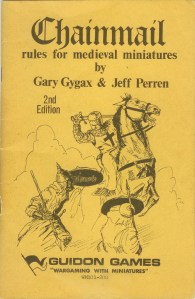
Rulebooks for these types of game were plentiful. One such rulebook published in 1971 was called Chainmail by Gary Gygax and Jeff Perrin. It did well.

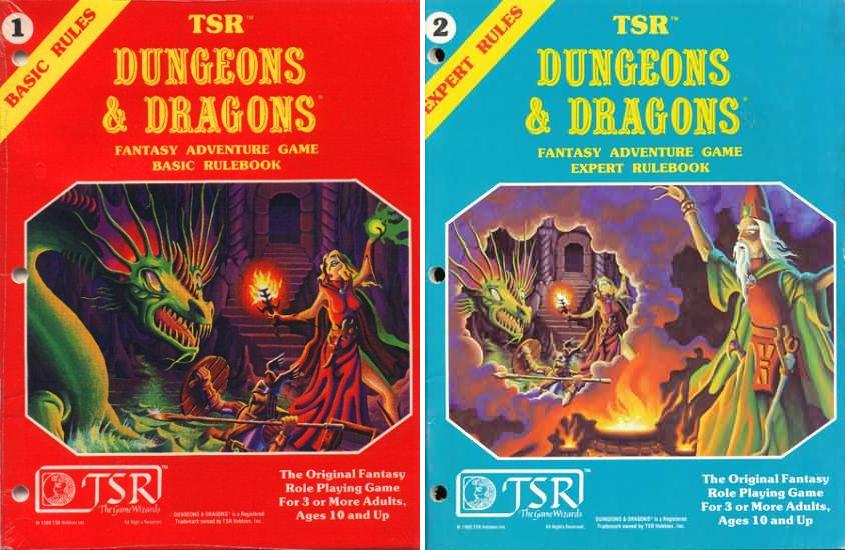
D&D1

The authors wanted to have some fun and added fantasy elements to their medieval miniatures. Instead of Charlemagne and his troops, elven soldiers took the fields. Wizards blasting bolts of fire took the place of ballista. Dragons flew overhead instead of boulders. Rules for such magical beings were informally written out.

D&D2

But what if the gamers wanted to storm the keep? What if they wanted to go after that dragon in his lair – deep within the bowels of the earth? Mass miniature battles were joined by individual characters exploring caves and castles. More rules were to help move groups of individuals instead of a mass of armies. Sometimes the gamers played the individual characters while the miniature figurines and terrain stayed in their cases.

spartan-aug70-gygax-medieval-s

The individual rules took on new type of game and required a new game system. Gygax and friends called it Dungeons and Dragons (“D&D”). D&D had simple rules that were easy to follow. With some dice, a piece of paper and a pencil, you could imagine playing a Lord-of-the-Rings elf or wizard (called a magic-user) or a Conan-esque or Fahfrd-and-The-Grey-Mouser-like fighter or thief. You could wander castles and its dungeons or deep into the bowels of the earth to root out a dragon’s lair. You could use miniatures, true, but you could do without them as well!

D&D3

Your character was based on the following attributes – basic physical and mental abilities – strength, intelligence, wisdom, dexterity, constitution and charisma. You rolled three dice and the total was your level of that attribute – 3-18. The higher the roll, the better the attribute. Fighters needed high strength, Magic Users, not so much – they needed a higher intelligence to cast their spells. Thieves? Dexterity.

And to add to the Tolkien flavor you could also become an elf or a dwarf. If you played a human you chose which class you wanted to play – the aforesaid fighter, magic user, thief, cleric (a holy healer/ fighter – think Knights Templar). Elves and dwarves had no classes – you either played an elf or a dwarf.

D&D4

                In 1977 or so, Advanced Dungeons and Dragons (AD&D) debuted. It was had new rules and changed bits of the original. It wasn’t a different, improved edition to the original. In fact for a time it was its own game. But it expanded the basics: any race (elves, human, dwarves, halfling – non-copyrightable hobbits – half-orcs, gnomes) could be any class they wanted with some limitations. Elves can be fighters and magic users now. Dwarves can’t be magic users or clerics, though. They can be thieves! Anyone can be a thief.  AD&D had its own Player’s Handbook, Dungeon Master’s Guide and book upon book of extra rules, stats on monsters and other characters one might meet in their imaginative play. It added monks for the ninja-wannabes, rangers for the Strider-ites, and bards so one can be a wandering minstrel, I …

This is about where I came in. I learned of D&D and AD&D through, of all places, church camp. I learned the basics without actually playing the game. That came in 1981 when our high school science teacher started a Dungeon & Dragons club. There I played the game for the first time – a human wizard named Mylock. The group even made the yearbook!

The game was still basic and had lots of role-play. Theater of the mind, so to speak. But the dice were still important. Let’s go back to the opening paragraphs.

“… your Dex,” says the DM (meaning roll the dice and if it is less than your Dexterity score you can, indeed, swing across on a vine).

{Roll} “Made it!” says the player.

“I throw a rope across to him,” another player says, “and tie it to the Magic User. You’re next.”

The player playing the Wizard rolls. He has a low Dexterity and the odds of him rolling below that number is smaller than the others. “Missed it!”

“You fall into the chasm, but you are tied to a rope and splat against the wall for {roll} 2 hit points (you also roll a certain amount of “hit points” – this is how healthy you are and how much damage you can take before your imaginary character dies. Magic Users don’t have a lot of hit points – fighters do to help them survive all those sword fights).

“I pull him up,” says the first player.

“Make a strength roll,” the Dungeon Master says. (Note: the Dungeon Master – DM – is the person who oversees the players, sets up the scenarios, arbitrates the rules, etc.).

{Roll} “Argh! I have a 17 Strength and rolled an 18!”

“Those are the breaks – the Magic User dangles above the abyss! But no other harm comes to him.”
“Get me outta here!” shouts the Magic User.

“I swing across,” the second player says. He also has a high dexterity and is not too worried about his odds. “Made it. I help pull up the Magic User.”

“With both of you working together, you don’t have to roll Strength, the Magic User is out of the crack and standing beside you.”

The first player says, “I throw the rope across the chasm – let’s get everyone else across before something bad spots us.”

“Too late for that …” mumbles the DM to himself, who rattles his dice and smiles.

TO BE CONTINUED…

Copyright 2014 Michael Curry
What Am I Reading? The Last Witch of Cahokia

What Am I Reading? The Last Witch of Cahokia

 LastWitch_front-Cover2-160x225

            The Last Witch of Cahokia (ISBN 9780979473746 Redoubt Books/Bluebird Publishing 2013) by Raymond Scott Edge concludes the trilogy of books beginning with Flight of the Piasa (“Flight”) and continuing with Witches of Cahokia (“Witches”).

            Here are the blogs for the previous two novels:

            You can read my review of Flight of the Piasa here: https://michaelgcurry.com/2014/07/03/what-am-i-reading-flight-of-the-piasa-by-raymond-edge/

            And my review of Witches of Cahokia here:

https://michaelgcurry.com/2014/08/02/what-am-i-reading-witches-of-cahokia/

            It is possible to read all three books alone, but this last book is really based on the events of the second. The first book is complete. The second is also complete, although the story of Snow Pine may confuse you if you do not read the first. But Last Witch (as I will refer to the third book in this little review) is based on the events of the second book: it will be difficult to read alone – although it also tells a complete tale.

            Four tales, in fact. It picks up in the days and weeks of Cahokia in all of its threads.

            1) Daniel French and his conflict with the Illini Confederation of the twenty seven female pre-Columbian skeletons.

            2) Josh Green’s “revenge” against the professors and university that wronged him,

            3) Fred Eldridge’s trip to China to examine an ancient Native American buffalo hide, and

            4) Shen Fu’s journal of meeting Wind Sage and their return to China in the early to mid-fifteenth century.

SPOILERS AHEAD

            We meet for the third time the family and friends of Daniel French. He has two problems – the first problem was introduced in Witches – the Illini Confederation demands the immediate reburial of the twenty-seven female bodies found near Cahokia Mounds.

            Daniel has meetings and discussions with the Illini Confederation and his Provost. This is a good and canny way of bringing in an Info Dump. “As you know, Bob, NAGPRA was passed in 1990 and it provides …” Subjects ranging from digs at Native American burial sites to the Mormon religion is discussed this way. The previous books had their info dumps as well, some awkward – discussing archaeological terms with fellow archaeologists – but the author whimsically gets around the awkwardness with an aside such as, “…ask a professor a simple question and you get a lecture.” A good way to get around a writer’s unavoidable conundrum.

            Daniels’ other problems deals with a mysterious character knows only as Ghost Dancer. Well, the readers know he is Josh Green, but the characters do not. Josh dug up the remains of Elijah Parish Lovejoy.

            As you know, Bob, Elijah Lovejoy was an abolitionist journalist who was killed by a pro-slavery mob in 1837, making him a martyr to the cause. See what I mean by unavoidable? His gravemarker is a nice historical site in Alton and many a speech and many a political announcements have been made there in the past nearly-two centuries. Josh sets up photo ops of the remains at various Native American massacre sites in the west and mid-west – as if he had stolen a garden gnome. He photographs the bones and mails the postcards to Daniel and the press.

            This is the “revenge” of which I speak. We follow Josh across the country in his ghoulish protest. Eventually he meets and befriends a Lakota family – Margaret, her brothers Peter, James and John and their father Poker Joe. Margaret helps Josh dry out and help redeem him. He goes through the ceremony to marry Margaret (who is excellently written as a strong and independent woman), become a member of the Lakota people, returns the Lovejoy remains, and takes up the argument against archaeological study of Native American remains.

            Throughout the book (and even on the back cover) was the mantra: “If I dug up your great-great-grandfather that would be sacrifice. If you dug up mine, that would be science, How can that be right?” the issue is discussed thoroughly through the book – particular at its end.

            The premise of course, couldn’t be further from wrong. Our European ancestors are frequently dug up and examined:

            Earlier this year ten skeletons from the Viking era were excavated in Flakstad, an island in the Norwegian Sea – some intact, some without heads – thought to be owners buried with slaves based on their diets revealed through isotope analysis.

            Also, eight graves were excavated dating from the early twelfth century in Brandenburg, Germany after being initially dug up by badgers.

            In 2008 a Templar Knight was found buried in an underground tomb near Rennes-le-Chateau in France. Did the Masons demand immediate reburial?

            The body of Sir Hugh Despenser the Younger was excavated at Hulton Abbey in Staffs, England – he is believed to be the lover of King Edward the First – hence his mutilated state.

            Then there was the news of finding King Richard III’s body under a car parking lot in early 2013. Did the royal family demand his immediate reburial?

            The point of Native Americans is that the European excavations are not put on display in museums and gift shops or held by private collectors. True – they bodies are or will be reinterred and given the respect due. Therein lay the difference, I think.

            But it brings up a point that was nagging me while reading the debate: Josh/Joseph’s stand is no different than his anarchic beliefs with the CRA – now he has an adopted family of Native Americans and the public opinion of guilty white folks to back him up. He is trying to accomplish the goals of the CRA but now through the sheen of respectability and precedent.  I didn’t buy it.

            But the author is to be commended for causing that reaction out of this reader – not condemned. This isn’t a mistake or an error on his part. To make me react this way to a fictitious character in a fictitious setting is the goal of every good writer.

            So what is the solution? The book provides one and, wisely, the solution is presented by Josh-Joseph. Thus expunging his earlier villainy in the eyes of the reader. Well, I’m with Daniel on this one; I still don’t trust him…

            In China, Fred and Marge Eldridge befriend Ben Wang, his wife Ah Cy and their daughter. Fred (and we) learns of Chinese culture as he examines the buffalo hide telling the tale of the White Buffalo Calf Women from Witches. The Cult of Ku, the bringing and cultivating of corn and the Viking rape – all events we the readers are aware from the prior book – are reviewed and examined with skepticism by Eldridge. Again Eldridge is brought to life and is a three-dimensional character as opposed to the nay-saying curmudgeon of Flight. Fred helps Ben and Ah when Ah becomes pregnant with their second child – verbotten in China – and his solution is written well. “Human rights” is the topic of discussion in these parts of the novel. What happens when my “pursuit of happiness” conflicts with others? What if there is no creator? Or there is a conflict as to who the creator is? How can these truths be self-evident if they have NOT been endowed?

            In a coincidence that only happens in novels, Fred is contacted by the same man who gave Daniel the transcript that made up the bulk of Flight – that told the tale of Sun and Snow Pine and their voyage to America and, eventually, to the cliffs of the Mississippi where the Piasa is painted.  This time he has a manuscript telling the tale of the Last Witch of Cahokia as told by a scholar names Shen Fu who travels with Admiral Zhu Wen, whom we met near the end of Witches. The last witch, who was unnamed save she was called She-Who-Waits, is given the name Wind Sage and travels with them back to China with the buffalo hide and Sun Kai’s manuscript in tow.

            It is tempting to parallel this part of the novel with Flight, but Shen Fu’s manuscript takes up only about 30+ pages of the book’s 244. It brings a nice conclusion to the witch’s line and it is fun reading Eldridge’s reaction to the manuscript. Comparing his skepticism with Daniel’s acceptance of Sun Kai’s manuscript in Flight is fun. Many times in Flight, Eldridge said to throw it out, it was fake, no one at the time wrote like that, etc. But here he was just as enthralled as Daniel with his manuscript – he asked about the historical events of the manuscript – even visited the village/city Shen Fu and Wind Sage lived. Stood on the Great Wall as they did and where they did. The writer did a good job showing the shoe on this particular foot.

END OF SPOILERS

            Last Witch pours a lot of information and brings up moral questions absent from the first two books. Between the info dumps and the morality discussions and, literally, lectures we are provided with enough information to take sides on the issues and be firm in our convictions. But we also find ourselves cheering on the peacemakers and hope they can find enough common ground to provide a reasonable solution – and hope we can do so in real life too.

            It is a novel of redemption and forgiveness and puts us in the middle of the debate between the search for knowledge versus respect for a culture’s beliefs.

            The author avoids the usual traps in books such as these – bad allegories, awkward info dumps, etc. Such things make a book preachy rather than entertaining. Witch is not preachy and VERY entertaining. I cared what happened to the characters – I hated to put it down at the end of a chapter during bedtime!

            The info dumps here are well done, although at times repetitive – the fact that the Cahokia Mound people have no known direct descendents and the Illini moved into the area centuries later is now etched in my brain.

            But that is a minor complaint – I loved all three books and will return to them in years to come. All three are quick and enjoyable reads.

            I hate to be petty, but there is one typo repeated from Flight in Witch … it’s “Shaggy” from “Scooby Doo” not “Scruffy” from “Scooby Do”. Although it‘s nit-picking, to a couch-potato boomer like me it might as well be in red type!

            Please don’t let things like that stop your enjoyment of these books. It didn’t stop me.

            Last Witch is still a Redoubt Book but published through Bluebird Publishing. My copies of the first two books were not so published. Thus the typeset and interiors of Last Witch is different from the first two. It certainly does not affect the readability of the story, but the difference is notable.

            Check the author’s website for his blog entries regarding his trip to China here: http://www.redoubtbooks.com/Author_s_Notebook.html

            Support independent authors! Support local authors! Read their books! Tell others to read their books! Post positive comments online if you enjoy it! Please?


Michael Curry


The Hobbit: The Desolation of Six Chapters

The Hobbit: The Desolation of Six Chapters
            Christmas Eve day we saw a 10:00am showing of “The Hobbit: The Desolation of Smaug”. The theater was full but not packed – with plenty of spare seats for our coats and colas – and but for a dweeb constantly texting in the row in front of us, it was a pleasant experience.
            Don’t worry; he finally stopped after I someone hit the top of his head with a kernel of popcorn.
            I liked the movie. I didn’t like it as much as the first Hobbit movie – “An Unexpected Journey” – for two reasons: the darker tone made it less likeable (although not necessarily less enjoyable) and the cliffhanger ending.
            The latter first: This would be a no-spoiler review, but there is nothing to spoil. It ended abruptly with no resolution. Some of the audience gasped and groaned. Really, folks? In this day and age in our State of Moviedom you are still surprised when the second film of a trilogy ends with a cliffhanger? The second “Matrix” and “Pirates of the Caribbean” ended the same way: lots of characters and plot points with nothing resolved. Bad move, I think. Although there may well be people who will see the third movie without first seeing the first two, they will be lost. Lost. “They started the movie with the final reel,” we would have said in the pre-digital age.
            And in a sense the makers of the third film will have…
            It is a darker movie than its predecessor. While this is not a bad thing, it does take away the fun that underlay the first movie. In “…Unexpected Journey” we got to return to Middle Earth and meet friends we thought we never would again – Bilbo, Gandalf, even Elrond. Plus we were introduced to more dwarves – eating, drinking, singing, belching and full of life. They were on a quest to reclaim their kingdom and we went along happily.
            But in “…Desolation…” the reality of the likelihood of succeeding sank in. Previously Thorin told Bilbo (and us) about the Dwarf race being scattered throughout middle earth and a return to their former glory as a united peoples by getting revenge against the forces that scattered them. This theme was echoed by Malekith in “Thor: The Dark World” to give him a bit of dimension unsuccessfully. He was going to destroy the universe to avenge his people? I’m not buying it. I’ll buy Thorin (since the names of the dwarves were taken from Germanic and Norse myths by Tolkien, the coincidence in Thor and Thorin’s names is canny) wanting to avenge his people. They were greedy, yes. Did they deserve what they got? Maybe. Are we rooting for them to get their kingdom back? By the third movie I’ll have spent about $300.00 bucks in tickets, popcorn, gas, after-movie dining and shopping. What do youthink? 😉
            Aside, but not a spoiler: Tolkien mentioned in his notes and other references that Thror, King Under the Mountain (Thorin’s grandfather) owned one of the seven Dwarven Rings of Power that gave him his uncontrollable lust for riches, which thus led to the downfall of the race. I have been waiting for a reference to that in the movie. If it is revealed in the third film, slated for July 2014 and tentatively called “There and Back Again”; you heard it here first.
            The movie is dark because the theme throughout is desperation.
            It begins with the dwarves, Bilbo and Gandalf being pursued by the orcs from the end of the first film. While they trudged through the tundra I wished someone would have said, “You know, we could have asked the eagles to fly us to the Lonely Mountain …” “Still your tongue,” says Gandalf. It would have gotten a laugh from the audience and resolved a big plot hole from both Hobbit and Lord of the Rings…
            They get refuge from the orcs at the home of Beorn, a skin changer. We despair for him as he is the last of his race. We care for this new and powerful ally.
            Gandalf leaves the party as they enter Mirkwood. In the book we learn he leaves to fight the Necromancer; in the movie we see the first part of that battle. Gandalf and Radagast go to the prison/tomb of the Nazgul/Ring Wraiths. They have escaped – more likely they have been released. Gandalf goes alone to Don Guldur to battle the Necromancer, whose identity is revealed. It ends with Gandalf pinned to a wall surrounded by an orc army and the Necromancer.
            The dwarves are caught by the Mirkwood spiders in a scene very much like the novel, a unique thing so far in the movie adaptations. Then on to the elven kingdom in Mirkwood (I can’t find its name on the internet) where we meet its king, Thranduil. He is desperately protecting his kingdom from the approaching murk – the spiders are but a sign of greater evil to come and he eventually closes his kingdom to outsiders. Thorin’s quest is folly, he believes, and will bring only additional woe to the world.
            The dwarves escape in barrels as per the novel and after another run-in with the orcs make their way to Laketown with the help of Bard. The people of Laketown despair under an autocratic regime; the Master of Laketown (played with oily glee by the wonderful Stephen Fry) is desperately trying to keep control of Laketown despite rumors of … elections?! And Bard despairs over his life and family – he is on the Master’s naughty list and has the stigma of being descended from the man who should have destroyed Smaug but could not.
            The dwarves make it to the secret passageway into the Lonely Mountain and despair that they cannot find the opening before their time expires. You feel their sadness and desperation as they realize their quest has sunk along with the setting sun.
            Once Smaug is revealed, we despair with Bilbo – how will he make it out of Erebor alive? We cheer the dwarves’ battle with Smaug, but do we honestly think they even have a chance?
            Hence a movie much darker than its predecessor.
            The film covers six chapters and (in my edition) one hundred and eleven pages of the novel. The movie clocks in at one hundred and sixty minutes. That’s about as long as it would take to read one hundred and eleven pages. As with the previous movie, there are plentyof scenes not from the book.
            As I mentioned in my review of “…Unexpected Journey” http://michaelgcurry.blogspot.com/2013/01/the-hobbit-expected-movie.html, I don’t mind that. Two reasons: 1) anyone who goes to movies nowadays expecting a word-for-word re-enactment of a novel might as well stay home – why do people like that go to movies anyway? Stay home and yell at the clouds. It will have the same effect and results; and 2) I enjoy any excuse to stay in Middle Earth. Peter Jackson keeps the feel and flair of Tolkien’s invented world in his new material. Fear not – we are in good hands.
            The biggest news before the movie release was the introduction of Tauriel – the head of the Elven guard of Mirkwood. She and Legolas are … kind of … romantically linked.
            Much was also made of Legolas appearing in the film. Of all the characters from “Lord of the Rings” to appear in The Hobbit trilogy, he is the most canny – this is where he lived, his father is the king, he would have been alive during the events of the Hobbit, so why not? Orlando Bloom is obviously older and a little thicker in the face here, but that is a minor quibble. His character is also darker and more cynical – in keeping with his father and his kingdom’s mood. Perhaps his time with the Fellowship revived (or created) a confidence for and loyalty with other races.
            The orcs continue to torment Bilbo and the dwarves even in Laketown. In the Lord of the Rings movie trilogy we had the “Elf Break”. Anytime there were scenes with Arwen or other elves it was a fine time to go to the bathroom, get a refill of popcorn and drink, go smoke, make a phone call, and so on. In the Hobbit movies we have the “Chase Break” – anytime there is a chase scene one can find time to do the same. The chase scenes are overlong – those criticisms are correct.  Thrilling? Yes! Can be done in half the time? Yes. Oh, I miss some fine special effects and CGI acrobatics, but if ya gotta go ya gotta go! And I don’t miss much of the plot. “What happened?” I asked my wife when I got back from the potty during the orc battle/barrel scene. “This,” she gestured to the screen during the final moments of the orc battle/barrel scene.
            Much is made of Bard’s sneaking around Laketown with the dwarves. Spies were everywhere and the Master and his lackey showed themselves as self-preserving minor villains. Funny how the dark aspects of the movie truly reared their heads when humans entered the movie. Not so funny, really.
            And the battle with Smaug in Erebor was thrilling. The dwarves fought valiantly and Thorin’s idea as to how to defeat Smaug is obvious but done well. If you read the book, you know how successful they will be in defeating Smaug, but you will cheer them on and catch yourself hoping they succeed – which is the point.
            The dialogue between Bilbo and Smaug is overlong and overwrought. But it was that way in the book, too. You don’t think Peter Jackson would miss not filming the only unnecessary lengthy part of the novel, do you?
            Fili received a near-fatal wound and had to stay in Laketown with his brother and Tauriel. There is the beginning of a romance between them in the best Florence Nightingale syndrome.  Legolas, you can imagine, seethes at the budding affection between elf and dwarf.
            Speaking of Legolas, he is last seen following the orc band out of Laketown. How much of the third movie will be dedicated to his plot thread?
            There were a few bits that bugged me, honest critiques of an otherwise great film:
1)      the special effects are nearly perfect. Nearly. One of the biggest goofs in “The Two Towers” was Legolas jumping on a galloping horse. His arm extended longer than was natural and the CGI was obvious.  There were more than a few times this happened in “… Desolation…” especially during the fight and chase scenes. Also, at times the forced perspective looks forced. You can tell the actor playing Beorn is speaking to air while the actor playing Thorin sits further back on the stage pretending to listen – as though they are face to face. This allows the actor playing Thorin to look smaller – dwarf-size – than his probably-same-size fellow actor. Things like this remind me I am in a theater watching a movie rather than being immersed elsewhere…
2)      The obvious foreshadowing of what will happen in the third movie. When Smaug first attacked, the only things that could pierce his hide were Black Arrows (harpoons) shot from special harpoon guns. The rumor is that one Arrow managed to flick off a piece of Smaug’s armor. But the person in charge of shooting the arrows, Bard’s ancestor, failed to kill Smaug. The citizenry of Laketown still blame Bard. One harpoon gun remains and it is revealed Bard still keeps one last Black Arrow. Gee, do you think he will ever find the opportunity to use it? Against … Smaug perhaps? Will he be able to find that one sweet spot and redeem himself and his ancestor? If this were marching down Main Street would the answer be more obvious?
            Minor quibbles really, in the face of a masterful movie. Go see it and enjoy it!
Copyright 2013 Michael G Curry


(adsbygoogle = window.adsbygoogle || []).push({});

A review of “Thor – the Dark World” (no spoilers edition)

A review of “Thor – the Dark World” (no spoilers edition)

(adsbygoogle = window.adsbygoogle || []).push({});             The movie starts with a voice-over recounting an epic battle from ages past. The Lord of all things evil wants to take the world back to the darkness over which he rules. He takes a part of his dark essence and creates a tangible symbol of his power.
            Eventually he is defeated by the powers of good and his symbol is hidden through the ages.
            The symbol is found by a citizen of Middle Earth; a citizen who appears to be one of its weakest members but contains hidden strength. 
            The re-discovery of his symbol awakens the Dark Lord, who again masses all things evil into another pitched battle against the forces of good. Should good fail, the entire universe will be taken over by darkness… 
            But enough about “Lord of the Rings”, this is a review of “Thor, the Dark World”.
            Oh, wait, they both start out like that.
            In “Thor…” Sauron is called Malekith, played by former Doctor Who Christopher Eccleston, whose make-up is reminiscent of 2009’s “Star Trek” baddie Nero.  For a time during the show I thought it may have been the same actor. I doubted the producers would have been that dumb to cast the same actor in a similar role with identical make-up, though.
            Malekith the Accursed was created by the superb comic book writer/artist Walter Simonson. He received a byline deep into the closing credits. I hope Marvel managed to pry open its billion-dollar coffer to give him his complementary free ticket as thanks for the millions of dollars this movie will rake in with the help of his creation.
            The movie picks up where the last “Thor” movie and “The Avengers” left off. As is and will be the routine for these Marvel movies (and for Marvel Comics as well), these are shared-world movies – it is all interconnected. Events from one movie spill into the other movies. There is even a cameo/crossover to wonderful affect with a certain shield-slinging Avenger.
            The plot – after the battle at the end of the Second Age – er – the battle with Malekith, the One Ring – er – the Aether is discovered by Deagol – er – Jane Foster. It takes over her body and will eventually destroy her if a cure is not found.
            Just as had happened five thousand years ago during the first battle with Malekith, the Nine Worlds are converging. Physics will go awry and it will be easy to travel amongst the worlds.
            So Thor finds Jane and takes her to Asgard. Not coincidentally, Malekith invades Asgard to get back the Aether out of Miss Jane. Chaos ensues.
            Beating back the invasion is costly and Thor wants to take the battle to Malekith. Odin forbids it. So Thor, as any son would, sneaks behind his father’s back with the help of his friends and his imprisoned brother Loki.
            Meanwhile, Malekith travels to earth to begin the process that will envelope the universe in darkness. The Convergence will make this easier since, from Midgard, he will have access to all realms.
            Thor, Jane and her seemingly incompetent scientific team are all that stand in the way of the coming darkness.
           
            Chris Hemsworth does an excellent job in his third go-round as the Thunder God. I like him better here than in the first movie. It is nice seeing Thor at full power.
            Anthony Hopkins returns as the scene-chewing Odin –ever barking and snapping at his lines with his usual gusto. I love him as Odin and hoped he would have a bigger role in the battle scenes. Alas.
            We DO get to see Rene Russo as Thor’s mother Frigga kick some ass though.
            Idris Elba as Heimdall also as a bigger role here. I hope to see more of him in future movies.
            The aforesaid Eccleston as Malekith makes a very good villain, but there’s not much else for him to do other than thrust the Aether at Thor time and again. There’s not much motivation for him in this movie other than to “destroy the universe”. Yeah, get in line. There is a small bit about his wanting to avenge his people, but, ye gods (pardon the pun), his people started it. This isn’t about revenge – this is just a second go-round. Perhaps if we were to feel more empathy for a dying race Malekith would have been a bit more well-rounded as a villain.
            Jane’s compatriots return in this movie – Dr. Selvig still recovering from his role in helping Loki in “The Avengers” and Jane’s intern, the annoying Darcy (her comic relief is unnecessary; this is meant as to the character not the actress portraying her). And now Darcy has her own intern, an equally annoying and incompetent Britisher. Of course after all this comic relief we then have to take them seriously during the final battle. It baffles me that filmmakers think after two hours of laughing at these dolts we will suddenly accept their sudden conversion to adequacy.
            Loki is again played by Tom Hiddleston and as with both “Thor” and “The Avengers” he steals every scene his is in. Here is a villain whose motivations are as clear as they are complex – unlike Sauron or Malekith.  Throughout the film, until its very end, you have no idea whose side he is on.  Well, that’s not true – you know he is always on HIS side, but his alliances have so many twists and turns it keeps your attention during the movie.  Oh, and the aforementioned “get in line”? One of Loki’s best cracks in the film…
            And the movie keeps your attention. It’s not a great film – not as jaw-dropping as Thor’s last film appearance, but on par with the other Marvel movies to date (only the first “Iron Man” has yet to raise the same goose bumps as “The Avengers” did).
            The effects are smashing, pun intended. The faux-Shakespearian dialogue is still a hoot and Thor is easy to cheer on as he battles to save us all.
            It is worth waiting until after the first few minutes of credits (after an excellently-done cast roll call) to watch a set-up of either a future Thor or Avengers movie plot. The final scene after the rolling credits – where we learn the names of the grips and gaffers – is not as satisfying and is worth waiting until it is out of DVD or on-line viewing. It is not worth the dirty looks from the theater crew waiting for you to leave so they can sweep up your popcorn. There’s no Nick Fury asking Thor to join the Avengers; there’s no surprise guest-hero or guest-villain – the bit after the casting credits takes care of that.
            Good movie. Go see it in the theaters to get the whole effect of the vastness of the subject. Enjoy.
Copyright 2013 Michael G Curry


Fall of the Titans

Fall of the Titans
 
            In the last two months we’ve lost some giants. They were icons of their individual fields that were imitated and emulated but stood alone on their own shelves – no one coming close to their level.
***
            Ray Harryhausen died in May at the age of 92. His stop-motion animation made the fantasy sequences of his movies real, especially to an impressionable youngster with a love of fantasy and monster movies. The Beast from 20,000 Fathoms was real. Mighty Joe Young was real. The skeletons that fought Jason – real. The Kraken, Medusa and Pegasus from “Clash of the Titans” were better actors than Olivier.
            And “The Valley of Gwangi”. Ray assured himself a special place in heaven with “The Valley of Gwangi”.
            Without him I would be taking Jean-Luc Godard and Dziga Vertov seriously.
            A friend’s mother went to high school with him. Her mother still has the year book. Isn’t that cool?
            It’s very easy in this cynical age to look back and say how cheesy his artistry was. “Look at Lord of the Rings,” one would say, “how can any of his work compare to that?” The answer is simple – the son always strives to be better than the father. Peter Jackson would be the first to agree.
            Watch the battle between Jason of “…and the Argonauts” and the undead skeletons near the end of the movie. Imagine you are eight years old. Did you fold your legs under you on your seat?  Were you afraid of a boney hand brushing your ankle from under the sofa? No? You are lying.
            He made me believe in monsters said “Shaun of the Deaddirector Edgar Wright in a memoriam.  Thank you, Ray, for making us believe.
***
            George Jones died in April at age 81. He was one of the last great country singers of his era. For almost sixty years he ruled the country music roost. If there was an award, he won it. His music was of a kind only imitated now.
            His signature tune, “He Stopped Loving Her Today” has been called the greatest country song of all time. It is certainly one of the saddest songs of all time. But that is saying the same thing, isn’t it?
***
            Jonathan Winters died in April at the age of 88. He was a comedian. No one, no one, has been able to match his styling. He didn’t do stand up, he didn’t do monologues, he didn’t do wry political commentary. He did one-man acts; skits with his own sound effects.
            Some comedians start with, “two Jews walk into a bar…”  Winters started with “Colonel, the Apaches are lining the hills…”, or
            “(affecting an elderly lady’s voice) Oh, what a lovely day for a drive…”, or
            “Did you ever undress in front of your dog?”  I laugh out loud still thinking of this bit. I smiled while typing it.
            “Are you queer?” “No, I’m homosexual. My little brother’s queer. He collects little bugs.”
            Marvin Kaplan, his co-star in “It’s a Mad Mad Mad Mad World” said he worked with two geniuses in his life – Charlie Chaplin and Jonathan Winters. Watch him discuss his time in that movie with Winters giggling alongside at http://www.youtube.com/watch?v=JD5WeFCcu68.
            Jonathan Winters was on Scooby-Doo, he was Papa Smurf, and he was on the Muppet Show. You can see the exact moment Frank Oz as Fozzy Bear gave up trying to improvise with him. The crew’s laughter drowned out the laugh track.
            Robin Williams is the only comedian who has come close to the weird and manic ways of Winters comedy-style; and even he admits he didn’t come close.
            Was he insane? He spent time in a mental institution. But he channeled any mental illness he suffered into a useful and beneficial way. He made us laugh. He made us laugh until our bellies hurt.  Goodbye old friend.
***
            We’ve lost two other artists who I will miss as well. Not the titans of their genre, but I was still saddened by their deaths.
            Richie Havens was a folk artist with a very unique guitar playing style. He died in April at age 72. He will be renowned for being the opening act at Woodstock, but he should also be known for his music. Among his accomplishments include something extremely rare: He remade “Here Comes the Sun” in a version more beautiful that the Beatles’ version.
            Ray Manzarek died at 74 in May. If he had not founded the Doors with Jim Morrison, he would have been known as a great keyboardist – either in rock or jazz. If he would not have stayed in the music business he probably would have been a professor of music at a distinguished university.  I interviewed him in the late 1980s and he was extremely intelligent and funny. He talked about the influence for his opening riff on “Light My Fire” and his relationship with Jim Morrison. He sang on a few Doors song – notably “Close To You”. 
Copyright 2013 Michael G. Curry

The Hobbit: An Expected Movie…

The Hobbit: An Expected Movie…
               Today being the 121st anniversary of the birth of JRR Tolkien, I thought it appropriate to have a brief review of the latest movie based on “The Hobbit”.
               My wife and I saw “The Hobbit: An Unexpected Journey” New Year’s Eve morning.  Although the film was in its third week as the #1 movie, there were only about twenty others in the theater – including one family we knew from the local library’s monthly Game Day.
               I enjoyed “The Hobbit” more than “Lord of the Rings”. Purists are spitting at me and preparing their flaming responses. True purists are angry that I enjoyed either (that does not upset me – if there is still anyone that, after a century of movie-making, still expects a film to follow the novel on which it is based; that person is a fool and should avoid movies altogether).
               I love the Lord of the Rings trilogy. Love it! But I enjoyed the Hobbit more and for different reasons.
               Note that during this little review I am referring to all three movies comprising the “Lord of the Rings” trilogy as one, whereas I will only be discussing “The Hobbit: An Unexpected Journey” by itself. I suspect I will have trouble keeping the names of the three Hobbit movies straight – the names of the individual LOTR movies in the trilogy are named from the books. When I refer to “The Hobbit”, I am talking about the first movie, “An Unexpected Journey”.
               My first thoughts after watching the Hobbit:  LOTR is looking at Michelangelo’s paintings on the ceiling of the Sistine Chapel; The Hobbit is looking at my three-year-old attempt to write her name. LOTR is viewing the Grand Canyon; The Hobbit is watching kittens and puppies play. LOTR is listening to a first-class symphony perfecting a complicated piece; The Hobbit is listening to and watching a ceilidh.
               LOTR filled me with awe and I spent most of the movie with my jaw dropped; I spent much of The Hobbit giggling. I laughed more during the first Hobbit film than I did during the entire LOTR trilogy. LOTR was the epic and apocalyptic battle that ending an era and ushered in the Age of Men. The Hobbit was about leaving home and going home.  There and back again.  The characters in LOTR were weary and wary. “Why did this have to happen during my time?”  The characters of The Hobbit wondered what was in their pockets.
               Both movies dealt with the very small. This was done in LOTR under the umbrella of an epic. It showed that even the least of us can make a difference – sometimes a big difference. The Hobbit has the same lesson but on a more accessible scale. Here are dwarves – themselves admitting that with one exception they are not the mightiest warriors – fighting to get their home back. They are aided by a mighty wizard (at this point we are not supposed to know Gandalf is an immortal Istari), and (for reasons yet to be explained) a burglar.
               The main character is a man at ease in his skin. He enjoys a good book in a good chair in his good home; that is until a strange visitor whisks him off and changes his life forever.  I am talking about Bilbo Baggins. I am also talking about Dr. John Watson of “Sherlock” and Arthur Dent of “The Hitchhiker’s Guide to the Galaxy”. All three have been played by Martin Freeman – who has by now perfected the art of incredulousness.  Ironically his partner in “Sherlock” – Benedict Cumberbatch – will play the Necromancer. I wonder if they will have any scenes together. Cumberbatch also does the voice of Smaug – who shares many a soliloquy with Bilbo, but voiceovers don’t count.
               The scenery and score were as majestic as LOTR. In that respect, the bar placed so high with the first trilogy was met.
               I was expecting some of the critiques of “The Hobbit” – overlong scenes not in the book, scenes taken from Tolkien’s other works to pad this greed-machine into its three films:  things like the character of Azog, a passing name in one line of the novel but given the role of chief villain of this first movie (Smaug and the Necromancer being the other two baddies to come, presumably); the meeting of the White Council – another line or two from the novel given a long but important (yet not vital) scene, etc.
               These did not bother me so much. Who wouldn’t enjoy spending more time in this vision of Middle Earth? If this represents the quality of added scenes, by all means add them! Add more!
               The trolls in LOTR were near-mindless brutes; in the Hobbit they could have been extras from “My Fair Lady”. I expected them to start singing “Any Old Iron” or “My Old Man Said to Follow the Van”. The AD&D player in me screams, “But these were mountain trolls, not cave trolls – an intelligence of 10 as opposed to 7…”  The truth is “The Hobbit” was written for children and the trolls’ names and actions were done for comic, although still scary, effect.
               Ditto the Great Goblin, played by Barry Humphries – more famous as Dame Edna. In LOTR goblins and/or orcs were vile and brutal beast-men.  In the Hobbit they are not as bestial.  Silly, in fact, as in the case of the Great Goblin. Think Jabba the Hut (the resemblance is notable) as the villain of the piece compared to Darth Vader (from the first two movies, not the wuss from the later trilogies…). Being used to the snarling cannibals of LOTR, his wise-cracks were off-putting (“did he just say that?”). I would not have been more surprised if he addressed Thorin as “dude”.
               Sylvester McCoy was just as silly as Radagast the Brown – mentioned but never seen in the novel (he has a cameo in the LOTR novels but not the film trilogy) and given an important role in the movie. I think if the two blue wizards (Alatar and Pallando) appear I might join in the protests – but McCoy as Radagast?  More giggly fun!
               The only criticism that resonated with me was the “sexy dwarves”. I realize the producers’ problem – you can’t have thirteen characters with paper-thin personalities take up nine hours of a movie. In fact, the only ones with any traits at all in the novel were the gluttonous Bombur (and that was his trait – gluttony) and Thorin (epitomizing greed).  And even if every dwarf is given a personality (which the producers try to do with some effect), it is difficult when they all look like Santa Claus or members of ZZ Top. So the dwarves are given smaller noses and little if any facial hair – as opposed to the hirsute dwarves spotted in LOTR. In fact, when they meet and argue at Bag End they resemble Klingons more than dwarves.
               It will be interesting to see if they continue to expand on the lives and lifestyles of dwarves. LOTR certainly showed us the way of elves. Maybe we will see dwarves as more than sidekicks (one can hope, unlikely as that may be). I did enjoy them saying they were a homeless race – they were tinkers, toymakers, smithies, but not a united peoples. Nice touch. I want more of that.
               I was pleased to see cameos by Elijah Wood and Ian Holm. I doubt these were outtakes from LOTR or we would have seen them in the hours-could-be-measured-in-days extra scenes from the various DVDs. I was worried when that started announcing the returning cast of “The Hobbit” – Orlando Bloom as Legolas, Cate Blanchett as Galadriel. “Great,” I said, “is there any character from LOTR that was actually IN ‘The Hobbit’ going to be in the film?” Yes, Gandalf, Elrond and Gollum all played – and played well – by the original cast members from LOTR (Ian McKellen, Hugo Weaving, and Andy Serkis respectively).  Christopher Lee is still sinister as Saruman – I had known the White Counsel was part of the movie, so why was I so surprised he reprised his role?
               Do not worry about the movie being too long and being padded to make even more money. Relax. Enjoy it.  Rather than be miffed, relish this visit with some old friends. “The Hobbit” was a joyful treat – how can that be a bad thing?