The CW’s Supergirl, a review

A DC-TV Primer: the CW Network’s superhero lineup

Monday: Supergirl

Part One

From Wikipedia (why should I do all the work?):

CONTAINS SPOILERS FOR SEASON ONE

Kara Zor-El (Melissa Benoist) was sent to Earth from the doomed planet Krypton as a 12-year-old by her parents Zor-El (Robert Gant) and Alura (Laura Benanti). Alura gave her instructions to protect her infant cousin Kal-El, and informed her that she, like her cousin, would have extraordinary powers under Earth’s yellow sun.

En route to Earth, Kara’s spacecraft was diverted by a shock wave from Krypton’s explosion and forced into the Phantom Zone, where it stayed for 24 years. During this period, time stopped for Kara so, when the spacecraft eventually escaped the Phantom Zone, she still appeared to be a 13-year-old girl. By the time the spacecraft crash landed on Earth, Kal-El had grown up and become Superman. After helping her out of the craft, Superman took Kara to be adopted by his friends, the Danvers family. The main series begins more than a decade later when the now 24-year-old Kara is learning to embrace her powers after previously hiding them.

Kara hid her powers for more than a decade, believing that Earth didn’t need another hero. However, she has to reveal her powers to thwart an unexpected disaster, setting her on her own journey of heroism as National City’s protector. Kara discovers that hundreds of the criminals her mother prosecuted as a judge on Krypton are hiding on Earth, including her mother’s twin sister Astra (also played by Benanti) and Astra’s husband Non (Chris Vance), who seek to rule the world. After briefly becoming suspicious of the true agenda of her boss, Hank Henshaw (David Harewood), she and her adoptive sister, Alex Danvers (Chyler Leigh), secretly discover that Henshaw is actually a benevolent alien refugee, J’onn J’onzz, who has resided on Earth for over fifty years after escaping a holocaust on his homeworld of Mars. J’onn infiltrated the DEO to reform the organization as well as to watch over both Alex and Kara in addition to guiding the latter in the use of her powers due to his experience with his own abilities. Kara is also being targeted by Earth’s criminals as the result of her being related to Superman, and later on encounters an emerging community of metahumans and individuals from parallel universes. In the process, Kara accumulates her own rogues gallery who seeks to defeat and destroy her. She is aided by a few close friends and family who guard her secrets—most notably her cousin’s longtime friend, James Olsen (Mehcad Brooks)—which also serves as a major plot in high tech mogul Maxwell Lord’s (Peter Facinelli) scheme to expose Kara’s identity.

***

            I adore this show. The few things I do NOT like about it are minimal, honestly.

The show is wonderful fun. Like the Flash, Supergirl tells us how much she enjoys being a superhero. No dark and brooding angst about being a hero! What little angst there is deals with normal emotional turmoil – balancing work and play, love and commitment.  Just like the rest of us! But overall the show exudes joy.

This is even more amazing considering the content compared to other DC-CW shows: In Arrow the main villain could (and tries to) destroy Star(ling) City. In Flash the main villains want to destroy … well … the Flash. The villains in Supergirl have the power to destroy the earth and everyone in it, have lunch, and then destroy Venus for snicks and giggles. That could be absolutely terrifying! But it’s not.

Don’t take that to mean the show is lightweight, or aimed at children. It just shows how much unbridled fun the show is even during tense moments..


DC characters abound – from villains (Hellgrammite, White Martians) to secondary characters (Lucy Lane). All lovingly plucked from the comics.

There are plenty of DC Easter Eggs to bring a smile or to make us worry. In the comics, Hank Henshaw (here the head of the DEO) is, in the comics, the evil Superman-Cyborg. When the character from the show intimates that he has a deep dark secret, comic book fans raise their eyebrows. “Aha! He’s going to become the evil cyborg!” Is he?

The major difference to Supergirl’s comic book origins (which has been tweaked over the years) is the addition of her adopted sister Alex. It adds to the show and its characters and is not a bad idea. If DC decided to make it comic book canon, I would not object. Trouble is, in modern comics her life expectancy would be quite short.

One episode is a reworking of the best Superman story ever printed: Action Comics Annual #11’s “For the Man Who Has Everything” by Alan Moore and Dave Gibbons, with Supergirl trapped by the Black Mercy instead of the Man of Steel. When I saw the opening scene and the alien plant attached to Supergirl I about hit the floor! It was a great adaptation!

A nice non-comic book Easter egg is the casting of Dean Cain and Helen Slater as her adopted parents. Slater played Supergirl in the 1984 movie and Cain played Superman in Lois & Clark: the New Adventures of Superman. It is little things like this that bring a smile to this old cynic: Berlanti Productions gives a damn enough about the comics to give us these treats.


You can tell the cast enjoys what they are doing, too. Melissa Benoist is phenomenal as Supergirl. She portrays an innocence (and a young person’s temper and frustration) and yet she will not hesitate to let you know she could pinch your head off with her thumb and forefinger.  Frankly she is cuter as flighty and naïve Kara Danvers.  Kara is a slightly less of a She-Geek than Arrow’s Felicity Smoak, but you can’t help but compare. Imagine if Mary Tyler Moore played the role of Mary Richards at age 24. Benoist is that good.


The show has a few drawbacks, in my opinion: More on those next time.


Original Material Copyright 2016 Michael Curry


Characters mentioned and their images are copyright their respective holders.  Thanks to DC Comics, the CW Network and Berlanti Productions and the actors portrayed for the use of their images.

I also thank the original creators of all characters mentioned, whether or not they have been properly compensated (gratmens during the credits aside).

The CW Network’s Superhero line-up!

A DC-TV Primer: the CW Network’s superhero lineup,

Introduction

Note: I have never been sure of the proper way to stylize the names of books, movies and television shows. Some say to italicize the titles of books and put the titles of TV shows and movies in quotes. Some say it is the other way around. I do not care, frankly, I never have. As long as it is consistent throughout the piece I am reading. If the next blog or article or book then does something different – it doesn’t bother me as long as it is consistent within that same text. I italicize both comic book titles and movie and TV program names in this exercise. It may be wrong, but at least it is consistent.


When I think of the CW Network’s lineup of DC Comics superheroes my mind goes back to the fall of 1976.

At that time DC created what we would now call an imprint line of four comic books. An “imprint” is a series of comic books that are not necessarily part of the line’s mainstream comic. The imprint books share a similar theme. There have been imprints aimed solely at children, for example. The Image imprint featured comics with mature themes and art – not for the kids – with creator-owned characters. The Milestone imprint from DC comics was set in a comic book universe outside that of Superman and Batman and featured African American characters and creators.

In 1976 four comics were published by DC with a television theme. DC-TV they called it, and the company even changed its logo for these comic books. The four comics featured television shows that aired at the time (or were about to debut): Superfriends, Welcome Back Kotter and Isis (no, not that Isis) debuted. The fourth was Shazam (the adventures of the original Captain Marvel – but DC dare not use his name on any comic book covers lest Marvel Comics finally get their sweet litigious revenge on National Comics … but that is a whole other story), a comic that had been around for a few years but was on hiatus until the Saturday morning live-action show aired. Kotter and Isis lasted ten and eight issues respectively, Shazam started their TV run with #25 and lasted through #33; after that it changed its style for the next two issues before cancellation (although the character and title continue to be revived these forty years later). Superfriends lasted for several more years – until 1981 over 47 issues – boosted not only by the successful cartoon but also by the familiarity of the characters – Superman, Wonder Woman, Batman and Robin.

Reviews and commentary of those four comics would make a fun blog series … maybe given time I will do it!

Forward to 2016. Forty years on I am tickled to see history repeat itself with another DC-TV connection.

This fall season the CW network will air a superhero program based on DC characters each weeknight Monday through Thursday (the rumor of Constantine being added on Fridays are unfortunately untrue).

DC has published comic books based on the shows – or has added some of the television regulars to their existing continuity (in the Flash comic book for example).

This blog series will be a primer for those who (like me) are finally jumping into the new DC-TV pool of programs. I hope to discuss and review all four (maybe five) shows that are soon to begin their new seasons on the CW.

Starting your viewing at this point (particularly Arrow, which begins its fifth season) will only make you … Lost, if you get my meaning.

I promise that I will use spoiler alerts. But you will generally learn nothing that you won’t be able to find out on IMDB and on the “Previously on …” front tags of each show.

***

My only child turns seven in October, right around the time the CW will begin its new season. She loves to read and play games – whether board games or on the computer.

This means that my days of staring at a parade of purple dinosaurs, child explorers and a prime-colored Australian singing quartet are done. Oh, I still have to sit through Frozen every few days, or some other Disneyanic Princess derivation, but shows aimed at children … no more.

So of course I fill my time watching TV shows about super-heroes!!

Hey, you can’t watch the Sopranos all the time …

***

I heard good things about the CW line-up from Facebook and “real” (haha) friends and I was finally able to see what all their posts and comments were about.

Netflix has the first three seasons of Arrow and the first season of Flash available for binge-watching. The entire run of Constantine is available on the CW’s website, and the network is rerunning Supergirl and Legends of Tomorrow until their new seasons start. CW is only running a few episodes from seasons four and two of Arrow and Flash respectively. I hope the entire season will soon be on Netflix or elsewhere before or during the new seasons. I don’t mind keeping the shows on Tivo for a few weeks while I catch up.

The only trouble is these shows are linked.

Don’t stop reading! By that I mean that the shows cross over, but they are not one long continued story. You won’t have to jump from one program to another! So don’t panic. In comic book terms, they share the same universe.

(They WILL do have a continued storyline during November sweeps – Supergirl will be chasing a villain through all four shows during one week.)

It’s been done. Remember when Murder She Wrote and Magnum PI had a continued story? There were two (I think) great Law & Order/Homicide shared storylines too. NBC was notorious for this in the 1980s and 1990s: one example is a hurricane hitting Florida affecting the plots of the Golden Girls, Nurses and Empty Nest all in one evening’s programming.

And who can forget the universal nexus of Sam’s General Store in the Beverly Hillbillies/Petticoat Junction/Green Acres?  (Try as I might … )

Here’s what I mean:

The explosion that opened the Flash series is mentioned in Arrow. When the character Arrow (note that the TV show is italicized, the character is not) changes his costume slightly, Flash mentions it. Flash and Arrow regular Felicity Smoak had a brief romance. Heroes, side-characters and villains would pop up in each other’s programs.

I watched Flash first. By the time of Flash season one, Arrow was in season three. It did not make for confused viewing, but it gave away some of the plot points when I later watched early Arrow episodes (we meet Felicity and Diggle in Season One of Arrow – will they be allies or enemies? It was fun to watch the development, but I already knew the outcome). And there WERE some spoilers, “I’m sorry to hear about so-and-so’s death.” Arrgh!

***

I will do my reviews in the order in which the episodes will air: Supergirl first, then Flash, Arrow, Legends of Tomorrow and finally Constantine (as of the writing of this blog series, Constantine has not yet been officially added to the line-up. I’ll discuss it anyway; I am a big fan of the show having finally seen it and would LOVE to have it added).


DC-TV.


Again.


Original Material Copyright 2016 Michael Curry


Characters mentioned and their images are copyright their respective holders.  Thanks to DC Comics, the CW Network and Berlanti Productions and the actors portrayed for the use of their images.

I also thank the original creators of all characters mentioned, whether or not they have been properly compensated (gratmens during the credits aside).

Beatlemania at its most … high!

A review of Eight Days a Week; the Touring Years

A film by Ron Howard

Part Three: 1965 – Beatlemania at its most … high!


Read Part one here.

Read Part two here


A film chronologically showing the Beatles touring and recording during the years of Beatlemania.

52 minutes (and three years) into the film we have an interlude focusing on George Martin. With Martin’s brief bio (Goon Show producer, he explains how he “produces” a Beatle song) we see a longer segment of the Fabs working in the studio than anywhere else in the movie except at the ending.

But who is complaining? We get to hear the evolution of the song Eight Days a Week – from which the movie gets its title – beginning as a demo to rehearsing the “Oooo”s to the final song. Wonderful!

This segment has my favorite line. Ringo: “On the early records, George Martin was a god.”

“Later ones, too,” I shouted from my couch in the living room! Good for you, Ringo!

For the Mania Years (as opposed to the Studio Years), 1965 was the band’s highlight. The Beatles were the first band to do a stadium tour, including the now-legendary Shea stadium performance in front of 56,000 people (bootlegs of the show on DVD and VHS can still be found – the picture and sound quality are wonderful but WARNING: the music MAY have been reproduced by the Fabs sometime later and dubbed in).

The Fabs, in current interviews as well as old ones, discuss how awful their performances were becoming. They could not hear themselves on their monitors. Ringo said he had to watch John or Paul to see when a song ended.  Baseball stadiums used their own sound systems in which it was hard enough to hear at-bat announcements let alone rock music. The film gave an example of what the Beatles’ concert must have sounded like through that kind of system. An AM signal going through a tunnel was clearer…

But I disagree. I have always disagreed with that. The few legitimately-recorded concerts (where the producers strived for quality) – such as the Shea stadium (although some of it may have been overdubbed by the Fabs themselves), the Hollywood Bowl (the only – to date – legitimate Mania-era live performance released as an album) and 1966’s Budokan shows were excellent! Not superb, but they were great and exciting live shows!

***

The movie, as are most Beatle documentaries, is sprinkled with modern interviews as well as archived interviews, press conferences and newsreels.

Along with Paul and Ringo, we meet writers, historians, musicians and celebrities telling us their Beatle stories: why they are fans and the impact on themselves personally and professionally: Richard Curtis, Eddie Izzard, Whoopie Goldberg, Elvis Costello, Malcolm Gladwell, Dr. Kitty Oliver (who tells us about sitting in a desegregated audience for the first time during a Beatle concert), Howard Goodall (I gasped when I saw him. And of course he discussed the Fabs’ musical writing style and impact, comparing them to Shubert and Mozart – his being a Beatle fan should not have been surprising…), Jon Savage, and Sigourney Weaver.

Sigourney Weaver’s story of attending the Hollywood Bowl show is a highlight. Being a descendent of media royalty (her father, Pat Weaver, was president of NBC in the 1950s and the creator of “Today” and “the Tonight Show”), she was filmed at the concert. We hear her in 2016 telling the story and watch her as a teenager shouting for John. And she hasn’t aged a day.

Whoopie Goldberg’s comments were the most moving. “You like that white group?” She would be asked. To me, she explained, the Beatles were neither black nor white. They were just the Beatles. And it didn’t matter if you were black, white, rich, poor … everyone loved the Beatles and they helped her learn she could be however she wanted to be and it was okay – you were still a Beatle fan!

Especially moving was the story of her mother, somehow, affording two tickets to the Shea stadium show. You’ll swallow back a tear just like she did.

Throughout the movie, especially during the 1964 US tour, was the commentary of Larry Kane, a reporter who toured with the Fabs. The movie replayed his 1964 reports along with his current thoughts, opinions and reminiscences.

He was a witness to these events. At first he was cynical (he was warned by his father to not do it) but quickly became a fan and friends with the Beatles. To hear him describe being mobbed by up to 7,000 screaming teenagers is at once thrilling and terrifying…

… and touching. When his mother died in1964, for example, John and Paul were especially sympathetic. Paul then tells us of him and John losing their mothers as well. It was the only time the movie harkened back to pre-Beatle days (a clip of George Martin and the Goon Show aside).

Kane is to this movie what Shelby Foote was to Ken Burns’ “Civil War”.

***

As with 1964, there was a segment on the filming of that year’s movie, “Help”. Here is where some of the cracks begin to show.

Surprisingly, Paul admits that the band was stoned during the filming. George and John had admitted this long ago, but for Paul to say so means only one of two things: 1) either HE was stoned during the interview, or 2) the band was REALLY stoned during the filming of “Help”.

The Beatles being awarded the MBE at the end of 1965 was a strange addition – the film ignores any event that had nothing to do with the music (including, up until now, their drug use).

But the MBE segment allowed the Fabs to talk about their dissatisfaction with touring and the constant pressure of being a Beatle. They found the studio more and more liberating. Lyrics such as “was she told when she was young that pain would lead to pleasure” would hardly be heard let along understood through baseball stadium PA systems and 50,000 screaming teens (paraphrasing Elvis Costello).

As a live group, the normally unbendable Beatles bent. In 1966, they would break.

***

Part Four the last is next …

Corporate shill department: I published a fictional account of John F Kennedy meeting the Beatles, titled, appropriately enough, “The Day John F Kennedy met the Beatles”, available here on Kindle. I hope you enjoy it!


Original Material copyright 2016 Michael Curry

… and in the end … part four of a review of Eight Days a Week, the Touring Years

A review of Eight Days a Week; the Touring Years

A film by Ron Howard

Part Four: 1966 and beyond…


Read Part one here.

Read Part two here.

Read Part three here.


1966 was the end of the Beatles as a touring band. The movie shows their frustration.

The year began with three months off! The Fabs are shown lounging in a pool. We see Ringo’s and John’s homes and family snapshots with their children – the only mention of their spouses and children in the entire film (and only Julian is shown).

Although John hardly lived in familial bliss, it showed the band start to drift apart physically and musically. We are introduced to George’s love of Indian music, for example.

We finally see their warts – something the film has avoided up until now. But then again, it had never affected their live performing.

The film tells us the story and shows a montage of the Butcher cover for the US album “Yesterday … and Today”.

On that subject: is this the ONLY documentary of the Beatles that does NOT even MENTION “Yesterday”?! They performed it live in 1966, but there is no clip of their singing it. Leaving out “Hey Jude” is understandable – the song is out of the movie’s timeline – but a song that has been played over seven million times? Of which there are over two thousand versions?

Wow …

The film next shows us the recording of the “Revolver” album. George Martin, Howard Goodall and the Fabs describe how their musical tastes are finally diverging. They are using Indian music and avant-garde techniques in their recordings. More importantly, they describe how hard (impossible) it will be to replicate these songs in a baseball stadium, where even an announcer’s voice sounds like white noise. “Tomorrow Never Knows?” Forget it …

There is one clip that I have never seen (it still amazes me that after over 50 years there are still film clips and photos that are truly so rare) and it shows the rot of 1966 – even the press is turning against the Fabs. In Hamburg a reporter asks the group why they are so “horrid snobby”.

“That’s your interpretation,” John says, in a tone we will hear a lot in the late 60s and early 70s usually in a bed with Yoko at his side. Paul gives a diplomatic answer (akin to “the quality of our answers reflects the quality of your questions”) which gets an applause, but his tone still has bite. Yikes! Even Paul is getting snippy!

The rest of the 1966 segment is filled with familiar Beatle lore: the protests in Tokyo, the Marcos “snub” in the Philippines and the US tour marred by protests over John’s “bigger than Jesus” remark – events even the poorest of Beatle documentaries portray (that’s not meant to be derogatory – it just means that I won’t go into detail about them here).

And again despite the complaints of their quality, Budokan (for example) is an excellent show with clear audio and video! Bootlegs of the concert exist.

The movie shows the silent film made of the last live performance in San Francisco, with the Fabs providing commentary.  George started the group’s anti-touring movement as early as the Shea stadium show, but by the time this Frisco show was finished, the other three finally agreed.

Paul McCartney has a poor cassette recording of this concert made by Tony Barrow. As bad as the sound quality (perhaps not the music) undoubted is, why didn’t he share it with the producers anyway? It can’t be any worse than the sound recording of the village fete where Paul met John …

The Mania Years were over.

***

For the next five minutes the movie does a recap of the Studio Years. They spend most of the time showing the evolution of “Strawberry Fields Forever” with the Beatles in their Carnaby-Street-pre-Sgt-Pepper clothing as well as clips of the party leading up to the recording of “All You Need is Love”. There is a photo montage of their last six albums.

A placard tells us of one last live performance on the rooftop of Apple Records in January 1969.

***

Three songs performed at the rooftop concert concluding “Let It Be” complete the film. The clips are clear, clean and sound fantastic! Despite assurances that everything Apple Corps is resolved we STILL do not have “Let It Be” in DVD. Why? I’m glad this movie managed to get permission to use more than just a brief clip: we hear nearly the entirety of “Don’t Let Me Down”, for example. Although “Let It Be” is available as a bootleg, it will be nice to finally get a clean copy.

***

“Eight Days a Week” is an excellent primer on the Beatles, their music and their live performances, along with the good and bad that came with it. It focuses on only one part of the Beatle mythos but does so thoroughly.

For other events during the Mania Years – or the Early or Studio Years – you may have to rely on documentaries such as “the Compleat Beatles” or “the Beatles Anthology”. Like those, “Eight Days a Week” is something of a white-washed version. For more dirt you may have to rely on books such as Cynthia Lennon’s books on John or former insider Peter Brown’s “The Love You Make”, of which Beatles insiders protesteth too much; if you know what I mean. Ron DiLello’s “The Longest Cocktail Party” is a rollicking fun read on the Fabs’ Apple Corp. The recent “Paul McCartney: A Life” by Phillip Norman is another warts-and-all biography. I am currently listening to the audio book and will review that in a few weeks.

Eric Idle’s “The Rutles: All You Need is Cash” is the closest anyone has come to likely capturing the real Beatles experience … from the Beatles’ viewpoint! George and John are on record as having loved it (George produced and appeared in it).

The only similar documentary is the recent “the Beatles: The First US Visit”, a re-release of a BBC documentary made in 1964 of the Fab’s US tour.

But “Eight Days a Week” has a broader scope than that made-for-television doc.  The movie is excellently done. It’s a great jumping-on point for young people first learning about their parent’s (grandparent’s?) favorite group and more about them can be learned elsewhere if their curiosity is whetted.

Old fans can bask in the Mania they may have been too young to experience. Plus there is enough “new” or unseen material to keep us interested.

5:50 into the movie is when Paul almost tears up. The movie is worth that alone.

It is available free to Hulu subscribers or on pay-per-view. It will be released in DVD sometime in the next few months.

I would buy the soundtrack if it consisted of live performances and the rehearsals. The movie rarely plays studio recordings and then mostly over commentary. If you have the Beatle’s music catalogue there will be nothing new here.

I already have the studio recording of “I Want to Hold your Hand”, thank you; but I’ll take the rehearsals of “Eight Days a Week” and the live “Nowhere Man”, please!

***

I cannot resist one personal story: when I loaded Hulu to watch it for the first time my six-year-old daughter walked into the living room and asked what I was watching. When I told her the film title she looked at me and said, “Daddy! There aren’t eight days in a week!” Which pretty much summed up her feelings about the movie.


I did not intend for this review to go on for four blogs; it must have meant I enjoyed writing about it as much as I enjoyed watching the movie. I hope you enjoyed it!

Corporate shill department: I published a fictional account of John F Kennedy meeting the Beatles, titled, appropriately enough, “The Day John F Kennedy met the Beatles”, available here on Kindle. I hope you enjoy it!


Original Material copyright 2016 Michael Curry


Beatlemania, American Style! “8 Days a Week” review part two!

A review of Eight Days a Week; the Touring Years

A film by Ron Howard

Part Two: 1964 Mania, American Style


Read Part one here.


“Eight Days a Week” shows us (and proves to us) the hectic pace set by the Beatles from 1963 through 1966. During this time they toured constantly, stopping only to record singles and albums.

Other documentaries focus on the press constantly asking about their long hair (particularly in the US), but the most frequently asked questions (as shown in this film) were “How long do you think you will last?” and “What will you do when the bubble bursts?”

Because of the fear of the bubble bursting, the Beatles were not only put on a grueling tour schedule, but an equally grueling recording schedule –a new single every three months and a new album every six months. Milk it, baby, milk it!

November 22nd, 1963 was the day US President John F Kennedy was assassinated, but also the day the Beatles’ second album, “With the Beatles” was released. The movie shows each album and it’s time at #1 on the British charts. These are placed chronologically along with the performance clips.

A British radio reporter tells us about the Kennedy assassination and Paul tells us the bands reaction. None, well, not much. Diplomatically, he says they were too young to comprehend what had happened and they were too busy touring to let it really sink in.

At that point, touring America is discussed. Paul tells us they did not want to go to America until they had a #1 record. They did not want to go to America, flop, and then come home with their tails between their legs.

During clips of their shows in Paris, we learn “I Want to Hold Your Hand” was #1 in America. While the song plays in the soundtrack, we watch photos of the Fabs clowning around in their Paris hotel room.

There is much Beatle lore left out of this movie – its focus is on live performances and their records. The movies “A Hard Day’s Night” and “Help” were shown in clips, but only as it related to their recording and performing schedules.

There is no mention of, for example, John’s two books, their personal lives (two were married and two had children during this period) or their introduction to marijuana and LSD.

If you blink you will miss the one shot of Jimmy Nichols with the band. When Ringo had tonsillitis, Jimmy Nichols replaced him in shows in Denmark and elsewhere.

Ringo was back by the time the Fabs toured Australia to young people in the grip of a Beatlemania perhaps even larger than the American version!

During this time they were guests (and sometimes hosts) in many television shows all through Europe. Although the movie uses some of the interviews from the various television programs, it does not use the performances. Perhaps because of copyright issues; but it cements that the heart of the movie is live performances, not studio performances.

So no television performances.

With one exception.

A documentary set during the time of Beatlemania can skip Stuart Sutcliff and Yoko Ono; a documentary focusing on live performances can skip Lennon’s books of poetry and Jane Asher; but no Beatle documentary – even ones that are not Ameri-centric – can skip “the Ed Sullivan Show”.

The viewership was mentioned (half of the population of the United States watched) and bits of trivia (no reported crime in New York that evening), but the film focused on the performance itself rather than its impact.

That being said, the film does a fine job showing America in the total grip of Beatlemania with shots of fans at airports and hotels with newsreels and at-the-time interviews with the Fabs and the fans.

I finally have a complaint about the film: the first US press conference as well as footage of the Washington DC concert were colorized. Poorly so. Why? Why didn’t you colorize “Ed Sullivan” and “Hard Day’s Night”, too? Showing black-and-white footage won’t befuddle us or lose our attention. Treat us like adults, please? Ron Howard, you of all people should know … why don’t you colorize the black-and-white episodes of a certain show set in Mayberry, instead? Because you don’t have to. They are both fine as is. Leave them alone.

The only other complaint of the film? Another point that shows the producers do not have much faith in their viewers: unnecessary false audio. Documentaries showing silent films (particularly World War I docs) are bad about this too. In “8 Days a Week” it shows home movies of the Beatles swimming in a pool. We hear a “splash” at the appropriate time, but no other ambient noise. At other times the fans’ individual screams are dubbed in. At one point a girl screams Ringo’s name. It’s easy to lip-read. Yet the film-makers dub a youngster shouting “Ringo” 52 years after that clip was made. At no point while watching clips of girls screaming during Beatle concerts did I ever say, “What did she say? What’s wrong with the sound?” Again, please treat us like adults.

So, “Ed Sullivan” aside, no TV shows. During the US publicity tour, the film interludes with a brief biography of Brian Epstein and how he met the Beatles and became their manager. Bare bones – a youngster asked for a copy of their record in Eppy’s record shop, his curiosity made him seek the band out. He signed them on as clients. Back to the tour …

The Fabs move to Washington DC and then Miami (no concert footage) and back to the UK to film “A Hard Day’s Night”.

A little time is spent showing clips and some background on the film, but then back to the music and the grinding tour schedule; including an August tour of the US.

Which is a pity: Lennon didn’t like the film in retrospect. After two days following the band, the writers developed personalities for the Fabs that are still unshakeable – the smart one, the cute one, the quiet one, the lovable one.

However, one of the best lines from “A Hard Day’s Night” captures the essence of the Beatles on tour. “… so far I’ve been in a train and a room, a car and a room, and a room and a room,” says Paul’s film-grandfather. They should have used that – sums up their touring schedule perfectly!

Something I have not heard mentioned in Beatle movies or documentaries: the controversy over segregating the Gator Bowl! There were plenty of clips of the Fabs at the time decrying segregation – “Why treat other people like animals?” “We refuse to play a segregated hall”. How much controversy did this cause in the summer of 1964? The kerfuffle over Lennon’s Jesus quip in 1966 is brought up in nearly every documentary (this one, too), but surely bigots protested their comments on segregation, too!

And the movie probably gives the Fabs a bit too much credit on this point. The Gator Bowl may have been desegregated during their show, but afterward…? And segregation certainly did not end in the south due to their American Tour of 1964; more hearty seed had already been planted and would take root in the years to come.

Moving on to 1965 next time …

***

            Corporate shill department: I published a fictional account of John F Kennedy meeting the Beatles, titled, appropriately enough, “The Day John F Kennedy Met the Beatles”, available here on Kindle. I hope you enjoy it!

Original Material copyright 2016 Michael Curry

The Mania Begins! Part One of my review of “Eight Days a Week”

A Review of Eight Days a Week; the Touring Years

A film by Ron Howard (yes that Ron Howard)

Part One: Mania Begins!

This documentary covers the Beatles during their Mania Years (March 1963 through August 1966) focusing primarily on their live performances and then their album recording sessions.

With only a few exceptions, the rest of the Beatle mythology during that time is ignored.

This is fine. As the title suggests, this is about their live shows. If you want a clip of John Lennon reading from “In His Own Write”, however, you had best look elsewhere.

Not that there was that much to leave out: during that time the band’s touring and recording sessions were marathons – it would have drained any mortal human beings. Their time “mach schau”-ing in Hamburg during the Early Years not only improved their musicality (as is frequently pointed out), but their stamina. 25 shows in 30 days while touring America? Grueling? You bet, but at least they are able to sleep at night. In beds. Separately.

The two big documentaries of the Fabs: “the Compleat Beatles” and “Beatles Anthology” encompass the members’ and their entourage’s lives up until 1970. This film has a much narrower focus. Only “the Beatles: The First US Visit” has a more narrow focus – their 1964 US tour. But that was a BBC documentary meant for television, not a feature film.

Most narrative films focus on the Early Years, of which little is really known and there are only vague photographs and fewer recordings extant: the band’s childhood, their formation and early days as a band. Movies such as the excellent “Backbeat” from 1994 and “Nowhere Boy” from 2009 are examples.

More rare are films of the Studio Years or the Solo Years showing the Beatles’ break-up and solo output. 1985’s “John & Yoko: A Love Story”, 2000’s “Two of Us” (although the creators state at the film’s outset that it is entirely fictional) and 2010’s “Lennon Naked” for instance.

And nothing more clearly shows the break-up of the band than “Let It Be”.

But this movie shows us neither the beginning nor the end, but the glorious middle, when Beatlemania was in full flower. For a fun fictional account, find the 1978 Roger Zemeckis movie “I Want to Hold Your Hand”.

The film as a whole shows the mania’s rise and fall. The movie opens with songs from their 1963 show in Manchester – the clips’ vivid color and sound are a wonder! Why isn’t the entire set released on DVD yet? Or has it been?

There is no narration for the film – no Malcom McDowell from “the Compleat Beatles”. It is told to us by the Fab Four themselves and their entourage ala “Beatles Anthology”. Current interviews with Paul and Ringo are interspersed with clips from John and George, as well as Beatle insider/roadie Neil Aspinall – who was with them from the beginning – and their film director Richard Lester. Most of George’s comments were culled from “Anthology” while John’s were taken from various lengthy interviews during the 1970s (Mike Douglas, Tom Snyder, Dick Cavett, etc.).

Note to Hulu: there were a few mistakes in your subtitles. You told us George was speaking when it was John. When asked about the fan reaction, John did NOT say, “the mob was incredible”, he said, “amazing, incredible”

The movie is chronological with only a few interludes taking us further back in time.

One such interlude starts about 4 minutes into the film for a three-and-a-half minute primer on the Early Years. But it was a very quick statement by John Lennon on bringing in Paul and then George and playing in Hamburg – but even here the focus is on the live performances as a upcoming band. Not of growing up in war-torn Liverpool. This means there is no mention of Pete Best, Alan Williams, Cynthia Powell or even Stuart Sutcliffe.

There is a surprisingly tender moment six minutes in – Paul talks about their first session with Ringo as drummer. His eyes mist up and he chokes back a tear. I’ve never seen him so emotional when discussing the Beatles …

After that the movie starts in earnest. It shows us the release of “Please Please Me” and then it’s on to the live shows!

One fun clip was of football fans in 1963 Liverpool singing “She Loves You” in unison. Young men bellow at full throttle whilst old men (wearing hats) are jostled as they keep smiling … but they don’t sing along.

There are the mandatory archival interviews with young people (“I love them!”) and the older generation (“They make an awful row!”).

The live music is real. No studio tracks with an audience dubbed in – as far as I can tell. The clips we watch may not be from the venue the soundtrack was recording, but the editors did an excellent job of splicing it together. Only on occasion does the mouth not match the soundtrack. In some spots, it is obvious the film is slowed down so the soundtrack can keep up, but that is forgivable.

And it is fun after all these years to still be able to see footage I have never seen before! Most notably the European concerts.

More next time …

Corporate shill department: I published a fictional account of John F Kennedy meeting the Beatles, titled, appropriately enough, “The Day John F Kennedy met the Beatles” available here on Kindle. I hope you enjoy it!


Original Material copyright 2016 Michael Curry

The Last Suicide Squad Movie Review (part 2)

In my last Suicide Squad blog I talked about the history of the Squad and a synopsis of the plot.

Let’s dig deeper:

I think most critics were put off by the fumbling opening of the film. It soured them to the rest of the movie.

Our heroes – er – villains were introduced in a very comic-booky sequence. Amanda Waller sat in a restaurant with men who may or may not have been her superiors. She plunked down a dossier of each of her recruits.

Deadshot! The screen fills with his stats. Then the movie flashed back to show the character and a bit of his background (in this case, his relationship with his daughter and eventual capture by Batman).

Harley Quinn! The screen fills with her stats!

Et cetera and so on…

Works for a comic book, not for a movie. It was as bad as an obvious info dump in a science fiction novel. “As you know Bob, we are on the first manned mission to Mars!” “Yes, I know, why are you telling me this?”

***

            You know what would have worked? They could have taken this entire twenty-minute introduction and put it online two weeks before the movie opened, either as a free download or on Youtube. Wherever.

Then they could open the movie twenty minutes in: with the bad guy doing his thing in Midway City and then showing the Special Forces dragging the Squad from their cells and on to their mission.

Of course if you missed the preview you might be a little lost at first. “How can we introduce all these characters in one movie and get to know all their personalities without the previews?!” “Aaa-chooguardiansofthegalaxy …!”

Then again, if you wanted to go see the movie, you probably would have found the preview online. In this day and age do people still wander into a theater not knowing what they want to see? “Oo, this looks interesting Margaret; let’s take a chance and spend a week’s income to see THIS movie!”

It could have started a trend: Watch this mega-preview first!

And they then could have added in all these scenes rumored to be on the cutting room floor that made the movie darker or funnier depending on who you believe.

***

            There are hundreds of reviews of “Suicide Squad”. Most of them were published on my Facebook wall by frenzied fans. I agree with parts of them and disagree with parts of them. Some random thoughts:

***

            Harley Quinn was fun and not as eye-rolling as the previews led me to believe she would be. A psychopath? Sure, but at least it was toned down from her comic book-y levels. And there was one moment that was wonderful. She slipped out of character for a few seconds. When the rest of the Squad caught up to her, she held up her head, pasted on the smile and was back to her psychotic self. That’s about as close as she came to three dimensions.

And she did steal every scene she was in. It helped that she was usually near the center of every the shot…

***

            Much as been made of Jared Leto’s Joker. He was on-screen for less than ten minutes total and got second billing. Unlike what some have writ, I do not think he stole every scene he was in. But is WAS a unique interpretation of the Joker. Crazy? I suppose, but no more so than villains we have seen on TV’s “Daredevil” or “Constantine”.

The actor is purportedly miffed that his best lines remain on the cutting room floor. I believe it: his Joker is a homicidal drug-dealing gangster running a nightclub. Will Smith’s wife also did that on “Gotham” with about the same body count. Leto’s Joker leans more towards Nicholson’s crazy than Ledger’s Lord of Chaos. In fact, in the few lines he had I thought “What if Johnny Depp’s Captain Jack Sparrow played Al Pacino’s role in “Scarface”? Relax, Leto fans, I’m comparing him favorably to Jack Nicholson, Johnny Depp and Al Pacino fer crissake!

Leto may or may not be back in the DC Movie Universe as the Joker, depending on the articles you read. He will have to be replaced by a DC villain who is psychotic and runs Gotham’s Underworld. Maybe the Penguin? A shame, but frankly the Joker is overused anyway.

And you don’t keep an actor who doesn’t WANT to play the character anymore! It would be like hiring someone who actively dislikes Superman to direct another … movie … Oh, yeah. I guess we WILL see Leto’s Joker soon…

***

            Will Smith was kept on a short leash and did very well with Deadshot. Granted, that of all of the Squad, he had the most characterization to sink his teeth into; but he avoided the “too cool to fool” hipness (dare I say, being Fresh?) of, for example, “Independence Day”.  Of course, a list of the things wrong with “Independence Day” would fill up a flashdrive…

He was given star billing, although Margot Robbie (Harley Quinn) and Leto got most of the press. He did a good job.

***

            Amanda Waller – more evil than even the bad guys – and Captain Boomerang – sowing seeds of rebellion and approaching Waller’s boundaries without ever crossing them – were the characters most like the comic book. The second series, of course.


SPOILER

            Slipknot? He was never given a preview at the beginning of the movie and introduced about a half-hour into the film. When they DID introduce him to the team, all but the most non-savvy movie-goers knew what was going to happen to him.  He might as well have been wearing a red shirt from the original “Star Trek”. His fate was so telegraphed it made the first “Jurassic Park” seem taut and suspenseful. Little things like this are why movies get bad reviews. They should have given him a preview and put him in the lineup of the movie posters, something…

END OF SPOILER


“Suicide Squad” wasn’t as dark as I thought. Even when Amanda Waller showed her VERY dark side, I wasn’t shocked by it.

It is relative: “Superman, The Man of Steel” being dark is shocking; “Suicide Squad” being dark is expected.

***

            So I liked it, I didn’t love it; I may or may not see the inevitable sequel. I will see “The Magnificent Seven” again. The original, not the remake. Dun dun-dundun, dundundun-dundun-dun; dun dun-dundun…


Original Material Copyright Michael Curry 2016


The Last Suicide Squad Movie Review

A cast of bad guys – outright villains, misfits, killers and sociopaths each with a unique mind-set and world view – are gathered by a morally ambiguous government agent to rid a town from an evil worse than even their own members. Along the way they bicker, fight and some of them die. But eventually they become a team!

The film was called “The Dirty Dozen”.

***

            Regular readers of this blog know I rarely go to movies on the first week.  By the time I see a movie so has most of the rest of the world.

That has its advantages: smaller crowds, shorter lines; but – most importantly – by the time I get around to reviewing the movie most of the spoilers have already been spoiled! But I will still try to warn you in advance.

I saw “Suicide Squad” with low expectations. The critics savaged the film. The only ones who seemed to like it were the same cheerleaders that thought “Batman vs Superman” was the epic of their generation.

You might even say I went to the movie expecting to dislike it: Movies based on DC’s superheroes have been very dark of late. And I like neither dark superheroes nor dark superhero movies.

So imagine how I felt when they announced a movie featuring DC Villains and based on a comic that is, by this time, sloshed with the uber-violent fare typically vomited upon the comic-book-buying public.

The usual group of … Hmm, what would the collective noun be for the fans of dark DC – the films of late, most of the “New 52” comic … ah, got it!

The usual goth of DC Dark fans have drooled over every preview and picture since the movie was announced.

I kept quiet. I chose to neither get excited over the movie nor to actively say I was not going to see it. But truthfully? Had my friend not invited me to an afternoon matinee, I might never have seen it.

I liked the movie! It wasn’t bad. It wasn’t a perfect movie. No movie is perfect.

Okay, Godfather I & II are perfect … but you know what I mean.

***

            Let’s go back and do a primer on what the Suicide Squad is …

The Suicide Squad debuted in the comic book the Brave & the Bold #25 in 1959.  It had only four members, including Commander Flag, but they were all normal humans – although all were experts in their field (astrophysics, etc.).  They fought the bug-eyed monsters typical of the era – intelligent dinosaurs, aliens, beings from the center of the earth, etc. They appeared in only six issues.

The Suicide Squad disappeared until 1987, when they showed up in their own magazine. This group was firmly ensconced in the super-hero genre. As with the movie Amanda Waller gathered a group of bad guys to fight global threats. Waller said in issue #1: “the administration needs something they can disavow if things go wrong. That’s us.” Rick Flag, Captain Boomerang, Deadshot and the Enchantress among others were in that first issue. It lasted 66 issues.

Back to the movie …

So we have the evil (and we see her being truly soulless in a few scenes) Amanda Waller gathering a group of villains to fight worse bad guys led by a morally bankrupt soldier.

It’s “The Dirty Dozen”. Before that it was “The Magnificent Seven”; and before that it was “Seven Samurai”.

In fact, one of the previews shown in my theater was the remake of “The Magnificent Seven” with Denzel Washington, et. al. Tip to DC Entertainment: Don’t remind us of a legendary film, even a remake (which itself has BIG shoes to fill), before showing us your movie… Do you REALLY want us to compare them?

We have old Batman villain Deadshot, “new” (the last thirty years is hardly “new”, but I am an old fart) Batman villains Harley Quinn and Killer Croc, Flash rogue Captain Boomerang, El Diablo (a villain who debuted in 2011 in the Suicide Squad comic. This was DC’s third character named El Diablo. The first was a GREAT Weird Western star that should have gotten more page time in the 1970s), the Enchantress – who started life in 1966 as a macabre hero until the character was completely rebooted in 2011, and Firestorm baddie Slipknot.

Along the way we meet Katana, a samurai-sword wielding hero used as Flag’s back-up in case any of the bad guys get uppity.  Her sword contains the souls of everyone the sword has killed, including her husband. She talks to her husband. That’s about all we know of her in the movie. Coincidentally, her comic book debut was in Brave & Bold #200, the same comic book that debuted the Suicide Squad 20+ years earlier.

SPOILER

The Enchantress was in the group, but very quickly defected. It seems the chief bad guy is her brother. Blood is thicker than … gallons of blood.

END OF SPOILER

In the movie they were gathered to fight off future threats to earth. What if the next Superman was a bad guy? How can we fight an evil Superman?

With bullets, boomerangs and a baseball bat, apparently.

But how will they be able to control this group of killers?

In the best Amanda Waller way: threaten them! “We know about your daughter. We will reduce your sentence. And ALL of you have implants at the base of your skull that will blow your head off if you disobey.”

Dry shave!

Sorry, Dirty Dozening again…

This time it is not an alien threat but a demon from earth’s past. He and his sister are in Midway City (the home of DC’s Hawkman, although he is never mentioned) building a machine to take over the world.

So our heroes – er – villains take on the demonic duo.

Along the way they bicker, fight and some of them die. But eventually they become a team!


More thoughts next time.

Corporate whore department: If you are interested in the original Suicide Squad, Katana or the Brave and the Bold comic book -read my free ebook available at Barnes & Noble! http://www.barnesandnoble.com/w/the-brave-and-the-bold-michael-curry/1120872264?ean=2940046443011


Original Material Copyright Michael Curry 2016


A review of Star Wars The Force Awakens (with some slight spoilers)

SW-THE-FORCE-AWAKENS

There are 7.125 billion people on this planet. On Christmas Eve I became the 7,125,000,001st person to see Star Wars: The Force Awakens. This is a brief review with minimal spoilers.

I was just the right age to enjoy the first Star Wars movie. Now, by first movie I mean FIRST movie, back in 1977, before it was a trilogy, or before that a nine-part-epic, then before that a trilogy, then before that just the one movie… 🙂 . The opening fanfare still brings back floods of memories. Every time I hear it, just for a brief second, just a nano-second, I am 12 years old again.

The only comparable feeling is the smile on my face when I hear THAT portion of the William Tell Overture. People of a certain age can’t help but shouting, “Hiyo Silver!” at just the right part of the song. The opening fanfare of Star Wars creates a logarithmically greater chill.

The archetype of the first Star Wars is well known to anyone who read (or saw) the Hobbit, Lord of the Rings, Harry Potter, the Wheel of Time series, etc.: a strange wizard whisks a youngster and his friends off to fight the forces of a dark lord.

***

The story of Star Wars boils down to this:

The movie opens with the forces of good losing a devastating battle against the forces of evil. One of our heroes has vital information that may finally defeat the bad guys once and for all. To prevent the information from falling into the hands of evil, it is hidden in a droid that is sent to a barren desert world.

After fighting off scavengers, the droid befriends our main hero. We meet the rest of our heroic band who join together to take the droid to the main HQ of the good guys – whilst in the meantime visiting various places in the galaxy including an odd bar filled with bizarre aliens and unusual – yet strangely familiar- music.

We discover that the bad guys have created a planet-size machine that can destroy an entire world in one blast. They discover a flaw that can destroy the machine, but first they have to infiltrate the machine and shut off the shields.

Then the good guys in their space fighters head to the planet’s one weak spot. Can they destroy it in time, before the machine can fire upon the good guy’s home base?

***

The rest is cinematic history: the merchandising of the first movie, the comic books, the Holiday Special (shudder), Splinter of the Mind’s Eye, the Empire Strikes Back, the Han Solo books, the Lando Calrissian books, Return of the Jedi, the cartoons, more comic books, Heir to the Empire, more and more books from the distant past and distant future, the Phantom Menace (slight chill), the other two movies of the second trilogy (shudder), the purchase by Disney … and on and on.

***

And now here we are at Star Wars Episode 7: The Force Awakens.

A brief plot descriptions (with only MILD SPOILERS):

The movie opens with the forces of good losing a devastating battle against the forces of evil. One of our heroes has vital information that may finally defeat the bad guys once and for all. To prevent the information from falling into the hands of evil, it is hidden in a droid that is sent to a barren desert world.

After fighting off scavengers, the droid befriends our main hero. We meet the rest of our heroic band who join together to take the droid to the main HQ of the good guys – whilst in the meantime visiting various places in the galaxy including an odd bar filled with bizarre aliens and unusual – yet strangely familiar- music.

We discover that the bad guys have created a planet-size machine that can destroy an entire world in one blast. They discover a flaw that can destroy the machine, but first they have to infiltrate the machine and shut off the shields.

Then the good guys in their space fighters head to the planet’s one weak spot. Can they destroy it in time, before the machine can fire upon the good guy’s home base?

END OF SPOILERS

***

Star-Wars-The-Force-Awakens-poster

I say the above with tongue planted firmly in cheek, of course. The plot of Force Awakens is an homage bordering on plagiarism, yet despite this slight similarity in plot 🙂 , it worked! Force Awakens is a great film!

And leave us not forget that the original Star Wars was itself an homage to old serials of the sci-fi and pirate genres …

It is not a complete reboot ala JJ Abrams’ two recent Star Trek movies, it is a continuation.  We meet new heroes and villains. All are interesting and I cannot wait to see them again. Each seems, again, to be an homage to those-who-came-before: Rey, the main hero from the desert-world whose past remains unresolved, Poe the pilot extraordinaire/lovable rogue (although despite such comparisons to a certain Correllian smuggler, from the first moment of his introduction Poe’s being a hero of the rebellion is never in question), Kylo Ren as the Darth Vader wannabe (SPOILER: when he takes off his mask I whispered to my wife; “Abrams couldn’t get Marilyn Manson?” END OF SPOILER), and even BB-8, the R2D2-spunky-and-cute-droid of the movie.

The most unique starring character is Finn – by that I mean he has no real original movie equivalent – as a storm trooper/deserter. He starts as a coward but his attraction to Rey, and his eventual discovery of his bravery and sense of right and wrong, turn him from the dark side.

By far my favorite character is the Palpatine-equivalent Supreme Leader Snoke, “played” by CGI-king Andy Serkis with a disturbing resemblance to Bill Nighy.

Our old friends are also present. No spoilers here, there are as-yet undiscovered tribes in the Amazon who know that Han Solo, Princess Leia and Luke Skywalker are also in the film. As are Chewbacca, C3P0 and R2D2. I heard the voice of Obi-Wan during one intense scene and although I read Yoda’s voice is also heard I must have missed it.

Certain characters (or their alien race) from the second trilogy have been happily omitted. Mesa happy about that.

Most of our old friends appear in vital slightly-more-than-cameos. Carrie Fisher’s Leia gives us more emotion here than she had in all three of the trilogy. She is wonderful in her role.

No spoilers here: I am very pleased to report that Harrison Ford’s Han Solo is more than a cameo – he has more of a roll in the movie than Poe. Captain Grumpy excels in the role that made him a superstar – I loved this Han Solo. Here is he is older and not necessarily wiser. And funnier!! “You’re cold.”

There is much more humor here than in the prior six films, but not enough to lower the movie into spoof territory. The humor comes from the characters and the situations and is realistically done. Poe and Finn especially give us some very canny quips to uncanny situations. “Why are you nodding your head at me while I am trying to talk?”

The Force Awakens is not perfect. No movie is perfect. Okay, Godfathers 1 & 2 are perfect. No OTHER movies are perfect.

But this is close. The only real issues were the deux ex machina of some of the rescues and sudden and coincidental appearances of the cast. But, to be frank, that is expected in this kind of genre, isn’t it?

The direct parallels to the first movie made for a pleasant homage to we old fuddy-duddies and still made for a great story.

The original fanfare opening the movie made me feel like a 12-year-old for that split second. The plot homages helped continue that feeling. An original plot – and remember Phantom Menace, for example, had a very original plot – might not have done so.

Perhaps it might be best Abrams is not involved in the rest of this third trilogy. If only because of his track record of his Star Trek movies: the first, a redo of the original series. The second, a redo of Wrath of Khan. I would worry about his plot of a second Star Wars movie: After a First Order assault decimates a rebel base, Finn & Poe seek refuge at a base they thought was run by an ally, but are betrayed. Meanwhile, (SLIGHT SPOILER ALERT) Rey goes to a swamp world to be trained in the Force by a reptilian Fozzy Bear … (END OF SPOILER)

For the first time since the first movie, I want to see more of this universe. Empire succeeded in doing that. Let’s hope Episode Eight does that, too.

And remember Empire had an original plot. We’ve now known the thrill of knowing this universe we love so much is back, so now let’s move forward instead of looking back …

Original Material Copyright 2016 Michael Curry

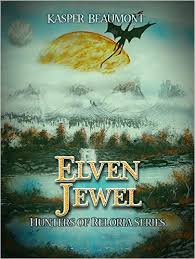
A review of Elven Jewel by Kasper Beaumont

Elven Jewel, Book One of the Hunters of Reloria series by Kasper Beaumont.

Elven Jewel

The author of this fantasy series sent me a copy of his book and asked that I review it! I did in Amazon, Goodreads and Smashwords.

An excellent adventure in a Tolkien-esque world populated by elves, dwarves, humans and halflings.

Reloria is “a peaceful land, protected by a massive force field” from the reptilian Vergais, who are determined to invade and complete their conquest of this world. The evil lizard men can occasionally rend a hole in the field and enter Reloria.

During one incursion they meet a family of halflings. The family travel through Reloria gathering allies, including a kingdom of dwarves and a few humans. They also meet an elven princess and her protector.

Through the eyes of the halflings we learn about the societies and peoples of the other humanoids of Reloria. We also learn of the halflings world – unique among the Relorians (and most of fantasy) are their fairies. Each halfling has their own fairy linked to their host. If one dies, apparently, so does the other. Although the halflings are not magical, their fairies certainly are. They are also fun and lighthearted for the most part. It is a nice and unique bit of flair added to the race.

We are also treated to some fun battle scenes against the Vergais, including a fun and epic final battle.

The book does not end on a cliff hanger, but it IS a continuing series and leaves some plot threads dangling. Friends are killed in the battle; enemies unite, if not as friends, then at least as allies.

Fun fantasy and highly recommended! I hope you enjoy it as much as I did and I am looking forward to reading the complete epic!

  Support independent authors! Support local authors! Read their books! Tell others to read their books! Post positive comments online if you enjoy it! Please?