Oh God, Body Grease! Murder in the Magnolias, Act One

Oh God, Body Grease! “Murder in the Magnolias”, Act One
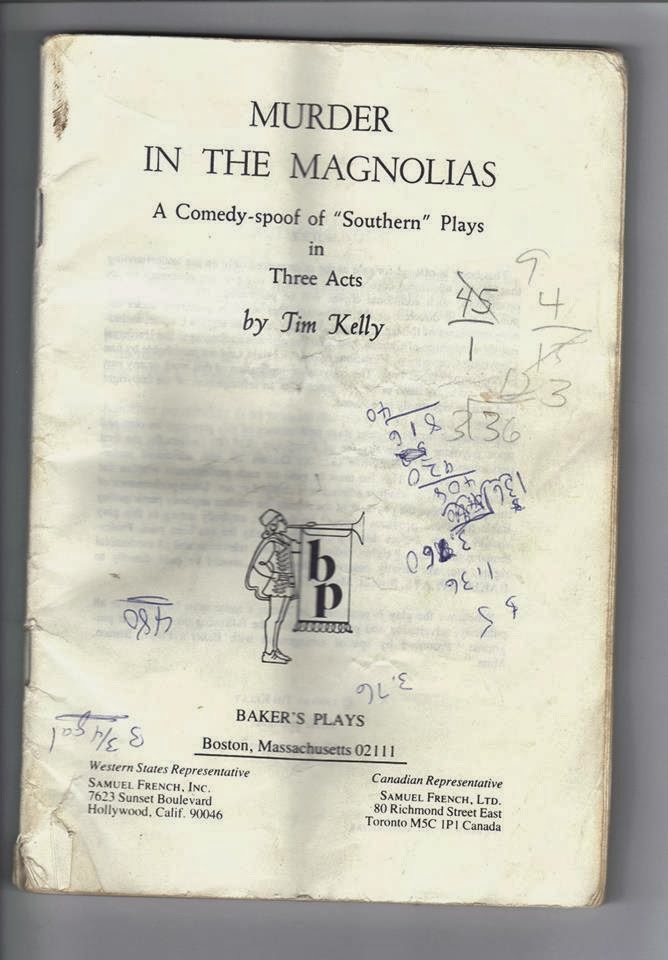
 
 
                In 1981 our high school drama club selected “Murder in the Magnolias” as their spring play. It was written in 1980 by Tim Kelly and is a spoof of “Southern plays” – Tennessee Williams and his ilk.
                I tried out for and was cast as Thornbird Chickenwing III, a Tennessee Williams-like poet who has multiple personalities. It is recommended by the author that he is played slightly effeminate. In one scene he is in drag, playing his own sister; and in another his grandfather’s grandfather.
                “Murder in the Magnolias” is appropriately silly with lots of caricatures insulting each other. The humor is broad and slapstick is present but fitting – hopefully it won’t be too over-the-top. Most of the humor comes from the characters verbally one-upping each other (“…any fool knows that.” “You know it…”). Very few characters possess any reason or common sense.
                It is a murder mystery. The mystery is not only who did it, but also is how can this motley crew of morons and locos identify the killer before anyone else drops off. And bodies drop in every act. Part of the fun in being in the audience is guessing who is next as well as who dunnit.
                We never got to perform the play in 1981. Our director, the art teacher, was fresh out of college and only about four years younger than the oldest of us. She was a very sweet lady but unable to handle the rougher students. She didn’t know how to crack the whip. That’s important when trying to herd students.
                But the students in the drama club weren’t the ones taking advantage of her meekness. The students who really gave her trouble were the ones waiting for our sixteenth birthday so we could leave school and get working at jobs we’d have the rest of our lives. You could do that back then.
                There was another problem that finally put the fatal wound in our production.
                Being of that age, the student cast had hormones a-ragin’. When one cast member was done with his part, he whisked himself away to his girlfriend’s house in another town. More than once the director wanted to rehearse the scene again, but the principal player of the scene was basking in the glow of love.
                The lead was replaced with another girl (I’m not being a pig here – we’re dealing with fifteen and sixteen-year-olds – hence “girls” and “boys”…). Why she left I do not remember. Trouble was the replacement had just won a fierce battle with the other female lead over rightful possession of a boyfriend. The two former female leads were best friends. The replacement not only “stole” the boyfriend of one cast member, but replaced that cast member’s friend in the play. Fur flew.
                And our meek director was powerless to knock heads together and douse everyone with cold water. With less than a month to go half the cast walked out. We remaining cast discussed putting on a play of small skits we would write ourselves. I didn’t think it would be very successful or funny so I left too. A few of the walk-outs were sitting on some sidewalk steps near the school and I congratulated them on their courage – they left the sinking ship just in time.
                No play that year.
                Flash forward almost 33 years. My friend Stephanie announced on her Facebook page that the Sparta (Illinois) Community Chorus was putting on “Murder in the Magnolias” as their spring play and they were holding open auditions December 14th.
                “I still have the playbook,” I posted.
                “You should try out,” Stephanie said.
                “I don’t think the dress in Act Two would fit me anymore,” I said.
                I thought seriously about it, talked it over with my wife and decided to try out for a part. A small part.
                After high school the only acting I did was for a local children’s program produced by the PBS affiliate. I wrote for the show and was asked to play the part of the evil Count Puzzleton during the show’s pledge-break extravaganza. I agreed. As was the case with most local PBS productions – it was cheesy and over-acted. But I had a lot of fun!
                I was a DJ for ten years and did some stand-up in Springfield, IL. The little stand-up I did in Carbondale was from introducing the main act at the city’s “comedy club” (read: bar with a stage and microphone – I think the biggest talent we got to perform there was Emo Phillips. No slight to Emo, he’s very funny, but that was the biggest name we drew).
                So aside from a few personas, imitations and performances of “skits” during commercials (“Gee, Jane, this coffee tastes like shit.” “He never talks about my coffee that way at home…” “Then try new Folger’s Carcinogenic…”); I haven’t acted since 1986. And even that was on television where I could do it take after take if we goofed up.
                As a lawyer I “act” in court, I suppose. Sometimes a bit of faux outrage or an ad-libbed quip can save the day (this bit is part of a legal record of a case; I am quite proud of it: Judge: “This was filed last night at 8:00, (turns to me) Counsel have you had a chance to review this?” Me: “Your honor, I have a ten-month old baby at home, I was asleep by eight – I was in bed by ten…”).
                The last time I trod the boards was in 1982 as Felix Unger in “The Odd Couple” – my senior year with the Coulterville High School Drama Club.
                At that same time I played an extra (George) in the SpartaCommunity Chorus (it was called something else back then) in “Oklahoma”. I had one line – “sounded like a shot” and danced in the fantasy sequence. OK! Yow!
                December 14th was the day of my family’s Christmas party. That evening my wife and I went to Powell Symphony Hall in St. Louis to watch the Symphony perform Mannheim Steamroller’s Christmas. I wouldn’t be able to sneak in an audition that day.
                No problem, said Stephanie, you can audition the next day, the 15th. There are a few others auditioning that day as well. And so I agreed to audition. My daughter stayed overnight at my sister’s while we went to the concert; and Sunday morning it was back to Coulterville to pick her up; then to Sparta to audition.
                I last saw Stephanie in 1996 at the hospital at which she worked when my father was admitted there – otherwise I had not seen her since 1982 (Facebook pics aside). She is a year younger than I and we lived across the street from one another. I’ve known her since our toddlerdom. It was wonderful to see her again.
                At the audition, I tried out for two of the smaller parts – Colonel Rance Chickenwing – the Big Daddy of the play and its first victim – and Thornbird. When I was done reading, my daughter piped out from the audience in her four-year-old voice, “Are you done, Daddy?”
                “Everyone’s a critic,” I told the four judges, two of whom were Stephanie and her adult daughter. They all laughed. When I was done they asked if I was willing to do two roles, as the number of men auditioning was small.
                “Sure,” I said with more confidence that I would have had if I thought about it. They gave me a copy of the playbook – in much better shape than my original – and thanked me. I was hopeful – they wouldn’t give me a playbook if they didn’t intend for me to be in it, would they?
                We drove seventy miles to our house; my wife put my daughter down for her nap and I stayed outside to repair the Christmas lights that had been savaged by a snowstorm of a few days before. When I went inside my wife said Stephanie had called – I had been cast as Rance AND Thornbird!
                Why? Why do I want to do this? Why drive seventy miles one-way two or three times a week and leave my wife and four-year-old alone all evening?
                I could be cavalier and say it is because I am a big ham and love the sounds of applause, but it is more than that.
                Perhaps it is a bit of mid-life crisis. Instead of buying a Harley or a canoe, I perform in a play.
Perhaps it is something from my past that was left incomplete and I want closure. But it’s not as if cancelling the play in 1981 scarred me for life.
                Perhaps it is a little of both… plus …
                I’m doing it to give me something fun to do. To meet some old friends and make some new ones.
                My work is challenging – I’m not doing this to escape work drudgery – but there is a sameness to it and being in a silly play will help me escape that a while. For the past four years it has been me, my wife and the baby. The baby is starting to get older and has her little friends at the day care; my wife sings in the choir in church and during Christmas and Easter practices with them. This would be … my thing to do.
                I knew I would have sympathetic audition judges – I had practiced these lines during the first few months of the Reagan administration and knew the play – and that gave me the courage to want to do it. I don’t jump into anything with both feet – I’m definitely the kind to stick my toe in first.
                Will this lead to more? If it works out, I hope so. It would be fun to be in more plays and musicals. Either in Sparta or (gasp) locally. It could be the start of a fun hobby.
                Future blogs in the next few months will review the characters and update on how rehearsals are going, etc.
                When I first considered trying out and performing in the play; I said it could be a lot of fun.
                Or it could be murder…
Copyright 2014 Michael G Curry


(adsbygoogle = window.adsbygoogle || []).push({});

A review of “A Mannheim Steamroller Christmas” with the St. Louis Symphony Orchestra

A review of “A Mannheim Steamroller Christmas” with the St. Louis Symphony Orchestra
 
 
            My wife and I went to Powell Symphony Hall to watch the St. Louis Symphony Orchestra perform “Mannheim Steamroller Christmas” on December 14, 2013.
            A college roommate introduced me to Mannheim Steamroller in 1982, one year after the release of their “Fresh Air IV” album. I was hooked.
            They combined classical music (particularly baroque) with jazz and rock into a light-progressive instrumental style. It featured Chip Davis, the founder, on drums, Jackson Berkey on the various keyboards – from piano to pipe organ to, particularly, harpsichord, and Eric Hanson on bass guitar.
            Their music avoids labeling – it has been called everything from New Age to Baroque-and-Roll (this label was first used on the group “The Left Bank” – a proto prog-pop band from the mid-1960s). The band does not embrace the New Age label, nor do most New Age enthusiasts embrace their inclusion into the genre.
             I am the exception. In the late 1980s and early 1990s I hosted “A New Age” at my local NPR station on Sunday nights. I happily included Mannheim’s music in addition to other artists outside the genre – Ravi Shankar, Isao Tomita and Blue Chip Orchesta along with stalwarts Kitaro, David Arkenstone and Enya. By this time there were surprisingly good so-called New Age music from the likes of even John Tesh and Barbie Benton.
            “Fresh Aire IV” combined medieval instruments on pop and rock arrangements of damnably catchy melodies. Ancient instruments playing tightly structured songs but with enough obtuse and unexpected variations on the melody to keep me listening.
            Four more “Fresh Aire” albums were to come – each album with a “theme”: the excellent “V” (a trip to the moon), “VI” (Greek Mythology), “7” (themes involving the number 7 – 7 seas, 7 chakras, Sunday, and “8” (infinity) – these last two reaching Number Two on the newly-created New Age charts; the only chart their music would seemingly fit.
            In 1984 Mannheim Steamroller released a Christmas album. For this ensemble known for its quirkiness and undefinability to enter the realm of Perry Como, Johnny Mathis and Percy Faith was the last thing one would expect – so of course it was a natural thing to do!
            Jazz musicians have released Christmas songs for decades, and there have been Christmas versions of electronic music; but for a still-obscure musical group to release a Christmas album was a substantial financial risk. Would those who enjoy traditional Christmas fare buy an album from this eclectic group? Would fans of this eclectic group buy an album of traditional Christmas fare?
            Fortunately for Mannheim Steamroller, both groups did. That first album “Mannheim Steamroller Christmas” was done in their unique style while still respecting the traditions of Yule. It spawned twelve other holiday albums with tunes ranging from original compositions to “You’re a Mean One Mr. Grinch”. They have sold in the millions and over the past thirty years the songs are considered Christmas classics.
            I saw Chip Davis and company perform their Christmas and Fresh Aire tunes in Chicago in 1987 on their first tour. They’ve toured at Christmastime regularly ever since – the band now down to Chip Davis, various session men and orchestras big and small.
           
            In October I was looking at what was happening in St. Louis during the Christmas season – perhaps we could see “A Christmas Carol” being performed, or a madrigal or a special concert. Perhaps the Nutcracker.
            “Elf” was playing at the Fox. Nah. No special individual Christmas shows were announced yet – not even Trans-Siberian Orchestra (another eclectic group – although firmly ensconced in the rock idiom – that had taken some of the thunder from Mannheim’s Christmas popularity). The St. Louis Symphony was going to perform a Gospel Messiah during the week of December 7th and their traditional Christmas program on the 21st. But the weekend of the 14thwas set for the Music of Mannheim Steamroller Christmas.
            I misread it at first and thought it was Mannheim Steamroller performing with the Symphony. Stop right there. We have a winner. My wife was excited too – especially since there were still front row seats available.
            A closer look shows it was not Mannheim Steamroller themselves (or himself – the “group” is now solely Chip Davis’s baby) but the St. LouisSymphony performing its music.
            Fine by me; fine with my wife, too. Would I like to go see one of the best symphony orchestras perform some of my favorite holiday music from one of my favorite performers from the front row? Sure, what the hell…
           
            The conductor/arranger of the concert program was Arnie Roth, the orchestral arranger for Mannheim Steamroller for many decades; so there was at least a connection with Chip Davis. He was there in spirit.
            I was interested in seeing how the orchestra would handle some of Steamroller’s electronic doodlings: the synthesizer intro to “Deck the Halls”, the mechanics of “Little Drummer Boy”, the swirling ending of “Silent Night”. 
            I needn’t have worried – the strings (cello and bass violin in particular) handled the “Deck the Halls” intro, for example. We sat right in front of the violins. I was enraptured by their ability and talents. Throughout the concert the violins played in the quiet, serene background. When they took the lead of a song – they were majestic and moving.
            There are no bad seats at Powell, but one unfortunate side effect of the front row is we could watch the violinists play masterfully at the cost of not seeing anyone else. The brass, percussion, harp and piano/harpsichord were heard but not seen. I could spot one trumpeter between the legs and feet of the viola section, but that was it. And unfortunately the brass, percussion, harp and piano/harpsichord were the main instruments in the concert. From the intro of “Hark the Herald Trumpets Sing” I knew I was missing watching professionals playing excellent music. I didn’t mind though – I got to observe the entire violin section. I have been tinkering with the violin for many years and, as with guitarists, I loved watching their playing techniques.
            So next time we’ll sit a little further back.
            There were only a few sour notes – twice from the brass section. A missed note and an early intro; I have already forgotten which songs because frankly, I didn’t care. The drummer did an excellent job keeping the beat, but there were times he lagged behind the rest of the orchestra; I think it was during “Joy to the World”. Again, who cares? It did not distract from a superb show!
The set list:
Hark Fanfare
Hark the Herald Angels Sing
Do You Hear What I Hear
Traditions of Christmas (an original Chip Daviscomposition)
The Little Drummer Boy
Greensleeves
We Three Kings
Cantique de Noel
Carol of the Bells
Hallelujah (a highlight of the concert)
Intermission
Deck the Halls
Pat-a-Pan/Fum Fum Fum Medley (another highlight)
Lo, How a Rose E’er Blooming
Joy to the World
Renaissance Suite: (my favorite part of the concert, a personal highlight)
            Gagliarda
            Il duci jubilo
            Wassail, Wassail
            Carol of the Birds
            I Saw Three Ships
            God Rest Ye Merry, Gentlemen
God Rest Ye Merry, Gentleman
Silent Night
encore Angels We have Heard on High
            During the 1987 concert, Mannheim performed the Renaissance version of “God Rest Ye …” and broke into “The William Tell Overture” between lines. I was hoping for the same here, but they did not. The smiles in this concert came not from humor but from enjoying superb musicianship playing superb arrangements.
           
            Here is another review of the concert from a classical radio station in St. Louis – another interesting view that touches on the differences between this orchestral performance and the original arrangements: http://kdhx.org/music/reviews/st-louis-symphony-a-mannheim-steamroller-christmas
            My wife and I enjoyed our evening at Powell very much! During the intermission the line to the rest rooms were in the dozens. I told my wife I would chance it and miss the beginning of “Deck the Halls”. Don’t worry, I said, we’ll hear it on the radio on the way home.
            Over the years the various Mannheim Steamroller Christmas albums have not been played on my stereo. They are played on the radio at Christmastime – a lot. A lot. But this concert gave me a new appreciation of the music from the albums and their quirky arrangements. Here we heard these quirky arrangements done in a very traditional way with a fine, fine orchestra. Loving this concert made me love the original arrangements as well. I even dug out my old Fresh Aire CDs to play in my car and in the 5-CD changer in the living room.
            Welcome back to the rotation, my friend. I had forgotten how much I missed you.
Copyright 2013 Michael G Curry


(adsbygoogle = window.adsbygoogle || []).push({});
The Hobbit: The Desolation of Six Chapters

The Hobbit: The Desolation of Six Chapters
            Christmas Eve day we saw a 10:00am showing of “The Hobbit: The Desolation of Smaug”. The theater was full but not packed – with plenty of spare seats for our coats and colas – and but for a dweeb constantly texting in the row in front of us, it was a pleasant experience.
            Don’t worry; he finally stopped after I someone hit the top of his head with a kernel of popcorn.
            I liked the movie. I didn’t like it as much as the first Hobbit movie – “An Unexpected Journey” – for two reasons: the darker tone made it less likeable (although not necessarily less enjoyable) and the cliffhanger ending.
            The latter first: This would be a no-spoiler review, but there is nothing to spoil. It ended abruptly with no resolution. Some of the audience gasped and groaned. Really, folks? In this day and age in our State of Moviedom you are still surprised when the second film of a trilogy ends with a cliffhanger? The second “Matrix” and “Pirates of the Caribbean” ended the same way: lots of characters and plot points with nothing resolved. Bad move, I think. Although there may well be people who will see the third movie without first seeing the first two, they will be lost. Lost. “They started the movie with the final reel,” we would have said in the pre-digital age.
            And in a sense the makers of the third film will have…
            It is a darker movie than its predecessor. While this is not a bad thing, it does take away the fun that underlay the first movie. In “…Unexpected Journey” we got to return to Middle Earth and meet friends we thought we never would again – Bilbo, Gandalf, even Elrond. Plus we were introduced to more dwarves – eating, drinking, singing, belching and full of life. They were on a quest to reclaim their kingdom and we went along happily.
            But in “…Desolation…” the reality of the likelihood of succeeding sank in. Previously Thorin told Bilbo (and us) about the Dwarf race being scattered throughout middle earth and a return to their former glory as a united peoples by getting revenge against the forces that scattered them. This theme was echoed by Malekith in “Thor: The Dark World” to give him a bit of dimension unsuccessfully. He was going to destroy the universe to avenge his people? I’m not buying it. I’ll buy Thorin (since the names of the dwarves were taken from Germanic and Norse myths by Tolkien, the coincidence in Thor and Thorin’s names is canny) wanting to avenge his people. They were greedy, yes. Did they deserve what they got? Maybe. Are we rooting for them to get their kingdom back? By the third movie I’ll have spent about $300.00 bucks in tickets, popcorn, gas, after-movie dining and shopping. What do youthink? 😉
            Aside, but not a spoiler: Tolkien mentioned in his notes and other references that Thror, King Under the Mountain (Thorin’s grandfather) owned one of the seven Dwarven Rings of Power that gave him his uncontrollable lust for riches, which thus led to the downfall of the race. I have been waiting for a reference to that in the movie. If it is revealed in the third film, slated for July 2014 and tentatively called “There and Back Again”; you heard it here first.
            The movie is dark because the theme throughout is desperation.
            It begins with the dwarves, Bilbo and Gandalf being pursued by the orcs from the end of the first film. While they trudged through the tundra I wished someone would have said, “You know, we could have asked the eagles to fly us to the Lonely Mountain …” “Still your tongue,” says Gandalf. It would have gotten a laugh from the audience and resolved a big plot hole from both Hobbit and Lord of the Rings…
            They get refuge from the orcs at the home of Beorn, a skin changer. We despair for him as he is the last of his race. We care for this new and powerful ally.
            Gandalf leaves the party as they enter Mirkwood. In the book we learn he leaves to fight the Necromancer; in the movie we see the first part of that battle. Gandalf and Radagast go to the prison/tomb of the Nazgul/Ring Wraiths. They have escaped – more likely they have been released. Gandalf goes alone to Don Guldur to battle the Necromancer, whose identity is revealed. It ends with Gandalf pinned to a wall surrounded by an orc army and the Necromancer.
            The dwarves are caught by the Mirkwood spiders in a scene very much like the novel, a unique thing so far in the movie adaptations. Then on to the elven kingdom in Mirkwood (I can’t find its name on the internet) where we meet its king, Thranduil. He is desperately protecting his kingdom from the approaching murk – the spiders are but a sign of greater evil to come and he eventually closes his kingdom to outsiders. Thorin’s quest is folly, he believes, and will bring only additional woe to the world.
            The dwarves escape in barrels as per the novel and after another run-in with the orcs make their way to Laketown with the help of Bard. The people of Laketown despair under an autocratic regime; the Master of Laketown (played with oily glee by the wonderful Stephen Fry) is desperately trying to keep control of Laketown despite rumors of … elections?! And Bard despairs over his life and family – he is on the Master’s naughty list and has the stigma of being descended from the man who should have destroyed Smaug but could not.
            The dwarves make it to the secret passageway into the Lonely Mountain and despair that they cannot find the opening before their time expires. You feel their sadness and desperation as they realize their quest has sunk along with the setting sun.
            Once Smaug is revealed, we despair with Bilbo – how will he make it out of Erebor alive? We cheer the dwarves’ battle with Smaug, but do we honestly think they even have a chance?
            Hence a movie much darker than its predecessor.
            The film covers six chapters and (in my edition) one hundred and eleven pages of the novel. The movie clocks in at one hundred and sixty minutes. That’s about as long as it would take to read one hundred and eleven pages. As with the previous movie, there are plentyof scenes not from the book.
            As I mentioned in my review of “…Unexpected Journey” http://michaelgcurry.blogspot.com/2013/01/the-hobbit-expected-movie.html, I don’t mind that. Two reasons: 1) anyone who goes to movies nowadays expecting a word-for-word re-enactment of a novel might as well stay home – why do people like that go to movies anyway? Stay home and yell at the clouds. It will have the same effect and results; and 2) I enjoy any excuse to stay in Middle Earth. Peter Jackson keeps the feel and flair of Tolkien’s invented world in his new material. Fear not – we are in good hands.
            The biggest news before the movie release was the introduction of Tauriel – the head of the Elven guard of Mirkwood. She and Legolas are … kind of … romantically linked.
            Much was also made of Legolas appearing in the film. Of all the characters from “Lord of the Rings” to appear in The Hobbit trilogy, he is the most canny – this is where he lived, his father is the king, he would have been alive during the events of the Hobbit, so why not? Orlando Bloom is obviously older and a little thicker in the face here, but that is a minor quibble. His character is also darker and more cynical – in keeping with his father and his kingdom’s mood. Perhaps his time with the Fellowship revived (or created) a confidence for and loyalty with other races.
            The orcs continue to torment Bilbo and the dwarves even in Laketown. In the Lord of the Rings movie trilogy we had the “Elf Break”. Anytime there were scenes with Arwen or other elves it was a fine time to go to the bathroom, get a refill of popcorn and drink, go smoke, make a phone call, and so on. In the Hobbit movies we have the “Chase Break” – anytime there is a chase scene one can find time to do the same. The chase scenes are overlong – those criticisms are correct.  Thrilling? Yes! Can be done in half the time? Yes. Oh, I miss some fine special effects and CGI acrobatics, but if ya gotta go ya gotta go! And I don’t miss much of the plot. “What happened?” I asked my wife when I got back from the potty during the orc battle/barrel scene. “This,” she gestured to the screen during the final moments of the orc battle/barrel scene.
            Much is made of Bard’s sneaking around Laketown with the dwarves. Spies were everywhere and the Master and his lackey showed themselves as self-preserving minor villains. Funny how the dark aspects of the movie truly reared their heads when humans entered the movie. Not so funny, really.
            And the battle with Smaug in Erebor was thrilling. The dwarves fought valiantly and Thorin’s idea as to how to defeat Smaug is obvious but done well. If you read the book, you know how successful they will be in defeating Smaug, but you will cheer them on and catch yourself hoping they succeed – which is the point.
            The dialogue between Bilbo and Smaug is overlong and overwrought. But it was that way in the book, too. You don’t think Peter Jackson would miss not filming the only unnecessary lengthy part of the novel, do you?
            Fili received a near-fatal wound and had to stay in Laketown with his brother and Tauriel. There is the beginning of a romance between them in the best Florence Nightingale syndrome.  Legolas, you can imagine, seethes at the budding affection between elf and dwarf.
            Speaking of Legolas, he is last seen following the orc band out of Laketown. How much of the third movie will be dedicated to his plot thread?
            There were a few bits that bugged me, honest critiques of an otherwise great film:
1)      the special effects are nearly perfect. Nearly. One of the biggest goofs in “The Two Towers” was Legolas jumping on a galloping horse. His arm extended longer than was natural and the CGI was obvious.  There were more than a few times this happened in “… Desolation…” especially during the fight and chase scenes. Also, at times the forced perspective looks forced. You can tell the actor playing Beorn is speaking to air while the actor playing Thorin sits further back on the stage pretending to listen – as though they are face to face. This allows the actor playing Thorin to look smaller – dwarf-size – than his probably-same-size fellow actor. Things like this remind me I am in a theater watching a movie rather than being immersed elsewhere…
2)      The obvious foreshadowing of what will happen in the third movie. When Smaug first attacked, the only things that could pierce his hide were Black Arrows (harpoons) shot from special harpoon guns. The rumor is that one Arrow managed to flick off a piece of Smaug’s armor. But the person in charge of shooting the arrows, Bard’s ancestor, failed to kill Smaug. The citizenry of Laketown still blame Bard. One harpoon gun remains and it is revealed Bard still keeps one last Black Arrow. Gee, do you think he will ever find the opportunity to use it? Against … Smaug perhaps? Will he be able to find that one sweet spot and redeem himself and his ancestor? If this were marching down Main Street would the answer be more obvious?
            Minor quibbles really, in the face of a masterful movie. Go see it and enjoy it!
Copyright 2013 Michael G Curry


(adsbygoogle = window.adsbygoogle || []).push({});

A review of The Beatles: On Air – Live at the BBC Volume 2

 A review of The Beatles: On Air – Live at the BBC Volume 2
 
(adsbygoogle = window.adsbygoogle || []).push({});             I received “The Beatles: On Air – Live at the BBC Volume 2” for my birthday. While listening to it I kept thinking about a quote from Roy Carr and Tony Tyler’s excellent “The Beatles, An Illustrated Record” – my copy from 1981. They were critiquing “Beatles at the Hollywood Bowl” and said (I am paraphrasing) – “The Hamburg Tapes” show the Beatles live at their beginning, “Let It Be” shows the band live at their end, but “…Hollywood Bowl” shows them in their glorious middle”.
            The awkwardly-titled “The Beatles: On Air – Live at the BBC Volume 2” also shows them in their glorious middle. At the beginning of their middle, so to speak.
            Most of the tracks aired on the BBC from 1963-1965. I prefer the earlier songs. This was when the Fabs just hit their popularity. Fame and fortune was still new and exciting. They were yet to be labeled “the greatest British composers since Schubert”. The mania was in full swing, but the hurricane had yet to reach Category-Five.
            John Lennon said by the time they reached the USthey were pros and already tired of it all. They weren’t musicians they were pop stars. They enjoyed the taste of fame but didn’t like gorging on it. In an interview on the disks, George Harrison says he was the first to get tired of people asking him the color of his eyes or what he drank at breakfast.
            “Live at the Hollywood Bowl” was in the midst of all that. The best and the worst of Beatlemania.
            “The Beatles: On Air – Live at the BBC Volume 2” shows the musicianship of that glorious middle without the mania – when the Beatles were still enjoying being the Beatles.
            Both Volumes contain songs and banter from the various BBC programs from 1963-1965 – including “Saturday Club” and Beatles specials (“Pop Go the Beatles” for example).
            Only a few of the tracks are performed live in front of a screaming audience. But the rest are studio tracks recorded at the BBC per their regulations. In such shows the Fabs could not simply hand the producers their albums to play. Songs had to be recorded for their specific programs.
            Now we would call it “studio live”. The Beatles may have done many takes of their songs, but each one was done in one take and the best picked to be aired during the BBC specials.
            In other words, these were studio live cuts of their hits – without overdubs, without vocal or music effects. Do You Want to Know a Secret without the reverberated introduction. There’s a Place without the harp/harmonica. These different arrangements highlight their musicianship. I’ll discuss that shortly
            They recorded 88 songs for these BBC shows – all either studio live or live before an audience. 36 of these songs were never recorded in their official (EMI/Capital) catalogue.  
            Most of the non-EMI songs were on Volume 1 – here we have only two that have never been officially released – (1) the standard Beautiful Dreamer – a rocked out version of the ballad recorded before an audience but with awful sound quality; comparable to the Hamburg live tapes. Pity – such a rare track and it sounds as if it were recorded through a fish tank; and (2) the Chuck Berry Rocker Talkin’ Bout You.
            Other rarities include different versions of Hippy Hippy Shake, Sure to Fall, and Lend Me Your Comb – which sounds uncannily like Wake Up Little Susie in places – already released on Volume One.
            And there is a version of “Happy Birthday”. Happy Birthday to you! Now I don’t have to ever play Birthday from the White Album – one of the most overplayed of their third-tiered tunes – again! Oh thank you, BBC, thank you and it’s. about. time. … 
***
            This is where the studio live performances make me enjoy the volumes so much: Songs I have been listening to for (literally) my 49 years on this planet are done differently – even if it is only a difference in the mixing. We hear Paul’s bass much more prominently in most songs. Ringo’s drumming is excellent throughout (and isn’t it time we finally put to bed the critiquing of Ringo’s ability. He’s a good drummer! Accept it!).
            When the initial giddiness of listening to the disks for a few times wears off, I will start rearranging the tracks in the following way:
            I’d like to arrange the tracks from Volumes 1 & 2 in the order of their album releases: in other words, take the song order from “Please Please Me” (their first album) and listen to their BBC versions in the same order. I Saw Her Standing There, then Misery, etc…
            I’ll bet the difference is staggering. In the EMI album “Please Please Me” we have four scared kids from the North going to London on New Year’s Day and nervously recording an album.  The BBC versions will let us hear professionals who are at the top of their craft.
            Perhaps the only disappointment will be Twist and Shout.  In his famous interview with Rolling Stone, Lennon groused about the song ruining his voice during the “Please Please Me” sessions. He said he never recovered the full power of his voice after that. Of course, keep that in perspective: during those interviews he was more bitter over the Beatles than Pete Best was.
            Then I can reconstruct their second album, “Meet the Beatles” with these BBC tracks. And to an extent their movie soundtracks and on until 1965 or so. “New” arrangements of all their songs done studio live at the peak of their musical prowess as a group – as a group, mind you – not as individual musical maestros who happen to share an album – which began with “Rubber Soul” on through “Let It Be”.  With a few exceptions most of the Beatles songs after that were individual efforts, not collaborations.  And even some of those only consisted of adding a line or two. Keep in mind that by “The Beatles” (the White album) they hadn’t even liked each other all that much. Such discord is no where – no where – to be found on these disks.
            On “The Beatles: On Air – Live at the BBC Volume 2”, they were still good mates and, as John Lennon correctly said in 1980, they were “the best fucking group in the goddamned world”.
***
            The banter in between is pretty banal. McCartney admits so in the liner notes. The hosts were the usual BBC announcers for such things and you could tell how square they were, man.
            The in-between-song bits usually consisted of the Beatles reading fan mail and requests – usually followed by the song itself. “Rita and Freda from West Hempstead love Ringo and think he’s gear and want to hear a song from him. So, here’s Ringo coming out from behind the drum kit to sing … Boys!”
            “And now it’s time for the lads to unshackle themselves as they sing Chains!”  You can almost see Lennon and Harrison look at each other and roll their eyes.
            The banter between the announcer and the band is scripted, although some of it sounds ad-libbed. John jokes about his going to college only to be called a “college pudding” and “posh” by Ringo. I can’t think of a more stinging insult to lob at Lennon. But everyone laughed, Lennon heartiest of all. Such genuine bits of humor are rare and I wish there were more of it.
            What makes up for the lack of non-scripted bits between the shows are interview segments with the four Beatles recorded individually in 1966 or so. Each of the segments are eight minutes plus and contain quiet and candid interviews. John talks about what kind of schooling he wants for his son/ He is hesitant to talk about politics and where he stands on certain issues. Quite a contrast to three years later when you couldn’t get him to shut up about it. George talks about his teen years in school and why he considers himself the Silent (not Quiet) Beatle. These interviews are the best part of the disk.
            Volume One was forgotten quickly, being released so shortly before the “Anthology” series because of the latter’s sheer volume of rare and then-unreleased tracks. “The Beatles: On Air – Live at the BBC Volume 2” led me back to the first volume and I enjoyed it more than I had since its first release.
            Are there going to be Volumes Three and Four? More? I would like to hope so, but no, I doubt it.  The bulk of the 88 tracks have been mined in these first two volumes. There are 40 tracks in this Volume – so what does that leave? A disk of remaining banter would get dull very quickly. Were there guests on these shows? Do we really want to buy a Volume 3 with tracks by Billy J Kramer and Joe Brown (actually I would buy that…)?  I’m not going to worry about that now.
            I have four disks of excellent music from the Beatles’ glorious middle – all done studio live with interesting variations in arrangement and styling. I’ll enjoy those in the meantime.
            I hope you do too.
Copyright 2013 Michael G Curry


A review of “Thor – the Dark World” (no spoilers edition)

A review of “Thor – the Dark World” (no spoilers edition)

(adsbygoogle = window.adsbygoogle || []).push({});             The movie starts with a voice-over recounting an epic battle from ages past. The Lord of all things evil wants to take the world back to the darkness over which he rules. He takes a part of his dark essence and creates a tangible symbol of his power.
            Eventually he is defeated by the powers of good and his symbol is hidden through the ages.
            The symbol is found by a citizen of Middle Earth; a citizen who appears to be one of its weakest members but contains hidden strength. 
            The re-discovery of his symbol awakens the Dark Lord, who again masses all things evil into another pitched battle against the forces of good. Should good fail, the entire universe will be taken over by darkness… 
            But enough about “Lord of the Rings”, this is a review of “Thor, the Dark World”.
            Oh, wait, they both start out like that.
            In “Thor…” Sauron is called Malekith, played by former Doctor Who Christopher Eccleston, whose make-up is reminiscent of 2009’s “Star Trek” baddie Nero.  For a time during the show I thought it may have been the same actor. I doubted the producers would have been that dumb to cast the same actor in a similar role with identical make-up, though.
            Malekith the Accursed was created by the superb comic book writer/artist Walter Simonson. He received a byline deep into the closing credits. I hope Marvel managed to pry open its billion-dollar coffer to give him his complementary free ticket as thanks for the millions of dollars this movie will rake in with the help of his creation.
            The movie picks up where the last “Thor” movie and “The Avengers” left off. As is and will be the routine for these Marvel movies (and for Marvel Comics as well), these are shared-world movies – it is all interconnected. Events from one movie spill into the other movies. There is even a cameo/crossover to wonderful affect with a certain shield-slinging Avenger.
            The plot – after the battle at the end of the Second Age – er – the battle with Malekith, the One Ring – er – the Aether is discovered by Deagol – er – Jane Foster. It takes over her body and will eventually destroy her if a cure is not found.
            Just as had happened five thousand years ago during the first battle with Malekith, the Nine Worlds are converging. Physics will go awry and it will be easy to travel amongst the worlds.
            So Thor finds Jane and takes her to Asgard. Not coincidentally, Malekith invades Asgard to get back the Aether out of Miss Jane. Chaos ensues.
            Beating back the invasion is costly and Thor wants to take the battle to Malekith. Odin forbids it. So Thor, as any son would, sneaks behind his father’s back with the help of his friends and his imprisoned brother Loki.
            Meanwhile, Malekith travels to earth to begin the process that will envelope the universe in darkness. The Convergence will make this easier since, from Midgard, he will have access to all realms.
            Thor, Jane and her seemingly incompetent scientific team are all that stand in the way of the coming darkness.
           
            Chris Hemsworth does an excellent job in his third go-round as the Thunder God. I like him better here than in the first movie. It is nice seeing Thor at full power.
            Anthony Hopkins returns as the scene-chewing Odin –ever barking and snapping at his lines with his usual gusto. I love him as Odin and hoped he would have a bigger role in the battle scenes. Alas.
            We DO get to see Rene Russo as Thor’s mother Frigga kick some ass though.
            Idris Elba as Heimdall also as a bigger role here. I hope to see more of him in future movies.
            The aforesaid Eccleston as Malekith makes a very good villain, but there’s not much else for him to do other than thrust the Aether at Thor time and again. There’s not much motivation for him in this movie other than to “destroy the universe”. Yeah, get in line. There is a small bit about his wanting to avenge his people, but, ye gods (pardon the pun), his people started it. This isn’t about revenge – this is just a second go-round. Perhaps if we were to feel more empathy for a dying race Malekith would have been a bit more well-rounded as a villain.
            Jane’s compatriots return in this movie – Dr. Selvig still recovering from his role in helping Loki in “The Avengers” and Jane’s intern, the annoying Darcy (her comic relief is unnecessary; this is meant as to the character not the actress portraying her). And now Darcy has her own intern, an equally annoying and incompetent Britisher. Of course after all this comic relief we then have to take them seriously during the final battle. It baffles me that filmmakers think after two hours of laughing at these dolts we will suddenly accept their sudden conversion to adequacy.
            Loki is again played by Tom Hiddleston and as with both “Thor” and “The Avengers” he steals every scene his is in. Here is a villain whose motivations are as clear as they are complex – unlike Sauron or Malekith.  Throughout the film, until its very end, you have no idea whose side he is on.  Well, that’s not true – you know he is always on HIS side, but his alliances have so many twists and turns it keeps your attention during the movie.  Oh, and the aforementioned “get in line”? One of Loki’s best cracks in the film…
            And the movie keeps your attention. It’s not a great film – not as jaw-dropping as Thor’s last film appearance, but on par with the other Marvel movies to date (only the first “Iron Man” has yet to raise the same goose bumps as “The Avengers” did).
            The effects are smashing, pun intended. The faux-Shakespearian dialogue is still a hoot and Thor is easy to cheer on as he battles to save us all.
            It is worth waiting until after the first few minutes of credits (after an excellently-done cast roll call) to watch a set-up of either a future Thor or Avengers movie plot. The final scene after the rolling credits – where we learn the names of the grips and gaffers – is not as satisfying and is worth waiting until it is out of DVD or on-line viewing. It is not worth the dirty looks from the theater crew waiting for you to leave so they can sweep up your popcorn. There’s no Nick Fury asking Thor to join the Avengers; there’s no surprise guest-hero or guest-villain – the bit after the casting credits takes care of that.
            Good movie. Go see it in the theaters to get the whole effect of the vastness of the subject. Enjoy.
Copyright 2013 Michael G Curry


We’re Off to See the Wiggles… A review of the Wiggles US Tour 2013

We’re Off to See the Wiggles…
A review of the Wiggles US Tour 2013
 
 
                September 18, 2013 my wife, daughter and I saw the Wiggles in concert at the Peabody Opera House in St. Louis, Missouri.
                I retired from concert-going in 1992. My hearing was shot even then and with a screeching baby the tinnitus has not gotten better. Going to concerts would rip apart what was left of my hearing, as well as rip apart what was left of my bank account. Five hundred bucks to see the Eagles?  I can hear them for free every time I turn on the radio. Every. Time.  Not even if they performed in my front room.  I came out of retirement three times – once to see Ringo Starr do a free concert under the St. Louis Arch on July 4thin the late nineties (a Beatle for free? Yes, I will come out of retirement to see a Beatle for free…), once last year to see Rik Emmett ($10.00, yes, I will come out of retirement to hear Triumph’s Greatest Hits live for $10.00), and now to take my daughter to see the Wiggles.
                This was the tour supporting their DVD “Taking Off” and was the first “solo” tour of the new Wiggles. Founders Jeff, Murray and Greg retired. Anthony continued with three new Wiggles – although all of them were with the franchise either playing secondary characters or back-up singers and dancers.
                The new members were Simon, Lachy and Emma. It was quite a controversy when the new Wiggles took over, but most of their world-wide fans wished them the best when the shock wore off.
                My daughter discovered the Wiggles early in 2013. To her mind, Emma is as much a Wiggle as Greg. Or Sam for that matter. She adores Emma. She is her favorite. So of course she wanted to dress like Emma for the show. Easy enough – she already has a black skirt, black leggings and a yellow shirt.
                She looks good in yellow, with her dark skin. My wife has always been happy about that.
                I was afraid I would be the only adult male at the show. I wasn’t. I was afraid I would be the oldest father there. Surprisingly, I wasn’t. In fact, most of the fathers I saw there were about my age. Some of them had children younger than mine (this concert was her fourth birthday present).
                I’m not sure what to make of that. I am afraid of generalizing by saying younger fathers wouldn’t bother going to such a thing … but I have no facts to support my theory.  Would an older father tolerate these things easier than a younger one? “See the Wiggles!?  And miss Kill Division playing across town!?”
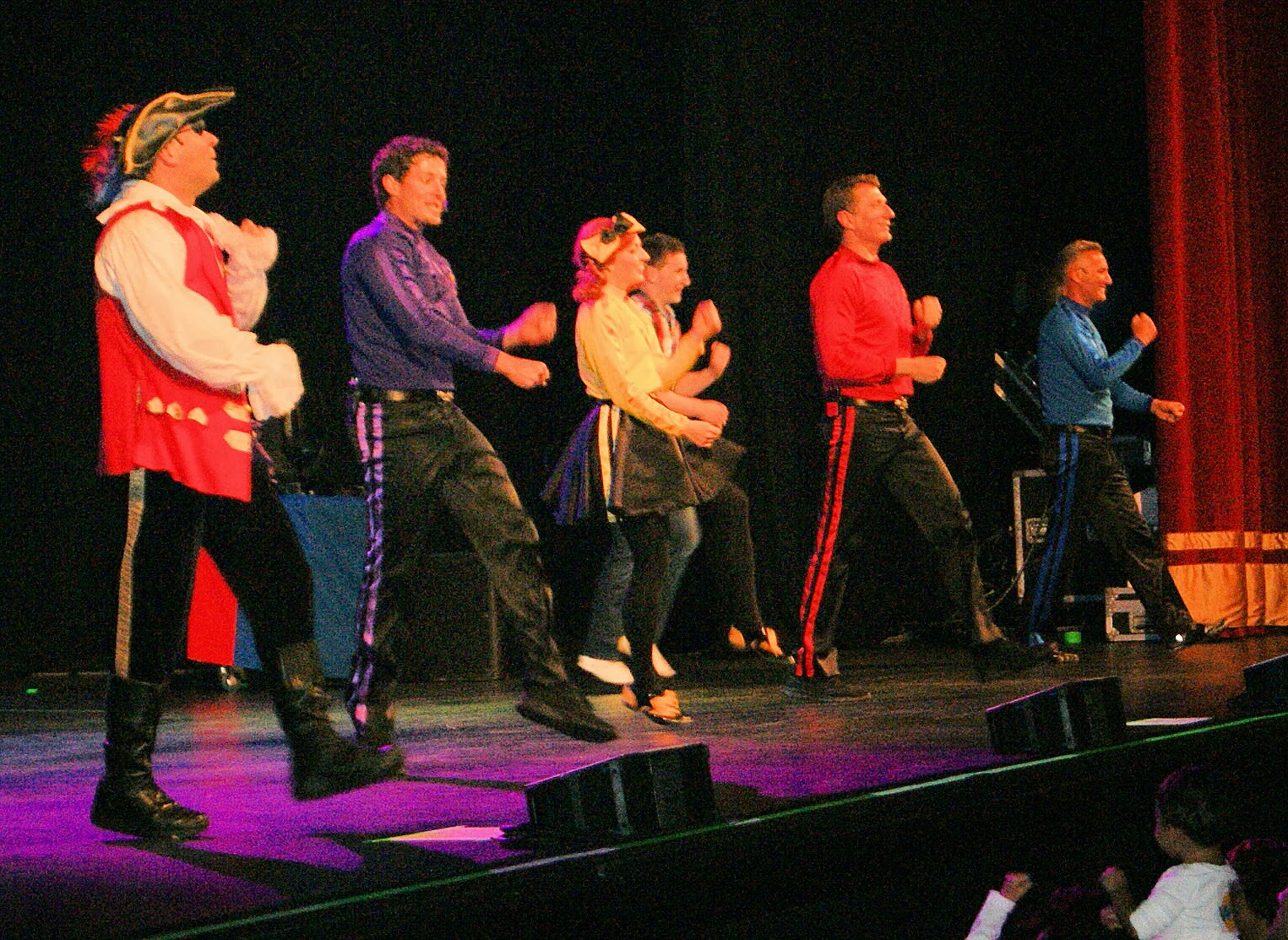
                The stage cast consisted of Anthony, Emma, Lachy, Simon and Paul Paddick as Captain Feathersword along with three back-up dancers and singers. They would take turns as the costumed characters of the franchise: Dorothy the Dinosaur, Wags the Dog and Henry the Octopus.
                They did an excellent job of keeping the pace going so that you never noticed who was missing from the stage when the costumed characters were on.  Paddick does the voice for Henry the Octopus. I didn’t notice if he was on-stage or off-stage while Henry was “singing” his song. He may have been IN the costume for all I know.
                The set was sparse considering the concert videos you can purchase or watch on You Tube. This isn’t Madison Square Garden or a packed amphitheater in Australia. This was the last few weeks of a two-month North American tour playing smaller venues. The following night they were in Nashville, then Detroit, then Chicago for two shows on Saturday. The following week they played two matinees in New York. Remember this was the same franchise that sold out twelve shows in a row at Madison Square Garden
                So there were no elaborate sets depicting Wiggle Town or the Wiggle House, no 12-foot blow-up Wiggles, no working Big Red Car. The backdrop was a replica of the cover of their new DVD that set behind a drum kit and keyboards and guitars. The only props were a cardboard castle set in front of a tall stand as well as a camel and airplane costume – each worn by Captain Feathersword.
 
                Sparse settings made sense, though. Who knows how successful this tour would be? Who wants to spend millions on setting up, tearing down and moving elaborate sets for half-filled stadiums?
                They needn’t have worried. They went for smaller venues and all of them are sold out. I checked the tour venues online and there were only forty or so seats remaining in each venue for the rest of the tour. All but forty seats available for a 3,500-seat venue (at least for Peabody)? I’d say that’s pretty good.
                I checked and checked online for a set list for this tour with little luck. The only review I found was on a blog of a Detroit mother. I thought I would do a set list and review the show. By the time this post gets to most of my readers the tour will be over, of course. But perhaps if they tour next year (or more likely the year after) this will give parents who know nothing of Wiggle concerts a taste of what to expect.
                I spent most of my time talking photos, writing down names of songs and smiling at a squealing and giggling three-year-old. Near the end of the show, my daughter and two others were on the far left aisle dancing. I had to warn my daughter not to flail around too much for fear of hurting the other children.
                The mother of one of the little girls asked her to stay near. She kept her arm around her daughter at first. She didn’t want her daughter dancing with other girls while some tall, fat, bald man took their pictures. But she soon relented.
                During the last song my daughter finally took that tumble I warned her about. She cried and I picked her up. It was by now 7:50 and she was very tired. As the Wiggles waved goodbye I told her they were leaving and to say goodbye. She stopped crying immediately – as children of that age do – and shouted goodbye to everyone on stage.
                Before and after the concert we took pics of the stage. An usher very kindly took a picture of the three of us in front of the stage when the show was done. Although sold-out, by 7:30 quite a few of the ticket-holders left with their sleepy charges. We ended up with only a few people in our Orchestra Left section.
                This allowed me to stand and take plenty of photos of the performers. Earlier I was afraid to stand too long for fear of blocking the people behind me. One of the few younger fathers sat two rows ahead of me. He wore his hair in high spikes, which blocked most of my camera’s flash. Near the end, as there was no one behind me; I could stand and hold the camera as high as I wished – his light-absorbing head no longer a problem.
                We had great seats. Well, Peabody Opera House (I still think of it as Keil Opera House – I saw Clapton there in the 1980s) does not have a bad seat; but we had particularly good ones. We were seventh row to the far left. The front rows taper outward. This means there were three rows between us and the far stage left. 
 
                 Lachey spent some time on our side of the audience. He gave my daughter a high-five!
                 When Anthony stood on the end of the stage he was ten feet in front of us. He waved back at Abby and me. Yes, I was waving at Anthony – I am one of the few surviving Cockroaches fans in the States…
                The Wiggles and their troupe sang and played their instruments live.  In most of the concert footage they look like they are lip-synching. With all their dancing and activity that isn’t surprising. And this is the Wiggles, not Milli Vanilli – who cares?
                But we were close enough to tell. They sang live. And their instruments were live, too. Good for them.
                This despite the fact that there was LOTS of dancing going on. Every song had its own moves. The children (and most adults) followed along faithfully. Captain Feathersword played bass, Anthony played acoustic and electric guitar and drums, Emma played drums, Lachy played keyboards and the glockenspiel. And even the dancers played percussion, drums and guitar as needed.
                Speaking of the dancers… They were introduced at the end, but by then I was dancing with and photographing my daughter.  Looking online doesn’t help identify the three dancers.  The beautiful Catarina Mete has a bit of a following and hers is the only name I can find. The other lady is Lauren –  I hope the spelling is correct.  She was named in a concert segment on the Wiggles’ new TV show.  The male dancer, Nick, looks a lot like Lachy; so much so my daughter thought it WAS Lachy when he came on stage.  
                He was the first one on stage. He gave us a safety lecture much like the stewardi on a plane – find your exits, watch your children, that sort of thing.  He also told us to tweet what we think about the show and they will later read their favorites during the concert.
                So spend the concert staring at your phone? Um, no. I disagree – My tweet would read, “I would love to watch the show but I haven’t seen a minute of it because I am trying to tweet.”  Don’t text and wiggle.  
                Like I’m one to talk. I spent the concert taking photos and jotting down the playlist.
                Speaking of which:
 
Rock a Bye Your Bear
Can You Point Your Finger and Do the Twist
Quack Quack
(My Sharona – spoof)
Monkey Dance
Here Comes a Bear
D*O*R*O*T*H*Y
Romp Pomp a Chomp
(The Rose – spoof)
Joannie Works With One Hammer
Numbers Rhumba
Shakey Shakey
Fruit Salad
Peanut Butter
Toot Toot Chugga Chugga
(If I Could Turn Back Time – spoof)
Captain’s Magic Buttons
Five Little Joeys
Emma (With a Bow in Her Hair)
We’re Dancing With Wags the Dog
Twinkle Twinkle Little Star
Henry’s Dance
Simon Says
There Was a Princess Long Ago
I’ve Got My Glasses On
Shimmy Shake
Hot Potato
Do the Propeller
                Oh, and I tried keeping a “Gee C’mon” tab, but I lost track among the other things going on. I know Anthony said it two or three times.
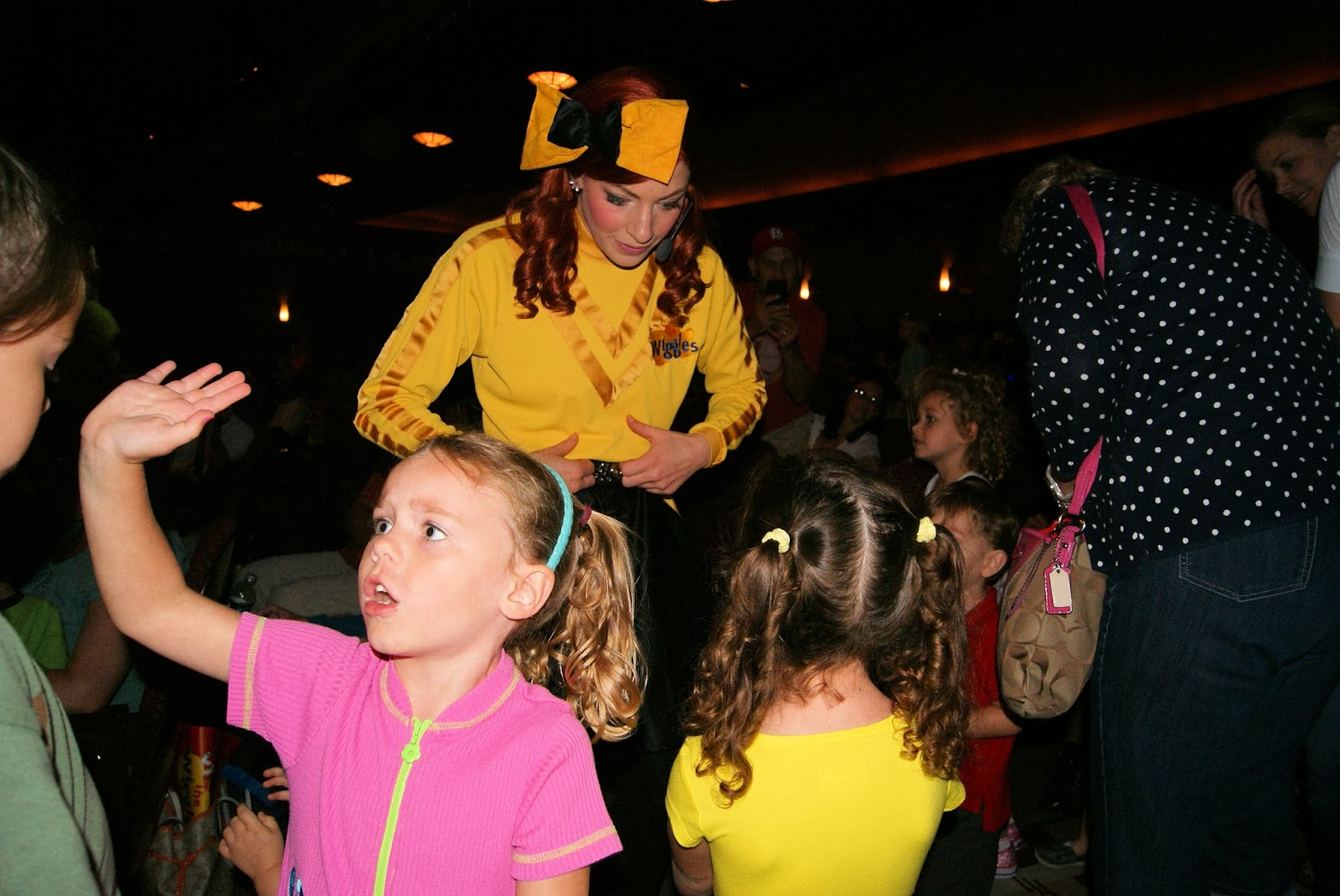
                Emma left the stage for a time to say hello to the fans. Doing my best stage-mother imitation, I grabbed my daughter and walked with her to the center aisle and plopped her in front of Emma. 
 
                “You’re wearing a yellow skivvie and a black skirt just like mine!” Emma said. My daughter was giddy! She met Emma! Her favorite! I was so happy for her!
                I knew my daughter was getting tired when she kept asking, “Is it over?” after ever song during the second half.  But not in a whiney way, just like asking if a TV show is over. She had a ball. She squealed with delight and laughed and giggled when she recognized a song. By the end, though, she was happy just to dance along with the songs in the side aisles. It made both of us so tremendously happy to see her so happy.
                There were enough nods to the adults to keep us smiling, too. Captain Feathersword did a funny Cher imitation.  Anthony made a Lady Gaga reference. He said, “We used to say Miley Cyrus but we changed that a few weeks ago.” It was funny but I’ll bet he was also very serious. There were comical homages to the songs “The Rose” and “My Sharona”.
                We might get one last Wiggles concert out of our daughter before she gets too old for that sort of thing and starts dragging us to the boy band dujour.  But I’ll cherish the look on her face and the sound of her laugh. Thanks Wiggles!
Copyright 2013 Michael G Curry


A Late Review of the Latest Superman Movie

            This is the last review you will read of “The Man of Steel”, I would guess. It has been out for several weeks, but I saw it during the July 4th week. And yes this contains spoilers. If you haven’t seen this movie yet and are still concerned about reviewers ruining the movie for you … then go see the damn thing before reading any more reviews.
            I was off work; the wife was not. So I spent the day shopping and thought an afternoon in a theater would be nice.
            But what to watch? “Giant Whoredog Corporate Blockbuster CGI Slagheap 3” (to quote artist Stephen Bissette on the latest batch of pornographically violent films)? There was not much else to select at the nearby multi-temple.
            I decided on the new Superman movie, called “The Man of Steel”. I’ve read many reviews raving for it and ranting against it. Most of the people whose opinions I trust did not like it.
            I expected to hate the movie. I even brought a pen and paper to write down my thoughts while watching; not having my lovely wife next to me to act as Crow to my Tom Servo.
            I liked it very much. I didn’t love it.  I wasn’t gaga and oohed and aahed at the prospect of this igniting a multi-movie franchise. But it wasn’t as bad as I expected.
            Comparisons to previous Supermovies is not fair, but it IS expected nowadays. I liked MoS (as it shall be hereinafter called in this little treatise) as much as I hoped to have liked “Superman Returns” from 2006 – the last big-screen treatment of the character. I was so hoping that movie would do well and be a wonderful experience. “Returns” had its moments – some wonderful moments – but it ended up being a forgettable movie. What was considered a “sequel” to the first two Christopher Reeve-Superman movies ended up being a rehash of the first Reeves movie.
            Before seeing MoS, I considered it a rehash of the second Reeves movie. Zod and his gang of Kryptonian thugs are bent on conquering the earth. MoS was a little more than that, but that is the plot in a nutshell.
            In the meantime we get a retelling of Krypton’s last days, Zod’s relationship with Jor-El, Kal-El’s life as a youngster on earth and his first few experiences as Superman.
            Reviews of MoS said the flick was dark and brooding, Batman-ifying the Big Red “S”. I bristled at the thought. I still bristle at the thought of Batman being turned into Brooding Sociopath Man. I didn’t want to see Superman turn into a dick.
            One of the first lines in the film has Jor-El speaking to Zod, who was leading a Kryptonian coup d’etat. “I will honor the man you were, not the monster you have become.” I wrote that down. What a perfect line to describe the dark Superdick I will spend the next two hours with…
            But I was happily surprised. Is the film dark? Yes. Is Superman himself dark? No. Here is Superman the way he should be, and the way he has always been portrayed on film so far – our honest and noble protector.
            When Zod threatened the earth with destruction if Superman (at that time a mysterious super-powered benefactor) did not reveal himself, Superman did so.
            When he protected the soldiers who were firing at not only him but Zod’s militant thugs, Colonel Hardy (played by Christopher Maloni with the same unlikeableness with which he infused Detective (un)Stabler in Law & Order: SUV (sic) said “this man is not our enemy”. Superman was grateful.
            (Incidentally, Maloni’s best moment was the look on his face when he realized he was getting in a knife-fight with a Kryptonian but still did not back down. His sacrifice to destroy the terraforming machine was canny. Well done, but expected. I was saddened that the sacrifice also had to include the woefully underutilized Richard Schiff. I would have loved to see him as a regular in the franchise.)
            In between all the explosions and CGI destruction were Superman’s relationships with both sets of parents. His birth-mother Lara was given more lines and emotions than in any previous movie or even the comics. She came this close to refusing to allow Kal-El to go to earth. It was very moving, especially to this new parent. I can barely imagine what she must have gone through.
            Superman got to speak to a simulacrum of his birth father Jor-El, rather than a pre-recorded Marlon Brando made up to look like Charlie Rich. Superman got to actually speak with his birth father.
            For the past two decades Jor-El was portrayed as cold, emotionless and on the cusp of evil – all of Krypton was. This Jor-El, played by Russell Crowe, was noble – a hero that a son could emulate.
            And although this Krypton was portrayed as a dystopia, it was still sad to see its inevitable end. It’s message of conservation seemed forced; although the skyline view of Krypton’s moon in pieces was, well, kinda cool.
            In the Bronze Age of comics (and before) – Superman’s adoptive parents, the Kents, were dead by the time he became Superman. It was a sober moment and reflected in Superman’s persona. “Despite all my powers, I couldn’t save them.” Superman will do his best to protect us, but there are times when he cannot. It is a basic tenant of his personality.
            Since 1985, when the Modern Age began, comic lore has ordained that his mother has survived. In MoS, Martha Kent has also survived to see his son become Superman. I have mentioned in previous blogs this is not necessarily a bad thing, but his moral compass is now external, not internal. Why would you need a Fortress of Solitude when you can go to Mom’s house for a slice of sympathy and apple pie after defeating Throgg the Omnipotent?
            His relationship with Jonathan Kent was more complex here – Kentwas played quite well by Kevin Costner. Rather than encourage Kal-El (or ClarkKent) to use his powers nobly for the benefit of mankind, Kenttells his son to be wary – people will be afraid of him. This is more a reflection of today’s society, I think. During the Reeve’s movies and before, Jonathan Kent and Jor-El would be in agreement: you have tremendous powers, you must prepare yourself to use those powers to benefit mankind. This Jonathan Kent would have preferred Clark wear a mask and hide his tracks. I was pleased to see him proven wrong. “This man is not our enemy.”
            Jonathan Kent’s death was the second most controversial part of MoS. My impression from other reviews fed into the “dark” Superman – callously allowing his father to die to prove a point. It wasn’t that way – Jonathan Kent prevented his son from saving him. Kent knew his son was not ready to reveal himself. It was a powerful scene and well done – it showed Superman doing what a superhero is supposed to do. He obeyed his father.
            This led to a period of wandering – I was led to believe this; I don’t know if that is the case or not. Wouldn’t that make a wonderful TV series? Sort of like the 1970s “Incredible Hulk” – a lone stranger wanders into town, resolves a crisis and wanders off again. A “Smallville” on the road…
            I expect he came home frequently. His mother’s reaction to seeing him is hardly that of a mother who has not seen her son in 15 years. She was almost casual about him walking down their driveway. “Why didn’t you tell me, you could have picked up a gallon of milk on your way…”
            There were a few undeniable religious symbolisms and comparisons. Superman-Moses parallels are something of a joke nowadays, but MoS” went a bit further.
            Superman was 33 years old during the film. Like Jesus, he spent 30+ years in the world as one of us before revealing himself. When Zod makes his threat to destroy the world unless the son of Jor-El surrenders, Clark takes solace and advice from a minister in a church. Presumably this was the church he went to in Smallville. As he talks to the minister, his headshot is framed with Jesus to his right facing away from him slightly above and praying with his face and arms pointing upwards. It makes a stair-step: right to left going up – Superman, Jesus, God. If you’re going to do a shot like that – that is the way to do it. Any other way would be awkward or raise eyebrows and create a controversy Warner Brothers did not need. What if Jesus was “below” Superman? What if he was above but praying in the direction over Superman’s head – making a strange triangle (Superman directly below God and Jesus off to the side?).
            My friend Clyde, whose blog about recent superhero movies can be read here, http://playmst3kforme.blogspot.com/, told me WB sent MoS study guides to churches. It would be interesting to see them. I googled the subject and found a few …
            The most controversial part of the movie came at the end in the final confrontation with Zod. Superman had to break the general’s neck to stop his killing civilians with his heat vision. Superman begged Zod to stop (I don’t recall if he used the magic words “please”) and screamed in frustration when the deed was done. It was overlong – to show us how much Superman agonized over the decision. I didn’t mind that – if the scene was done quickly one could argue Supes’ callousness in killing. The argument came anyway, but at least the callousness wasn’t obvious. Batdick, Punisher or Lobo would have snapped his neck an hour ago…
            “Superman doesn’t kill,” critics of the scene wrote. True. Very true. As with the death of Jonathan Kent, I was expecting Superman to be indifferent or even gleeful as shown by the brooding sociopathic “heroes” mentioned above and other so-called “heroes” DC, Marvel and independent comics have been vomiting up since the 1990s.
            Superman could have thrown Zod into the Phantom Zone or tricked Zod into entering the Zone or destroying himself or his powers (remember how that was resolved in Reeve’s Superman II?), but that is not the way for the fans of “Giant Slagbag Bucket of CGI Ticks 6” (another Bisette-ism) who the producers of MOS need to attract to make money.
            A few minutes showing Superman’s regret would have resolved this. The trouble is, the filmmakers couldn’t linger on such regret. They would need to balance Superman’s facing his decision with his wallowing in pathos. “Oh woe is me.” Rend, rend…
            Perhaps a short scene with General Swanwick … “Have you ever had to kill?”
            “Yes, many times…”
            “How do you think about that?”
            “I don’t think about the people I had to kill, I think about the people I protected.”
            Or something like that.
            Or a brief flashback with his father. Jonathan Kent would have been old enough to serve during Viet Nam (Costner was born in 1955, just a bit too young, but his character could have been five years older…). Perhaps his war experience is what infused his fear of humanity.
            So that is my view of the film. I liked MOS as much as I was hoping to like “Superman Returns”. I was as disappointed in “Superman Returns” as I was expecting to be disappointed in MoS. Will it be as iconic as the Reeve’s movies? No, but that is hardly fair to compare it to those films. Well, the first two at any rate.
            Now, what about a sequel?
            I hope to god they stop with Reeve’s “Superman II”. If “…Returns” was a remake of Reeve’s I and MoS was a rehash of II … well, let’s stop there. Let’s get some new ideas, shall we?
            “Luthor in the sequel! Luthor in the sequel!” So scream the corporate-boot-licking-uberwonks from their parents’ basements.
            No. Luthor is as overused as the Joker.
            The trouble is, who else is there? Braniac? All during the CGI destruction shown in MoS I imagined how these effects could have also been used to show Braniac trying to shrink and “steal” Metropolis. The Lovecraftian-mechanical tentacles would have fit Braniac’s machinations too. A pity. The last thing a franchise needs is such repetition for its second film.
            Clyde came up with a wonderful idea. Bizarro. And in between slugfests we could see ClarkKent interact with his coworkers. We’ll get to know and understand the cast. Perhaps empathize with them.
            What am I saying …
            Some final thoughts:
            1) I like the idea of Lois Lane knowing Clark is Superman from the beginning. She could even help protect his identity. I got tired of the constant toying around with this even as a kid reading the comics. She’s an investigative reporter. She should know. I always felt that way about Commissioner Gordan and Batman.
            “How did you find out I was Bruce Wayne?”
“I’m a detective, too. A good one.”
            “Obviously…” 
            “Are you going to use your Bat-Amnesia Spray on me?”
            “I’m not that Batman; I’m the Batman that will break every finger until you swear not to tell anyone.”
            “I’ve known for years and haven’t told anyone yet … OW! You dick! OW! Stop it! Ow! Shouldn’t you be killing off another Robin? Ow!”
            2) Perry White is now a black man?  “What’s his middle name – ‘Ain’t’?”
            Well, why not? Lawrence Fishburne did a wonderful job and fits the role well. As with most comics, especially those created in the Golden and Silver Age, the lack of non-caucasian characters is embarrassing… Comparisons with Samuel L. Jackson’s Nick Fury are unavoidable. Tokenism?  Maybe, but as with Fury, it didn’t seem to be a case of “Quick, Africanize someone! Anyone!” Perry White is black. Okay, let’s move on…
            3) Near the end we saw a flashback of a young Clark Kentplaying along the laundry-line posing in a cape.  Um, who was he supposed to be emulating?
            In this Superman-less world without superheroes, who was there to pretend to be? I imagine a “Watchmen”-like world where comic books were horror, war, teen and funny animal books only.
            Where else would he turn for imaginary heroes?
            Comic strips? The Phantom? He didn’t wear a cape.
            Pulps? Doc Savage? Ditto. Crime-fighters who wore capes were of the Shadow and the Spider mold – and they were hardly Good Guys. I doubt young Clarkstood there, puffed out his chest and said “The seed of crime bears bitter fruit…”
            I avoided getting into arguments about this issue on Facebook with children born after the Modern Age in 1985. DC declared that Superman had only been around ten years while the other heroes of WWII (and before) existed before. The Golden Age Wonder Woman and Black Canary were the mothers of the “current” heroines.
            “He could have been pretending to be members of the Justice Society of Americaor All-Star Squadron.” They forget their history – if not for Superman, there would have been no JSA or, um, ASS.
            Besides, if there WERE superheroes in this MoS continuity; then why was Superman’s existence such a surprise?  “Who saved the children in the school bus?” “It was probably Hourman passing by.”  “Who was the mysterious stranger at the oil rig?” “Neptune Perkins, I guess.” “Oh, okay, case closed.”
            Now that Superman “exists” in this MoS world, it will be interesting to see how his presence affects this world. Which of Superman’s fathers will be proved right? It will make the upcoming sequels interesting.  In between scenes of CGI Pop Slough (thank you again Mr. Bissette …)
Original material copyright 2013 Michael G Curry


Superman turns 75 …

Superman turns 75 …
Happy Birthday to comic book’s greatest creation and to one of comic book’s greatest creators…
            Seventy-five years ago today thousands of children (the vast majority of them boys) went with their parents (the vast majority of them the mothers) to drug stores, to grocery stores and past magazine stands.  There they spotted a new magazine, published on that very day (the vast majority on the northern east coast of the United States).
            It wasn’t a new type of magazine – it was a comic magazine. There have been magazines featuring comic strips as long as there have been magazines and comic strips.
            This one featured new comic strips – never published anywhere else. This WAS fairly new. Comic magazines featuring new material had only been around a few years. Most of them were comical, had funny animals or reprinted adventure strips – retreads of the popular pulps of the day.
            On the cover of this magazine was a man in blue tights and a red cape lifting a car over his head and smashing it to the ground while other men ran in panic. He was called Superman and his 14-page story was the first feature.
            Other stories in Action Comics #1 were boxer Pep Morgan, Marco Polo, ace reporter Scoop Scanlon, two stories of crime-fighting cowboys – one set in the Wild West and one in modern times in England, and master magician and crime fighter Zatarra – whose daughter is still around in the comics.
            Nearly all the stories were serials – part one of who-knows-how-many.
            The comic book was a hit. It marked the birth of the superhero.
            Happy 75thbirthday to Superman.
            Superman was created by Jerry Siegel and Joe Shuster. In their mind they created a comic strip along the lines of pulp hero Doc Savage; they had similar powers and even a Fortress of Solitude. An early advertisement for Doc Savage called him a “superman”.
            They did not know they created an new literary archetype.
            The superhero is one of only two purely American archetypes – the other being the cowboy. The superhero is also the last archetype to have been created. Well, with any lasting power, that is. You could argue the hippie was also a lasting archetype. At one time it was, true, but now the hippie is used for laughs or otherwise has a negative connotation.
            Look at the upcoming summer movie schedule to see what affect Superman has had on our culture. Look at the cartoons on television; even sit-coms. Do you think there would have been a “Big Bang Theory” without him?
            I have written in a previous blog about the rotten treatment of Siegel and Shuster and their heirs – receiving hardly a penny from the Superman franchise. Many comic book professionals are making very valid points about this on their blogs and on their Facebook pages today. I join in their chorus. But I still wish Superman a happy birthday.
***
            It is also Carl Burgos’ birthday. 75 years ago he turned 22. At this time he was drawing backgrounds and panel borders while working for Harry Chesler, a comic book magazine publisher. Did he pick up a copy of Action Comics #1 on his birthday? Probably not. Did he ever read Superman comics? I don’t know for sure, but I would suspect the answer is “Oh yes!”
            Some time before October 1939 Burgos sold a character he created to Timely Comics, a rival of National Comics – Superman’s company. It was another superhero of the Superman archetype, but different enough to avoid being a mere copy of Superman
            The character was the Human Torch. While not as popular as Superman at the time, it was still a success.
            So much so that there is still a Human Torch (albeit with a different origin and identity) to this day.
            So much so that the company, Timely, is still around (albeit with a different name – Marvel Comics, home of Spider-Man and the Avengers; you might have heard of them…).
            Except for the 1950s, the Human Torch has been a published character since its creation. Only Batman, Wonder Woman and, oh yes, Superman, have been published longer and/or more continuously.
            75 years ago a character was published that created an industry and through it America’s last great literary archetype.  97 years ago a man was born who would help launch one of that industry’s biggest publishers.
            And on a personal note, happy birthday to my friend Don – born some time after Burgos and Superman – whose infectious love of comics and pulp magazines is greater than anyone I know!
            Happy Birthday to them all!

The Hobbit: An Expected Movie…

The Hobbit: An Expected Movie…
               Today being the 121st anniversary of the birth of JRR Tolkien, I thought it appropriate to have a brief review of the latest movie based on “The Hobbit”.
               My wife and I saw “The Hobbit: An Unexpected Journey” New Year’s Eve morning.  Although the film was in its third week as the #1 movie, there were only about twenty others in the theater – including one family we knew from the local library’s monthly Game Day.
               I enjoyed “The Hobbit” more than “Lord of the Rings”. Purists are spitting at me and preparing their flaming responses. True purists are angry that I enjoyed either (that does not upset me – if there is still anyone that, after a century of movie-making, still expects a film to follow the novel on which it is based; that person is a fool and should avoid movies altogether).
               I love the Lord of the Rings trilogy. Love it! But I enjoyed the Hobbit more and for different reasons.
               Note that during this little review I am referring to all three movies comprising the “Lord of the Rings” trilogy as one, whereas I will only be discussing “The Hobbit: An Unexpected Journey” by itself. I suspect I will have trouble keeping the names of the three Hobbit movies straight – the names of the individual LOTR movies in the trilogy are named from the books. When I refer to “The Hobbit”, I am talking about the first movie, “An Unexpected Journey”.
               My first thoughts after watching the Hobbit:  LOTR is looking at Michelangelo’s paintings on the ceiling of the Sistine Chapel; The Hobbit is looking at my three-year-old attempt to write her name. LOTR is viewing the Grand Canyon; The Hobbit is watching kittens and puppies play. LOTR is listening to a first-class symphony perfecting a complicated piece; The Hobbit is listening to and watching a ceilidh.
               LOTR filled me with awe and I spent most of the movie with my jaw dropped; I spent much of The Hobbit giggling. I laughed more during the first Hobbit film than I did during the entire LOTR trilogy. LOTR was the epic and apocalyptic battle that ending an era and ushered in the Age of Men. The Hobbit was about leaving home and going home.  There and back again.  The characters in LOTR were weary and wary. “Why did this have to happen during my time?”  The characters of The Hobbit wondered what was in their pockets.
               Both movies dealt with the very small. This was done in LOTR under the umbrella of an epic. It showed that even the least of us can make a difference – sometimes a big difference. The Hobbit has the same lesson but on a more accessible scale. Here are dwarves – themselves admitting that with one exception they are not the mightiest warriors – fighting to get their home back. They are aided by a mighty wizard (at this point we are not supposed to know Gandalf is an immortal Istari), and (for reasons yet to be explained) a burglar.
               The main character is a man at ease in his skin. He enjoys a good book in a good chair in his good home; that is until a strange visitor whisks him off and changes his life forever.  I am talking about Bilbo Baggins. I am also talking about Dr. John Watson of “Sherlock” and Arthur Dent of “The Hitchhiker’s Guide to the Galaxy”. All three have been played by Martin Freeman – who has by now perfected the art of incredulousness.  Ironically his partner in “Sherlock” – Benedict Cumberbatch – will play the Necromancer. I wonder if they will have any scenes together. Cumberbatch also does the voice of Smaug – who shares many a soliloquy with Bilbo, but voiceovers don’t count.
               The scenery and score were as majestic as LOTR. In that respect, the bar placed so high with the first trilogy was met.
               I was expecting some of the critiques of “The Hobbit” – overlong scenes not in the book, scenes taken from Tolkien’s other works to pad this greed-machine into its three films:  things like the character of Azog, a passing name in one line of the novel but given the role of chief villain of this first movie (Smaug and the Necromancer being the other two baddies to come, presumably); the meeting of the White Council – another line or two from the novel given a long but important (yet not vital) scene, etc.
               These did not bother me so much. Who wouldn’t enjoy spending more time in this vision of Middle Earth? If this represents the quality of added scenes, by all means add them! Add more!
               The trolls in LOTR were near-mindless brutes; in the Hobbit they could have been extras from “My Fair Lady”. I expected them to start singing “Any Old Iron” or “My Old Man Said to Follow the Van”. The AD&D player in me screams, “But these were mountain trolls, not cave trolls – an intelligence of 10 as opposed to 7…”  The truth is “The Hobbit” was written for children and the trolls’ names and actions were done for comic, although still scary, effect.
               Ditto the Great Goblin, played by Barry Humphries – more famous as Dame Edna. In LOTR goblins and/or orcs were vile and brutal beast-men.  In the Hobbit they are not as bestial.  Silly, in fact, as in the case of the Great Goblin. Think Jabba the Hut (the resemblance is notable) as the villain of the piece compared to Darth Vader (from the first two movies, not the wuss from the later trilogies…). Being used to the snarling cannibals of LOTR, his wise-cracks were off-putting (“did he just say that?”). I would not have been more surprised if he addressed Thorin as “dude”.
               Sylvester McCoy was just as silly as Radagast the Brown – mentioned but never seen in the novel (he has a cameo in the LOTR novels but not the film trilogy) and given an important role in the movie. I think if the two blue wizards (Alatar and Pallando) appear I might join in the protests – but McCoy as Radagast?  More giggly fun!
               The only criticism that resonated with me was the “sexy dwarves”. I realize the producers’ problem – you can’t have thirteen characters with paper-thin personalities take up nine hours of a movie. In fact, the only ones with any traits at all in the novel were the gluttonous Bombur (and that was his trait – gluttony) and Thorin (epitomizing greed).  And even if every dwarf is given a personality (which the producers try to do with some effect), it is difficult when they all look like Santa Claus or members of ZZ Top. So the dwarves are given smaller noses and little if any facial hair – as opposed to the hirsute dwarves spotted in LOTR. In fact, when they meet and argue at Bag End they resemble Klingons more than dwarves.
               It will be interesting to see if they continue to expand on the lives and lifestyles of dwarves. LOTR certainly showed us the way of elves. Maybe we will see dwarves as more than sidekicks (one can hope, unlikely as that may be). I did enjoy them saying they were a homeless race – they were tinkers, toymakers, smithies, but not a united peoples. Nice touch. I want more of that.
               I was pleased to see cameos by Elijah Wood and Ian Holm. I doubt these were outtakes from LOTR or we would have seen them in the hours-could-be-measured-in-days extra scenes from the various DVDs. I was worried when that started announcing the returning cast of “The Hobbit” – Orlando Bloom as Legolas, Cate Blanchett as Galadriel. “Great,” I said, “is there any character from LOTR that was actually IN ‘The Hobbit’ going to be in the film?” Yes, Gandalf, Elrond and Gollum all played – and played well – by the original cast members from LOTR (Ian McKellen, Hugo Weaving, and Andy Serkis respectively).  Christopher Lee is still sinister as Saruman – I had known the White Counsel was part of the movie, so why was I so surprised he reprised his role?
               Do not worry about the movie being too long and being padded to make even more money. Relax. Enjoy it.  Rather than be miffed, relish this visit with some old friends. “The Hobbit” was a joyful treat – how can that be a bad thing?

Thankful for Television

Thankful for Television

“Thirty days of being thankful” is this month’s flavor on Facebook. Some of my friends participate, I do not. My friend Clyde has posted every day so far this month. One post caught my attention and I thought I would share it with you. It is his thoughts and he would own any copyright on it and it is reprinted here with his permission:

 
TV may seem a strange thing to be thankful for. It can be a huge, vapid wasteland of tawdry reality shows, mismatched programming (I still don’t see how WWE belongs on the Syfy Channel) and tepid melodramas. But the other side of TV is a blessing we take for granted. It’s the medium that let us experience as a nation and as the entire human race, in real time, the historic landing of a man on the moon. And it gave us a united strength as we shared the tragedy of Challenger, of assassination attempts, of that dark September day in 2001. When TV is bad, it is very bad…but the good found in it shines all the more for it. The Tonight Show and Mr. Carson crossed generations, gave them common ground at a time when that was the rarest thing in the world. It has made our childhood Saturday mornings a balm for the weekly growing pains of school. It has given us role models in kindly Neighborhoods of Make Believe and in marsupial Captains of the Treasure House. It has given us 5 Year Missions of futuristic space exploration that lifted our spirits after little mundane, difficult days we thought would never end. It has given us Lucys and Barts and Cosbys and MST3Ks and Big Bang Theorists who brought needed laughter into our homes on days when life gave us nothing to be amused at. If you think TV cannot be artistic as well, watch the Dr. Who episode ‘Blink’…a Hugo Award winner and the kind of taut writing I watch TV in the hopes of experiencing once a decade or less. TV is human and flawed and at times detestable; a lesser medium derived as a tertiary offshoot of theater and motion pictures. But God uses all venues to reach His children, and He has made it a hallmark to utilize the least to do the most. That is how I will always recall The Man in the Water. January 13, 1982. Air Florida Flight 90, insufficiently de-iced by ground crews during a cold snap in Washington DC, strikes a busy commuter bridge and crashes into the deadly frigid waters of the Potomac River. Six injured survivors come to the surface, clinging to wreckage and hoping for a miracle. TV showed dramatic footage of the aftermath, and I have never forgotten the day I saw it or the impact it had. Still photos showed one of the six passing the lowered lifeline from the first helicopter on the scene to his fellow survivors first. One is badly hurt and still cannot hold on, and a watching man on the shore dives in, risking the hypothermia threat of the water to finish bringing her ashore. When the helicopter went back for the 6th man, the one who had given up the lifeline for others, he was gone. Arland D. Williams, Jr. chose that moment of chaos and death to live these words, the whole television-linked world as witness: Greater love has no one than this, that he lay down his life for his friends. That is the blessing of TV.

Although I would disagree with him on a small point – TV’s coverage of 9-11 was disgraceful. True it brought us together, but only akin to how a school of fish is brought together by sharks preparing to feed.  There is an entire book in what Clyde has written, i think. Perhaps I should write it! Thank you, Clyde, for this wonderfully thought-out mini-essay on television.