Cover Charges: My favorite comic book covers…

Cover Charges: My favorite comic book covers…
               Recently Facebook pages and groups devoted to comic books have listed “Top Ten Comic Book covers” from professionals and fans.
               My friend Clyde and I discussed this topic one Saturday night and resulted in his blog post that you can view here. http://playmst3kforme.blogspot.com/2013/06/weve-got-you-covered-10-great-comic.html
               I stand by what I said. It would be very hard to do. But as I flogged my memory it became easier. I ended up with quite a long list. I could either go with comic book covers that have become iconic – Brave & Bold #28, Amazing Fantasy #16 and Action Comics #1 …

I could have gone with comics that I love as a work of art, such as this beauty – Batman #241 with
art by Neal Adams. It’s a comic I do not own, but is definitely one of my favorite covers. Wow!
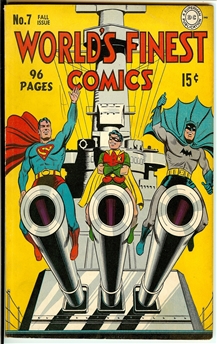
               Or this famous cover from World’s Finest #7 from the 1940s. It’s another comic I do not own, but it IS one of my favorite covers. If only because it never fails to elicit a sophomoric giggle. Hee-heehee-

hee…

               Robin does look quite proud, doesn’t he?


               I wanted to do something more personal. These are ten comic book covers that made me want to buy the comics. Something about the cover attracted me enough to say, “Oh I’ve got to get that.” Some are iconic, some are beautiful pieces of art; some just pressed my buttons (in a good way). If a comic book cover is supposed to entice you to purchase and/or read it, these worked … for me …
               You may notice the distinct lack of Marvel comics. This is because I did not read much Marvel growing up. I got most of my comics for free from Sparta Printing – who printed National Comics (they officially changed their name to DC Comics in 1976), Harvey and Archie. So Marvel comics were only picked up in the grocery store.
               And all of the comics were from the 1970s. This was when I was a boy into my very early teens; comic book covers mattered more to me than they do now. I haven’t been excited by a comic book cover in many decades. Maybe older and wise, maybe not.  A cover may intrigue me but it is the interior art or story that catches my imagination. That is too bad, I suppose, but it helps keep impulse buying in check…
                Someone might say, “How could this cover excite you? It’s silly! Now Spiderman #28 – THAT gave me the willies!”  Really? Tell me more about it! I’d love to read your lists!
               So these are personal favorites only. Maybe someday I’ll do my favorite list of “iconic” or “classic” covers, but for now, this is all about me! Haha!
               These are in no particular order:
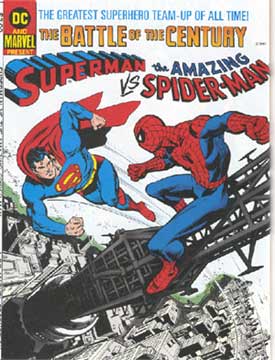
Superman vs Spider-Man: the Battle of the Century. 1976.  What comic book fan did not soil themselves upon seeing this cover? Even the house ads in other DC and Marvel comics brought a chill. It was this iconic cover with the words, “THIS … SAYS IT ALL!!” It helped that it was a rollicking good read that lived up to the hype! The cover was by Carmine Infantino (layout), Ross Andru (finishing and pencils) and inked by Dick Giordano – all hall-of-famers.
               Occasionally a comic cover lives up to its hype. This is one of them.
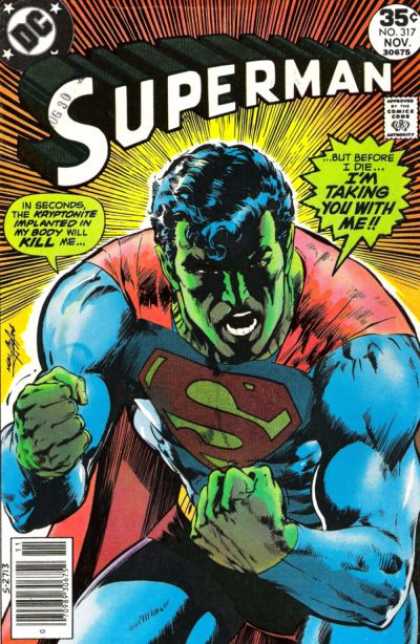


Superman #317. 1977? Neal Adams art. A later part of a multi-part issue, which was a better-than average story; so I would have gotten the issue anyway.  , but I was so wooed by the cover! An angry Superman!?  Wouldn’t you run away, too?
               Adams is a wonderful artist. Look at those muscles.  You can almost hear the cords creak as Superman flexes…
Superman vs. Muhammad Ali (All-New Collectors’ Edition #C-56). 1978. How can you look at this and NOT say, “Oh, I’ve got to see what the hell this is about…”. Iconic cover by Neal Adams. He was asked to redo this for a millennial-end issue of “Sports Illustrated” with the 20th century’s greatest sports legends. Muhammad Ali and Michael Jordan boxed in that one. Babe Ruth was in the forefront. In the audience were Sandy Koufax and a legion of others.
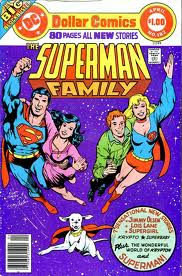
 
 
Superman Family #182, 1978? Neal Adams art. Are you sensing a theme here? This was DC’s first “Dollar Comic”. A dollar? For a comic book? Yeek! It would blow the budget of any teenager, but I couldn’t resist the cover. The stories inside ranged from great to mediocre. Neal Adams draws Supergirl.  Ooo-la-la. Plus it had Krypto on the cover.
               You gotta love Krypto!


Marvel Team-Up #74. 1978. “Is this a joke?” Talk about a cover that

screams “I’ve GOT to get this one.” Art by Dave Cockrum & Marie Severin. A fun issue that never wallowed in silliness.
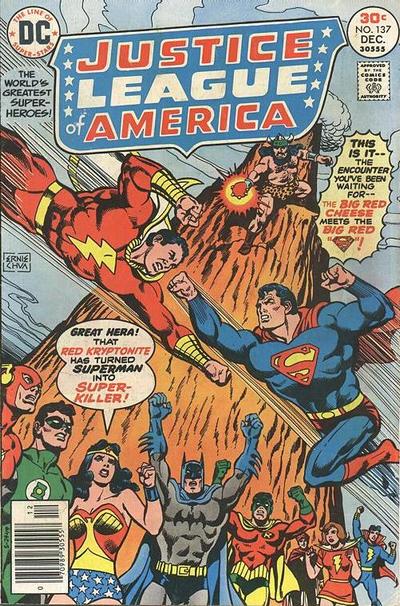
Justice League of America #137. 1977. Ernie Chua (Chan) pencils and Frank McLaughlin inks.
               Nowadays Superman and Captain Marvel (Shazam) fight each other annually. But this was the first time they shared a story – how could I resist it? It was also the first time they “really” shared a cover (earlier comics had Supes “introducing” Cap or their posters were hanging side-by-side, that sort of thing…).
This was part 3 of the traditional JLA/JSA team-up with Cap and other Fawcett characters appearing and fighting alongside our favorite heroes. It was the first time I had heard of or read about Spy Smasher and Ibis the Invincible – who have gone on to become two of my favorite comic book characters!

Batman #253. 1973
Oh.
My.
GOD!!!
Mike Kaluta art (no one – NO ONE – would have been able to do this better).
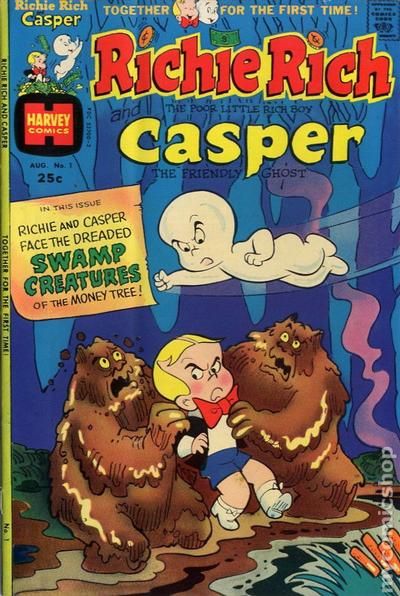


Richie Rich and Casper #1. 1974. Artist unknown. Oh, wow! Together! Oh, WOW, said my nine-year-old self!
               The story was fun and the artwork well done. Surprised to see a non-superhero comic on the list? Me too. But I still remember how thrilled I was seeing this and reading it. Forty years later I still remember the entire series with fondness.
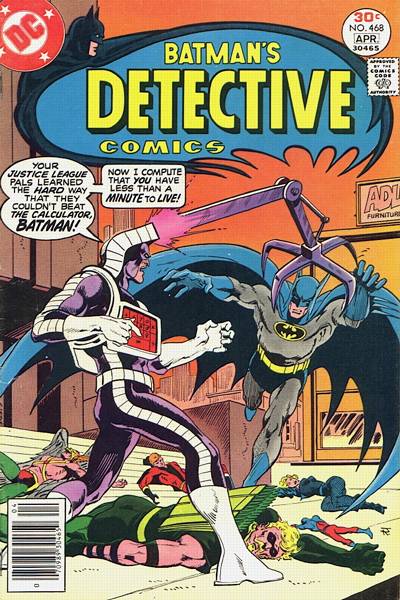
 
 
Detective Comics #468. 1978? It’s hard to believe this is the only comic on this list drawn by my beloved Jim Aparo, inked by Tatjana Wood.
               The Calculator! Over the past five issues this villain fought other DC heroes in the back-up feature (Green Arrow, Hawkman, etc. – all of them beaten and lying unconscious on the cover) and NOW he’s fighting Batman in a book-length battle! I was so excited seeing this cover when it came out! Great conclusion to a fun story line! It is in no way an iconic cover or a legendary story – but this youngster loved it!
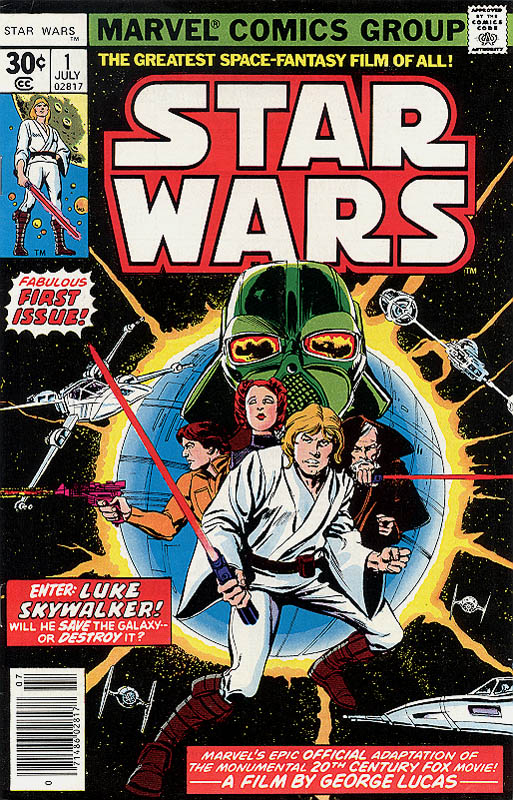


Star Wars #1. 1977. Cover by the legendary Howard Chaykin, inked by Tom Palmer.
               Great cover as always by Chaykin, especially considering the flood of Star Wars comic art to come. But imagine the impact of this cover on this 12 year old kid …
               Star Wars? As a comic book? Star Wars! As a comic book! STARWARSASACOMICBOOK!! “Earl to Aisle 3, Earl to Aisle 3. We have another boy passed out in front of the book stand. Earl to Aisle 3.”
Oh, ok, one more.
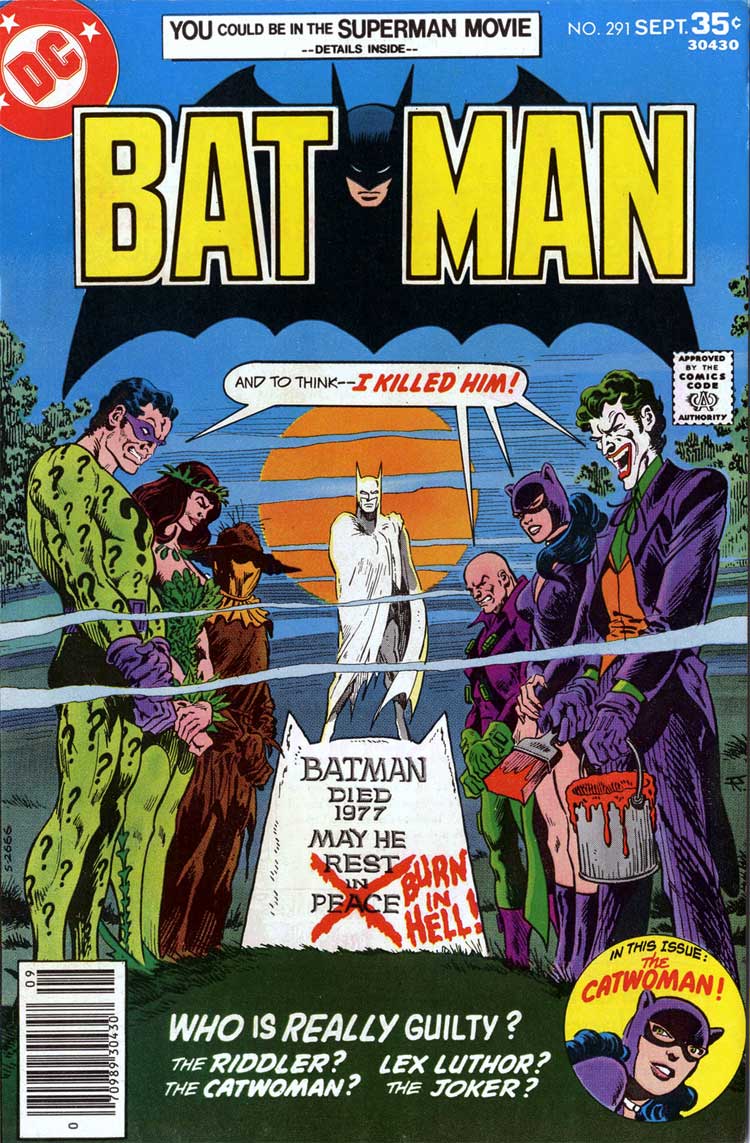


Batman #291. 1979 or 1980? Look at this beautiful Jim Aparo art (I felt bad about only having one other Aparo cover on the list and this issue immediately sprang to mind…). Tatjana Wood again inked.

               The cover made me snap this up – only to find out it was part one of four! Rats! Even so, it was a great story arc. I wish it would be released in a graphic novel. The Bronze Age gets a bad rap nowadays and that is too bad. There were some wonderful stories that a lot of fans missed during that late-1970s era. This is one of them!
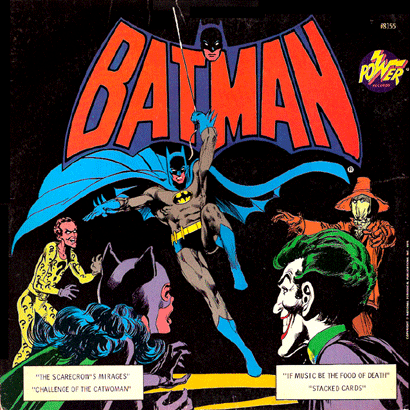
Honorable Mention:  Power Records, 1975. This is not a comic book, but dig the cover! Another Neal Adams classic. When I saw this album I had to have it! It took the Beatles (or my discovery of them in 1979) to knock this off of my record player once and for all. I still have it!
                If this were a comic book cover it would rank in any Top Ten!
 Honorable Mention #2 – the entire run of Marvel’s “What If…” 1978?  The whole point of this comic series – tales of alternate endings to the various Marvel Universe mythos – was to goad the reader into buying this anthology series. “Ooh, aah,” was often heard at the newstands when a new issue came out – What if Spider-Man joined the Fantastic Four? What if Captain Ameria had not “disappeared” after WWII? What if Shang Chi served Fu Manchu? What if Bruce Banner had always kept Bruce Banner’s intelligence? What if the New X-Men never formed? What if someone else had been bitten by that radioactive spider?
               Others will muse over “great” covers and “iconic” covers, but these captured by heart and imagination more than the others. There have been better covers – there have certainly been better stories on the inside. But just looking at the covers on my list brings back good memories.
               Isn’t that the whole point?
Hey Comics! Kids!

Hey Comics! Kids!
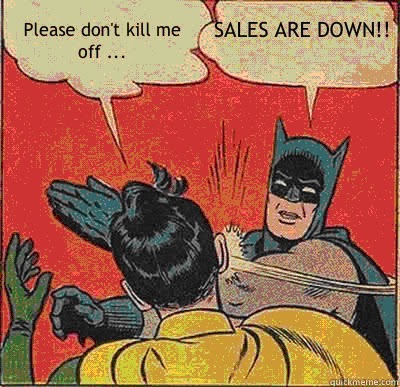
  d113b-batslap-bmp
              The recent death of Robin the Boy Wonder got me thinking about superheroes and children. This Robin was the illegitimate love child of Batman/Bruce Wayne and Talia al-Ghul, the daughter of his enemy Ras Al-Ghul.
                My favorite comic book eras were the Silver Age and the Bronze Age, roughly comics released from 1956 – 1985.  During those eras, superheroes did not have children; with only two exceptions. The end of the Bronze Age saw the end of that – but more of that later. “World’s Finest” brought us the sons of Superman and Batman; and Superman and Lois seemed to have a super-powered kid every few issues; but these were imaginary stories (as opposed to the “real” stories), not canonical progeny.
                And during those years we had the adventures of Superbaby and Wondertot (no lie), but those were our beloved heroes as toddlers, not the children of an existing superhero.
                Why no kids?  It was probably because of the readership – oh, yes, some comic book readers enjoyed romance comics. Also, at this time Archie was always pining over Betty or Veronica. But to actually marry? And have a baby?
                No. Keep your reality out of my fantasy.
                Did we want to see Superman changing a diaper? Did we want to see Flash literally racing to the store to buy more formula? Probably not.
                The two exceptions signify the two extremes why such things did not happen otherwise in those eras…
                In the “Fantastic Four”, Reed Richards (Mr. Fantastic) married Sue Storm (Invisible Girl/Woman). An entire special issue (an Annual) was made of their wedding. The birth of their first baby, Franklin, was on the blurb of their comic a few years later. It wasn’t an event on par with Lucy and Ricky’s on early television, but in comicbookdom it was big stuff. It was a superhero’s (and thus comic books) first baby. Every few issues the child was threatened; or he and his babysitter were kidnapped or disappeared. The stories always turned out well, but the easy plot devise was used again and again.
                Aquaman was not so lucky.
                He married Mera and had Arthur Jr. Sometimes Junior would be called Aquababy.
                 In the mid-1970s, some years after the cancellation of his own title, Aquaman was revived in “Adventure Comics”. The creators kept the cast intact: Mera, Vulko, and Arthur Junior.
                 Like Franklin Richards, Arthur Junior was shown at the beginning and ending of most tales playing with Mommy and Daddy or their friends/partners/sidekicks. But Aquaman wasn’t the Fantastic Four. He was a secondary character in a low-selling magazine. Writers could get away with things here they couldn’t elsewhere.
                Baby Arthur was kidnapped. Ho-hum. Aquaman vows vengeance. Yeah yeah.
                Aquaman smacks the shit out of Black Manta and opens up the pod in which Manta put Arthur.
                He was too late. Arthur Jr. was dead.
                Whoa.
                What? He’s a baby! Well, a toddler. That can’t be. This is a comic book for chrissakes!
                That’s the trouble with children in comics even today.  I’ll be frank: putting children in life-threatening jeopardy should be off-limits. Isn’t it bad enough I have to see talking heads blather about the children of Sandy Hook on the idiot box? I don’t want to read about this stuff in my comics.
                Maybe I’m just turning into a crabby old man, but that’s my stand on that subject. Superheroes having kids can make for wonderful stories and great personal drama – but once born, leave them alone.
                Was the death of Arthur Junior done for shock value or publicity or a sales boost? Probably not. It was a second-string character in a second-tier comic book. The cover gave no indication as to what would happen. It wasn’t hyped in other comics in the line or other media (such hype was non-existent then anyway…). The next issue’s cover showed Aquaman in mourning at the gravesite of his son with a furious Mera in the background.
                As mentioned in a previous blog, death in a comic book is not always a bad thing. Most of the time, yes, but occasionally it can make for a great story. Arthur Junior’s death shadowed Aquaman for the next thirty years. It was even part of Aquaman’s legacy in the Batman TV cartoon “The Brave and The Bold”.
***
                By 1980 or so – the end of the Bronze Age – a child of a superhero was not such a rare thing.
                The Batman from the 1940s had a daughter. By the time we meet her she was a grown woman and fighting crime on her own as the Huntress. We saw more and more children of superheroes, but not as infants ripe for kidnapping. These were adults fighting crime on their own. Either flesh-and blood progeny, step-children or foster kids put on the cowl and became the next generation of crime-fighters.
                Green Lantern, Wonder Woman, Hawkman, even the Atom all had kids. They formed their own group called Infinity Inc.
                This was all DC Comics. The other big comic book producer took a different tact.
                Their children came from the future – alternate futures. The comic book based on the upcoming X-Men movie “Days of Future Past” featured a grown Franklin Richards. Scott Summer/Cyclops has so many children-from-alternate-futures-who-now-live-in-the-present they could form their own comic book line.  He has five at last count – if you count the clone of one of his sons.  And why wouldn’t you count the clone of one of your sons as your own?  I managed to say that with a straight face…
***
                In the Modern Age – the past twenty-plus years – our comic book heroes have lots of babies. Franklin Richards has a sister. “Astro City” featured a story arc with superhero Jack-in-the-Box and his pregnant wife. And more and more superheroes find their children taking up the trade – the aforementioned Robin, Green Arrow has a son in spandex, so does Plastic Man.
                Yes, Plastic Man … I expect that was one satisfied woman…
***
                Looking back at the later Bronze Age, I wonder why they didn’t tinker more with the caped ones having children? Especially so-called second-stringers?  Hawkman and Hawkgirl/woman were one of the few married comic book characters around. They were married when introduced! Why didn’t they have a baby? Granted they didn’t have a regular feature of their own at the time, but it could have been done in the pages of “Justice League of America” or “Detective”.
                Same with the Flash. He and his wife Iris exemplified the white-picket-fence existence. Their parents appeared frequently, as did other family members. Kid Flash was Iris’ nephew. A child would have been a perfect fit in that book. Then again, they did (temporarily) kill off Iris at the end of the Bronze Age … I wouldn’t expect a comic book editor to be merciful to their child …
                I am surprised a young man didn’t walk up to the Silver-Age Green Lantern and say, “Hi, I’m your son.”  It could have been from the days Hal Jordan was a truck driver or an insurance salesman when he and his original/current paramour Carol Farris were broken up.
                I think they would have made for some great stories. But with “The New 52” rebooting the entire line, the Silver Age/Bronze Age characters and their characteristics are gone, perhaps for good.
                A son for Hal Jordan would still make a good story though – make him a late teen or older. The power ring could check his DNA.  The son could be the reader’s link to GL’s world. We could see it through his eyes.
                Jordan would have to hide his identity again. The son would look for him in the months GL was away on a space mission. Jordan could start to feel … worried? Is that the phrase? Fear? Me?
                The conversation with Batman would make for an iconic scene, especially with the slight animosity between the two (which is getting better – the subject of another blog):
                This could take place in Justice League HQ.
“Are you sure he’s yours?”
                “Yes, the ring (taps at his ring) and Clark verified it.  Well, see you at the next meeting, Batman.”
                “Jordan…”
                “Here we go”, GL thinks. “Yeah?”
                “Hal.  Don’t give him a ring. Don’t let him put on a mask. Make him go to school, go to work. Make him get married, give you a grandson or granddaughter. Don’t turn him into one of us.”
                Trouble is, nowadays, within three or four years someone would kill him off. Or make him yet another Green Lantern. Or a different hero altogether. But it would make for some fine issues if done well; if they respected the characters and the genre.
                Aye, there’s the rub.
Copyright 2013 Michael G. Curry

The Pros and Cons

The Pros and Cons
                In April St. Louis held its first Wizard Con.
                In all my years as a science fiction and comic book nerd I have never been to a convention of any sort. A few years back there was a “convention” in a meeting room in a Holiday Inn in Chesterfield, Missouri; but it was just dealers and individuals selling comic book and related items. I found some good stuff, but it wasn’t a convention in the … er … conventional sense.
                But THIS was Wizard Con. One of the biggest convention companies around. My friends were eager to go and, since this would not involve a long trip and a motel stay, I wanted to go too!
                Not being a major con, and being the first in a new city, the guest list was not too impressive.  Philadelphia gets William Shatner; we get a wrestler and a Power Ranger.  Stan Lee was the biggie. The fact that he and the other media guests charged for autographs and photos riled me a bit. It’s one of those things that I suppose I will have to accept as “the way things are nowadays”.
                None of the media guests impressed me that much. I didn’t really feel like paying $80.00 to Lee and stand there smiling while he pontificated …
                “You know, I created the comic book convention!  I helped arrange the very first one in New York.  Well, by “helped arrange” I mean I did it all myself…”
                “There are a lot of folks in line, Mr. Lee, could you just sign the comic?”
“You know, I created the Sharpie…”
                Most of the other guests I flat-out didn’t know. The prostitute from “Firefly”, Lou Ferrigno (was it worth getting his autograph … nah … now if Bill Bixby was still around…), Henry Winkler (the Fonz charging for an autograph? I thought he was supposed to be cool…), James Hong (“Seinfeld, four!”), Juliet Landau (I remembered her from “Ed Wood” – others know her from “Buffy”), professional wrestlers and the like.
                I was much more excited to meet the writers and artists scheduled to be there:
                Gary Friedrich – creator of Ghost Rider (Marvel barred him from stating that but they didn’t bar me…), Michael Golden (artist who drew the best “Star Wars” issue in its run, he also drew “Micronauts”, “Marvel Premiere” and the Marvel poster I had on my college dorm wall for years. I bet I threw it away…) and Neal Adams.
                Yes, Neal Adams.
                My backpack was loaded with comics to sign and my wish list of comics to purchase.  Neal Adams’ booth was near the entrance with no line. I went there first. He autographed the postcard I brought with his Green Lantern stamp and my copy of “Superman vs. Muhammad Ali” (if you don’t know, don’t ask). He showed me the special “Sports Illustrated” cover he did as homage to that comic featuring the “Greatest Athletes of the Twentieth Century” with Michael Jordan replacing Superman. I asked if he knew of Ali read and enjoyed the original comic. “Yes, he loved it. I met with him while I was drawing it.” It was a thrill to talk to him!
                Overwhelming is putting it simply. It was very crowded at the con and at times the crowds moved like cattle past the exhibitors. I ran into the friends I intended to go with (I had missed the turn to the meeting place and ended up taking the train into downtown St. Louis alone) but was very pleased to see my sister, her husband and my nephew there! I spent the rest of the day with them.
                THEY were please to see the guests from Buffy and Power Rangers and others. By now I had bought my comics and had by belongings signed and saw the convention through my nephew’s eyes. He pored over the Doctor Who exhibits and we discussed our individual favorite Doctors (mine had died before he was even born…).
                I had a wonderful time but left disappointed. Wizard Con St. Louis was, basically, a large and expensive flea market. Very crowded and not very organized. At the time I doubted I would go back. I can get the comics I need on ebay.
                For example: there was no information kiosk. Apparently Gary Friedrich had canceled. He was nowhere on the information map (he has health problems – were he allowed to hype himself as the creator of Ghost Rider he might attract some work without Marvel losing a penny of their billions … but no).
                The point is if there was a kiosk I could have asked if Friedrich was there or not.
                Another example: the next day Neal Adams told his Facebook fans what a great time he had. He even got to talk about some movie deals he is working on at the panel at which he was featured.
                Panel?
                Panel!?
                There were panels?
                Oh yes, there were panels, movies, seminars, all kinds of things!
                There were?  Nowhere on their website did they mention panels – let along tell the public what they were about and where they were. I looked and looked before going. I would have loved to watch panels on artists, upcoming events and the like.
                I hear from my friends who go to bigger conventions (even the granddaddy-of-all-conventions at San Diego) talking about seeing previews to new movies, TV shows, guest speakers hyping their latest books and films. Sometimes there are seminars on writing and publishing.
                But I had no idea such things were at Wizard Con St. Louis.
                But this was the first and was quite a success. They are already hyping next year’s con. They already have a line-up – more actors I don’t recognize from shows I don’t watch … with the exception of Peter Mayhew (Chewbacca). Him I know.  I don’t want his autograph – my sister already got me his autograph at another convention in 2011 – so I’ll once again look forward to meeting the artists and writers I have loved in the comics!
                Perhaps they will strive to improve the Con next year and in following years. A bigger venue is a start – or at least open up more space. An information kiosk. A list of events – preferably online so we plebs can plan our day (“Sorry, Chewie, I gotta head for the panel on writing short stories in the digital age.”)
                “You know, I created the short story …”
                “Shut up, Lee.”
                I’ll go next year now that I know how it works.  It’s just too bad this one left a bad taste in my mouth.  
Copyright 2013 Michael G. Curry


Superman turns 75 …

Superman turns 75 …
Happy Birthday to comic book’s greatest creation and to one of comic book’s greatest creators…
            Seventy-five years ago today thousands of children (the vast majority of them boys) went with their parents (the vast majority of them the mothers) to drug stores, to grocery stores and past magazine stands.  There they spotted a new magazine, published on that very day (the vast majority on the northern east coast of the United States).
            It wasn’t a new type of magazine – it was a comic magazine. There have been magazines featuring comic strips as long as there have been magazines and comic strips.
            This one featured new comic strips – never published anywhere else. This WAS fairly new. Comic magazines featuring new material had only been around a few years. Most of them were comical, had funny animals or reprinted adventure strips – retreads of the popular pulps of the day.
            On the cover of this magazine was a man in blue tights and a red cape lifting a car over his head and smashing it to the ground while other men ran in panic. He was called Superman and his 14-page story was the first feature.
            Other stories in Action Comics #1 were boxer Pep Morgan, Marco Polo, ace reporter Scoop Scanlon, two stories of crime-fighting cowboys – one set in the Wild West and one in modern times in England, and master magician and crime fighter Zatarra – whose daughter is still around in the comics.
            Nearly all the stories were serials – part one of who-knows-how-many.
            The comic book was a hit. It marked the birth of the superhero.
            Happy 75thbirthday to Superman.
            Superman was created by Jerry Siegel and Joe Shuster. In their mind they created a comic strip along the lines of pulp hero Doc Savage; they had similar powers and even a Fortress of Solitude. An early advertisement for Doc Savage called him a “superman”.
            They did not know they created an new literary archetype.
            The superhero is one of only two purely American archetypes – the other being the cowboy. The superhero is also the last archetype to have been created. Well, with any lasting power, that is. You could argue the hippie was also a lasting archetype. At one time it was, true, but now the hippie is used for laughs or otherwise has a negative connotation.
            Look at the upcoming summer movie schedule to see what affect Superman has had on our culture. Look at the cartoons on television; even sit-coms. Do you think there would have been a “Big Bang Theory” without him?
            I have written in a previous blog about the rotten treatment of Siegel and Shuster and their heirs – receiving hardly a penny from the Superman franchise. Many comic book professionals are making very valid points about this on their blogs and on their Facebook pages today. I join in their chorus. But I still wish Superman a happy birthday.
***
            It is also Carl Burgos’ birthday. 75 years ago he turned 22. At this time he was drawing backgrounds and panel borders while working for Harry Chesler, a comic book magazine publisher. Did he pick up a copy of Action Comics #1 on his birthday? Probably not. Did he ever read Superman comics? I don’t know for sure, but I would suspect the answer is “Oh yes!”
            Some time before October 1939 Burgos sold a character he created to Timely Comics, a rival of National Comics – Superman’s company. It was another superhero of the Superman archetype, but different enough to avoid being a mere copy of Superman
            The character was the Human Torch. While not as popular as Superman at the time, it was still a success.
            So much so that there is still a Human Torch (albeit with a different origin and identity) to this day.
            So much so that the company, Timely, is still around (albeit with a different name – Marvel Comics, home of Spider-Man and the Avengers; you might have heard of them…).
            Except for the 1950s, the Human Torch has been a published character since its creation. Only Batman, Wonder Woman and, oh yes, Superman, have been published longer and/or more continuously.
            75 years ago a character was published that created an industry and through it America’s last great literary archetype.  97 years ago a man was born who would help launch one of that industry’s biggest publishers.
            And on a personal note, happy birthday to my friend Don – born some time after Burgos and Superman – whose infectious love of comics and pulp magazines is greater than anyone I know!
            Happy Birthday to them all!

SOME THOUGHTS ON RELIGION AND SUPERHEROES…

SOME THOUGHTS ON RELIGION AND SUPERHEROES…
             My gaming group was playing the RPG DC Superheroes, which the GM set during WWII.  Some of us played original characters while others played established golden age DC folks: Dr. Mid-Nite, Green Lantern, Phantom Lady, etc. I played the Shining Knight.
            During the game Nazis stole a book by one of Copernicus’ protégés and in the course of the adventure I asked if I could read it. I said my character could probably read or understand Latin because as a knight of King Arthur’s Round Table he would have been at mass at least once per day!
            “He’s Catholic?” someone asked.
            There was no Catholic Church back in the seventh century; there was only “the church”. Sir Justin (the Shining Knight’s real name) lived during King Arthur’s reign. Whether he wanted to or not, if he lived back then, he probably attended mass in Latin.
            That got me thinking about superheroes and religion: what religion would our favorite superheroes be? In what faiths were they raised, if at all?
            I read the Fantastic Four graphic novel of Marvel’s Civil War where the Thing talked about being Jewish. This was the first reference to the Thing’s religion I knew of (not being up on Marvel over the past decades I don’t know when they first mentioned that).
            There are some superheroes (scant, but some) whose religion is central to their character. The current Dr. Mid-Nite, for example: in the pages of the last version of JSA he used his Catholicism to help Mr. Terrific deal with the loss of his wife (see my previous blog regarding good and bad deaths of comic book characters…).
            Religion is (was) strongly emphasized with the X-Men. Magneto’s Jewish-ness (is that a word?) and Nightcrawler’s Catholicism has been used well for story fodder.
            Like they did with the Thing, Marvel may have established religions for all their characters. I will freely admit if I am wrong. So this is a purely objective list subject to only my whims and generalizations! Feel free to argue! And note this gets sillier as it goes along (as said: if a character’s religion has reallybeen established in the comics, let me know!).
            Also this is from a Silver and Bronze Age fan. The post-Crisis and post-New 52 (for DC) and post annual reboot (for Marvel) have changed the personalities and backgrounds of all these characters thus making my generalizations questionable, haha:
            SUPERMAN: raised in a Kansas farm town? Baptist. Maybe Methodist. Currently, not attending a church. Rao was a Kryptonian god and Superman would sometimes shout out “Great Rao” in times of shock and stress, but otherwise the comics never showed Supes really worshipping him per se.
            BATMAN: I imagine his unbelievably rich and isolated childhood (pre-Crime Alley obviously) to be much like Teddy Roosevelt. “Gotham City – home of high crime and the cod, where the Ryders talk only to the Waynes, and the Waynes talk only to God.” Episcopalian.  Currently? … oh c’mon! Agnostic is being kind.
            WONDER WOMAN: Pagan. Pretty obvious there.
            FLASH (Barry Allen): Solidly set in the Midwest. Methodist or Lutheran. But with the last name Allen being of Irish extraction, I would guess Presbyterian or Catholic. Same with Wally West. However, the various weddings of family and friends throughout the 60s and 70s do not show the usual Catholic trappings (I don’t mean that in a bad way), so I would guess Protestant.
            Jay Garrick? What is Garrick? If a German name, Lutheran; if Irish, Presbyterian.  I would believe all Flashes would still be attending church, it fits their characters.
            GREEN LANTERN: father was in the military. I’d say non-denominational if he was given any religion at all as a child. More likely with his cavalier attitude toward life; he probably wasn’t taken to church much at all as a youngster.
            GREEN ARROW: Oh, please, with his intense hatred/aversion/suspicion over authority figures? Lapsed Catholic.
            BLACK CANARY: No opinion. Any religion (or none at all) would fit. When she married Green Arrow it wasn’t in a Catholic Church. But then GA may have vetoed a Catholic wedding. I’d bet she went to church well into adulthood and may still go on major religious holidays.
            TEEN TITANS: By this I mean the original teen sidekicks – Batman would raise ROBIN to be as irreligious as he is.
            Ditto SPEEDY.
            Probably only KID FLASH would have gone to church.
            AQUAMAN/AQUALAD: Pagan. Interesting that with his worship of Neptune he and Wonder Woman haven’t argued over the similarity/assimilation of Greek and Roman mythos.
            ATOM: Northeast Ivy Leaguer? Episcopalian. And was a regular attender until his life fell apart with the split with his wife.
            HAWKMAN/HAWKWOMAN: I think Thanagar’s religion was established, but I can’t see Katar and Cheyera being very religious.
            The original Carter Hall? Well, I suppose with his hundreds of reincarnations he has been many religions. But I suspect his worship of Horus the Hawk (really a falcon) headed god still lurks underneath.
            ELONGATED MAN: United Church of Christ. Just seems right.
            MR. FANTASTIC: He probably eschewed religion early on, but what about his heritage? If Ben Grimm is Jewish, I’ll bet Reed Richards is, too.
            INVISIBLE WOMAN AND HUMAN TORCH: Their last name Storm is probably a derivative of Strom, western German/French. Tight family with a large age disparity. I’d guess Catholic. Any brothers and sisters in between?
            ANT MAN/GIANT MAN/YELLOWJACKET: What kind of a last name is Pym? Welsh? Anglican or Catholic. Dutch? Danish National – a type of Lutheran.
            WASP: With a maiden name like Van Dyne? Danish National again – which would help explain the initial attraction of a wealthy socialite and a bookish scientist.
            THOR: Rather obvious. Is it narcissism to worship yourself if you really are a god?
            SPIDERMAN: He was probably irreligious as he got in his teens, but what denomination were Ben and May Parker? Where would they have taken Peter as a youngster? Methodist.
            X-MEN: (Other than as professed in the introduction)
            Professor X: Jewish;
            Colossus: Russian Orthodox;
            Wolverine: In Canada, Catholicism and Anglican make up 81% of the religions, so I guess lapsed Catholic – he has that distrust of authority-thing going, too;
            Storm: well, herself… (she was worshipped as a god in her tribe before joining the group);
            Kitty Pride (whatever her moniker is this week): I believe in the comics she has said she is Jewish;
            Cyclops: tough one, but I would guess a very Orthodox conservative Catholicism;
            Marvel Girl: Catholic (if only because of imagining her in the schoolgirl outfit… oy…)
            DOCTOR DOOM: Latverian Orthodox, what else?
            LEX LUTHOR: Russian Orthodox. Can’t you see that?
            THE NEW GODS: well, each other I guess.
            THE JOKER: Scientology.
            Except for the last one, none of these were meant to be for the sake of a joke or to be insulting. If I have insulted anyone, I apologize for doing so, even if unintentional. But if Marvel & DC decide to announce that most of the X-men are Catholic or that Superman was raised a Baptist, it wouldn’t surprise me. Keep in mind – if I didn’t know the Thing was Jewish, I would have guessed Catholic with his inner-city-street-gang-past-coming-straight-out-of-“Angels-with-Dirty-Faces”.
            So what do I know?
            JWhat do you think? Who would you add?
Copyright 2013 Michael G. Curry

Robin the Boy Wonder – the Spinal Tap drummer of comic books…

Robin the Boy Wonder – the Spinal Tap drummer of comic books…

            DC Comics is killing off Robin the Boy Wonder.
            Happy 1988 everyone!
            No wait, it’s happening AGAIN. NOW!
            This isn’t the first Robin to be killed off. The first Robin killed wasn’t even the first Robin.
            Robin the Boy Wonder, the Spinal Tap drummer of DC Comics. The first Robin was Dick Grayson, Bruce Wayne’s ward. This was the Robin from the 1960s TV show and the cartoons up until about 1990 or so. When his character grew into manhood, he was replaced by Jason Todd. Jason was killed by the Joker as a gruesome publicity stunt. We the people called a 900-number and voted whether to off the Boy Wonder. We the people responded with a resounding yes.
            Then came Timothy Drake – a more likable character who was eased into the role. Dick Grayson was shown in the comics mentoring Tim, so that we the people would learn to like him in case of another telephonic publicity stunt.
            Tim Drake also grew up and became Red Robin – he was replaced by his fiancé.
            Then came Damian Wayne. He is the child of Bruce Wayne and Talia Al-Ghul, Ra’s Al-Ghul’s daughter. I didn’t read many comics with Damian Wayne as Robin. What little I read of him came from his appearances in other comics. Much like his father (or at least the personality of his father over the past 20 years or so), he was a smart-ass dickwad. He told Wonder Woman to put on some clothes, called her a “harlot”. That sort of thing.
            Lots of other people have dressed as Robin over the years – including Bruce Wayne’s girlfriend Julie Madison and Superman’s pal Jimmy Olsen.
            According to the DC press machine, Damian grew from a brat into a noble and honorable hero.
            So, of course they kill him.
            Is it a sales boost in a bottle? You bet. Will Damian be back? Sure, Jason Todd came back, Damian will to. “No, sorry,” say the DC press machine, “this one is permanent.” They lie.
            My friend Clyde Hall discusses his frustration at this publicity stunt in his blog here: http://playmst3kforme.blogspot.com/2013/03/dc-marvelstop-before-you-kill-again.html
            I applaud his letter and would sign on to it as well! But killing off Robin got me thinking in a different direction.
            Death has been a part of comic book history since the explosion of Krypton. Death can create a hero and mold their personalities and motives just as it can in a traditional story. The trouble is it can also be a cheap way to boost sales and a shortcut for real storytelling and character development.
            It hasn’t always been that way. The three most familiar characters in comic books had their origins mired in death. Superman was orphaned twice. “With all my powers,” he would opine at the gravesite of his adopted parents, the Kents, “I couldn’t save them.” His first parents, along with the billions of inhabitants of Krypton, didn’t give him the moral base that Jonathan and Martha Kent did. In later years, when the powers-that-be retconned his mother back to life, it did not seem the same. His internal moral compass became an external one. Superman would save the world from Throgg the Omnipotent, then have a slice of pie at his mother’s farm.  Eh…
            Imagine if someone retcons Batman’s origins so that his parents lived. The murder of Thomas and Martha Wayne (by Joe Chill, the future Joker, or anyone – personally I preferred it to be always unknown – a random killer; the one case Batman couldn’t solve) is vital, VITAL, to Batman’s origins, motives and personality.
            Likewise the murder of Ben Parker, Peter’s uncle, was vital to Spiderman’s origins, motives and personality. Had Ben Parker lived, Spidey would have been a sideshow attraction/stuntman. After his uncle’s death, Peter had his now-famous epiphany, “with great power comes great responsibility.” This is more dry-eyed then Superman’s epiphany, and more famous, but just as effective. “Thus a superhero was born.” Can’t you hear that in Stan Lee’s voice?
            Sometimes a death mid-series can be done without shock value or for the sake of a sales boost. And that death can affect motive and personality as much as the death of the Kents, Waynes and Ben Parker.
            Gwen Stacy was Peter Parker’s main squeeze and was killed in a battle between Spider-Man and the Green Goblin. Her death shadowed the Spider-Man books for decades.
            The most famous example was Bucky. When Captain America came back from post-WWII obscurity into the 1960s in the pages of the Avengers, we learned that his side-kick Bucky had been killed in an explosion just before Captain was frozen for nearly twenty years. Bucky’s death permeated everything Captain America did for the next 45 years. They brought Bucky back eventually, which (although well done) diminishes Cap’s mortality. During the excellent JLA-Avengers miniseries, Captain America and Batman worked together in the Batcave to find a solution as to what is causing all the other heroes to thrash each other. Cap stared at a mannequin of Robin’s outfit. “You lost a partner too?” Batman replied with something like a “let’s concentrate on our work” or some such. It would have been worth a panel or two later to show them drinking coffee and each discussing losing their sidekicks.
            Which brings us back to Robin. It seems most deaths in comics over the past three decades have been publicity stunts and sales boosts. Once in a great while, though, the stunt grows into an interesting few years of comic book tales.
            Take the death of the first Robin, for example. A stunt? Sure, some fan-boys probably maxxed out their credit cards calling the “kill Robin” number. But over the next few years the death of Jason Todd haunted Batman. Tim Drake’s taking over of the Robin mantle developed slowly – Batman did not want to lose a partner again.  Oh sure it was also done slowly to ingratiate him with those same fan-boys with the 900-number on their speed-dial, but it wasn’t BAD…
            Bringing Jason back to life, however, nullified any literary gains made. It turned the whole thing into the old chestnut – “No one stays dead in comic books.”  We used to say, “except Bucky.” Not even THAT is true anymore.
            I give DC comics the benefit of the doubt over the death of Superman twenty years ago. I believe DC planned to make this a year-long line-wide event.  Looking back, it was very well done after all. It created some new villains and heroes that are still around today. But even the creators admit that when the mainstream news got a hold of the story on a slow Friday and ran with it – they saw money signs flash before their eyes. “Superman dead!” screamed headlines and newscasts, as if he were an actual person. The powers-that-be knew they had a publicity blitz on their hands and milked it. Oh yes, he’s dead! No doubt about it! This is for real!
            Yeah right.
            Within days the powers-that-be were backsliding. “Well, death for a Kryptonian isn’t the same as death for we earthlings.” Ah, he’ll be back. It WAS all a stunt…
            And the bloodbath didn’t stop there. Within a few years we saw the deaths of Greens Lantern and Arrow after big build-ups. They came back eventually too.
            So did the Flash. He was killed in 1985 along with Supergirl and a few secondary characters by a universal threat that enveloped the entire line of DC comics (the “Crisis on Infinite Earths” to you comic book-types).
            The original heroes of DC/National comics – the members of the Justice Society – were DC’s whipping boys all through the 1990s and on. Golden Age heroes were killed nearly annually. Dr. Midnight, Dr. Fate, the Atom, the Sandman, the original Superman, all were killed off for its shock values.  Whereas, the original Batman was killed off in the 1970s in a well-done (if not widely read) series of stories that still affected the characters involved for the next eight years (until the “Crisis…”).
            How many times has Spider-Man’s Aunt May been killed?
            So I roll my eyes when I hear news of “the Human Torch is to be killed off!” Remember that a few years back? It’s okay if you don’t… because they will all be back.  Maybe not within the year, but soon. It’ll happen when the editor runs out of ideas and needs another sales boost. After killing everyone off – the only thing left to do is bring them back.
            Marriage in comics is the same way. Superman and Lois Lanemarry. Spider-Man and Mary Jane marry. OK, what next? Umm, un-marry them. It never happened. That’s what they did. To both marriages.
            “Robin is to be killed!” Mmm-hmm. He might not be Robin when he comes back, but he’ll be back. If Bucky and Martha Kent can come back, so can Damian.
            Will anyone care? Well, was his death and eventually resurrection a good story ala Bucky? Did his death make a difference in the Batman universe? And will his return make an equal difference? If so; if it makes for quality reading and enthralling entertainment, then the answer will be yes!
            In other words, no.
Copyright 2013 Michael G. Curry

This is an open letter from Laura Siegel Larson. Her father co-created Superman.

http://www.scribd.com/doc/109878615/LSL-Open-Letter-10-11-2012-1

This is an open letter from Laura Siegel Larson. Her father co-created Superman.

Ever since the Avengers movie came out there have been several comic creators protesting the exclusion of Jack Kirby and his heirs from even token consideration and thanks for his creations. Jim Starlin, the creator of Thanos – the mysterious bad guy at the very end of the movie – received a free ticket to see the film. A movie that made half a billion dollars domestically and he received a free ticket.

The second most memorable scene of the Avengers movie was seeing Jack Kirby’s original work used as Agent Coulson’s Collectible Cards. They used his characters; they used his art. His original art.

At first I was torn by this issue and could see both sides. I have since come to the sides of the creators.

The corporate owners argue that these men and women were hired to draw and write comic books. They did so and they were paid for doing so.

On a vastly smaller scale I was a radio announcer for ten years during the 1980s and 1990s. My job (among other things) was to create commercials for local businesses. Sometimes those commercials were awful and sometimes they were very very good. A few were so good they played on other stations throughout the listening area. I won a contest with a restaurant chain and had my commercial played in every city that had that chain – my sister heard me at Purdue University. The commercial played in Chicago, Champaign IL, Springfield IL among other markets. I was quite proud of that commercial.

Twenty years later I was driving through one of the cities in which I was a DJ. A commercial came on the radio that was a word-for-word remake of one of my old commercials. It was a auto repair place instead of a video store but it was mine! It was a Star Trek spoof I fell back on a few times when someone wanted something quick. There are lots of Star Trek spoofs out there, but I repeat this was a word-for-word remake. Someone must have gotten a hold of an old tape and thought they could use it.

Was it my commercial? No. I was hired to create that commercial and was paid (somewhat) for doing it. Most such commercials, especially in the smaller markets, are owned by the station. Only rarely does the commercial belong to the company for which it was made. Remember the WKRP TV show in which a jingle was made for the funeral home? The deal fell through and they used the commercial for a tire business. That’s why about once a year I would drag out an old Star Trek spoof for in-house promos and businesses. “You used that commercial for ME last year!” “So we did, would you like us to use it for you next year?”

I did a Peter Falk/Columbo spoof for a liquor store that was hugely successful – patrons mentioned it when they bought their booze. Was I entitled to any profit from the liquor store? No. Could I have used that same spoof later for another store? Yes, although it would not be a good marketing idea – you annoy your old client and patrons would call out the new client for being a copy-cat. Would the owners of the Columbo character be successful in suing us for stealing their character? Probably – they would win a “cease and desist” action, even though it caused them no loss of income.

Look at the employees of an automobile manufacturing plant. They are also hired to do a job; say, putting on a widget on the bottom of the car. They put thousands of widgets on cars every year. Are they entitled to a percentage of every car sold that has their widgets? No.

But why not? Why shouldn’t they be if the car is successful and sells well?

You can argue that they ARE paid a percentage of every car sold – that’s profit sharing by its very definition. They are provided insurance if they get sick or hurt as a result of their work. Although I suspect if I kept digging I would discover those benefits were given to the employees only through intense collective bargaining (dare I say … unions?).

And if the car is successful the employee continues to work there until he decides to quit or retire. So he does participate in the success of his widget-placement.

I don’t want to get too deep into this argument – but there is a difference between widget placement and creating a unique piece of art. There are millions of cars with widgets, there is only one Captain America.  Not to belittle the work done by the factory worker who places the widget; but that argument is valid as well.

Back to my “borrowed” commercial; suppose this auto repair shop becomes phenomenally successful – with chains all over the nation. And they still use my commercial. Suppose their profits are in the millions. Would I be entitled to a share of that because of my commercial? Would the person who found my commercial and “borrowed” it be entitled?

I’m talking on a national scale here – millions and millions of dollars.

Just like the laws of quantum mechanics and cosmology – some laws (or at least things that seem to run on common sense) break down on a vast scale.

The Avengers movie has made one-and-a-third billion dollars. Billion. Carl Sagan billion. Was Jack Kirby – who helped create not only the Avengers but all – ALL – of the main characters portrayed in the movie – entitled to any share of the movie’s income. The courts have said no.

Why not?

Why not a token amount? Why not at least set up a college fund for his grand-children or great-grandchildren? Would it cut into their profits that much?

Why didn’t DC Comics “simply” give the 35-million spent on fighting their flagship character’s creator’s family to them directly?

And this is how they treat the dead – they treat the living even worse! If Thanos is the main villain in one of the future Avengers movie – will Jim Starlin still get a free ticket? Maybe ten tickets so he can take his family?  Will he be mentioned in the movie credits? Kirby wasn’t.

Gary Friedrich created Ghost Rider. He’s been barred from saying so at comic convention appearances, but he is. The Ghost Rider comic books say he is. He is sick and unable to pay his medical bills. How much have the Ghost Rider movie franchise made? Joke all you will about the quality of the movies – but they did make millions.  Not billions, true, but millions. Can’t they pay Gary’s bills?

Why not at least recognition? “Ghost Rider created by Gary Friedrich” – how much money will Marvel lose by putting that in their movies or allowing Gary to put that on a poster at a convention? Gary would get recognition and hopefully parley that into more writing gigs so he can earn an income (and hopefully at a company that allows creator-owned properties).  Jim Starlin, too.

Hollywood celebrities love their causes. But they have been mysteriously silent on this issue. Nicholas Cage is a comic book fan – he even owned a copy of Action Comics #1. He took his name from the comic book character Luke Cage, created by Archie Goodwin and John Romita Sr. Why hasn’t he offered Gary Friedrich any recompense for his Ghost Rider movies?  Where is Bryan Singer? Where is Kevin Smith? Smith has written comic books – Green Arrow among them. What if the recent TV series “Arrow” took one of his plots and presented it as a story arc for the TV show? Would he stand up then?

The companies that own DC and Marvel are determined to cut the creators from the huge profits made. They will spend (35) millions of dollars fighting when they could settle for half of the amount. At least give the creators recognition. It will cause no loss of income to the companies and help the people who helped make their profits.

Copyright 2012 Michael G. Curry

The Brave & The Bold Index Part 19

The Brave & The Bold Index Part 19
Fun facts: Part 2

Tale of the Tape
 
            DC was “required by law” to publish financial statements in their May/June/July issues, usually cutting into precious letter column space.  These statements include total average issues printed each issue, total issues actually purchased, total subscriptions, and issues closest to the publishing date (October).  Here I have used the average per issue for that year. Did Marvel, Harvey & Archie had to publish these too? Regardless, if the publishing statements can be believed (they were attested to, but then so were financial statements by Enron and Worldcom …), the following is a list of the annual sales of Brave & Bold and comparables:
Year
Issues Sold
Compared to
Issues Sold
Notes
1966
249,000
1967
279,000
#74 sold for 398,000
Justice League of America (“JLA”)
385,800
Strange Adventures
146,600
Deadman debut
1968
290,900
Haney-Adams issues
JLA
315,500
1970
212,200
The Flash
184,400
JLA
200,785
World’s Finest
356,200
1971
210,708
1972
179,819
JLA
168,871
World’s Finest
234,878
Phantom Stranger
138,629
1973
190,047
JLA
187,055
The Flash
162,400
1974
190,100
JLA
189,392
World’s Finest
181,542
Adventure
166,398
The Spectre (Aparo art)
Phantom Stranger
179,566
Wonder Woman
132,675
Superboy/Legion
260,480
Superman Family
174,416
1975
158,000
JLA
166,000
Adventure
106,647
Aquaman (Aparo art)
Swamp Thing
124,581
Superboy/Legion
173,232
1976
151,000
JLA
193,000
World’s Finest
132,185
Adventure
104,309
Superman
216,122
Superman Family
156,636
1977
147,912
JLA
151,982
World’s Finest
95,997
Dollar Comic begins
Detective
105,078
Superman
226,127
Superman Family
95,109
Dollar Comic begins
1978
119,955
JLA
126,805
World’s Finest
63,463
1979
152,252
#155 sold over 200,000 issues
World’s Finest
85,194
1980
109,180
JLA
123,099
1981
92,847
JLA
128,243
DC Comics Presents
135,604
Wonder Woman
81,725
1982
91,097
JLA
114,071
World’s Finest
80,696
1983
(B&B was cancelled before the sales were published)
JLA
119,519
World’s Finest
81,179
1984
None
JLA
108,222
World’s Finest
70,677


The Brave & The Bold Index Part 18

The Brave & The Bold Index Part 18
Fun facts: Part 1

Errata, Additional and Supplemental
            The Golden Gladiator appeared in an issue of Swamp Thing in its controversial time-travel story arc: controversial in that the story in which Swampy met with Jesus of Nazareth was not allowed to be published.
            Cave Carsondoes not appear in Showcase #100. Although it does not claim to include every character appearing in the magazine, a one-panel appearance (as was done with such obscure characters as Jason, Firehair and Manhunter 2070) could have been done. Cave has appeared in cameos in issues of Wonder Woman and JSA.
            The Golden Gladiator, Silent Knight and the Viking Prince appeared in All Star Squadron #54 as part of the line-wide cross-over mini-series Crisis on Infinite Earths.
            Cave Carsonappears in Crisis on Infinite Earths #11.  Rick Flagg and the Suicide Squad do not!  It’s the only group or character from B&B that is not involved in the mini-series.
            It has been established that the Silent Knight is one of the many reincarnations of Carter Hall in the fourth Hawkmanseries.  The “ghost” of the Silent Knight appeared in the comic to battle his former B&B co-star. One presumes Shiera Hall is therefore the fair Lady Celia!
Final Tally
            Batman starred in Brave & Bold in 134 issues, appeared in two cameos (in the first two Teen Titans stories – including their first team-up without the TT logo), and appeared in three issues with the Justice League of America, for a total of 139 issues.
            Other characters have appeared several times – adding JLA appearances definitely helped.  Flash appeared in 13 issues; Hawkman appeared in 11 issues, six of which were his solo stories; Green Arrow and Wonder Woman each appeared in 10 issues; and Metal Men, Aquaman and Green Lantern appeared in 9 issues.
            The following DC characters appeared in B&B and did not team-up with Batman:  Martian Manhunter (although he appeared with Batman in the JLA stories), Doom Patrol, Johnny Cloud and the Haunted Tank.
The tally for Batman team-ups is as follows:
Total team-ups with Batman —
9:         Green Arrow
7:         Metal Men
6:         Flash, Green Lantern, Wonder Woman
5:         Black Canary, Sgt. Rock, Wildcat
4:         Hawkman, Aquaman, Atom, Teen Titans, Metamorpho, Spectre, Plastic Man, Deadman, Joker (counting his “also starring” and “4 Famous…” spots)
3:         Creeper, Phantom Stranger, Adam Strange, Mr. Miracle
2:         Supergirl, Robin, Demon, Man-Bat, Kamandi, Swamp Thing, Nemesis, Rose & Thorn (in a two-parter)
1.         Eclipso, Bat Squad, The House of Mystery, Kung Fu Fighter, Unknown Soldier, Superman, Red Tornado, Dr. Fate, Ra’s Al Ghul, Black Lightning, Zatanna, Scalphunter, Firestorm, Guardians of the Universe, Lois Lane, Elongated Man, Legion of Superheroes, Hawk & Dove, Riddler, Huntress, Superboy,
             I … Vampire, Ragman, Catwoman, Karate Kid.
A tally of writers and artists are below (no, the numbers do not add up to 200.  More than one artist did appear in multi-story issues).


Writers:
Bob Haney:                  122 issues
Robert Kanigher:          39 issues
Garner Fox:                  16 issues
Mike W. Barr:              9 issues
Cary Burkett:                5 issues
Gerry Conway: 5 issues
Alan Bennet:                 3 issues
Marty Pasko:                3 issues
Denny O’Neil:              2 issues
Paul Kupperberg:         2 issues
Dan Miskin/Gary Kohn:
                                    2 issues
Mike Fleisher               2 issues
Don Krarr                    2 issues
John Broome:               2 issues
One issue each:
            Charlie Boatner
            Marv Wolfman
            Bill Kelly
            J.M. DeMetteis
            Alan Brennert
 Artists:
Jim Aparo:                   82 issues
Joe Kubert:                  26 issues
Irv Novick:                   22 issues
Ross Andru:                 10 issues
Carmine Infantino:        10 issues
Neal Adams:                 9 issues
Dick Giordano:             6 issues
Nick Cardy:                 6 issues
Mike Sekowsky:          6 issues
Ramona Fradon:           4 issues
Bruno Penanini:             3 issues
Don Newton:                2 issues
Joe Staton:                   2 issues
Bob Brown:                  2 issues
John Calnan:                 2 issues
Murphy Anderson:        2 issues
One issue each:
            Romeo Tanghal, Sal Trapani
            Alex Roth, Bernard Bailey
            George Roussos
            John Rosenberg
            Win Mortimer
            Johnny Craig
            George Repp
            Dave Cockrum
            Dave Gibbons
            Rick Estrada
            Chuck Patton.
The Batman Family
            Batman’s cast of supporting characters appeared frequently in Brave & Bold.  In some issues, Commissioner Gordon appeared in more panels than the supposed guest!
The issue list is as follows:
Batgirl: #78 (despite many promises to the contrary, she only appeared once)
Batwoman: #182, 197
Robin (as Batman’s sidekick, not as a member of the Teen Titans or a named guest): #s 86, 89*, 164*, 167*, 185 (a robotic Robin), 197, 200          *as Dick Grayson only
The Mayor of Gotham City: #s 59, 67, 89, 94, 102, 105 (kudos to Aparo for drawing the same mayor in 102 and 105 – he must have won re-election!), 113, 148, 150
Alfred: #s 79, 82, 90, 96, 100, 101, 105, 141, 142, 147, 150, 153, 155, 157, 165, 167, 168, 169, 173, 176, 177, 184, 187, 190, 193 (Nemesis in disguise), 194, 200 and DC Special Series #8: Brave & Bold Special
Commissioner Gordon: (although it would be easier to list the issues in which he didn’t appear…) #s 59, 64, 67, 68, 69, 70, 74, 75, 76, 77, 78, 79, 80, 81, 82, 86, 89, 90, 91, 93, 94, 98, 100, 101, 102, 104, 105, 107, 108, 109, 111, 112, 113, 114, 115, 116, 117, 120, 122, 123, 124, 125, 132, 133, 135, 136, 137, 139, 140 (a wax figurine), 141, 145, 146, 147, 148, 149, 150, 152, 153, 155, 156, 157, 161, 163, 165, 166, 167, 168, 170, 173, 177, 183, 184, 186, 197, 198, 200 and DC Special Series #8: Brave & Bold Special.

The Brave & The Bold Index Part 17

The Brave & The Bold Index Part 17
Team-ups: The Long Goodbye Part 3
June 1979 – July 1983

#185:   … & Green Arrow, “The Falcon’s Lair”, W: Don Kraar, A: Adrian Gonzales.
            The Penguin sets a trap disguised as a Gotham socialite’s birthday party filled with mechanical knights, killer falcons and fake Robins all to kill Batman!  Bats can’t make it, will Green Arrow do?
Green Arrow’s last appearance in B&B.  He totaled ten appearances (nine with Batman – more than anyone else – and one with the Martian Manhunter in the first team-up issue in #50) in the comic. He ranks fourth among total B&B appearances (only Batman, Flash and Hawkman have had more – Hawkman with six issues devoted solely to him.  And that’s not counting Viking Prince and Silent Knight!).
            Nemesis: “Triple Threat”, (Burkett/Spiegle). The three remaining Council members make a deal – whoever destroys Nemesis will become the new Head of the Council! Nemesis infiltrates Jay Kingston’s manor, not knowing Kingstonkeeps lions roaming his grounds. Bad time for his wound from last issue to start bleeding again!
#186:   … & Hawkman, “The Treasure of the Hawk-God’s Tomb”, W: Dan Mishkin & Gary Cohn, Art: Jim Aparo.
            The Fadeaway Man steals treasures from Gotham’s museums to sell them to the highest bidder, unless Batman & Hawkman stop him first!  Penguin must have escaped – he has a cameo during the museum auction eyeing the Gotham Eagle statue!
            Speaking of Hawkman, this was his last appearance (his 11th). He had six issues as a try-out series (#34-36 and 42-44). His silver-age revival was second only to the Justice League as a successful B&B try-out. He was featured in four team-ups with Batman and one team-up with Aquaman.
            Nemesis: “In the Lion’s Den”, (Burkett/Spiegle).  Nemesis escapes Kingston’s lion and his gun toting henchmen, but Kingstonhas other plans.  He discovers that Nemesis is somehow connected with widow Marjorie Marshall …
#187:   … & Metal Men, “Whatever Happened to What’s’ername?”  Writer: Charlie Boatner, Art: Jim Aparo.
            Nameless, the robot created by Tin (he called her Beautiful), was kidnapped by Platinum Man (of the Metal Women, don’t ask…). Platinum Man rebuilds the Floating Furies, the Gas Gang, the Missile Men and BOLTS to kill Doc Magnus and the Metal Men!
            I remember Nameless, she has a brief cameo in Brave & Bold #74!
            Nemesis: “Arena of Despair”, (Burkett/Spiegle).  Kingstonkidnaps Marjorie Marshall, who with her husband Ben Marshall raised Nemesis and his brother, to lure Nemesis back to Kingston’s manor and certain doom!
            Jill Weber contributes again to the letter column – her second!  Karen Wu’s second letter appears this issue, too!
            Another B&B staple makes their last appearance. The Metal Men appeared nine times – twice without Batman (teaming instead with Metamorpho and the Atom) and seven with Batman.
#188:   … & Rose & Thorn, “A Grave as Wide as the World”, Writer: Robert Kanigher (Rose & Thorn creator, and his first story for B&B since #52 18 years before).
            A Nazi spy on his death bed thinks he tells Hitler himself the location of a lethal canister of nerve gas he had stolen during WWII. Instead of Hitler, it was a neo-Nazi bent on destroying America! Continues in the next issue.
            Rose & Thorn was a reboot of a Golden Age Green Lantern villain and appeared many time as the backup feature to Superman’s Girlfriend Lois Lane. This was during the time at National when it seemed the backup feature was more interesting than the lead – Black Orchid, Captain Fear and Rose & Thorn are examples.
            Nemesis: “Gladiator’s Gauntlet”, (Burkett/Spiegle).  Nemesis fights off gun traps! Spike-filled pits! Bullwhip carrying goons! A man with a hook for a hand! Knife tossers!  Judo experts!  Exploding doors!  I can’t watch anymore!  Tell me when it’s over!
#189:   … & Rose & Thorn, “Grave…” Part Two, W: Kanigher, A: Aparo.
            The hunt for the nerve toxin leads to Argentinaand Martin Bormann!  “Agoinzed”?  Should have been “agonized”, a veryrare typo!  The last multi-part story in B&B.
            Nemesis: “Betrayal”, (Burkett/Spiegle).  Nemesis evades more traps and rescues Marjorie. Kingstonis killed by a rival Council member’s spy.
#190:   … & Adam Strange, “Who Killed Adam Strange?” Writer: Mike W. Barr, Artists: Carmine Infantino and Sal Trapani.
            Still in the jungle in South America (where’s Thorn?) Batman is sent by Zeta-Beam to Rann. With the use of the beam, Batman restores Adam Strange to life, finds his killer and helps defeat alien invaders.
            Infantino’s art is very good for his style at this late date. Too bad it is such a poor story. Batman’s detective skills are at their nadir – he guesses who killed Adam Strange and happens to be correct. He brings Adam back to life because the Zeta Beam takes Adam back to earth in the same state he left. So how come it doesn’t work in reverse and he returned to Rann dead? Mike W. Barr is better than this!
            Nemesis: “Murderer’s Proxy”, (Burkett/Spiegle).  Council member Maddox hires a hitman to kill his mole in Kingston’s operation, to stop the mole from squealing.  Nemesis is bent on stopping him!
#191:   … & Joker, :Only Angels Have Wings”, Writers: Don Mishkin & Gary Cohn, Art: Jim Aparo.
            An imitation Joker kills the Penguin (he’s back again!?) on live television. The real Joker asks Batman to track down the killer. This story makes for a better “team-up” than the classic #111.
            This is the third time a Batman villain appears as a guest, the second for the Joker and his fourth cover blurb (along with #111, 118 & 130). He also appeared as the villain in #s 68 and 141.
            Nemesis: “Dead Man’s Bluff”, (Burkett/Spiegle). Disguised as the assassin, Nemesis convinces Maddox’s mole to turn himself in and implicate Maddox in Kingston’s murder.
#192:   … & Superboy,, “You Can Take the Boy Out of Smallville…” Writer: Mike W. Barr, Art: Jim Aparo. Len Wein takes over as editor.
            Mr. IQ tries to whisk Superman into the distant past to prevent Supes from foiling IQ’s plot. Instead, he mistakenly switches the Superman of 1982 with the Superboy of 1967!  IQ tries to empower his computerized brain that will take over the world with solar flares! Can Batman and the Boy of Steel stop him in time?
            Great idea turned into (thankfully) a great story. Note that Superman was shown only in silhouetted shadows – there is a touching scene where he avoided nearly being seen by his parents. It was heart-wrenching to see him fly away instead of seeing his parents alive again. Also, it was interesting watching Batman “train” Superboy on using his powers more effectively (“don’t use your heat vision to detonate a gun – you could hurt someone!” “Yes sir.”). Considering he’s talking to someone who could break his neck with his pinky, Batman does a very good job teaching and instructing the lad!
            Nemesis: “Operation Overkill”, (Burkett/Spiegle). Sole surviving Council member Irene Scarfield tries to resurrect the Council. Nemesis, disguised as an actor in Scarfield’s traveling troupe, overhears the plans to Operation Overkill that brings a chill to his spine. Good thing the next stop of the theater troupe is Gotham City! Next issue’s guest with Batman is … surprise!  Sisemen!  Er, Nemesis!  Damn that Zatanna!
#193:   … & Nemesis, “Those Who Live by the Sword…” W: CaryBurkett, A: Aparo.
            Scarfield hires the terrorist group the PLA to kill a senator who is sponsoring a strict anti-crime bill. Batman defeats the PLA and its leader Bloodclaw. Nemesis sacrifices himself to destroy the last Council member in a helicopter crash. The scales of justice have finally balanced. (Nemesis survives the crash, spends years recuperating in a hospital and joins fellow Brave & Bold alumni the Suicide Squad).
1983
#194:   … & Flash, “Trade Heroes and Win!”, Writer: Mike W. Barr, Artist: Carmine Infantino and Sal Trapani.
            Little-known/long forgotten Flash and Batman villains, the Rainbow Raider and Doctor Double-X take lessons in self-confidence from a female Tony Robbins-like character and nearly defeat our brave and bold comrades.
            It is announced in the letter column that issue #200 will be the last issue featuring a Batman team-up format, and announces Batman and the Outsiders, but provides no other information.
            This is Flash’s last appearance: six times teaming with the caped crusader, four times with other superheroes and three times with the JLA, not counting cameos (#172 for example). Only Batman, Viking Prince and Silent Knight appeared more than the Flash.
            Infantino drew the first Flash-Batman team-up (#67) and the last. These are the two superheroes with which he is most associated. Infantino’s art isn’t bad here, but still not very good. As with his later Flashwork, sometimes his art just doesn’t look realistic.  But compared to more stylized artwork in comics in the past ten years, it’s still very accessible.
#195:   … & I …Vampire, “Night of Blood”, Writer: Mike W. Barr, Art: Jim Aparo.
            A Gothamgangster makes a deal with Batman – find the vampire killer that attacked his daughter and Batman will be provided with incriminating evidence against a rival gangster. In one of those coincidences that only happen in comics, the rival gangster is in cahoots with the vampire cult The Blood Red Moon, sworn enemy of Andrew Bennett (who tells the tale in his first person narrative typical of the “I … Vampire” series).
            I do not recall if any other B&B tales were told in first person narrative.  None spring to mind. Neither the Viking Prince or Silent Knight tales, although some might have been. Some of the Sgt Rock tales had sections told in first person. Lots of issues had “flashback” scenes in first person, but a whole comic? This might be the first – I’m not going back through 194 issues to find out!
            Future Flash scribe Mark Waid writes a (deservedly) scathing review of issue #190. Constant letter writers TM Maple and Kent Phenis also contribute. It is hinted in the letter column that after issue #200, Brave & Bold will feature stories by new talent rather than team-ups. This idea will turn instead into what will be a 19-issue run of New Talent Showcase beginning six months later in January 1984.
            This issue could have ranked with the Haney/Adams Deadman stories (#79 & 86) as a great chapter in the guest character’s mythos. This tale, although a good story, did not make you want to run out and buy House of Mystery.  It is also a rare case of bad Aparo art. Let’s put bad in quotes. The art is still marvelous, but not his best.  For one thing: there’s hardly any background!  Instead of looking stylized, it looks rushed. You can actually tell on which panels he took his time and on which panels he did not. This issue was in desperate need of a finisher. Fortunately, even his poor artwork is better than most . The reason?  Well, by this time he was doing other Batman books, including preparing Brave and Bold’s replacement!  Where this issue could have been a classic, instead it seemed like they were buying time. The end is nigh.
#196:   … & Ragman, “The Two Faces of Midnight!” Writer: Robert Kanigher, Art: Jim Aparo, doing his last Batman team-up for Brave & Bold.
            A banker’s daughter is kidnapped by terrorists.  Batman and Ragman, each exhausted and wounded, take the other’s leads, and costumes, to find her!
            Another great tale with a unique hero.  If DC really wanted to push this issue and issues 195 and 197, they would be best-sellers.  Instead they already had their sights set on Batman’s new book.
#197:   … (Earth Two) & Catwoman, “The Autobiography of Bruce Wayne”, Writer: Alan Brennert, Art: Joe Staton (who else but the pre-eminent Earth-Two artist?) and George Freeman.
            The Scarecrow’s latest trick is a gas that creates the realistic illusion of one’s greatest fears come to life!  Batman sees Robin, Batwoman, Commissioner Gordon, Alfred and Clark Kentall disappear! He is alone! Who can help him since his friends are gone? How about an adversary? Batman asks Catwoman to help catch the Scarecrow.  During the hunt, they help each other conquer their fears and also fall in love.
            Bruce writes: “But lately I’ve had the feeling that time is somehow running short, that endings are not so very far away.”  He was writing about his own death previously shown in Adventure Comics, but he could also be writing about the end of his world’s existence – three years from now the Crisis on Infinite Earths will be published: DC’s failed attempt to reboot their long and wonderful history, eliminating any and all references to Earth-Two and these types of stories. Or he could have been writing about Brave & Bold’s demise in three months…
            Back to this issue:  another great story, and a fine addition to the Earth-Two Batman mythos. This tale has been reprinted in several “Greatest Batman Stories…” anthologies.
These last three issues were fantastic!  Could it be that they were trying to revive an interest in keeping B&B going, or were they trying to make their last issues final blazes of glory? Regardless, overall the quality of the tales (story and art) of B&B’s last year was phenomenally good! Certainly more hits than misses.
#198:   … & Karate Kid, “Terrorists of the Heart”, W: Mike W. Barr, A: Chuck Patton.
            It’s a story that can only happen in comics: Terrorist group the Black Heart hire Karate Kid bad guy Pulsar to kill their traitor, Katy. Katy escapes and hides out in Karate Kid’s girlfriend Iris Jacobs’ apartment. Karate Kid travels to 1983 just in time to get in the middle of it all! Oh yeah, Batman is after the Black Heart too!
            The letter column features fans reaction to B&B’s “cancellation”. But the editors, over the past few issues, have only stated that #200 will feature the last Batman team-up and will change its format. Ominously, the editors do not correct the mistake. The final team-up in #200 is announced.
#199:   … & Spectre, “The Body-Napping of Jim Corrigan”, Writer: Mike W. Barr, Art: Ross Andru and Rick Hoberg.
            The Spectre enlists Batman’s aid to find the body of Jim Corrigan, who was kidnapped by a sorceress who will use Corrigan’s body as earthly host for her astral lover. If she succeeds, Spectre will be unable to regenerate and will cease to exist!
            The editors announce #200 will be the final issue in the letter column.
#200    Batman & Batman (Earth Two), Smell of Brinstone, Stench of Death” Writer: Mike W. Barr, Art: Dave Gibbons.
            $1.50!!  Aw, it’s the last issue, let it go…
            Earth-Two 1955 (the year B&B began): After a series of robberies, Batman and Robin finally defeat Brimstone. Earth-Two 1983: Hate is all that has kept Brimstone alive. His hatred of Batman is so great; when he hears of Batman’s death, his mind passes into his Earth-One counterpart where another hated Batman stilllives! Earth-One 1983: Brimstone causes riots in Gotham and eventually traps Batman in the same lava “hellpit” Batman escaped 28 years before! Can Batman escape – er – again – in time to save Gotham, catch Brimstone and find out who the heck Brimstone is? Well of course he can, but he never figures out Brimstone’s Earth-Two secret. And he never will.
            “Batman and the Outsiders”, Writer: Mike W. Barr, Art: Jim Aparo. Batman and the Outsiders protect Mikos from his own terrorist subordinates – who vow to kill Mikos (under his own orders) for the glory of the cause!
            Oft-requested Batmite finally appears in Brave & Bold in a one page comic.
            For the first time since Nemesis, new characters were introduced – Halo, Geo-Force and Katana.  They are the first new B&B superheroes since Metamorpho, who is also a member of the new Outsiders.
            One last team-up and one last try-out.  The try-out was a success: the Outsiders going on to their own series (replacing Brave & Bold on DC’s roster) and lasting for several years afterward. Later incarnations link the Outsiders (still featuring the resurrected Metamorpho) as a splinter group of the Teen Titans.  Appropriately, both groups began in Brave & Bold. The third incarnation harks back to the Batman-formed play-by-their-own-rules meta group.
            It was trendy at DC for a while to introduce new groups by mixing new characters and old. At times it worked brilliantly (the Teen Titans), at times it was an utter failure (the Justice League of America). The Outsiders were another success.
***
            And that’s it!  After 262 new stories and 28 reprints Brave & Bold was gone.  We’ve seen them all – from the Atom to Zatanna.  We’ve been from Camelot to Hell, from Rann to Oa and all points in between.  We’ve seen knights and dictators, Vikings and terrorists, ordinary citizens and supermen, hard-working cops and pliable freaks.  From King Arthur to Satan, from Queen Elizabeth II to Snapper Carr.  It was quite a ride.
            Team-up books were not necessarily on their way out with B&B’s cancellation – there were only four in existence by this time.  But the cracks were showing – Marvel Two-in-One was canceled one month before Brave & Bold with issue 100 (June 1983).  Solely on the strength of their stars (as opposed to the quality of material), Marvel Team-Up was cancelled on February 1985 after 150 issues, and DC Comics Presents’ last issue was September 1986 with issue #97.  Subsequent attempts at team-up-books (mostly by Marvel with Spiderman Team-Up and a revived Marvel Team-Up, didn’t last long.  Although supergroups would come back to popularity, with JLA, JSA, Avengers, Defenders and others being vigorously revived, the team-up book is probably gone forever.
            The Brave & Bold format, as discussed, probably wouldn’t have fit into DC’s paradigm after 1983.  That includes to this day.  Kevin Smith brought up the prospect of bringing back Brave & Bold with Green Arrow, but it has yet to come to pass.
            But history won’t judge Brave & Bold by its team-up years, praiseworthy as the Haney-Aparo issues were.  B&B will be more known for its first fifty issues – the Viking Prince, the Justice League, Hawkman.  And rightly so, but the team-up stories were also good, quality fun. Some were fantastic! Some of the very best stories appeared in the last twenty issues of the magazine’s run!
            DC still trots out comics under the Brave & Bold banner to preserve its copyright, but they have all so far failed to capture the wonder and wonderfulness of B&B’s glory years; B&B’s very best issues.
            All two hundred of them.
Next: Fun Facts
Copyright (c) 2012