The CW’s Flash! A review (part one)

A DC-TV Primer: the CW Network’s superhero lineup

Tuesday: the Flash

Part One


From Wikipedia (as I said before, if they are going to do the work FOR me …):

CONTAINS SPOILERS FOR SEASONS ONE & TWO


Season One: After witnessing his mother’s (Michelle Harrison) supernatural murder and his father’s (John Wesley Shipp) wrongful conviction for the crime, Barry Allen (Grant Gustin) is taken in by Detective Joe West (Jesse L. Martin) and his family. Allen becomes a brilliant but socially awkward crime scene investigator for the Central City Police Department. His obsession with his tragic past causes him to become an outcast among his peers; he investigates cold cases, paranormal occurrences, and cutting-edge scientific advancements that may shed light on his mother’s murder. No one believes his description of the crime—that a ball of lightning with the face of a man invaded their home that night—and Allen is fiercely driven to vindicate himself and to clear his father’s name. Fourteen years after his mother’s death, an advanced particle accelerator malfunctions during its public unveiling, bathing the city center with a previously unknown form of radiation during a severe thunderstorm. Allen is struck by lightning from the storm and doused with chemicals in his lab. Awakening after a nine-month coma, he discovers he has the ability to move at superhuman speeds. Dr. Harrison Wells (Tom Cavanagh), the disgraced designer of the failed particle accelerator, describes Barry’s special nature as “metahuman”; Allen soon discovers that he is not the only one who was changed by the radiation. Allen vows to use his gifts to protect Central City from the escalating violence of metahuman criminals. He is aided by a few close friends and associates who guard his secrets.

Season Two: Six months after the events of the first season, after a singularity event, the Flash is recognized as Central City’s hero. However, the event brings an evil from a parallel universe to Central City in the form of the speedster Zoom (Teddy Sears; voiced by Tony Todd; Ryan Handley in costume) who seeks to eliminate everyone connected to the Speed Force throughout the multiverse. Harrison Wells’ parallel universe counterpart, and his daughter Jesse (Violett Beane), work to help Barry and his friends stop Zoom. Joe and his daughter, Iris (Candice Patton), struggle with their shared painful past related to their family, especially after the arrival of Iris’s brother Wally West (Keiynan Lonsdale), whom Francine West (Vanessa A. Williams) gave birth to shortly after abandoning her family. After Zoom kills Barry’s father, the season concludes with Barry travelling back in time to save his mother’s life from the Reverse-Flash.


***


If I were ever asked to create a television show based on the Flash, I would refuse. This show has already done it. I. Love. This. Show.

Every character. Every Villain, Every plotline. Its tone. Its mood.

Everything.


When I decided to finally watch the DC-CW programs, this was my first pick. That caused some problems: Arrow had already been on for two seasons and its cast’s appearances in Flash spoiled some Arrow plotlines (“So-and-so just took over Queen Industries.” “I’m sorry to hear about the death of – fill in the blank”), but it didn’t ruin Arrow for me. Knowing what was going to happen to this character or that plot line didn’t bother me.


The Flash was the first superhero I discovered. Every six year old knows who Batman and Superman are, but the Flash was only on a few Filmation cartoons from the 1960s rerun in the mornings. When I was old enough to discover comic books, the characters Flash and Green Lantern quickly became my favorites (they were at one time both featured in the Flash comic book.

The comic book was simple without being simplistic. His abilities were easy to explain and easy to illustrate to this grade schooler. So were his rouges gallery: Captain Cold shoots ice from his cold gun; Heat Wave shoots fire from his gun. Got it.

Try explaining the Penguin or Brainiac to the same group of kids …

The comic and its characters were always fun and light – not childish, just light-hearted. The villains robbed banks and jewelry stores. Stories were (usually) done in one issue – rarely causing the reader to try to find the conclusion over the next month. (They did a particular continued story back in 1976 where Flash’s wife disappeared. It was a three-parter and it took me until 2001 before I found it on Ebay. After 25 years I finally found out how the story ended; as well as the continued Green Lantern back-up feature, too).


The show captures that joy and light-heartedness, even when facing serious subjects.


The producers changed some of the background of the characters.  But the changes are not overwhelming nor are they insulting to we old-timers! It sticks pretty close to the Flash’s Silver Age origin.

With some exceptions: Barry’s parents were alive and well during “my” time and showed up frequently in the comic. Barry’s father being accused of killing his mother was a modern take on the character in the comics of the 2000s.

The TV show went with Barry’s father supposedly murdering his wife. Barry being “adopted” by the Wests was an invention of the TV show. So was the explosion of the particle accelerator that led to his powers (the lightning strike and the resulting chemical explosion WERE part of the original story of the Silver Age Flash).

The coma, being healed and then trained and helped in the use of his powers by Caitlin Snow, Cisco Ramon and Dr. Harrison Wells were all invented by the TV producers for the show.

But that is fine! If they want to make it canon I would not object! Considering now they are changing superhero origins on nearly a monthly basis; this would be one of the better changes!


A review and critique of the characters, the actors who portray them and the plots will come next time…


Original Material Copyright 2016 Michael Curry


Characters mentioned and their images are copyright their respective holders.  Thanks to DC Comics, the CW Network and Berlanti Productions and the actors portrayed for the use of their images.

I also thank the original creators of all characters mentioned, whether or not they have been properly compensated (gratmens during the credits aside).


Beatlemania, American Style! “8 Days a Week” review part two!

A review of Eight Days a Week; the Touring Years

A film by Ron Howard

Part Two: 1964 Mania, American Style


Read Part one here.


“Eight Days a Week” shows us (and proves to us) the hectic pace set by the Beatles from 1963 through 1966. During this time they toured constantly, stopping only to record singles and albums.

Other documentaries focus on the press constantly asking about their long hair (particularly in the US), but the most frequently asked questions (as shown in this film) were “How long do you think you will last?” and “What will you do when the bubble bursts?”

Because of the fear of the bubble bursting, the Beatles were not only put on a grueling tour schedule, but an equally grueling recording schedule –a new single every three months and a new album every six months. Milk it, baby, milk it!

November 22nd, 1963 was the day US President John F Kennedy was assassinated, but also the day the Beatles’ second album, “With the Beatles” was released. The movie shows each album and it’s time at #1 on the British charts. These are placed chronologically along with the performance clips.

A British radio reporter tells us about the Kennedy assassination and Paul tells us the bands reaction. None, well, not much. Diplomatically, he says they were too young to comprehend what had happened and they were too busy touring to let it really sink in.

At that point, touring America is discussed. Paul tells us they did not want to go to America until they had a #1 record. They did not want to go to America, flop, and then come home with their tails between their legs.

During clips of their shows in Paris, we learn “I Want to Hold Your Hand” was #1 in America. While the song plays in the soundtrack, we watch photos of the Fabs clowning around in their Paris hotel room.

There is much Beatle lore left out of this movie – its focus is on live performances and their records. The movies “A Hard Day’s Night” and “Help” were shown in clips, but only as it related to their recording and performing schedules.

There is no mention of, for example, John’s two books, their personal lives (two were married and two had children during this period) or their introduction to marijuana and LSD.

If you blink you will miss the one shot of Jimmy Nichols with the band. When Ringo had tonsillitis, Jimmy Nichols replaced him in shows in Denmark and elsewhere.

Ringo was back by the time the Fabs toured Australia to young people in the grip of a Beatlemania perhaps even larger than the American version!

During this time they were guests (and sometimes hosts) in many television shows all through Europe. Although the movie uses some of the interviews from the various television programs, it does not use the performances. Perhaps because of copyright issues; but it cements that the heart of the movie is live performances, not studio performances.

So no television performances.

With one exception.

A documentary set during the time of Beatlemania can skip Stuart Sutcliff and Yoko Ono; a documentary focusing on live performances can skip Lennon’s books of poetry and Jane Asher; but no Beatle documentary – even ones that are not Ameri-centric – can skip “the Ed Sullivan Show”.

The viewership was mentioned (half of the population of the United States watched) and bits of trivia (no reported crime in New York that evening), but the film focused on the performance itself rather than its impact.

That being said, the film does a fine job showing America in the total grip of Beatlemania with shots of fans at airports and hotels with newsreels and at-the-time interviews with the Fabs and the fans.

I finally have a complaint about the film: the first US press conference as well as footage of the Washington DC concert were colorized. Poorly so. Why? Why didn’t you colorize “Ed Sullivan” and “Hard Day’s Night”, too? Showing black-and-white footage won’t befuddle us or lose our attention. Treat us like adults, please? Ron Howard, you of all people should know … why don’t you colorize the black-and-white episodes of a certain show set in Mayberry, instead? Because you don’t have to. They are both fine as is. Leave them alone.

The only other complaint of the film? Another point that shows the producers do not have much faith in their viewers: unnecessary false audio. Documentaries showing silent films (particularly World War I docs) are bad about this too. In “8 Days a Week” it shows home movies of the Beatles swimming in a pool. We hear a “splash” at the appropriate time, but no other ambient noise. At other times the fans’ individual screams are dubbed in. At one point a girl screams Ringo’s name. It’s easy to lip-read. Yet the film-makers dub a youngster shouting “Ringo” 52 years after that clip was made. At no point while watching clips of girls screaming during Beatle concerts did I ever say, “What did she say? What’s wrong with the sound?” Again, please treat us like adults.

So, “Ed Sullivan” aside, no TV shows. During the US publicity tour, the film interludes with a brief biography of Brian Epstein and how he met the Beatles and became their manager. Bare bones – a youngster asked for a copy of their record in Eppy’s record shop, his curiosity made him seek the band out. He signed them on as clients. Back to the tour …

The Fabs move to Washington DC and then Miami (no concert footage) and back to the UK to film “A Hard Day’s Night”.

A little time is spent showing clips and some background on the film, but then back to the music and the grinding tour schedule; including an August tour of the US.

Which is a pity: Lennon didn’t like the film in retrospect. After two days following the band, the writers developed personalities for the Fabs that are still unshakeable – the smart one, the cute one, the quiet one, the lovable one.

However, one of the best lines from “A Hard Day’s Night” captures the essence of the Beatles on tour. “… so far I’ve been in a train and a room, a car and a room, and a room and a room,” says Paul’s film-grandfather. They should have used that – sums up their touring schedule perfectly!

Something I have not heard mentioned in Beatle movies or documentaries: the controversy over segregating the Gator Bowl! There were plenty of clips of the Fabs at the time decrying segregation – “Why treat other people like animals?” “We refuse to play a segregated hall”. How much controversy did this cause in the summer of 1964? The kerfuffle over Lennon’s Jesus quip in 1966 is brought up in nearly every documentary (this one, too), but surely bigots protested their comments on segregation, too!

And the movie probably gives the Fabs a bit too much credit on this point. The Gator Bowl may have been desegregated during their show, but afterward…? And segregation certainly did not end in the south due to their American Tour of 1964; more hearty seed had already been planted and would take root in the years to come.

Moving on to 1965 next time …

***

            Corporate shill department: I published a fictional account of John F Kennedy meeting the Beatles, titled, appropriately enough, “The Day John F Kennedy Met the Beatles”, available here on Kindle. I hope you enjoy it!

Original Material copyright 2016 Michael Curry

A review of Suicide Squad: the 1959 DC comic book team (who did YOU think I meant)?

With comic book fans a-quiver over the Suicide Squad movie, I thought we should look back to the original team!

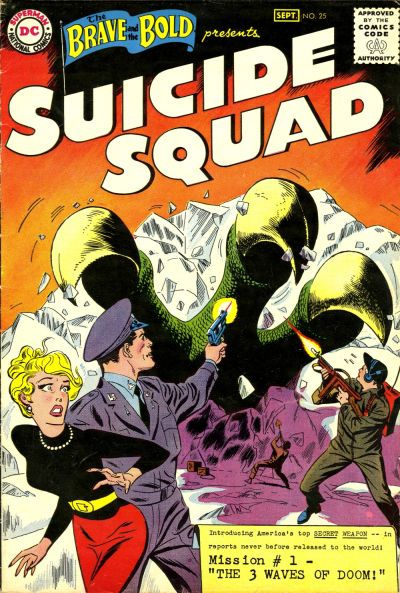
Brave_and_the_Bold_v.1_25

“Introducing America’s Top Secret Weapon” screamed issue #25 in September 1959, “in reports never before published to the world!!”  Thus was introduced The Suicide Squad:  Colonel Rick Flagg, command pilot; Jess Bright, nuclear physicist; Dr. Evans, astronomer/astrophysicist; and Karin Davies, eye-candy, er, space-medicine nurse.  Yes, Task Force X, “known as the Suicide Squad because of the fantastic perils it unhesitatingly faces with supreme courage and unique methods.”

Rick and Karin are in love of course (typical 1950s science fiction – there’s always a female assistant who is in love with the leading man).  However, Jess and Dr. Evans love Karin too!  So Rick and Karin decide to keep their love for one another to themselves for the good of the team.  A love quadrangle would only get in the way of team missions!  This was mentioned every issue and was pretty much the sole character development.

The Suicide Squad was Robert Kanigher’s attempt at “The Challengers of the Unknown”, with wonderful Ross Andru/Mike Esposito art instead of wonderful Jack Kirby art!  The art was typical 1959 – straightforward and realistic-looking men, women and machinery.  Imaginations were let loose on the “perils” – gigantic aliens and beasts attacked our heroes non-stop.  While the artwork was good, the storylines were for the most part … well … silly; even for the times.  The perils were usually of the science-run-amuck-we-tampered-in-God’s-domain found in the “B” movies of the time.  One expected to find Peter Graves or Leslie Nelson popping in to help!

In their first story (#25: Three Waves of Doom) an earthquake awakens a dinosaur-like creature that sets fire to Tokyo er Atlantic City, freezes metal and absorbs all chlorophyll!  The Suicide Squad defeats it by tricking the beast into grasping onto a rocket and shooting it toward the sun!

The stories seem to talk down to its youthful audience.  Facts are thrown in almost as if the characters are showing off their intelligence (one character actually says, “It’s a good thing we have enough sodium manganate on board!”  What?!).

And in six issues we never learn Dr. Evans’ first name!

The Suicide Squad was given three issues to do their thing (#25 – 27) and another three-issue try-out later in 1961 (#37 – 39), without success.  The plots of the other five issues read like an edition of Weekly World News:

  • Radiation shrinks the Squad down to matchstick size, yet they must still thwart a submarine attack against America! (#26: The Sun Curse)
  • Dinosaur-like serpent attacks Paris metro, boats on the Seine and the Eiffel Tower! (#26: Serpent of the Subway)
  • Scientist turns self into ten-story reptile – carries A-bomb into city! (#27: Creature of Ghost Lake)
  • Intelligent dinosaurs from other dimension invade earth! (#37: Raid of the Dinosaurs)
  • Planeload of nuclear missiles land on island of Cyclops! (#37: Threat of the Giant Eye)
  • Alien giant’s pet pterodactyls capture warships, planes, Statue of Liberty! (#38: Master of the Dinosaurs)
  • Other-dimensional “mirage men” try to kill the Suicide Squad! (#38: Menace of the Mirage People)
  • Gigantic dinosaur-shaped spacecraft contains Jurassic zoo! (#39: Prisoner of the Dinosaur Zoo)
  • Sculptor-Sorcerer kills scientists by turning them into gold statues! (“Mr. Kanigher? The attorneys for Ian Fleming are still holding on line three!”) (#39: Rain of Fire)

The texts in the issues were interesting, albeit soon forgotten: “real” sea serpents and dragons were examined, including the one spotted in Gloucester Harbor, Massachusetts in 1817.  Another text teaches us how sonar can track a submarine.

Task Force X faded into obscurity for twenty-five years.  Keith Griffin brought back the idea of a Suicide Squad in the late 1980s as a companion to his new “Justice League” title.  This time, Rick Flagg recruits villains and minor superheroes (including fellow B&B alumni Nemesis) to do battle with evil.  Flagg even went toe-to-toe with Batman to a mutual draw (not even Superman could do that in the late 1980s!).  That version of the Squad was definitely more successful, being fully entrenched in the superhero genre.  But these six issues are the originals and a fun read: just as the Thunderbirds TV show was some years later – silly, but charming.

***

Enjoy the movie!

Excerpt from The Brave & the Bold: From Silent Knight to Dark Knight, a guide to the DC comic book. Available here:

http://www.barnesandnoble.com/w/the-brave-and-the-bold-michael-curry/1120872264?ean=2940046443011

False Filing: Protect yourself from Identity Theft and False Tax Returns

You probably know someone who has been the victim of identity theft. Perhaps YOU have been the victim of identity theft as well. Someone has used my credit card or got a credit card in my name; someone has used my social security number on a tax return.

As a bankruptcy attorney, I have seen the latter quite a lot in the last few years. In both the Chapter 7 liquidation and Chapter 13 consolidation bankruptcy, Debtors are required to give some of their tax refund money to the trustee to disburse to their creditors.

But I have had a few Debtors who were unable to file their taxes (and get their refunds) because taxes have already been filed in their name! Fortunately, both the court and the trustee are sympathetic and do not put them on a deadline while the IRS sorts out the problem.

The Debtors in those cases were lucky – the identity theft was discovered. What if I were on social security, disabled, not employed or otherwise were not required to file a tax return? How can I find out if someone is using my social security number to file tax returns?

This type if scam could go on for years. You would have no idea someone was using your social security number to file tax returns and receive refunds – because you do not HAVE to file! The only time you would discover it is if, for some reason, you decided to file taxes OR the scammers goofed up and the IRS or state department of revenue contacted you about an error or other red flag.

You can check to see if anyone has used your social security number by preparing and filing Form 4506-T Request for Transcript of Tax Return.

4506t

Now hold on, you say. How can I request a transcript of a tax return I did not file?

Fill in the top of the form – name, address, social security number, etc. Then check box #7:  Verification of Nonfiling, which is proof from the IRS that you did not file a return for the year. Current year requests are only available after June 15th. There are no availability restrictions on prior year requests. Most requests will be processed within 10 business days.

Line 7

The IRS will verify that you did not file tax returns. At worst, they will verify there HAS been a tax return filed under your social security number in the past. You will then have to take steps to report the identity theft to the IRS and elsewhere. This blog post does not go into those details, but Google it – there are dozens of places you can seek advice on where to go and what to do next.

Note the June 15th date – you cannot check to see if someone filed a return under your social security number for 2015 until June 15, 2016. Information on 2014 and prior years are available before that June date.

Identity theft leaves us feeling sick and angry. But in this high-tech society, it is something we have to watch out for; something we have to ardently guard against. This particular type of theft – tax returns filed for people who do not have to file returns – is particularly heinous because it can be left undiscovered for years. Someone is using you to line their pockets with our tax dollars – and this time we didn’t vote for them!

If you are worried about this issue, request verification. Do it every year.

Original Material Copyright 2016 Michael Curry

Batman #277: my Bicentennial blog continues!

DC SALUTES THE BICENTENNIAL

#11

Batman #277

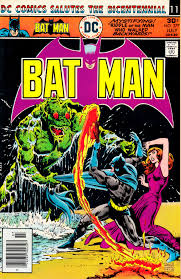
277 cover

Published monthly, thirty cents, July

Cover artist: Ernie Chua (Chan)

Editor: Julius Schwartz

            Batman debuted in Detective Comics #27 cover dated May of 1939. The next spring in 1940 he was given his own comic. Batman #1 featured the debut of iconic villains the Joker and Catwoman. For the past 70+ years, renamings and renumberings notwithstanding, there has been a Batman comic book published ever since.

            By the time of the Bicentennial, though, Batman was suffering a lull in sales, if not popularity. The popularity of the television show in the 1960s turned the comic into a campy child-like (or even child-ish) version of the Caped Crusader.  The 1970s turned him back into the dark knight of vengence. The pendulum swung even farther in that direction in the 1980s and has yet to swing back to even a middle ground. That is in the future, however, on July 1976, Batman the character and the comic were somewhere in between…

***

            “The Riddle of the Man Who Walked Backwards”, David V. Reed ( w ), Ernie Chua and Tex Blaisdell (a)

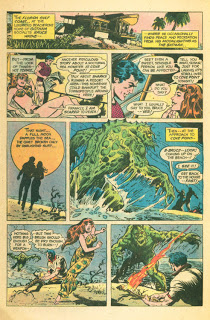
            A Black-Lagoon-ish sea creature terrorizes the sitizens of a Florida resort town. A vacationing Bruce Wayne and girlfriend investigate and fight off the beast near a cave on the beach.


277-1


            The next night Batman stakes out the cave and spots a man land his small boat on the beach and walk backwards into the cave – sweeping away his prints.


277 backwards


            Batman enters the cave and fights off the stranger only to be knocked out by a third man!

            Batman awakes … as Bruce Wayne! His assailant is dead and Wayne arrested. He escapes from the local jail and meets Alfred. Alfred had followed Batman to the cave and quickly removed his costume to protect his identity from the killer and the police!

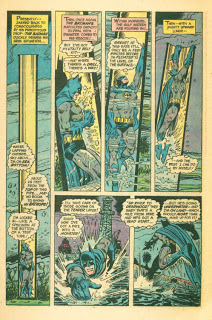
            Escaping, Batman – back in costume – searches the cave for clues and finds oily goo, that leads him to an off-shore oil rig. He overhears crooks talking about a “drop”. They catch Batman and throw him in a huge tube under the sea.


277 tube


            Escaping again, Batman goes to the new drop point discussed by the crooks in the rig – their old drop point, the cave, is now compromised. He fights the sea creature again – it is one of the crooks in disguise, and stops their drug-smuggling ring.

            Bruce Wayne is released and returns to Gotham City, where an unbelievable naive Jim Gordon believes that he and Batman being at the same Florida resort is entirely a coincidence…


Letters to the Batman, answered by the Answer Man himself, Bob Rozakis for issue #273. Rod McLaughlin of Ramsey, Mont. (positive), Peter Sanderson of New York, NY (guesses that David V Reed is another name for Julius Schwartz;  Rozakis debunks it), Fred Schneider of New York, NY, Mike White, Mackinaw, IL, & Michael D. Darguy of Royal, MI all contribute with positive comments.

***

            Join me for my next review of DC’s Bicentennial issue #12, a little magazine called PLOP!


Original Material copyright 2015 Michael Curry

Images used are copyright their respective holders and reproduced here under the “Fair Use” doctrine of 17 USC 106 & 106a for the purposes of criticism and comment.


DC Comics advertisements (July/August 1976)

DC SALUTES THE BICENTENNIAL

Part Three: But First, a Word from Our Sponsor…


            There have been ads in comic books as long as there have been comic books. Some of the ads have become part of our pop culture – more memorable than most of the comic book characters themselves. Sea Monkeys, anyone?

seamonkeyscomicad

            During my prime-time comic reading, I quaked in fear at the Deadliest Man Alive – Count Dante’! 

Count Dante

             I wanted X-Ray Specs and to learn to throw my voice and go on the Tilt-A-Whirl at Palisades Park (free admission with my Superman coupon) and to win valuable prizes selling Christmas cards and what the hell is Grit?

            The 33 DC comics with the Bicentennial heading contained either 32 pages or 48 pages – not counting the covers (which would add four more pages). Counting those four, all the comics contained 17 pages of the same ads. They might not appear in the same places – an ad from page 12 of one comic would be on page 23 of another – and some reprint titles would have house ads at the bottom third of the page ending a chapter or a story. I will tell you about those variations when I talk about the specific issues. But otherwise the ads were all the same. The centerfold (the middle four pages) of the 32-page comics were all ads, which was traditional for DC at the time.

            I’ll use the first Bicentennial Comic – Our Army At War #294 as the template.

            Inside front cover: Hostess Cupcake ad: “Superman Saves the Earth” – there are websites dedicated to these classic Hostess ads. DC, Marvel, Harvey and Archie comics had dozens of them featuring every popular character you can think of – the Joker starred in three, Josie of “…and the Pussycats” fame? 19! This one is typical – aliens meet to discuss the fate of the earth. Because it is so primitive and backward, humanity must be destroyed! Superman takes the aliens to a grocery store and introduces them to Hostess Cupcakes. The aliens love the cupcakes and spare the earth (the aliens are obviously of great intellect – in this writer’s opinion the original Hostess Cupcakes are tangible proof of the existence of God…). A species that can create such spongy cake and creamy filling deserves a chance! Whew … good thing the aliens decided this in 1976 and not after Hostess went bankrupt … we’d be doomed!

superman saves the earth

            A few DC Comics exchange this Superman ad with one starring the Joker called “The Cornered Clown”. He is trapped in a building cordoned off by the police. He tosses them Hostess Fruit Pies to distract them as he escapes out the back. Despite such tasty treats, the police are not fooled and are waiting to arrest him. Now if he had only thrown glazed doughnuts he might have succeeded. I will let you know which comics feature the Superman ad and which feature the Joker ad.

cornered clown

            Page 5: a full-page ad for Charms Blow Pops.

            Page 6: two half-page ads for selling social security plates (checkbook-sized holders with your number and an American eagle emblazed above it) – this was before identity theft was prevalent, obviously; and an ad for Slim Jims.

            Page 11: a full-page ad for Grit. Grit is still around, you know. It’s not a newspaper anymore; it’s a glossy magazine, but still around. Did anyone out there sell Grit for big money and prizes?

            Page 12: a full-page DC house ad for its latest tabloid-sized Limited Collector’s Edition comics C46 (Justice League of America) and C47 (Superman Salutes the Bicentennial) – see Part Two – the Leftovers for more about these comics.

limited collectors ad

            Page 15: two half-page ads selling Isokinetics (an exercise technique – are they implying that readers of comic books are out of shape? Well, we ARE, but I resent the implication…) and another ad for the social security decorative plates/holders from page 6.

            Page 16: a full-page ad for NCG Merchandise’s comic book binders.

            Page 17: a full-page ad for Action Lure to catch more and bigger fish (comic book fans fish? Really?)

            Page 18: a full page of house ads – a half-page ad for the Amazing World of DC Comics #11 (the Super-Villains issue – I have this one!) and a half-page DC Comics subscription form

            Page 21: a full-page ad from the US School of Music – a self-taught guitar program

            Page 22: a half-page ad for New American Physique and a half page of 10 S. Schwarz & Company ads of various sizes: learn vehicle decor customizing, hobby coin company sales, Universal Inc. muscle growing technique, custom bicentennial t-shirts for sale, Jack Hunt (comic book back issues), the famous X-Ray Specs, Estell (comic book back issues), Abracadabra Magic Tricks, Debt Relief solutions, and Discount Comics (comic book back issues).

            Page 23: a full page public service ad for Justice For All Includes Children. This is #5 of the series. Superman instructs children on their rights and duties as citizens. Here he advises the kids not to crash a party. Trespassing is illegal and could be dangerous!

Justice for all includes children, 5

            Page 27: a full-page ad for “DC Salutes the Bicentennial” reproduced in Part One of this series.

            Page 28: 14 ads from S. Schwarz & Company of varying sizes: “Space 1999” models for sale, learn karate, Robert Bill (comic book back issues), Richard Alt (comic book back issues), Pacific Comics (comic book back issues), weight lifting techniques, stamps for sale, Howard Rogofsky (comic book back issues), muscle building techniques, baseball card holders (called “lockers” – now we would call them deck holders), CCCBA (comic book back issues), techniques to grow taller, live seahorses for sale, and then several small ads designed as “classified newspaper” ads for: earning money stuffing envelopes, selling t-shirt iron-on decals, secret agent pens for sale, gliders for sale, earn money addressing and mailing envelopes.

            Page 32:  a full-page ad for muscle building (from the same company as one of the smaller ads on page 28).

            Inside front cover: a full-page ad for Monogram flying airplanes.

monogram

            Back cover: Spalding gloves (with as-always-excellent Jack Davis art!)

spalding

***

            Eyes spinning yet? I haven’t even begun to review the 33 comics yet! I’ll start with #1: Our Army At War #294…

             All comic covers, advertising, characters and images are the property of their respective copyright holders and reprinted here for your entertainment and review under the Fair Use Doctrine as commentary, criticism and … sometimes … parody.

            Keep in mind the actual creators probably only received a fraction of their creative worth at the time of their creation … but that is a whole other story …


Original Material Copyright 2015 Michael G Curry

Five Years Ago Today – from Abby’s Road: Our baby is finally ours…

And Baby Makes Three …

Five Years Ago Today … an Abby’s Road anniversary

             October 3, 2009. The baby is released to our custody by the birth mother’s attorney, Ronnie…

            Starting at page 156:

            “I drove the car to the hospital entrance, just as I did half a decade before during Esther’s battle with the fibroids. After a few minutes waiting, I walked back into the hospital. Esther, Ronnie and a nurse turned the corner and I led them to the car. On the steps Ronnie handed Abigail to Esther, who put her in the car seat.

            This was the baby carrier/car seat combo we got when we rented the car. We had something like that in our car at home, too. The car seat pops off and we have instant baby carrier.

            The nurse wished us luck and Ronnie said he would call us in a few days. He congratulated us and gave Esther a pat on the shoulder and shook her hand. He came around to the driver’s side and shook my hand, too.

            We stopped by Target to buy supplies and formula.  This was during the big Asian flu pandemic and I worried about someone sneezing near our little baby.  Esther said it would be all right.

            We bought diapers with Big Bird on them. Ah, the crass commercialism starting from day one, well, day three. I took a Diet Coke from the mini-fridge by the check-out counter and it was warm. Every bottle was warm – the fridge wasn’t working. The only other mini-fridge with Coke products was several aisles down, but I found a cold bottle of the stuff eventually.  We each used the restroom then back to our motel with our little girl.

first family photo

            …our little girl…

            I learned how to use the camera timer and took pictures of the three of us.  Then some photos of Esther feeding Abigail for the first time. She took photos of me holding her and mugging for the camera. For the first time – for us anyway – Abby’s eyes were open and she squeaked and cooed.

home

            She had beautiful dark eyes – nearly black.

            I tested her grasp reflexes.

            Grasp reflexes were mentioned in all those books I read months before. Abigail grabbed my thumbs tightly in her little hands. This is, supposedly, a throw-back to the days when babies held on for dear life to the hair on their homo-habilis mommas as they climbed from tree to tree; this was back in the day when the appendix and the tonsils had a purpose.

            My little Abigail snuggled on my chest. She was as tiny as the baby dolls we bought for her.

            It was October 3rd. It was exactly – exactly (even to the hour) – nine months ago I asked Esther if she would consider adopting.

            Abigail was more beautiful than she was in the hospital. Pouty lips, round nose, prominent eyebrows, deep dark eyes, feathery hair and soft skin. We’ve only had her for two hours and I already loved her. I loved her with all my heart.”

***

            And I still do…and baby makes

This will be the last Abby’s Road anniversary for many days – we have a baby to take care of!

***

The cover of Abby's Road

The cover of Abby’s Road

“Abby’s Road, the Long and Winding Road to Adoption and how Facebook, Aquaman and Theodore Roosevelt Helped” leads a couple through their days of infertility treatments and adoption. It is told with gentle (and sometimes not-so-gentle) humor from the perspective of a nerdy father and his loving and understanding wife.

Join Mike and Esther as they go through IUIs and IFVs, as they search for an adoption agency, are selected by a birth mother, prepare their house, prepare their family, prepare themselves and wait for their daughter to be born a thousand miles from home.


Abby’s Road is available at Amazon here: 
http://www.amazon.com/Abbys-Road-Long-Winding-Adoption/product-reviews/0692221530/ref=cm_cr_pr_top_recent?ie=UTF8&showViewpoints=0&sortBy=bySubmissionDateDescending


at Barnes and Noble here: 
http://www.barnesandnoble.com/w/abbys-road-the-long-and-winding-road-to-adoption-and-how-facebook-aquaman-and-theodore-roosevelt-helped-michael-curry/1119971924?ean=9780692221532


and at Smashwords here:
 https://www.smashwords.com/books/view/457270


Copyright 2014 Michael Curry


Continuing my history of D&D with 3rd edition – this changes EVERYTHING!

What Am I Reading: Dungeon & Dragons Player’s Handbook, 5th edition

Part Three: You Turned My Game Upside Down …


I started to write a simple review of Dungeon & Dragons Player’s Handbook, 5th edition, but it grew into a series of blogs about the history of the game itself! Refer to my previous blogs for some of the terms if you are confused.

In 2000, Dungeons and Dragons, now owned by Wizards of the Coast, released a 3rd edition of the game. They referred to the “core books” – Player’s Handbook, Dungeon Master’s Guide and Monster Manual but over the next seven years added dozens upon dozens of supplemental books and modules.

The biggest change was the d20 system.

3rd ed

                The d20 system turned dice rolling on its head. Instead of rolling lower, I had to roll higher! Not necessarily higher than my Dex, but higher than a fixed number that was based on what I wanted to accomplish. 10 is an easy task, 15 more difficult, 20 still more difficult. Tasks were given a Difficulty Class (DC). Remember the scenario from prior blogs…?

“I try to grab the vine and swing over the chasm.”

“That has a DC of 15,” says the DM.

{Roll} “8!! Finally! I beat my Dex! It’s about frickin time – after twenty years! Woohoo!”

“No, this is 3rd edition, you have to roll higher than the DC now. You fail. Your character plummets to his death. Mage?”

{Rolls} “I got an 18,” says the mage.

“You swing across safely,” says the DM.

“I hate this game…” mumbles the poor roller.

The people I have gamed with for nearly twenty years had a very hard time adjusting to d20. My wife suggested we look at it as an entirely new game system. We are no longer playing D&D; we are playing something like Rolemaster or Chill. That helped a little. Switching to Pathfinder definitely helped with the “it’s a different game system” mentality – primarily because it WAS a different game. But I am getting ahead of myself.

“Remember – roll higher,” is the 3rd edition mantra. Armor Class and Difficulty Class are similar. Before, the lower the Armor Class the harder it was to hit it. Now … roll higher. Someone with an AC of 18 is harder to hit than someone with an AC of 12 – in the older editions there was no such thing as AC 12. The limit was 10 going down to negative infinity, presumably … although negative five and lower were usually reserved for gods and unbeatable demons…

Classes and races remained unchanged. Thieves were now called Rogues. Bards were given their own class instead of a Thief sub-class. Half-orcs, removed from 2nd edition to appease the Bible thumpers, returned. Sorcerers were mages who cast spells without the aid of studying spellbooks were added as a class. That always smelled like an appeasement for whiners to me (“Why do I hafta study?” “That may work on your mommy, but not the DM! Study!”).

Experience points (XP) changed. As a character wins battles, solves puzzles and gets treasure, he gains experience. After gaining so much experience, he gains a level. This adds to his hit points, increases his ability to hit or avoid magical damage (called saving throws) and otherwise makes him more powerful. Different classes had different XP – a first-level fighter became a second-level fighter after accumulating 1000 XP. Magic User’s had to get 2000 XP to level up. Now it is all uniform – no matter what class 2000 got you to second level, 4000 to third, etc. (those may not be the exact numbers, but you get the idea)

Initiative was changed. Initiative is the term used to determine who goes first. “I hack at the ogre with my sword!” “Sorry, the ogre goes first.” “Who says?” “The initiative roll.” At the beginning of combat, each player rolled initiative on a dice (some used d6, some d10); the DM rolled for the bad guys. In the old system players or the DM who rolled 1s went first, all the way to 10. If you had a high Dex score you could subtract from that roll. If you were dexterous, you could go faster you see. When everyone was done, everyone rolled again.

3rd edition changed that. Those who rolled HIGHER went first. Once you roll, that was it until you were done with combat. “I go last AGAIN!?” “You rolled a 3; you go last until combat is done.”

Now there are Prestige Classes. These are class kits you can take at higher levels to make your specific character different from other players of the same class. Instead of just a cleric, you can be an undead slayer. Instead of a thief – er – rouge, you can become an assassin (brought back from 1st edition) or a dragon-horde stealer. As you go up in levels, you must pick certain skills and feats to give you the abilities to become a prestige class.

Leveling causes quite a bit of rule-hunting. In 1st edition, if you went up a level, you’d role more hp and find some new spells and that was it. In 2nd edition, you have more non-weapon proficiency points to increase your ability to Jump or Appraise. Now, along with the above, you may also get to increase a stat, or gain a skill or feat.

There I go again with the skills and feats, what are they? Oy. The optional non-weapon proficiencies of 2nd edition are the mandatory skills of 3rd edition. But now skills include, for example, what was once the domain only of thieves. If your wizard wants to learn pick-pocketing, he can get that skill. If he wants to wear heavy armor and use a sword, he can get that skill. Some skills have prerequisites (the wizard will have to learn the light armor skill first, for example). As with 2nd edition, some skills have levels, or slots. You get points to spend on skills when you create your character and when you level up. If I have two slots in the Jump skill, I can add +2 to your jump roll. At least they whittled the skill list down to 47 skills. Some of the rest were turned into feats.

Feats? They are harder to explain. These are bonuses you can choose to improve a character’s abilities and stats. These are real bonuses – not just for flare and role playing like a white scar down the cheek. A Feat can be, for example, Toughness, giving you two extra hit points; or Quickness, giving you +1 on initiative (I know there is a feat called Toughness; Quickness I made up as an example).In 3rd edition you had 60 feats from which to choose. You gained a feat every three levels. Not a lot, but when you could choose, where do you begin?

Thus now with feats and skills, the designers have finally closed the mouths of the whiners. Or have they?

“I try to snag a rock on the other side of the chasm with my rope,” says Mr. Poor Roller.

“You don’t have a rope. I took it when I picked your pocket,” says another player.

“You’re a gnome cleric!? Why are you picking my pocket?”

“It’s a skill I wanted.”

Sigh, I try to grab a vine to swing across, I have the Jump Skill, 2 slots.”

“I have the Empowerment Feat active, so you get plus one,” says the gnome.

“I’d rather have my rope.”

“Your Dex gives you another +2,” says the DM. “This is DC 15”

“I cast Helpful Hand,” says the mage,” that’s another +1.”

{Roll} “Carry the five, cosine of the two vectors … 45? Do I do it?”

“Damned if I know,” says the DM.

“I hate this game.”

There was a 3.5 edition released shortly after 3.0. It cleaned up some of the inconsistencies, but it was otherwise the same game with no major changes. It’s what a new edition should do…

Said major changes would come in 2007 with the 4th edition. It was to 3.5 what 3rd edition was to 2nd and changed the entire dominance of the roleplaying game business. So much so the D&D label has yet to recover.

3rd ed books

TO BE CONTINUED…

Copyright 2014 Michael Curry

End note: I made up the names of the “feats” because, frankly, I’m too lazy to look them up myself and I wanted this to come from my heart, but the rulebook. So ease up on the “that feat doesn’t exist” because I do not doubt you, I just wanted to give you the flavor of what a feats can do. If those are actual feats, I simply made a good guess…

The Ten Best Christmas Songs of All Time

The Ten Best  Christmas Songs of All Time
 
                Despite what retailers have been telling you since before Halloween, the Christmas season begins the day after Thanksgiving.
                Now that has passed and the Christmas season is in full swing.  Some radio stations are playing holiday tunes 24/7. As is usual with radio broadcasting in its current state (see my prior blog titled “I Finally Bury a Long-Dead Friend”), you will likely hear the same ten songs over and over instead of a wide variety of cuts.
                Some songs you will undoubted be sick of by December 25th; some songs you are still sick of from all the airplay last year. Some songs will make you smile. And there are some songs you’d wish they play even just once.
                I used to say the holiday season doesn’t really commence until I hear two specific songs: “Happy Christmas (War is Over)” by John Lennon and “Snoopy’s Christmas” by the Royal Guardsmen.  The latter was hard to catch on the radio, if it was played at all; but now thanks to Youtube I can listen to the tune even on a hot August day.  Those two are on the list, by the way.
                I’m listing individual tracks. I could do another list just on general songs that I enjoy (although some versions are grating): “Holly & Ivy”, “Bring a Torch, Jeanette, Isabelle” and “I Saw Three Ships” would make that list.
                These are the songs that transcend the genre: the “He Stopped Loving Her Today” or “Layla” of holiday music. And these are in no particular order.
                I’d love to know YOUR list of favorites:

1.       Joy to the World by Percy Faith. The opening fanfare of this song makes you rise from your seat. It makes you want to march out in the snow with arms stretched outward and shout “Ho! Ho! Ho!” Listening to this makes you picture a bustling city street seen through swirling snow. This should be played when the Ghost of Christmas Present is showing Scrooge Christmas morning in Old London. It’s as majestic as it is iconic. It is the opening song of “A Christmas Story”.  It should be the first song played at the start of the season.
2.       Ring Those Christmas Bells by Fred Waring and his Pennsylvanians. I’ll bet you’ve not heard this one. If you have, you know how strange this song is – especially since it was produced in the 1950s. It has an early 1970s post-psychedelic feel to it. It starts off with the singers talking merrily and then break into a chorus of Jingle Bells. Someone chants “Merry Merry Christmas” and it is repeated by the singers as a mantra. That segues into “Ring Those Christmas Bells”; a song whose tune sounds vaguely like the theme to “Green Acres”. At the end the “Merry Merry Christmas” mantra returns. It’s a bizarre tune. I love it! It is on Youtube.
3.       Silent Night by Mannheim Steamroller. The first two tunes on the list are upbeat songs of celebration. This is a very quiet song, appropriately. You listen to this song sitting on the couch in the evening drinking hot cocoa and watching the snow fall. Being Mannheim Steamroller, this version of the song is filled with electronics tweets and whistles and notes that don’t quite sound like they fit, but eventually do. And the end is beautiful; a swelling crescendo followed by a wisp of the first four notes played as if by a child on a toy piano. Absolutely beautiful.
4.       All I Want for Christmas is You by Mariah Carey. A fun romping song that sounds like it came off of a Phil Spector Christmas album. Mariah has the chops to pull off the vocal acrobatics of the song and the sex-kittenish sensuality of the lyrics and her delivery (especially the introduction) makes the song a favorite. Ignore the remakes and stick to the original. You’ll thank me. The song is alluring, and not in the creepy sexiness of a “Santa Baby”. Whereas the latter requires a shot of penicillin after every listen, “All I Want …” is a wonderful upbeat happy song for the holidays. This song sometimes makes lists of worst Christmas songs, and there are some remakes that are pretty bad, but I like the original.
5.       Happy Christmas (War is Over) by John Lennon. I used to joke, “You know it is Christmastime when you hear Bing Crosby and Yoko Ono on the radio”.  Yoko sings the middle eight of this sweet song. Like “Imagine”, this is likened unto a children’s song. However, I always found it a sad song. Not only because Lennon was murdered in the month of December and this song was on the playlists at the time; but also because I hear the lyrics as an accusation or condemnation. A man looking at himself in the mirror – “so this is Christmas, and what have you done? Another year over, a new one just begun…” Another year passed with unfulfilled expectations.
6.       Snoopy’s Christmas by the Royal Guardsmen. The band hit big in 1966 with “Snoopy vs The Red Baron” and this is a sequel from 1967. Our man Snoopy is once again called upon to fight his arch enemy.  Without giving away the ending, I wonder if the band knew this is similar to an actual event – the Christmas Truce.  In 1914 German and British soldiers exchanged greeting and songs across “no man’s land” – even exchanging gifts such as food and souvenirs. At the end the opposing troops sang carols together and played football (that’s soccer for you mouth-breathers…).  But soon the unofficial truce was over and such fraternization was banned by the so-called superior officers and both sides went back to slaughtering each other over the next four years.
7.       My Little Drum by the Vince Guaraldi Trio. It’s a shame that Vince Guaraldi will be known for only his work on the Charlie Brown cartoons, as he should be remembered for the piano-playing genius he was. We are lucky we have his soundtrack to “Charlie Brown Christmas” available on CD. Every song on the album could be included in a Top Ten, but “My Little Drum” is a unique take on the traditional song (that being “Little Drummer Boy”). Once you hear it, you’ll want to hit the back button and listen to it again. Minor and major notes are hit on the beat and off; and the children singing and humming and prrrrr-ump-ump-ing make a sweet counterpoint to the jazzy beatnik arrangement. It’s the cat’s meow, man. One of the best songs from one of the best holiday albums of all time.
8.       Must Be Santa by Bob Dylan. Even at his best Dylan’s vocal “style” is an acquired taste. Now that he is older and his voice is scorched from too many tours, he sounds the way an oak tree would sound it if could sing. “Someone is vivisecting a wildebeest!” “No, it’s Dylan’s latest album.”  BUT, his voice fits this genuinely great, great version of the Christmas song. It sounds like a rollicking good party was going on while recording it (and the video accompanying the song plays that out to great effect. Mordant bleu, Bob Dylan dances in the video – dances!!). The song is a chestnut of Mitch Miller’s Christmas song chest, but here Dylan made the song fun without quite pushing it into novelty territory.
9.       Little Drummer Boy/Peace on Earth by Bing Crosby and David Bowie. The 1977 Christmas special from which this song aired is available on DVD. It is strange watching Crosby introduce the video of Bowie’s “Heroes” standing behind a Christmas trees and twinkling lights. The legend says that Bowie hated “Drummer” and did not want to sing it as a duet with der Bingle. So the writers whipped up “Peace on Earth” to act as a descant to “Little Drummer Boy” and also a middle eight for Bing and Bowie to duet. It worked. Bowie’s high vocals paired beautifully with Crosby’s baritone. Crosby sang the main song quietly. This is important. “Little Drummer Boy” is usually performed as a big production filled with artificial melodrama in complete contrast to the ideals within the song. Here the song is quiet and respectful – a small child presenting the only gift he could give to the infant king. Plus I like Crosby’s vocals in his later years. His voice deepened and rumbled. Water glasses vibrated when he sang. It’s a lovely song. And it was Crosby’s last Christmas single. That lends a sadness to it that it otherwise might not have.
10.   Jingle Jingle Jingle by Rudolph the Red Nosed Reindeer soundtrack. I have not heard anyone remake this song, but it is one of my favorite Christmas songs, perhaps THE favorite. Clocking in at just over two minutes, it is sung by Santa in a deep baritone. A predictable song of ascending and descending notes with staccato trumpets and strings. A simple song for children that captures the season in their eyes. A sweet and lovable song.
11.   OK, one more, what the heck, it’s Christmas. Plus, this list is pretty bare as far as Bing Crosby – only one? You might think I’m building up to “White Christmas” – the song is so iconic and I think the past two generations have forgotten how tremendously HUGE that song was and is. But I want to go with another song by Bing that brings a holiday smile – Melaka Leke Maka. I love singing along and imitating Bing’s low rumble. He sounds like he’s having a fun time with it too. The song is so much fun the Andrews Sisters tolerated each other long enough to sing backing vocals.  And by the way, “Melaka Leke Maka” is NOT the Hawaiian term for “Merry Christmas” – it is the phonetic spelling of a Hawaiian native trying to SAY “Merry Christmas”.

                And there we have the ten best individual songs! Are any of these already stuck in your head? Lucky you…

Thanks for reminiscing with me!
Copyright 2013 Michael G Curry


(adsbygoogle = window.adsbygoogle || []).push({});

The Business of Bankruptcy

The Business of Bankruptcy
                On September 9, 2013 I spoke at the monthly meeting of the Mount Vernon Business Women’s Club about bankruptcy.
                The person who invited me, Marilyn, was my wife’s boss for many years before she retired and is also a good friend of both of us. I said I would be happy to speak at their meeting. Considering the audience, we decided the topic should be about how bankruptcies affect businesses.
                Here is a transcript of the speech from my notes with details filled in and some details changed for a wider audience (“In my district courthouse” replaces “In Benton”, that sort of thing). I hope you enjoy it.
***
                As a business owner, bankruptcy can affect you in three ways: as a creditor, as an employer and as a debtor.
                Of the different types of bankruptcies available, there are three that you would see – the Chapter 7, Chapter 13 and Chapter 11.
                They are called that because the Bankruptcy Code is just like any book – it is divided into chapters, 1 … 2 … 3. And the Chapters that involve individuals are 7 & 13. Why 7 & 13 and not 1 & 2, who knows, that’s just the way it is laid out.
                Chapter 7 is what most people think of as bankruptcy – a liquidation of all unsecured debt. These are credit cards, medical bills, back utilities, book clubs, record clubs, finance company loans, bad checks, and cash advance businesses. Unless you’re in the business of giving loans to customers in exchange for collateral, debt owed to your business is unsecured debt.
                Chapter 7 lasts for 90 days. From the time of filing until it is finished, 90 days pass.  At the end of those 90 days the debtor receives a discharge and all of those unsecured debts are discharged.
                As for secured debts – where I have a lien on my house or car – I can either reaffirm with the bank and keep paying for the collateral or surrender the collateral. Banks usually will allow me to do that if I am current.
                Some bills survive bankruptcy – taxes, student loans, and child support – government-ordered debt. The federal government is saying, “We’ll forgive all debt you owe except for debt you owe to us.”  I would doubt any of your accounts receivable would qualify as that kind of debt.
                Chapter 13 is a consolidation of all debt into one payment. It includes all debt owed – even vehicles – except for your house payment if you are current. Otherwise the bankruptcy payment has to include that as well.
                Chapter 11 – I do not do Chapter 11s although the senior partner of our firm does once in a while – is similar to a Chapter 13 but it is for corporations or individuals who owe about $260,000.00 in unsecured debts.
                Corporations or LLCs cannot file Chapter 13. Only an individual or an individual doing business as can.
As a Creditor:
            You will receive notice in the mail that a customer/client/debtor has filed for bankruptcy in any of the available Chapters.
                At that time, all collection activity must cease. It’s called a “stay”. It’s automatic. Boom. No questions asked. Stop the collection. You might dispute the dischargeability of your debt, but that is an argument for another time. Right now, stop collecting it.
                To avoid anti-dun letters or even sanctions, contact your collection agency, department or individual in charge of trying to collect the debt and get it stopped. Press whatever button you need to press on your computer to stop that bill from being mailed out.
                You don’t have to write the bill off entirely – wait until you get the letter from the court discharging the debtor. If for some reason the bankruptcy is dismissed or the discharge is set aside, your debt is “revived” and you can go back to collecting it.
                A bankruptcy can be dismissed for several reasons – usually because the debtor has done something wrong.  He doesn’t qualify because he had filed before or his income is too high. He may have failed to appear in court or failed to provide the Court the documents required.
                You can dispute and fight someone’s discharge – if they wrote a bad check or if they committed fraud against you. It’s hard to do, and you should discuss the possibility with an attorney. And I don’t mean fraud in that someone left off a credit card on their application. I’m talking about if they said their income was double what it really was.
                But you will have to prove you had the wool pulled over your eyes to win. The first thing the court will ask is “did you pull a credit report? Was the missing credit card on there? Did you ask for paystubs? Didn’t you notice his income was substantially lower than what he said it was?”
                Here’s a tip – if he just got a loan from you five days before filing bankruptcy; unless there was a change of circumstances in between (he lost his job, his family went to the hospital), odds are he was insolvent when he got the loan and was considering filing bankruptcy when he was in your office.
                Sometimes if the Chapter 7 Trustee (this is the person in charge of investigating the facts of the case to make sure the person qualifies for the discharge of his or her debts) has an asset to sell you will be notified to file a claim.
                A Chapter 7 liquidation is not only the liquidation of debts but also liquidation of assets. If someone has a luxury item or property they do not need – a boat, a piece of land, a third car, expensive collections of coins or guns or comic books – those things can be liquidated and the cash from the sale will be disbursed to the creditors for one last payment. But to get any money, you have to fill in and file the claim form provided.
                It’s a simple form. Fill it in, mail it to the court, and send a copy to the Debtor’s attorney and you you’ll get a few bucks. You may have to file it electronically, which will mean a trip to the courthouse. Ask the clerks for help. That’s what they are there for.
                “It’s not worth the time and postage.” I don’t think that’s true, even if it only gives you a few dollars.  But I’m cheap that way…
                In Chapter 13, you will also be notified to file a claim. You will probably get substantially more than you would in a Chapter 7, so it is worth preparing the claim and sending it to the court and Debtors/counsel. It is possible after five years you will get a few dollars, if any at all. With the time-value of money it is easy to repeat, “It’s not worth the time and postage.” Five minutes to fill in the form, a stamp or a trip to the courthouse. If you complain about the gas spent, do something else during the trip to the courthouse. In my district the courthouse is next door to a wonderful city museum. See the radio DJ booth George Harrison visited in 1963.  See the jail cell of the last man hanged in Illinois – my grandfather was there and watched it.
                You should not send the Debtor a 1099 for the unpaid debt – a debt discharged in bankruptcy is not taxable income. It is not a forgiven debt. That IS a waste of time and postage.
                You can write it off as a loss. If you have insurance (most credit cards have bankruptcy insurance), you can submit a claim.
                The only thing you cannot do is try to collect the debt from a discharged debtor.
As an employer. 
                You’ll probably never know that your employee has filed a Chapter 7 unless his wages are being garnished.
                If an attorney knows what he is doing he will fax you a notice of the bankruptcy as soon as it is filed and ask you to stop withholding the funds. If you have already given the funds to the judgment creditor; that is nothing for you to worry about. If you are still holding funds and don’t know what to do about it – you can ask for a court order, you can call your attorney, the attorney for the creditor, the attorney for the debtor. “I’ll give this money to whoever the court tells me to…” Generally, though, if you stop the garnishment when you receive the notice of filing bankruptcy, you’ll be fine.
               
                An employer will receive notice if the employee does a Chapter 13.
                If you are employed the Chapter 13 payment comes directly out of your paycheck.
                The employer will be mailed a notice from the court to withhold a certain amount per month from this person’s paycheck. You should try to do it but if you simply cannot don’t worry about it. It is ultimately the responsibility of the Debtor to pay the Chapter 13 payment, not the employer.
                The withholding is an allotment, not a garnishment, so avoid assessing points against an employee or charging processing fees. You can do it, but … shame on you.  It would be best to simply not withhold it. If a Debtor’s attorney calls and asks why it isn’t being withheld, be honest: we don’t have the wherewithal to do that sort of thing; I don’t want to be responsible for any misplaced checks sent out, etc.
                If you do assess points or charge a fee the Debtor’s attorney will likely ask for direct payment and the court in this district is good about granting that. So, hey, maybe it IS a good idea to assess points or charge a fee, your employee will ask the court for direct pay and you’re out of it. No, don’t do that. It’s best just to contact the debtor’s attorney (and your employee) and tell them you just can’t withhold it.
                And remember – 525(B)(1) – (3) of the bankruptcy code says you cannot fire or discriminate against someone for filing bankruptcy.  Any employment attorney will tell you to keep a long paper trail when firing someone. You don’t want them to say, “You fired me because I filed bankruptcy,” any more than you want them to say, “You fired me because of the color of my skin or my religion or my gender.”
                “No, we fired you because you were late five days in a row or stole from us…” Keep a paper trail!
               
                And just as a favor to me – don’t blame the employee for collection calls. 
                “I get in trouble when I get personal calls at work.” I hear that a lot.
                “Then don’t take the call,” I say, “tell whoever is telling you that you have a call to hang up.”
                Boss:  “You have a call.”
                Employee: “You said I can’t take personal calls at work.”
                Boss: “That’s right.”
                Employee: “Then why are you telling me?  Tell them I can’t take calls. Yell at them the way you are yelling at me now.”
                It’s silly.  Imagine how easy it would be to get someone you don’t like fired. You just keep calling his work anonymously and after a week they’ll fire him for receiving personal calls. You can clear a factory floor in a few months.
                Don’t blame them for calls. They’re not the ones calling.
As a debtor
                Chapter 7 will eliminate the debts, but will also likely eliminate the business. People or corporations file Chapter 7 to walk away from their business. Let the Trustee dole out who owns what collateral and who gets what from the liquidated assets of the company. That way, it won’t be your fault if someone gets more than their fair share – you’ve dusted off your hands of the whole ordeal when you signed the paperwork.
                Chapter 13 (for non-corporations) or Chapter 11 (for corporations) – keeps the business going. You pay a trustee or an administrator; the trustee pays your creditors. It’s never that simple but that is the basics of it.
                You file a Chapter 7 to close the business; a Chapter 13 to keep it going.
                Results may vary.  In any of the three circumstances – if you have any questions, do some research and then ask an attorney. It’s worth paying an attorney for advice to avoid confusion and aggravation. As a creditor or employer you can always call the debtor’s attorney. They will USUALLY help answer your questions as long as you are courteous about it. You can always consult an attorney of your own.
                There are not many books out there about bankruptcy. The ones that do exist give only the most general and basic information. This is because a lot of bankruptcy law, although federal, depends also on the state laws in which the bankruptcy was filed. Plus it also depends on the individual trustee and judges. Some require specific documents, such as bank account statements; some do not. No book can cover every Trustee and judge’s rules and rulings. It’s like the old joke – a good attorney knows the law, a great attorney knows the judge. It’s true – in that a “great” attorney knows what will work and what will not. What works in Tennessee will not work in Missouri. What works in central Illinois will not work in southern Illinois. What works in Benton will not work in East St. Louis.
                The closest thing to a pamphlet is the 342(b) notice. That’s just the section of the code that says we have to give this paper to every debtor. It explains each type of bankruptcy, although it’s a little dry. You can each have a copy if you wish.
                I thank you for letting me speak with you today. I hope it informed you as a business owner of your rights and duties and responsibilities under the bankruptcy laws. Thank you for inviting me.
               
                And I hope you enjoyed reading it too. As a bit of a disclaimer – ALWAYS consult an attorney before attempting anything mentioned above. If you try to rely on the information above to file a bankruptcy alone or to try to fight a bankruptcy as a creditor, you are a very silly person and I will laugh at you if you blame me or this speech if something goes wrong …
 
Copyright 2013 Michael G Curry