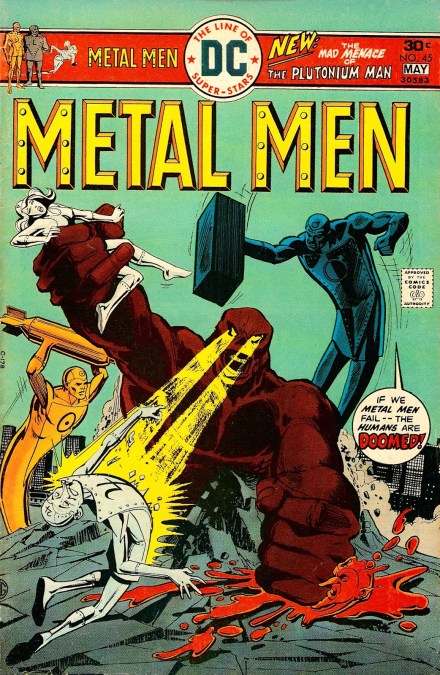
Metal Men #45, May 1976: Welcome Back!

Behold!

Bronze age

Metal Men #45, May 1976

“Evil is in the Eye of the Beholder”

Cover: Dick Giordano; Editor: Gerry Conway

Writer: Steve Skeates; Penciler/Inker/Colorist: Walt Simonson

The Metal Men tour the country’s colleges displaying their powers. This allows new readers some exposition as to who the Metal Men are. Doc Magnus, meanwhile, is held for mental examination after being rescued from Karnia.

To aid in his recuperation, the Feds allow Doc time and equipment to make another Metal Man. He creates Plutonium Man. PM escapes and leaves a trail of mayhem behind. A Karnian spy is exposed among Magnus’ keepers. Magnus and the surviving military hunt down Plutonium Man.

But the Metal Men get their first. Despite all their efforts, nothing works and member after member meet their doom … until Platinum wraps herself around Plutonium Man to cause a mini-China Syndrome, destroying them both.

Magnus, seemingly all better, vows to rebuild the Metal Men.

***

Metal Men’s history by this point is very strange, stranger than you expect from this group: even Gerry Conway admitted so in the letter column. And if the man who brought you Conway’s Corner’s stable of comic books thinks something is strange …

In brief: by 1968 the original Metal Men creative team moved on to other things and the new team made the Metal Men fugitives from justice and hunted by the law. The robots created secret human identities and fought supernatural enemies. Doc Magnus was kidnapped by the dictator of Karnia and brainwashed to evil and hatred as to his creations. The comic ended with a cliffhanger, of sorts, with #42, January 1970.

Three reprint issues in 1973 failed to gain traction. The magazine was revived again in 1976 with this issue.

Rather than start anew, this new creative team wrapped up the storyline from six years before. Perhaps they should have restarted the comic and pretend 1968 – 1970 never happened! If only because it gives the series an awkward grittiness.

But if this comics’ creators insist on grittiness, it picked the perfect team. Walt Simonson’s art (his first DC work since Manhunter) fits in perfectly. His workman-like style is instantly recognizable even at this “early on” stage. It fits well.

And Gerry Conway’s obvious love for the characters is evident. He does a Red Adair-like job of putting out the continuity fires and inevitable clean-up!

Welcome back, guys!

***

About the author: Michael Curry is the author of the Brave & Bold: From Silent Knight to Dark Knight, The Day John F Kennedy Met the Beatles and the award-winning Abby’s Road, the Long and Winding Road to Adoption and How Facebook, Aquaman and Theodore Roosevelt Helped.  Check his website for more releases! Thanks for reading!

Kobra #1: Kirby’s DC leftovers, but great pulpy fun!

Behold!

Bronze age

Kobra # 1, March 1976 (remember the cover date of comics is about three months ahead of the actual publication date, blah blah blah…)

“Fangs of the Kobra” written by Martin Pasko and Jack Kirby, art by Kirby and Pablo Marcus. Editor: Gerry Conway, Inkers: D. Bruce Berry and Pablo Marcos, Colorist: Carl Gafford, Letterer: Ben Oda

Cover by: Ernie Chua (Chan)

Synopsis: (why type it all out when someone else has done it for me?)

(the following paragraph courtesy of ReadComicsOnline):

Deep beneath the streets of Manhattan, assassin-for-hire, Horst Buchner, along with two associates, are ushered through secret tunnels, to keep a prearranged rendezvous with Kobra. At the first sign of insult, Buchner’s men draw on Kobra. Put off by Kobra’s arrogance, Buchner declines his offer of employment, deciding, instead, to rob Kobra of several intriguing artifacts. Still held at gunpoint, Kobra leads Buchner and his gunsels into another chamber, one that holds Kobra’s most unique artifact, the Ovoid. Within the confines of the still shimmering meteoroid, Kobra reveals an enormous alien robot, he calls the Servitor. At Kobra’s command, the Servitor steps forward, then murders Horst and his associates, pummeling them to death with its giant metal fists. Sensing that his brother, Jason Burr, is soon to learn of Kobra’s existence, and whereabouts, Kobra sends the Servitor up to the streets, on a mission to slay Burr. The Servitor leaves a swath of destruction in its path, as it makes its way to Columbia university. Despite opposition from New York’s finest, the Servitor moves inexorably to the student union building. Inside, Lieutenant Perez is interviewing Jason Burr. Just as Perez is about to reveal to Burr the existence and identity of his brother, the Servitor crashes through the wall. Lifting Burr up in one of its gargantuan hands, the Servitor, at Kobra’s command, begins crushing him. Suddenly, Kobra, too, feels the crushing force of the Servitor’s grip compressing his own chest. Realizing that he and Burr share a sympathetic bond, Kobra orders the Servitor to release him. The countermand causes the Servitor to self-destruct…

Jason meets Lt. Perez who tells Jason the secret origin of Kobra …

(from Wikipedia): (Kobra) “… was born part of a set of Siamese twins, but was stolen at birth by the Cult of the Kobra god, since a prophecy claimed he would lead them to rule the world. Under their teaching, he became a dangerous warrior and a sadistic criminal mastermind. He led the cult into using advanced technology to menace the world.  … However, unknown to the cult, he had a psychic link to his twin brother, Jason, who knew nothing of Kobra. As a result, one felt what the other felt, including pain. Because of this, his brother was recruited by an international agency to help them combat Kobra.”

Perez convinces Jason to injure himself (holding his hand over a candle flame. Kobra cannot stand the pain any further and confronts Jason for the first time). Perez and his men try to capture Kobra, who slithers through their trap. The police shoot at the terrorist. “No guns!” shouts Jason to no avail. Were they trying to kill Kobra? IF they do, he will be collateral damage! Kobra escapes unharmed …

***

(from Wikipedia):

(Kobra was) “… created by Jack Kirby for a proposed DC Comics series called King Kobra, the first issue of which was both written and drawn by Kirby (the letter column discussed Infantino and Kirby wanting to do a take on the Corsican Brothers). This first issue then sat in DC inventory for over a year, during which time Kirby left the publisher to return to Marvel Comics.  Eventually the concept was handed over to writer Martin Pasko with orders to make a series out of it. Pasko was unimpressed with King Kobra, feeling it to be a throwaway idea churned out by Kirby as he was preparing to leave DC, and tried to make the best of the assignment by whiting out all of Kirby’s original dialogue, rescripting the issue, and having Pablo Marcos redraw some of the art (and re-)titled simply Kobra. … Pasko later reflected, “I wrote all of Kobra with my tongue firmly planted in my cheek—it was a preposterous exercise dumped in my lap, and it helped pay the rent on a very nice place in the Village.”

Dumped? Even the letter column introducing the comic said the title was “thrown” into Conway’s Corner. It seemed no in at DC gave much of a damn about the comic.

Pasko was correct about this preposterous exercise, but THIS pre-teen loved every issue of it! I still have every issue of the original run. The comic is great fun straight from the pulps – not a caped crime-fighter in sight! It was akin to Dr. Yen Sin or the Mysterious Wu Fang.  DC did something it did not do often – it took a chance! An unknown villain in the lead and an unknown cast! Very shortly it would launch another villain-led comic: the beloved Secret Society of Super-Villains, firmly entrenched in the DC’s superhero world.

Kirby’s art by the mid-1970s was an acquired taste: exaggerated physiologies, gaping mouths, fingers the size of Snickers bars, women whose eyes were set below the center horizontal line of their faces, etc. Marcos did his best redrawing Jason and Perez, but the redo was glaring and obvious. I would have loved cringing at Kirby’s original dialogue, but Pasko did a fine rewrite with what he had (I kept expecting one of the Cobra Cult to say, in Kirby’s typical expositional shorthanded way, “We must obey!”).

Not an auspicious beginning to only the second DC title to headline a villain (The Joker was first by less than a year). Villains starring in comics was a rarity (and was to remain so for the next several years – nowadays it is somewhat common): the Golden Age had its Yellow Claw and the Sub-Mariner (who was more of an anti-hero than an outright villain). The Silver Age, with its Comics Code, was more cautious about villain-led features. Even the House of Ideas itself – Marvel in the Silver Age – only gave Doctor Doom the lead in an anthology without giving him his own title.

The comic got better in later issues … much better …

***

 About the author: Michael Curry is the author of the Brave & Bold: From Silent Knight to Dark Knight, The Day John F Kennedy Met the Beatles and the award-winning Abby’s Road, the Long and Winding Road to Adoption and How Facebook, Aquaman and Theodore Roosevelt Helped.  Check his website for more releases! Thanks for reading!

Adventure Comics #425: a new, less super direction…

Behold!

Bronze age

Adventure Comics #425. January 1973.

Joe Orlando: editor. Mike Kaluta: cover artist.

***

“The Wings of Jealous Gods”

Writer: Lynn Marron; Penciler/Inker/Letterer: Alex Toth

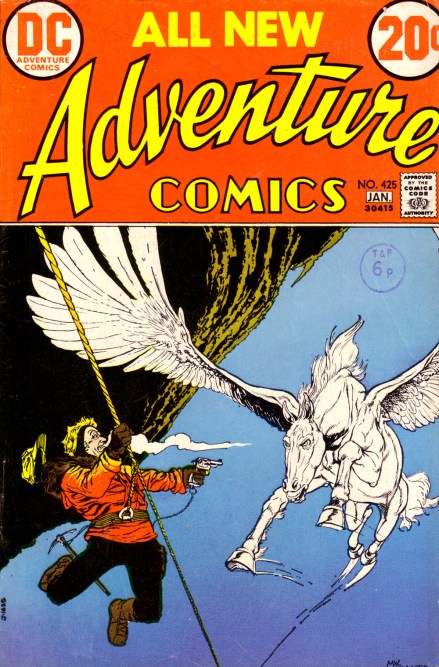
Rodeo showman Chad L. Hammond is in the Himalayas, where he hears rumors of “hawkhorses”. His guides say they are a myth, but he wants to hunt them anyway! In a snow-less grassy valley, he captures a foal and kills its winged mother. His guides accuse him of killing a sacred god and desert him.

While descending with the foal, he is attacked by pegusi, but managed to take the foal (now named “Cloud”) to the US and enters her into the racing circuit until its wings sprout. It wins, often, making Hammond a rich man.

Cloud’s wings begin to grow much to Hammond’s ire – he can’t race it if it has wings! He orders the wings removed. Cloud’s handler (who came with Hammond from the Himalayas) tries to stop Hammond but is killed for his concern over the sacred animal. Hammond sets the barn on fire – hiding the evidence of his murder.

After Cloud’s wings sprouted, Hammond rides the skies – only to be held hostage as Cloud joins the white Pegasus. They make it back to the sacred mountain and drop Hammond into a nest of hungry, sharp-toothed foals!

***

“Prior Warning” Writer: unknown. Penciler/Inker/Letterer: Frank Redondo

Aliens come to earth claiming to be peaceful. They think they are tricking the earthlings and actually plan to attack. But earth attacks them first and drive them off! The aliens have no idea what made the earthlings know they were, in fact, aggressors. Maybe the fact they dressed like Nazis and their leader is a dead ringer for Hitler!

***

“Sword of the Dead” Writer/ Penciler/Inker/Letterer: Gil Kane

Evlig, the renegade knight, slaughters a woman and her children, not knowing it was the family of John the Gaunt, retired champion of the kingdom. John comes out of retirement to hunt down the killer and both fight to the death … and beyond!

***

“Captain Fear”

Writer: Robert Kanigher; Penciler/Inker/Letterer: Alex Nino

A native Carib tribe in Haiti are attacked by Spaniards in search of slaves. Fero, the son of the chief, and others are captured and put to work in the mines. They revolt and escape in a Spanish ship; only to have the ship destroyed in a storm.

Rescued by other pirates, Fero fights for the command of the ship and kills the Asian captain. He renames himself Captain Fear – for that is what he will put in the hearts of every white devil he will meet! This he vows to the cheers of his bloodthirsty crew!

***

In a short letter column Joe Orlando explains the change in the magazine’s format from Supergirl to high adventure: fantasy, science fiction, mystery and/or horror!

***

Until its first cancellation in 1982, Adventure Comics was the oldest continually running comic book on the stands (back when there were stands…). Its first issue was called New Comics dated December 1935 by someone calling themselves National Allied Publications. It changed its title with issue #12 (January 1937) to New Adventure Comics. The “New” was removed in November 1938 and remained that way until its cancellation (although during the Spectre’s run in the early 1970s it was called Weird Adventure Comics, to cash in on the horror trend: Weird Mystery, Weird War, Weird Western, etc.

With its change to New Adventure Comics, it changed formats from humorous stories to action/adventure tales – some stories were written and drawn by future-Superman creators Joe Shuster and Jerry Seigel.

At the dawn of the superhero age Adventure dove right in with the debut of the Sandman with issue #40, Hourman (#48, March 1940), Starman (#61, April, 1941) and Simon & Kirby’s Manhunter (#73, April 1942).

When More Fun Comics changed formats to humor stories, its characters moved to Adventure, including Superboy, as of issue #103 (April 1946).

Issue #247 (April 1958) the Legion of Superheroes debuted. They eventually shared billing with Superboy during their classic run.

They were replaced by a solo Supergirl lead as of issue #381 (June 1969). She starred in the comic until #424 (October 1972). The letter column of her last issue explains she will get her own book but says the editors do not yet know the next issue’s new format. It only says to be back for a “new line-up of fantastic features!”

With #425 Adventure went back 35 years to focus on … well … adventures! Why? A search of the internet does not say specifically, but I can guess. At this point both DC and Marvel were making good money with their non-superhero lines – horror comics weren’t outselling Superman, but by gum the sales figures weren’t bad! With the Legion safely ensconced in Superboy and the Maid of Steel getting her own magazine, maybe it was time to add another non-superhero anthology … perhaps a repository for some not-quite-horror-themed tales …

(For more on Adventure Comics history AFTER issue #425, click here … or watch this blog for future issues!)

***

Captain Fear is the only feature of this short-lived era of Adventure with any legs. He had back-up stories in later issues of Adventure and in the Unknown Soldier.  He is given pages in Who’s Who and the History of the DC Universe.

***

About the author: Michael Curry is the author of the Brave & Bold: From Silent Knight to Dark Knight, The Day John F Kennedy Met the Beatles and the award-winning Abby’s Road, the Long and Winding Road to Adoption and How Facebook, Aquaman and Theodore Roosevelt Helped.  Check his website for more releases! Thanks for reading!


Behold! The Bronze Age! A new series

Regular readers of Curry Takeaways know of my many loves; including the Bronze Age of comic books.

What is the Bronze Age? It is a vague time period of comic book publishing. Most ages are determined by fixed events or dates in the history of comic book publishing – although even those are debated.

Only a contrarian disagrees that the Golden Age of comics began with the publication of Action Comics #1 and the debut of Superman (June 1938 – let’s please stop discussing cover date vs actual date; if you don’t know by now …).

There are more arguments over the beginning of the Silver Age, but the majority still believe it began with the publication of Showcase #4 and the (what we would now call) reboot of the Flash (October 1956).

The Bronze Age beginnings are more arguable. Was it when the price of comics went to fifteen cents? Was it when Jack Kirby left Marvel for DC? Some simply say 1970. This was when Kirby left for DC, Green Lantern became Green Lantern/Green Arrow and symbolized DC’s going “relevant” and growing up, many old-time writers and artists retired and were replaced by fans-turned-pros, Marvel published Conan the Barbarian, etc.

I do not really have a preference, although I lean more to the fifteen-cents-theory (early 1969).

The theories as to the date of the end of the Bronze Age is almost universal – the Crisis on Infinite Earths and the deaths of Flash, Supergirl and others in 1985.

Ages since have been of little interest to me – I just call anything since the Modern Age (some have coined post-Bronze Ages as the Copper Age and the Modern Age …).

I love comics in all of the various Ages, but the Bronze Age was when I first really read and paid attention to the comics I was getting (and saving).

Over the next few years on this blog I will share my favorite Bronze Age comics – sometimes going through entire series or a specific run. It will focus mainly on DC versus Marvel, Atlas, Harvey or Archie – but that’s because that is what I read.

They will be similar to other specific runs in the past (what I call the Adventure Line imprint, the Bicentennial issues and a few others) and may repeat some blogs. Forgive the reruns – I’ll keep them to a minimum.

I’d like to hear your opinions. Keep up the comments.

Enjoy.

Michael Curry


About the author: Michael Curry is the author of the Brave & Bold: From Silent Knight to Dark Knight, The Day John F Kennedy Met the Beatles and the award-winning Abby’s Road, the Long and Winding Road to Adoption and How Facebook, Aquaman and Theodore Roosevelt Helped.  Check his website for more releases! Thanks for reading!


More on The Warlord – a supplement to a prior blog!

A supplement to a prior blog:

See my original review of the Bronze age comic book Warlord from DC Comics.

To quote my review of the series Warlord: “(issue #2’s) … story does not end in a cliffhanger per se, as had the previous issue, but it had an open ending. Yet “The End” was prominently written on the final page. Did Messers. Grell and Orlando know this was the last issue? Did they know it would come back in a few months?”


Scoop is an excellent e-newsletter and I recommend anyone who enjoys my blog to subscribe.

Recently Scoop featured an interview with Mike Grell and he addressed Warlord’s hiatus:

“ … when I turned in pages I would pick up the letter pages and stand in the office and read through it, proofread to make sure there were no errors that needed sent back for corrections before I did the finished inks, when it came to issue 3, I was in Joe’s office and at the end of the book instead of saying “Next Issue” it said “The End.” I turned to Joe and said, “This is wrong. It says ‘The End’ but it should say ‘Next Issue.’” Joe said, “Yeah, well, Carmine cancelled the book.” I said, “He can’t do that, he promised me a year’s run.” And Joe says, “Yeah, well, he lied. He does that.”

“Fortunately for me and for the Warlord, within a couple of weeks Carmine Infantino was out and Jenette Kahn arrived on the scene. It turned out that Jenette was a pretty astute cookie and she had studied the entire lineup very thoroughly before she ever took over the company. I come to find out that Warlord was one of her favorite books. She looked at the production schedule and said, “Where’s the Warlord?” I told her, “Well, Carmine cancelled it.” She said, “Carmine’s not here anymore, put it back.” So that’s how Warlord got continued on past issue 3.”


So the mystery is solved!


Read the entire interview, where he also talks about his time on the Legion of Super-Heroes.

Interview with Mike Grell ©2017 Gemstone Publishing, Inc., Geppi’s Entertainment Museum, Diamond International Galleries, and/or the Fandom Advisory Network. They hold all rights.


What Might Have Been: the CW’s Constantine

A DC-TV Primer: the CW Network’s superhero lineup

? … Maybe someday … Constantine


From Wikipedia (as I said before, if they are going to do the work FOR me …):

CONTAINS SPOILERS FOR SEASON the ONLY (so far)

John Constantine, a demon hunter and dabbling master of the occult, must struggle with his past sins while protecting the innocent from the converging supernatural threats that constantly break through to our world due to the “Rising Darkness”. Balancing his actions upon the line of good and evil, Constantine uses his skills and a supernatural scry map to journey across the nation to send these terrors back to their own world, all for the hope of redeeming his soul from eternal torment.

***

            Rumors of Constantine becoming the fifth DC-CW show were just that – and became wishful thinking among fans of the show.

Like me.

Only the most zombie-like of Marvel zombies will refuse to admit that DC’s horror comics were better than Marvel’s horror comics; even well into the 1990s when Constantine the comic book was in full vigor. (“What about DC’s Wasteland?” “Shut up.”)

Even in their super-hero line, horror would rear its misshapen head with characters like the Phantom Stranger, the Spectre and Dr. Fate – two of those three had fun Easter egg references in Constantine’s run. The show even had the Justice League’s baddie Felix Faust in an episode!

Constantine would have been a repository of all things supernatural in CW’s superhero universe.

Too bad the show was doomed from the start.


It had the usual Berlanti Production touches: the main character had a team of followers behind him helping with that episode’s problems. Oh sure after the pilot episode they dumped his first female companion for another without a word, but that happens with pilots. I guess.

Chas was to John Constantine what Diggle is to Arrow – muscle when needed. Like Diggle, he is knowledgeable about the goings-on of the show. He has helped Constantine in the time before the show and does not need an explanation about what kind of baddie he is fighting. He has his own arcane powers that are revealed slowly during the show. Charles Halford plays him wonderfully.

The audience conduit is played by Angelica Celaya as Zed. John and Chas explain that week’s Big Bad to us through her. Her arcane powers of divination help with necessary shortcuts in the show (otherwise how would Constantine know about evil doings in New Orleans?). She is also a great actress playing a great character.

I liked the underused Harold Perrineau as Manny – an angel ally of Constantine but still a pain in the main character’s backside. Although he seemed to be on Constantine’s side, he also seemed to have a different agenda. Constantine didn’t trust him. I didn’t either… He would have played a larger role in the series had it continued (as the final aired episode clearly showed).


There was a Big Bad who was (presumably) going to duke it out with our hero in the season finale. Unlike the other Berlanti shows, we never knew who the Big Bad was until late into the season. In fact, the main villain was revealed in the last broadcast show – ending in a bit of a cliff-hanger. It is likely we will never see it resolved.

And mcguffins abounded in the show – there was always a talisman or other thingumabob that Constantine and his crew discovered that would defeat the bad guy (be it human or demon) after the initial failed confrontation. But here it worked. Using a magical devise to defeat the Big Bad makes sense in this supernatural setting…

Perhaps the horror element made us forget this by-now over-used CW super-hero plot device.


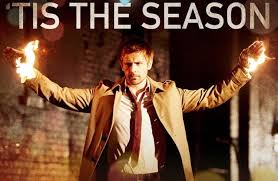
The original character was based on the musician Sting, but actor Matt Ryan made the character his own. He played Constantine with an exhausted charm. You want to have a drink with him – then run away as fast as you can!

He seemed tired and confused (that is, drunk) most of the time. With his trench coat, he was something of a horror-themed Columbo with a northern British accent. But like Columbo, he always knew what he was facing and (sometimes) knew what he was doing. True, at times it didn’t work …

And intended or not, the thought of Kolchak always bubbled below the surface…


One highlight episode was “The Devil’s Vinyl” featuring a satanic LP. The show introduces sometimes ally/sometimes villain Papa Midnite.


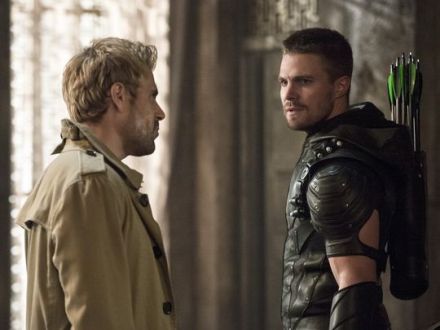
Perhaps the character will pop up again in the other DC-CW shows as he did in his wonderful appearance in a fourth-season Arrow episode, when Flash, Supergirl or Arrow (again) needs some supernatural help.

constantine_2

I would hate to see them waste an excellent character played by an excellent actor.

All of the episodes are available on CW-Seed. Find them and watch them.

And Happy Halloween!

download

Original Material Copyright 2016 Michael Curry


Characters mentioned and their images are copyright their respective holders.  Thanks to DC Comics, the CW Network and Berlanti Productions and the actors portrayed for the use of their images.

I also thank the original creators of all characters mentioned, whether or not they have been properly compensated (gratmens during the credits aside).
 

DC Legends of Tomorrow, a primer

A DC-TV Primer: the CW Network’s superhero lineup

Thursday: Legends of Tomorrow

From Wikipedia (as I said before, if they are going to do the work FOR me …):

CONTAINS SPOILERS FOR SEASON ONE

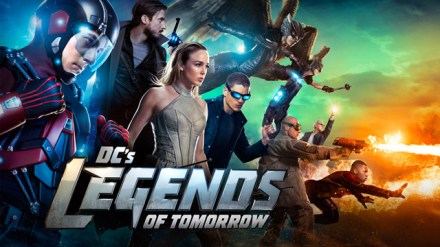
After the murder of his family by immortal dictator Vandal Savage, time master Rip Hunter travels back in time to the present day where he brings together a team of heroes and villains (Atom, White Canary, Firestorm, Hawkman, Hawkgirl, Captain Cold, and Heat Wave) in an attempt to prevent Savage from destroying the world. However, they are opposed by the Time Masters, an organization from the future dedicated to protect and manipulate the timeline as they see fit and a body to which Hunter had sworn allegiance. During their early adventures, they are hunted by the Time Master’s agent Chronos.

***

            Lordie do people dislike this show. Go to IMDB and read some of the reviews.

Sure, it’s not perfect, but it’s not THAT bad.

Isn’t it?

I liked the show! I look forward to watching it and am happy when I see it on my Tivo every Friday morning.

But after writing this review I realized there were parts – big parts – that I didn’t like.

In the end I decided the show was a mixed bag.


The premise itself is part of the problem: it’s the Gilligan’s Island syndrome. Once they defeat Vandal Savage, the show is over! SPOILER: The last episode proves this out. The gang breaks up and only some of them come back!


The show is not as dark as Arrow (despite its premise) and has light moments that rival Flash. The time-travelling premise should be liberating, but instead it seems limiting.

We KNOW they won’t finally confront Savage until the season finale, so the battles with him are incidental from the very beginning.


The show provides us with Easter eggs harkening to their DC comics’ roots…

Jonah Hex’s appearance was a highlight.

Finding Per Degaton as a youth made for some interesting moral debates: would you kill Hitler-as-a-child if you could?

Characters from other DC-CW shows pop up; notably Quentin Lance. We spy alternate futures including Diggle’s son taking up the Green Arrow mantel. They are careful in the future – not wanting to spoil anything. But they are also careful in the past when they did not have to be.

Professor Stein, Captain Cold and even Rip Hunter meeting their younger selves provided some good moments, but even I was confused when they snatched some team members as newborns. That plot-thread was quickly forgotten and wrapped up on the next show before the opening credits.

I found the multi-part arc in the 1950s especially disappointing. Racial hatred was only just touched upon. Maybe it was because the story was in Washington state. Jax’s flirtation and dating a white girl created some trouble with goons, but it was no worse than were he beat up by a jealous boyfriend rather than bigots.

Meanwhile, Ray Palmer and Kendra Saunders play a mixed race couple who move into the neighborhood with only the slightest double-takes from the neighbors. Maybe Washingtonians were more progressive in the late 1950s than I thought.

They should have taken a chance and placed the story arc in Old Miss. But I don’t think CW wanted to do that.


One complaint that I had about the show from the beginning was the dialogue. Sometimes the characters quipped without having anything to say. Did the actors have to have an equal number of lines? Did the writers once in a while say, “Mick hasn’t spoken for a while…”

I noticed one scene where the camera panned left to right. As the camera passed, each character had a line. People don’t speak in the order in which they are standing.


***

            So what DID I like about it?

The characters!

Wentworth Miller and Dominic Purcell stole every scene as Captain Cold and Heat Wave (although they were mostly called by their civilian names Leonard Snark and Mick Rory). The duo was my favorite part of the show, despite my initial fear that they would be its weakest link (villains? They couldn’t come up with two other heroes?)! The occasional “I like this guy,” from Rory always made me giggle.

Best line of the show was Rory’s: “I need you to burn something.” “About time…”

Snark’s slow turn from bad guy to almost-good guy was the best part of the show. “Why do you care about any of them?” Rory would ask. “I don’t, but they’re on my team, and you watch out for your team.”

Nice.

So was Rory’s very very slowly developing friendship with Ray Palmer.

Speaking of him, Brandon Routh still channels his inner Christopher Reeve. He was excellent as Superman and very good as the Atom. I just don’t think he is given much to work with here. His eccentricity in Arrow became flightiness here.

His romance with Kendra Saunders was not very convincing. Plus the constant reminder that she is meant only for Carter Hall wears thin.

Saunders meeting her previous incarnation in the Old West was a fun few minutes, though.

Both characters were more interesting and better done in Flash and Arrow.

Poor Sarah Lance (the White Canary), despite being played excellently by Caity Lotz, seems bored. The few times the show focuses on her are excellent: her falling for a nurse in the 1950s and rebuffing Snart’s hesitant advances. Maybe the writers weren’t sure what to do with her and her powers. She kicks butt, true, but what can she do against a robot as tall as a skyscraper? Hopefully she will be back on Arrow soon providing some grist for that mill should Legends fail to keep up good ratings.

I like Victor Garber as Professor Martin Stein; always pontificating and irritating his team while providing the viewer exposition. He talks down to the team to provide exposition for the viewer. His “partner” is Franz Dramah as Jax. Their friendship was only explored occasionally and we need more of it.

Arthur Darvill as Rip Hunter was also wonderful. His Ahab-like need for vengeance wore pretty thin, though. Savage killed his wife and son! Yes, we know, we were told in the opening credits and two or three times every show – even shows that don’t really feature Savage.

I wish Casper Crump were given more to do as Vandal Savage than preen and smirk. His final battles in the season finale were very good, though.

***

            The show was an exemplary example of Berlanti Productions #1 rule of a Big Bad who fights the heroes throughout the season culminating in the season finale.

But fortunately the nature of the show made it nearly impossible for Rule #2: bad guy (or gal) appears, heroes fight him or her and gets whipped. Team finds flaw and makes a macguffin to defeat bad guy. Arrow does it, Flash does it, even Supergirl. Legends? Not so much.

***

            It’s not a perfect show, but it is fun to watch, and that’s the whole point isn’t it?

***

So what’s next for our legends? It looks from the previews that the show is entering into Doctor Who territory – going to different times and meeting the famous and infamous.

They will be repairing the timeline.

They will also be meeting more heroes (and villains) from the DC roster: Vixen will join as will Steel. They meet the Justice Society of America.

And fight the Legion of Doom! Malcolm Merlin, Damien Darhk, Captain Cold (what!?) and the Reverse Flash gather together to try to defeat our heroes.

I’ll be there. Will you?


Original Material Copyright 2016 Michael Curry


Characters mentioned and their images are copyright their respective holders.  Thanks to DC Comics, the CW Network and Berlanti Productions and the actors portrayed for the use of their images.

I also thank the original creators of all characters mentioned, whether or not they have been properly compensated (gratmens during the credits aside).


The CW’s Supergirl, a review (part two)

A DC-TV Primer: the CW Network’s superhero lineup

Monday: Supergirl

Part Two

My review of Supergirl begins here.


I love the show, I do, but it is not without its problems …

Cat Grant (a character from the Modern Age (post-1986) of Superman) is one of the few characters that tend to plod down the story. She’s not a villain, in fact she is key in getting the world to love Supergirl and not fear her, but is still cold and self-centered CEO.  She is shallow almost to the point of being flighty. The staff of Catco (including Kara) sycophantically acquiesce to her every whim for fear of being fired and black-balled from the industry. It is good in small doses, but like Spider-Man’s J Jonah Jameson, the character wears thin pretty quickly.

Of course, a woman who works her way to the top in her field HAS to be tough and cold, I suppose. That seems to be their message. Maybe I don’t agree with that; maybe that’s why I role my eyes when the character stomps out of the elevator onto her first scene of every episode. She has the power of an Oprah without the humanity. Cat Grant would never give away a fleet of cars.

Attempts to humanize her are forgotten or fall flat. Her interest in Kara being a foster child, for example. The one line (“that is not uninteresting.” – I paraphrase), brings the hope of a non-two-dimensional moment. Her adult son comes to National City and mother and child try to make amends. We get to see how she became the way she is through the visit of her unloving and shrewish mother.

It is quickly forgotten by the next episode.

When kidnapped by a supervillain, she begs for her life for the sake of her children. By this point I do not know if she is sincere or just buying time…

This is no slight on Calista Flockhart – she does a wonderful job with what she has. She looks like Holly Go Lightly but talks and acts like Maude.

But with Cat Grant, a little goes a long way.

Calista Flockhart will only have a few cameos in Season Two, which may or may not be a good thing – if they keep the character as is, small doses is best.


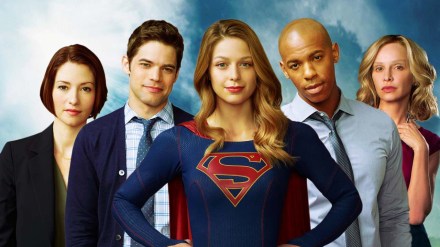
I think they really missed the boat on the relationship with fellow nerd Winn (played by Jeremy Jordan). He was in love with Kara before she became Supergirl.  He revealed his feelings but it was glossed over in a few episodes. Now they are back to being good friends. Too bad. That could have been explored more – he loved Kara before she donned the cape and big red S. Has his affection changed now that she is Supergirl? Does he still love Supergirl, or are his affections aimed at Kara only? He never said, “I wish we could go back to where we were. I wish I could talk to Kara when she’s not Supergirl.” I think they missed a good thing there.

Kara’s maybe-romance with Jimmy Olsen (played excellently by Mehcad Brooks) continues to slowly bloom.

Speaking of Jimmy: knowing Supergirl’s identity and being Superman’s Pal gives the character a worldliness that Brooks plays quite well. He half-smiles at Cat Grant’s – er – cattiness. If he could he would turn his back and wink at the camera; just like Superman did in the 1960s cartoons. Once you’ve faced down Brainiac, not much unnerves you…


So now that the show is under the CW umbrella, what can we expect?

It was established on the wonderfully fun Flash-Supergirl meeting in the episode “World’s Finest” that Supergirl and her show take place in another dimension. Whether that is thrown out to make all DC-CW shows one world remains to be seen. With Flash and Legends of Tomorrow constantly tinkering with alternate realities, it can easily be done.

The first season was on CBS which meant it tried to be all things to all people. Now it can focus on a narrower audience. The three other Berlanti Production shows have a total of seven seasons between them all. And the most common denominator is the epic season-long fight with a specific super-villain, culminating in a senses-shattering free-for-all at season’s end/sweeps. It has almost become a joke. From Quenton Lance in Arrow (I paraphrase): “Someone’s threatening to destroy Starling City? It must be May!”

Supergirl had an epic villain (Non), but it was not the main focus of the season. In fact in a few shows he seemed forgotten. But the season-long story arc will likely happen with Season Two. Because of the nature of the heroes and villains, it might be earth-shattering and not as vanilla as it seemed on CBS.

That may not be fair. We take Arrow’s villains seriously because the characters are human. Flash is the same, only a little less due to the character’s powers. There is no way to forget that Supergirl is fantasy and that creates a disconnect that doesn’t exist in the other shows. Ra’s al Ghul is thus a scarier villain than a White Martian (being a more well-rounded character played by a superb actor aside…).

That being said Flash, Arrow and Legends of Tomorrow did it correctly. Other things happened during the season, too. There was story progression; not one long episode with no progression and no enjoyment – where you could skips months of programs and not lose any of the plot (kaff-agentsofshield-kaff).

Season Two will introduce a character names Maggie Sawyer from the National City police department.  Will she be an ally or an antagonist like Joe West on Flash or Quenton Lance on Arrow?

The press is all over TV’s Wonder Woman Lynda Carter appearing as the US President. Will she have a regular role or just appear occasionally?

Another item the press is gaga over is Superman’s larger role in the next Season. In Season One he is shown only in vague visions. Good move. This is Kara’s show. He would only have up-staged her at this point. He does contact Kara by texting her (“Need help?” “Are you all right?”), which was another good move: the show didn’t ignore him, but he wasn’t a deux ex machina saving the day every other episode, either. Hopefully he won’t steal Season Two.


Also in Season Two we will meet Mon-El, a member of the Legion of Super Heroes who started off as another youngster sent to earth from another planet. Unfortunately, he had amnesia and could not remember where he came from. Having the same powers as Superboy, he assumed, using comic book logic, that this stranger was his brother! We will see how Supergirl treats the story.

Because of what they did with “For the Man Who Has Everything” though, I’m not worried.

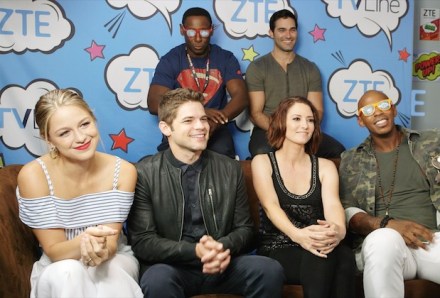
supergirl-cast-2

Up Next: the Flash

Original Material Copyright 2016 Michael Curry


Characters mentioned and their images are copyright their respective holders.  Thanks to DC Comics, the CW Network and Berlanti Productions and the actors portrayed for the use of their images.

I also thank the original creators of all characters mentioned, whether or not they have been properly compensated (gratmens during the credits aside).
 

The CW’s Supergirl, a review

A DC-TV Primer: the CW Network’s superhero lineup

Monday: Supergirl

Part One

From Wikipedia (why should I do all the work?):

CONTAINS SPOILERS FOR SEASON ONE

Kara Zor-El (Melissa Benoist) was sent to Earth from the doomed planet Krypton as a 12-year-old by her parents Zor-El (Robert Gant) and Alura (Laura Benanti). Alura gave her instructions to protect her infant cousin Kal-El, and informed her that she, like her cousin, would have extraordinary powers under Earth’s yellow sun.

En route to Earth, Kara’s spacecraft was diverted by a shock wave from Krypton’s explosion and forced into the Phantom Zone, where it stayed for 24 years. During this period, time stopped for Kara so, when the spacecraft eventually escaped the Phantom Zone, she still appeared to be a 13-year-old girl. By the time the spacecraft crash landed on Earth, Kal-El had grown up and become Superman. After helping her out of the craft, Superman took Kara to be adopted by his friends, the Danvers family. The main series begins more than a decade later when the now 24-year-old Kara is learning to embrace her powers after previously hiding them.

Kara hid her powers for more than a decade, believing that Earth didn’t need another hero. However, she has to reveal her powers to thwart an unexpected disaster, setting her on her own journey of heroism as National City’s protector. Kara discovers that hundreds of the criminals her mother prosecuted as a judge on Krypton are hiding on Earth, including her mother’s twin sister Astra (also played by Benanti) and Astra’s husband Non (Chris Vance), who seek to rule the world. After briefly becoming suspicious of the true agenda of her boss, Hank Henshaw (David Harewood), she and her adoptive sister, Alex Danvers (Chyler Leigh), secretly discover that Henshaw is actually a benevolent alien refugee, J’onn J’onzz, who has resided on Earth for over fifty years after escaping a holocaust on his homeworld of Mars. J’onn infiltrated the DEO to reform the organization as well as to watch over both Alex and Kara in addition to guiding the latter in the use of her powers due to his experience with his own abilities. Kara is also being targeted by Earth’s criminals as the result of her being related to Superman, and later on encounters an emerging community of metahumans and individuals from parallel universes. In the process, Kara accumulates her own rogues gallery who seeks to defeat and destroy her. She is aided by a few close friends and family who guard her secrets—most notably her cousin’s longtime friend, James Olsen (Mehcad Brooks)—which also serves as a major plot in high tech mogul Maxwell Lord’s (Peter Facinelli) scheme to expose Kara’s identity.

***

            I adore this show. The few things I do NOT like about it are minimal, honestly.

The show is wonderful fun. Like the Flash, Supergirl tells us how much she enjoys being a superhero. No dark and brooding angst about being a hero! What little angst there is deals with normal emotional turmoil – balancing work and play, love and commitment.  Just like the rest of us! But overall the show exudes joy.

This is even more amazing considering the content compared to other DC-CW shows: In Arrow the main villain could (and tries to) destroy Star(ling) City. In Flash the main villains want to destroy … well … the Flash. The villains in Supergirl have the power to destroy the earth and everyone in it, have lunch, and then destroy Venus for snicks and giggles. That could be absolutely terrifying! But it’s not.

Don’t take that to mean the show is lightweight, or aimed at children. It just shows how much unbridled fun the show is even during tense moments..


DC characters abound – from villains (Hellgrammite, White Martians) to secondary characters (Lucy Lane). All lovingly plucked from the comics.

There are plenty of DC Easter Eggs to bring a smile or to make us worry. In the comics, Hank Henshaw (here the head of the DEO) is, in the comics, the evil Superman-Cyborg. When the character from the show intimates that he has a deep dark secret, comic book fans raise their eyebrows. “Aha! He’s going to become the evil cyborg!” Is he?

The major difference to Supergirl’s comic book origins (which has been tweaked over the years) is the addition of her adopted sister Alex. It adds to the show and its characters and is not a bad idea. If DC decided to make it comic book canon, I would not object. Trouble is, in modern comics her life expectancy would be quite short.

One episode is a reworking of the best Superman story ever printed: Action Comics Annual #11’s “For the Man Who Has Everything” by Alan Moore and Dave Gibbons, with Supergirl trapped by the Black Mercy instead of the Man of Steel. When I saw the opening scene and the alien plant attached to Supergirl I about hit the floor! It was a great adaptation!

A nice non-comic book Easter egg is the casting of Dean Cain and Helen Slater as her adopted parents. Slater played Supergirl in the 1984 movie and Cain played Superman in Lois & Clark: the New Adventures of Superman. It is little things like this that bring a smile to this old cynic: Berlanti Productions gives a damn enough about the comics to give us these treats.


You can tell the cast enjoys what they are doing, too. Melissa Benoist is phenomenal as Supergirl. She portrays an innocence (and a young person’s temper and frustration) and yet she will not hesitate to let you know she could pinch your head off with her thumb and forefinger.  Frankly she is cuter as flighty and naïve Kara Danvers.  Kara is a slightly less of a She-Geek than Arrow’s Felicity Smoak, but you can’t help but compare. Imagine if Mary Tyler Moore played the role of Mary Richards at age 24. Benoist is that good.


The show has a few drawbacks, in my opinion: More on those next time.


Original Material Copyright 2016 Michael Curry


Characters mentioned and their images are copyright their respective holders.  Thanks to DC Comics, the CW Network and Berlanti Productions and the actors portrayed for the use of their images.

I also thank the original creators of all characters mentioned, whether or not they have been properly compensated (gratmens during the credits aside).

The CW Network’s Superhero line-up!

A DC-TV Primer: the CW Network’s superhero lineup,

Introduction

Note: I have never been sure of the proper way to stylize the names of books, movies and television shows. Some say to italicize the titles of books and put the titles of TV shows and movies in quotes. Some say it is the other way around. I do not care, frankly, I never have. As long as it is consistent throughout the piece I am reading. If the next blog or article or book then does something different – it doesn’t bother me as long as it is consistent within that same text. I italicize both comic book titles and movie and TV program names in this exercise. It may be wrong, but at least it is consistent.


When I think of the CW Network’s lineup of DC Comics superheroes my mind goes back to the fall of 1976.

At that time DC created what we would now call an imprint line of four comic books. An “imprint” is a series of comic books that are not necessarily part of the line’s mainstream comic. The imprint books share a similar theme. There have been imprints aimed solely at children, for example. The Image imprint featured comics with mature themes and art – not for the kids – with creator-owned characters. The Milestone imprint from DC comics was set in a comic book universe outside that of Superman and Batman and featured African American characters and creators.

In 1976 four comics were published by DC with a television theme. DC-TV they called it, and the company even changed its logo for these comic books. The four comics featured television shows that aired at the time (or were about to debut): Superfriends, Welcome Back Kotter and Isis (no, not that Isis) debuted. The fourth was Shazam (the adventures of the original Captain Marvel – but DC dare not use his name on any comic book covers lest Marvel Comics finally get their sweet litigious revenge on National Comics … but that is a whole other story), a comic that had been around for a few years but was on hiatus until the Saturday morning live-action show aired. Kotter and Isis lasted ten and eight issues respectively, Shazam started their TV run with #25 and lasted through #33; after that it changed its style for the next two issues before cancellation (although the character and title continue to be revived these forty years later). Superfriends lasted for several more years – until 1981 over 47 issues – boosted not only by the successful cartoon but also by the familiarity of the characters – Superman, Wonder Woman, Batman and Robin.

Reviews and commentary of those four comics would make a fun blog series … maybe given time I will do it!

Forward to 2016. Forty years on I am tickled to see history repeat itself with another DC-TV connection.

This fall season the CW network will air a superhero program based on DC characters each weeknight Monday through Thursday (the rumor of Constantine being added on Fridays are unfortunately untrue).

DC has published comic books based on the shows – or has added some of the television regulars to their existing continuity (in the Flash comic book for example).

This blog series will be a primer for those who (like me) are finally jumping into the new DC-TV pool of programs. I hope to discuss and review all four (maybe five) shows that are soon to begin their new seasons on the CW.

Starting your viewing at this point (particularly Arrow, which begins its fifth season) will only make you … Lost, if you get my meaning.

I promise that I will use spoiler alerts. But you will generally learn nothing that you won’t be able to find out on IMDB and on the “Previously on …” front tags of each show.

***

My only child turns seven in October, right around the time the CW will begin its new season. She loves to read and play games – whether board games or on the computer.

This means that my days of staring at a parade of purple dinosaurs, child explorers and a prime-colored Australian singing quartet are done. Oh, I still have to sit through Frozen every few days, or some other Disneyanic Princess derivation, but shows aimed at children … no more.

So of course I fill my time watching TV shows about super-heroes!!

Hey, you can’t watch the Sopranos all the time …

***

I heard good things about the CW line-up from Facebook and “real” (haha) friends and I was finally able to see what all their posts and comments were about.

Netflix has the first three seasons of Arrow and the first season of Flash available for binge-watching. The entire run of Constantine is available on the CW’s website, and the network is rerunning Supergirl and Legends of Tomorrow until their new seasons start. CW is only running a few episodes from seasons four and two of Arrow and Flash respectively. I hope the entire season will soon be on Netflix or elsewhere before or during the new seasons. I don’t mind keeping the shows on Tivo for a few weeks while I catch up.

The only trouble is these shows are linked.

Don’t stop reading! By that I mean that the shows cross over, but they are not one long continued story. You won’t have to jump from one program to another! So don’t panic. In comic book terms, they share the same universe.

(They WILL do have a continued storyline during November sweeps – Supergirl will be chasing a villain through all four shows during one week.)

It’s been done. Remember when Murder She Wrote and Magnum PI had a continued story? There were two (I think) great Law & Order/Homicide shared storylines too. NBC was notorious for this in the 1980s and 1990s: one example is a hurricane hitting Florida affecting the plots of the Golden Girls, Nurses and Empty Nest all in one evening’s programming.

And who can forget the universal nexus of Sam’s General Store in the Beverly Hillbillies/Petticoat Junction/Green Acres?  (Try as I might … )

Here’s what I mean:

The explosion that opened the Flash series is mentioned in Arrow. When the character Arrow (note that the TV show is italicized, the character is not) changes his costume slightly, Flash mentions it. Flash and Arrow regular Felicity Smoak had a brief romance. Heroes, side-characters and villains would pop up in each other’s programs.

I watched Flash first. By the time of Flash season one, Arrow was in season three. It did not make for confused viewing, but it gave away some of the plot points when I later watched early Arrow episodes (we meet Felicity and Diggle in Season One of Arrow – will they be allies or enemies? It was fun to watch the development, but I already knew the outcome). And there WERE some spoilers, “I’m sorry to hear about so-and-so’s death.” Arrgh!

***

I will do my reviews in the order in which the episodes will air: Supergirl first, then Flash, Arrow, Legends of Tomorrow and finally Constantine (as of the writing of this blog series, Constantine has not yet been officially added to the line-up. I’ll discuss it anyway; I am a big fan of the show having finally seen it and would LOVE to have it added).


DC-TV.


Again.


Original Material Copyright 2016 Michael Curry


Characters mentioned and their images are copyright their respective holders.  Thanks to DC Comics, the CW Network and Berlanti Productions and the actors portrayed for the use of their images.

I also thank the original creators of all characters mentioned, whether or not they have been properly compensated (gratmens during the credits aside).