Seven Soldiers of Victory, part 3: the Crimson Avenger

Adventure Comics #440, August 1975

The back-up feature is an unpublished saga of the Seven Soldiers of Victory – written in the Golden Age but never rendered and completed until 1975.

Adventure 440 splashPart Four: The Crimson Avenger

“Kings Make a Full House!”

Writer: Joseph Samachson, Penciler/Inker: Mike Grell, Inker: Ben Oda, Editor: Joe Orlando & Paul Levitz

Crimson Avenger and Wing discover streams of water that makes them grow to giant size or shrink to the size of blades of grass. They experiment to get themselves back to normal.

They spot a collapsing castle. Growing to giant size, they prop up the castle to prevent any damage.

The castle’s owner, King Mistybrain objects to their saving his castle. He has visitors – other kings – who refuse to leave and collapsing the castle is the only way to get them to leave! The Crimson Avenger and Wing offer to help. One of the guests, King Adelbert, overhears and vows to stop our heroes!

He spikes our heroes’ drinks with the shrinking potion and tries to smash them on the dinner table. CA and Wing escape by tossing the salad and other food at the king until they can get to their growing potion.

Growing to giants, Crimson Avenger and Wing vow to find work for the lazy guests. At the mention of work, the kings run off. To thank them for their help, Mistybrain shows Crimson Avenger and Wing the direction out of the Land of Magic.

***

I’ve gotten rid of semi-permanent guests by demanding they chip in for the electric bill and rent. I therefore have first-hand knowledge that Crimson’s plan would have worked…

***

A house ad announces this is the last issue starring the Spectre, ending the classic Fleisher-Aparo run. The run is reprinted in the series Wrath of the Spectre, with stories written but not completed (much like this Seven Soldiers of Victory tale) in Wrath… #4.

***

Why was Wing never considered a member? He was in every adventure – they counted Speedy (and Stripesy, but he and SSK were more a team than a hero-sidekick). Was it a racist thing?

About the author: Michael Curry is the author of the Brave & Bold: From Silent Knight to Dark Knight, The Day John F Kennedy Met the Beatles and the award-winning Abby’s Road, the Long and Winding Road to Adoption and How Facebook, Aquaman and Theodore Roosevelt Helped.  Check his website for more releases! Thanks for reading!


Seven Soldiers of Victory, part 2: Green Arrow and Speedy!

Adventure Comics #439, June 1975

The back-up feature is an unpublished saga of the Seven Soldiers of Victory – written in the Golden Age but never rendered and completed until 1975.

Adventure 439 splash

Part Three: Green Arrow and Speedy

“Father Time’s Inn!”

Writer: Joseph Samachson, Penciler/Inker: Lee Elias, Editor: Joe Orlando & Paul Levitz

Green Arrow and Speedy enter the Land of Magic in front of Father Time’s Inn. They enter hoping to find a way home. They meet Father Time and his Boarders – heavenly bodies such as stars, moons, planets, etc. All of the Boarders are arguing.

Green Arrow and Speedy stop the erupting brawl, but are themselves knocked out my Mars and Mercury. They escape by turning Father Time’s hourglass upside down, thus reversing time and making the ropes untie themselves. Time goes all the way back to the beginning of Father Time and the heavenly bodies’ argument.

Father Time turns his hourglass back to normal and commands the constellations to attack Green Arrow and Speedy. After GA beats back Sagittarius and Cancer, he offers to help mediate the argument (the sun intentionally hid behind the earth to eclipse the new, shiny crescent moon).

Father Time rewards Green Arrow and Speedy by lending them a comet to return home.

***

You know, reading through this plot synopsis had me thinking there may be a REASON this story sat in a drawer for thirty years…

The Statement of Ownership says the average number of issues sold were 144,055.

***

What a coup to have Lee Elias draw this Green Arrow strip! He was GA’s regular artist during his 1959-1964 runs in Adventure Comics and World’s Finest! He is the co-creator of Eclipso … an eclipse was the reason for the argument in the story. Coincidence?

***

About the author: Michael Curry is the author of the Brave & Bold: From Silent Knight to Dark Knight, The Day John F Kennedy Met the Beatles and the award-winning Abby’s Road, the Long and Winding Road to Adoption and How Facebook, Aquaman and Theodore Roosevelt Helped.  Check his website for more releases! Thanks for reading!


RIP Geoff Emerick 12/05/1945 – 10/02/2018

If George Martin was a wizard (and he was), Geoff Emerick was his familiar.

From Wikipedia:

Geoffrey E. Emerick was an English audio engineer who worked with the Beatles on their albums Revolver (1966), Sgt. Pepper’s Lonely Hearts Club Band (1967) and Abbey Road (1969). Producer George Martin credited him with bringing “a new kind of mind to the recordings, always suggesting sonic ideas, different kinds of reverb, what we could do with the voices”.

Emerick also engineered the Zombies’ Odessey and Oracle (1968), Paul McCartney and Wings’ Band on the Run (1973), and Elvis Costello’s Imperial Bedroom (1982). He won four Grammy Awards for his work in the music recording field. His 2006 memoir Here, There, and Everywhere: My Life Recording the Beatles caused controversy for its factual errors.

Early career at EMI

Geoff Emerick was brought up in Crouch End, London, and educated at Crouch End secondary modern school, where one of his teachers heard about a job at EMI and suggested he apply. At age 15, he was employed as assistant engineer. The fifth of June 1962 was his first day at work, and on the following day the Beatles came to Studio 2 at Abbey Road for their first recording session for EMI. To familiarise Emerick with his work, he was placed under the supervision of another assistant engineer, Richard Langham, assistant engineer to Norman Smith, who would be doing the first recording session of the Beatles in the evening. As a new recruit, Emerick was not entitled to get over-time pay, but was lucky enough to witness this first-ever EMI recording session by the finalised line-up of the Beatles in 1962, during which the group recorded for the first time with new drummer Ringo Starr on what would eventually become their debut hit single, “Love Me Do”.


Working with the Beatles and others

beatles-studio

As assistant engineer, Emerick worked on several early recordings by the Beatles, including “She Loves You” and “I Want to Hold Your Hand”. From early in 1964, his involvement with the band was limited due to his training program at EMI, as he progressed to lacquer cutter, mastering engineer and then balance (or recording) engineer. During that time, he helped record other artists for the label, including Judy Garland, and assisted at the EMI artist test of the Hollies. After working his way up to the recording engineer’s position, Emerick engineered the 1966 Manfred Mann single “Pretty Flamingo”, which became a number 1 hit in the UK.

In April 1966 at the age of 20, Emerick took over as the Beatles’ recording engineer, at the request of producer George Martin, when Smith became a producer. Emerick’s first album in this new role was Revolver, starting with the sessions for “Tomorrow Never Knows”. It was Emerick’s suggestion to record John Lennon’s vocal through a Leslie speaker on the song, to capture the ethereal sound Lennon wanted, and to close-mic Starr’s drums, formerly a prohibited practice at EMI Studios. In 1967, Emerick engineered “Being for the Benefit of Mr. Kite!”, one of the most musically complex songs on Sgt. Pepper’s Lonely Hearts Club Band. Lennon told Martin he wanted to re-create the “carnival atmosphere” of the Pablo Fanque circus poster that inspired the song. For the middle eight bars, Emerick spliced together multiple recordings of fairground organs and calliope in an attempt to create the effect; after a great deal of unsuccessful experimentation, Martin instructed Emerick to chop the tape into pieces with scissors, throw them up in the air, and re-assemble them at random. Later in 1967, he engineered the Zombies’ Odessey and Oracle and Tomorrow’s self-titled debut album.

Emerick abandoned work on The Beatles (also known as the “White Album”) on 16 July 1968, fed up with the intra-band tensions and arguments that hampered the sessions. Emerick also objected to Chris Thomas, Martin’s inexperienced assistant, being elevated to the role of producer in Martin’s absence, with the band’s acceptance. He returned to work with the Beatles on Abbey Road. Emerick received Grammy Awards for the engineering of Sgt. Pepper’s Lonely Hearts Club Band and Abbey Road.

Despite his departure from the White Album sessions, Emerick remained on good terms with the Beatles, particularly Paul McCartney, who invited Emerick to quit EMI and come and work for their company Apple Corps in 1969. In addition to engineering duties, Emerick oversaw the building of the Beatles’ Apple Studio in the Apple Corps building.

After the Beatles

Following the Beatles’ break-up in 1970, Emerick continued to work with McCartney. He served as recording engineer on McCartney albums such as Band on the Run (1973), which netted Emerick another Grammy, London Town (1978), Tug of War (1982) and Flaming Pie (1997). Emerick later said that he had always been perceived by the other ex-Beatles as “Paul’s guy”. As a result, for their solo recordings, Lennon and George Harrison chose to work instead with Phil McDonald, another former EMI engineer.

Emerick was the sound engineer on Robin Trower’s 1974 album Bridge of Sighs, and was credited by both Trower and producer Matthew Fisher for that album’s sound. He also recorded some of the backing tracks for the debut album by Stealers Wheel, The Psychomodo, but resigned early on in the process, handing over to Apple recording engineer John Mills to continue working with producers Jerry Leiber and Mike Stoller. The Stealers Wheel album featured “Stuck in the Middle with You” and went on to receive the Dutch Edison Award.

Following the success of EMI’s The Beatles at Abbey Road presentation in 1983, Emerick prepared an album of the Beatles’ studio outtakes, to be titled Sessions, for release. The former Beatles initiated legal proceedings to prevent EMI from issuing the album, saying that the work was substandard; when made available on bootleg compilations, his mixes and editing of some of the tracks were widely criticised by collectors. In the mid 1990s, these recordings were used for the Beatles Anthology CD releases.

Emerick also worked on albums by Elvis Costello (for whom he produced Imperial Bedroom and All This Useless Beauty), Badfinger, Art Garfunkel, America, Jeff Beck, Gino Vannelli, Supertramp, Cheap Trick, Nazareth, Chris Bell, Split Enz, Trevor Rabin, Nick Heyward, Big Country, Gentle Giant, Mahavishnu Orchestra and Ultravox. His other recording projects included Matthew Fisher’s first solo album, Journey’s End; Kate Bush’s demo tape to EMI, which landed her a record deal; and Nellie McKay’s critically acclaimed 2004 debut CD Get Away from Me. In 2003, he received his fourth Grammy, a Special Merit/Technical Grammy Award.

In 2007, Emerick produced a re-recording of Sgt. Pepper’s Lonely Hearts Club Band in honor of the album’s 40th anniversary. It included performances by contemporary artists such as Oasis, the Killers, Travis and Razorlight. Emerick used the original equipment to record the new versions of the songs, and the results were broadcast on BBC Radio 2 on 2 June that year.

From 1984, Emerick resided in Los Angeles.

Here, There, and Everywhere

In 2006, Emerick released his memoir, Here, There, and Everywhere: My Life Recording the Music of The Beatles, co-authored by music journalist Howard Massey. The book caused controversy for its factual errors, and for its allegedly unfavorable portrayal of Harrison, bias towards McCartney and belittling and dismissal of Harrison and Starr’s contributions. According to Beatles biographer Robert Rodriguez, Emerick’s recurring theme that Harrison lacked prowess as a guitar player until the late 1960s is more reflective of Emerick’s personality, and is countered by several other sources, and some of his descriptions of the Beatles’ recordings are negated by the availability of bootleg compilations of the band’s multitrack masters.

Beatles historian Erin Torkelson Weber said that, apart from Lennon’s account in Lennon Remembers, the book also presents arguably the most negative depiction of Martin as a record producer. The publication led to an Internet flame war, as former Beatles engineer Ken Scott challenged the accuracy of Emerick’s recollections and stated that, before writing the book, Emerick had contacted him and other EMI technical staff saying he had limited memory of the events. Scott’s 2012 autobiography, From Abbey Road to Ziggy Stardust, sought to correct Emerick’s statements in Here, There, and Everywhere, especially with regard to Harrison’s musicianship and character.

Death

Emerick died from a heart attack on 2 October 2018, aged 72. He had been hospitalized two weeks beforehand after experiencing trouble walking, but was ruled to have been dehydrated. His manager, William Zabaleta, recalled talking to Emerick for the last time: “While on the phone, he had complications and dropped the phone. I called 911, but by the time they got there, it was too late. Geoff suffered from heart problems for a long time and had a pacemaker. When it’s your time it’s your time. We lost a legend and a best friend to me and a mentor.”

Paul McCartney commented on social media: “He was smart, fun-loving, and the genius behind many of the great sounds on our records. I’m shocked and saddened to have lost such a special friend.”

***

geoff_emerick

As buried in the article, he produced my beloved Badfinger (the No More album). The list of McCartney albums is not complete (Run Devil Run), but you get the idea.

Rest in peace, sir, and thank you.

For everything.

Literally, everything.

***

About the blogger:

Michael Curry is a life-long Beatles fan and has written the short story “The Day John F Kennedy Met the Beatles”, available here on Amazon Kindle.


The Seven Soldiers of Victory: the lost story!

A Bronze Age/Golden-Age hidden gem!

The Seven Soldiers of Victory (or Law’s Legionnaires) is DC Comics’ second super-hero team, following the Justice Society of America. Like the Justice Society, the membership of the Seven Soldiers is drawn from DC’s anthology comics: The Vigilante (Action Comics); the Crimson Avenger (Detective Comics); the Green Arrow and Speedy (More Fun Comics); the Shining Knight (Adventure Comics); and the Star-Spangled Kid and Stripesy (Star-Spangled Comics).

The Seven Soldiers of Victory appear in the first fourteen issues of Leading Comics.

A script by Joseph Samachson (co-creator of Martian Manhunter and Tomahawk) from the 1940s, in which the elflike Willie Wisher banishes the Soldiers to the “Land of Magic,” where they encounter various supernatural characters, was later serialized in 1975 in Adventure Comics #438–443, with each chapter illustrated by a different artist (Dick Dillin, Howard Chaykin, Lee Elias, Mike Grell, Ernie Chan, and José Luis García-López).

The first few issues of this story were overshadowed by the now-classic Fleisher/Aparo Spectre run as the main feature. Compared to those stories, nearly anything else would pale in comparison. But we fans of the back pages got a nice Golden Age gift!

Around this time, DC Comics had redrawn some Golden Age stories in their reprint books, but this was an unusual move for DC – taking a discovered script of third-tier characters (and except for Green Arrow, calling them third-tier is kind) and putting some of their best artists on it. It was a treat for Bronze Age readers. This story has not been reprinted that I know of – not even in the Seven Soldiers of Victory Archives (which in three volumes reprinted all the Leading Comics issues).

A truly hidden Bronze Age gem.

***

Adventure 438 splashAdventure Comics #438, April 1975

The Seven Soldiers of Victory

“Land of Magic!”

Writer: Joseph Samachson, Penciler: Dick Dillin, Inker: Tex Blaisdell, Editors: Joe Orlando & Paul Levitz

John Shoman, philanthropist, introduces the first film he has produced – the Seven Soldiers of Victory gather and ask each other who called the meeting. It was Willie Wisher. The elfin Wisher can make anything happen simply by wishing it. He brings in John Shoman and a film crew and decides to send the 7 to the Land of Magic for their new adventure.

Dick Dillin, at that time rendering the adventures of the Justice League of America, was a canny choice for the opening salvo in this team adventure, and his workman-like style did not disappoint!

***

Shining Knight 438The Shining Knight

“Knight After Knight!”

Writer: Joseph Samachson, Penciler/Inker: Howard Chaykin, Editors: Joe Orlando & Paul Levitz

The Shining Knight lands Winged Victory near a castle reminiscent of Camelot. He overhears that the magician living in the castle is keeping a fair maiden captive – the Princess of Twin Oaks. The Shining Knight vows to rescue her!

He fights his way into the castle before seeing his own image in a mystic mirror. His reflection steps out of the mirror and does battle with the Shining Knight.  They are too evenly matched and wear each other out. When the evil magician tries to capture the Knight, he pretends to be the reflection. Not knowing which is the real Knight, the magician locks them both into the dungeon.

The Shining Knight escapes his bonds and confronts the magician. The wizard explains that the Princess of Twin Oaks is a prize sow promised to him before the farmer reneged. The magician vows to do no further harm and Shining Knight’s doppelganger tells Knight that the mystic mirror can return the Knight to any location he wishes.

The Shining Knight and Winged Victory use the mirror to go back to Willie Wisher and to find his fellow Soldiers.

Legendary artist Howard Chaykin lent his pencils to this segment – superb art reminscent of the Shining Knight’s former pen man Frank Frazetta!

***

About the author: Michael Curry is the author of the Brave & Bold: From Silent Knight to Dark Knight, The Day John F Kennedy Met the Beatles and the award-winning Abby’s Road, the Long and Winding Road to Adoption and How Facebook, Aquaman and Theodore Roosevelt Helped.  Check his website for more releases! Thanks for reading!


Paul McCartney’s Egypt Station: a review

The number one record in the United States this week was from a 76-year old man. This would be a shock in our otherwise-youth-oriented culture until we learn the man is Paul McCartney and his album is Egypt Station. It is his first #1 album in 36 years.

eight_col_McCThe album has grown on me in its two weeks since release. The first taster, “I Don’t Know” disappointed me the first few times it aired, despite its genuinely lovely piano intro. Paul’s voice sounds flinty and … old. The mix (and the too-loud and simplistic drumming), that was made more for a youthful audience, only enhanced the weakening vocals of this musical legend.

The second song released for listenership, “Fuh You” that Paul describes as “a raunchy love song”, certainly got a lot of free publicity due to its title. But the style and mix seems meant for someone born when Usher was making hits, not Glenn Miller.

And the controversy had any Beatle-fan rolling their eyes. It’s been done (google “King of Fuh”).

The album is produced by Greg Kurstin, who also produced Adele and Beck. This explains the album’s penchant for modern-style recording techniques (murky overdubs and autotuning); my first reaction was Paul was emulating the current sounds and artists he enjoys – Kanye West, Katy Perry, etc.  I found this to be a mismatch … at first.

It reminded me of a critique of 1979’s Back to the Egg with Chris Thomas as producer, who did albums for Roxy Music and the Pretenders – cutting edge hipness at that time especially for a former Beatle.  The criticism went something like “a state-of-the-art hypodermic needle does not necessarily improve the medicine being taken…”.  I felt the same here.

BUT, multiple listening (and they play Paul’s new songs on Sirius every hour) has revealed the album’s charms.

In fact, it is safe to say this is his best album of this century. I would have to go back to 1989’s Flowers in the Dirt for a comparably solid, all-around-well-done album.  Ignore comparisons to 2007’s Flaming Pie – one of his best of course; but to be fair, Paul plucked 35 years of unused material to pepper the selections on that album.  Also ignore comparisons to 2008’s Electric Arguments. That album was a force of nature and belongs on any list of Paul McCartney’s All-Time Top One Albums.

With someone of Paul McCartney’s industrial stature, comparisons to his legendary catalogue is inevitable and, ultimately, disappointing. “It’s not as good as Band on the Run!” Well, what is?

How is Egypt Station standing alone on its merits?

Pretty good. Very good. In fact, the two tasters above are the weakest links of the album.

“Dominoes”, “Back in Brazil”, “Caesar Rock” are all fun and (more importantly) memorable songs. “People Want Peace” harkens back to the Beatles’ ultimate message of peace and love. The title comes from another of Paul’s father’s wise sayings. Paul should dip into his dad’s insights more often – “Put It There” from Flowers in the Dirt is another Jim-ism and one of Paul’s best songs.

“Come on to Me” is an average rocker with a superb middle music break that redeems the song. Otherwise it seems like a Wings B-side (see? I told you comparisons to his legacy are unavoidable).

“Happy With You” is gentle and sweet – one of the best on the album.

“Hunt You Down” is the final song on the album and a rocker worthy of being on Electric Arguments. There can be no greater compliment for a Paul McCartney song.

The modern-influenced production will attract the young ‘uns and there is enough “Paul-ness” to keep we geezer-fans happy. As its position in the charts shows, it will gain more than a “generally favorable” response as did his prior albums New and Memory Almost Full. Good albums, yes, but when was the last time those were on your playlist?

Egypt Station will likely stay there for a while. You go, grandpa…

***

About the blogger:

Michael Curry is a life-long Beatles fan and has written the short story “The Day John F Kennedy Met the Beatles”, available here on Amazon Kindle.

Copyright 2018 Michael G Curry

John Lennon on US commemorative stamp

by STEPHEN R. GROVES

https://apnews.com/568c687641f147deaff0d9f1c18bfb9e

Sep. 07, 2018

NEW YORK (AP) — John Lennon’s iconic round glasses and shaggy 1970s mane will now adorn a U.S. stamp.

800

Lennon’s widow, Yoko Ono, and their son, Sean Lennon, were in New York City’s Central Park Friday to celebrate the U.S. Postal Service’s release of a stamp honoring the late Beatle. Hundreds of Beatles fans gathered for the event.

“I know that my father would have been really thrilled to be accepted, officially in this way, on a stamp,” said Sean Lennon. “About as official as it gets, I think.”

The commemorative stamp features a photo of Lennon taken in 1974 on the roof of his Manhattan apartment building by photographer Bob Gruen, who also spoke at the event. The stamp is designed to look like a 45-rpm record sleeve.

“Everybody loves to listen to John’s songs and I’m very proud of it, but also the fact that this day, Imagine and you guys are here. It’s incredible,” Yoko Ono said.

She also joked about the blame she gets for breaking up the Beatles.

“If John just went with me and then he began, ‘La La La, Da Da Da’ or something like that, people say, ’Well, that’s Yoko’s fault,’” she said. “Well, it’s always my fault.”

The crowd received her warmly though, giving her a standing ovation.

“I always knew how much he loved her,” said Donna Gallucci who came from Pennsylvania for the event. “A lot of people didn’t understand that.”

After the event, people lined up to buy the stamps and enjoy one more day of Beatlemania in New York City.

Gallucci said, “He was so much a part of the city, so much a part of the park.”

***

I got mine!

20180911_092956

Thanks for allowing me to share the story!

About the blogger:

Michael Curry is a life-long Beatles fan and has written the short story “The Day John F Kennedy Met the Beatles”, available here on Amazon Kindle.

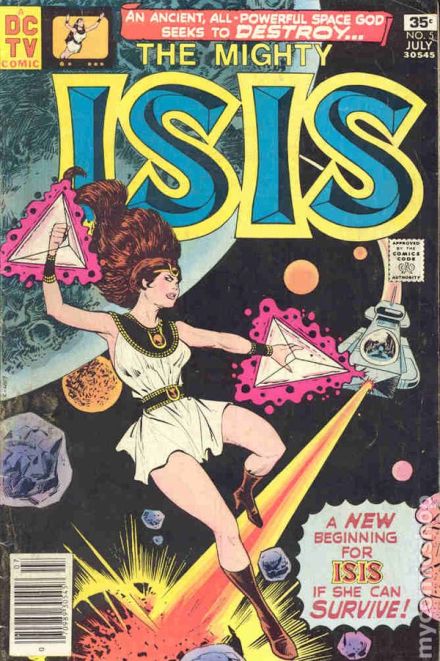
Isis #5. July 1977.

“Perilous Pyramid Power”

Cover Artists: Mike Vosburg & Vince Colletta

Writer: Jack C Harris; Penciler: Mike Vosburg

Inker: Vince Colletta; Editor: Dennis O’Neil; Managing Editor: Joe Orlando

logo

From DC Wikia: During a class field trip to the observatory, the astronomer spots a UFO in Earth orbit. Andrea slips into another room and becomes the Mighty Isis. When she reaches the alien spacecraft, she finds that the air is too thin, so she cannot utter a spell to stop it. She is stunned by a force beam and plummets back to Earth. She lands near the highway and, unconscious, changes back into Andrea.

As Rick starts to look for her, Andrea awakens and begins to doubt why she has to put up with the pressures of being, “The World’s Only Human Goddess”. Andrea comes back to her apartment where Rick is waiting for her. When he demands an explanation, she says that where she goes is none of his business. Rick then has to tell her she’s been laid off by the school board. After throwing Rick out of the apartment, Andrea decides that this is the last straw and says, “Oh Mighty Isis — FOREVER!”

The next day, Isis shows up at the high school to take Andrea’s place. She is appalled when the students ask her about the secrets of nature and she walks out.

Meanwhile up in orbit, the alien observes Isis as she flies back to Egypt. Isis brings forth her sacred dwelling from its hiding place, near the Great Pyramid at Giza. The alien, having landed nearby, declares that he is Aten, the Sun God of the Egyptian heretic, Akenaten. He tells Isis how thousands of years ago he was forced to land his damaged spacecraft in Egypt. He came to be worshipped by Akenaten and his Queen, Nefertiti. He taught them Astronomy and other sciences. The Egyptians taught him the powers of the Gods and their pyramids. When Akenaten died, Aten knew the people would soon revolt, so he buried a signal device to warn him if the Gods of Egypt returned and left for his home planet. The planet’s high council then banished Aten for interfering with Earth’s development. Now, to gain revenge on the council, he returns to use the power of the Great Pyramid; the same one that Isis receives her powers.

Isis tells Aten that she would destroy the pyramid before letting him use it, so Aten attacks Isis with a power bolt. She replies with a power bolt of her own, but Aten absorbs it and hurls it back at her. True to her word, Isis then destroys the source of her power, the Great Pyramid. Aten marvels at the Goddess who gave up her powers to stop his plans for revenge and leaves the Earth. Isis smiles a knowing smile, then uses Andrea’s knowledge of geometry to magically reshape the pyramid.

Back in the United States, Rick and Cindy discuss Andrea’s disappearance and Rick decides to go look for her. However, Andrea Thomas no longer exists. The Mighty Isis has returned — forever.

***

The letter column promises us a new direction: is Andrea really gone forever?

***

A great story – we see that Isis and Andrea really are two separate individuals who share the same space! At times in this comic it seems they disagree on issues – they might not even like each other!

***

About the author: Michael Curry is the author of the Brave & Bold: From Silent Knight to Dark Knight, The Day John F Kennedy Met the Beatles and the award-winning Abby’s Road, the Long and Winding Road to Adoption and How Facebook, Aquaman and Theodore Roosevelt Helped.  Check his website for more releases! Thanks for reading!


Shazam #29. June, 1977

“Ibac Meets Aunt Minerva”

Cover Artist: Kurt Shaffenberger

Writer: E. Nelson Bridwell, Penciler: Kurt Schaffenberger

Inker: Vince Colletta; Managing Editor: Joe Orlando

logo

Sivana kidnaps Stanley Printwhistle to convince him to help defeat Captain Marvel. Prince Lucifer appears (the one who gave Printwhistle his powers) and vows to make him stronger. Stanley says his magic word: “Ibac” (Ivan the Terrible, Borgia, Attila, Caligula) and turns into Ibac the Cursed! Sivana also brings in arch-criminal Aunt Minerva and instructs her and Ibac to distract Captain Marvel while he is busy blowing up Niagara Falls.

But Cap is busy doing charity work! So, when Ibac starts crushing cars and destroying lampposts, it is up to Uncle (Dudley) Marvel to stop him! Ibac runs from Uncle Marvel – well, it was actually from Minerva who rounded a corner and also gave chase…

… all the way to Niagara Falls! Ibac hides from Minerva in a barrel – which Sivana was to used for his bomb. Ibac begs Dudley for help and they both seek advice from Solomon.

Captain Marvel finds Dudley and Ibac. Thinking Dudley needs rescuing, he fights Ibac. Minerva finds them all, and Ibac reverts back to Printwhistle to stop Minerva’s advances (she’s not THAT desperate for a husband!). Cap catches Minerva and Sivana (who vows to escape and battle Marvel in Pittsburgh) and Printwhistle vows never to turn into Ibac again – to avoid Minerva’s romantic advances!

***

So far so good – the letters are positive for Cap’s new direction! The return of great Captain Marvel villains continues: This is Aunt Minerva’s first Bronze Age appearance (Shazam #12 was a reprint) and Ibac’s fourth!

***

About the author: Michael Curry is the author of the Brave & Bold: From Silent Knight to Dark Knight, The Day John F Kennedy Met the Beatles and the award-winning Abby’s Road, the Long and Winding Road to Adoption and How Facebook, Aquaman and Theodore Roosevelt Helped.  Check his website for more releases! Thanks for reading!


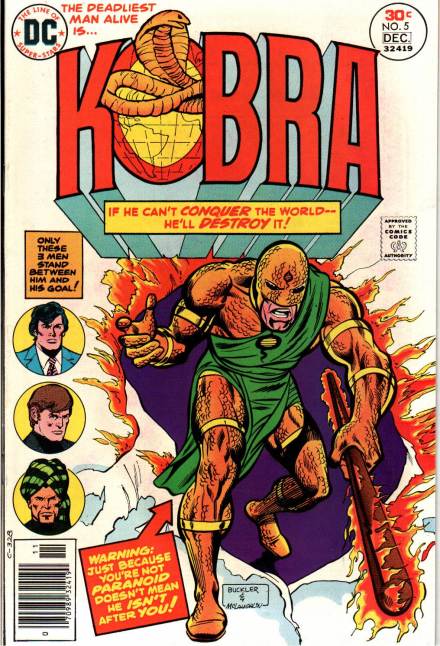
Kobra #5, December 1976

bronze-age

“The Eye of the Serpent”

Cover Artists: Rich Buckler & Frank McLaughlin

Writer: Martin Pasko

Penciler: Rich Buckler, Inker: Frank McLaughlin

Colorist: Carl Gafford, Letterer: Ben Oda

Story Editor: Paul Levitz, Managing Editor: Joe Orlando

I contributed this description to DC Wikia:

Kobra lands his ark in San Francisco. His surveillance overhears Jason Burr and Randu Singh back in New York discussing Melissa’s disappearance.

We then meet Jonny Double, a private eye from DC’s past who questions his current assignment – helping a secretary accused of murdering her lover/boss. His suspicions are aroused when police records confirm the murder, but there is no evidence of the existence of the boss … that and Double spots his client leaving a motel with her supposed victim.  Before he can trail them in his borrowed cab, he is flagged down by a fare. The customer leaves his valise; Double deduces it contains explosives – this WAS a set-up! Double escapes the destruction of his taxi. He finds remains of the case containing the bomb – marked with a strange cobra symbol…

Double returns to the office building at which he dropped off his murderous fare and is attacked by three hoods. Dispatching them, Double takes an elevator to a computer control room, where he gathers as much information as he can about the murder of Ricardo Perez and something called Operation: Chrysopylae … Through his contacts, Double learns of Perez, Horst Buchner and … Jason Burr. He calls Jason …

Double complains about the heavy traffic on the Golden Gate Bridge due to construction while on his way to testify to a trial. One of the construction workers has a cobra symbol on his hand-held radio.

Double hopes to meet Mack, his CIA contact, at a Chinatown theater, but finds Mack murdered. The killer fires on Double Meanwhile, Jason Burr cannot find a flight to Frisco. The booking agent helps find a flight on a smaller airline. She reaches for her walkie-talkie … which has a cobra symbol on it.

The gunman who killed Mack runs for it and Jonny Double gives chase. He also takes out two more Kobra hitmen before escaping onto a cable car. Kobra confronts Double directly and disengages the cable car, causing it to plummet downhill.

After several hours of delay, Jason finally boards his flight to San Francisco. The pilot’s hand-held radio is marked with a cobra-symbol.

Jonny Double jumps from the cable car just before it crashes, knocking him unconscious on the street; his limp form rises slowly in Kobra’s anti-gravity beam.

The engines of Jason Burr’s plane catch fire; it plummets into the Oregon wilderness.

Double awakes to find himself strapped to the Golden Gate Bridge. Kobra reveals his plan – he will destroy San Francisco with an earthquake! To use his words: “… an earthquake created by one of my devices … which is implanted in the beam to which you are tied. The mechanism is constructed of a material that disintegrates when it vibrates. The earthquake’s shock-waves will destroy the machine and no evidence of its ever having existed will survive! The device extends down through the support beams – into the bay – forming a needle which penetrates the earth’s crust! The needle will cause the San Andreas fault to shift! … The action of sunlight on the solar panel triggers the mechanism. At dawn – approximately 20 minutes from now – the bridge will be the first casualty. And you, Mr. Double, will be …. the second!”

Mwah-Ha-ha-ha-ha!!!!!

To be continued!

***

The letter page mentions a new approach and welcomes Rich Buckler as the new penciller. The magazine was saved by an “avalanche” of positive mail!

***

Jonny Double previously appeared in Showcase #78, Challengers of the Unknown #74 and Wonder Woman #199-203.

Note the cover date – December? Three months since issue #4. Was it scheduled for cancellation but given a reprieve with a new direction and new art team? The opening splash says “The story originally scheduled for this magazine will not appear.” Hyperbole? Did the story exist and crumbled to dust in someone’s file cabinet telling us of the “Panic on Pennsylvania Avenue” (as hyped on the final panel of issue #4)?

Regardless, the quality of this comic’s plot increased 1000%. DC hyped this issue and the next – these last three issues (and the “conclusion” in DC Special Series #1) were some of the best pulp-inspired comics ever published. Seriously. I love them, I f’ing love them!

***

About the author: Michael Curry is the author of the Brave & Bold: From Silent Knight to Dark Knight, The Day John F Kennedy Met the Beatles and the award-winning Abby’s Road, the Long and Winding Road to Adoption and How Facebook, Aquaman and Theodore Roosevelt Helped.  Check his website for more releases! Thanks for reading!

Super-Team Family #2: January 1976

Behold, the Bronze Age!

bronze-age

Creeper and Wildcat: “Showdown in San Lorenzo!”

Writer: Denny O’Neil, Artists: Ric Estrada & Bill Draut, Editor: Gerry Conway

Wildcat agrees to fight contender Japhy Shim for charity but also to drum up publicity for Shim and the resort paradise San Lorenzo. Jack Ryder of WHAM is there doing the play-by-play.

A gas grenade interrupts Wildcat’s interview. In the chaos, thugs grab Shim and Jack Ryder changes into the Creeper! Creeper’s old enemy Proteus is standing in the ring and Creeper attacks!

Creeper eventually realizes he is fighting Wildcat and not Proteus; deducing that Proteus used hypnotic gas to fool Creeper to get him and Wildcat out of the way. Creeper and Wildcat decide to rescue Shim together.

Their hunt leads them to San Lorenzo. General Pedro Lobo (who lost the recent national elections), demands to be put back into power or Shim will not fight the champion! The financial loss to San Lorenzo will bankrupt it! The readers discover Lobo is really Proteus using his power of disguise.

Wildcat agrees to take Shim’s place during the big fight.

Jack Ryder/Creeper spots one of the thug from the charity match and follows him. He discovers Proteus intends to off Shim by dropping him to the ring from the ceiling of the arena!

Creeper captures Proteus and his thugs, but not before Proteus hurls Shim from the rafters to the boxing ring. Wildcat, knocked flat by the champ, sees Shim and breaks his fall. Through the thugs’ confession, Creeper confronts the President of San Lorenzo – who orchestrated the entire kidnapping plan to consolidate his power and ensure his reelection!

***

The text feature gives brief origins for Wildcat and Creeper.

***

“Track of the Hook” (Batman and Deadman) from Brave and Bold #79 (September 1968)

Even in 1976 the Deadman saga from Strange Adventure was considered a comic book classic. Part of the saga was told in the pages of Brave & Bold. In fact, the two Batman/Deadman tales (of which this was the first) book-ended B&B’s greatest run: #s 79-86. Unabashed plug: for more check out my free ebook, Brave & Bold: from Silent Knight to Dark Knight).

***

Green Arrow: “Mystery of the Vanishing Arrows” from Adventure Comics #266 (November 1959).

Superman appears to help solve the mystery.

***

The Batman/Deadman story was not an odd choice to reprint in this issue, but it certainly overshadowed the “new” tale that fronted the magazine. This story got top billing on the cover.

So why “debut” the team-up format with (to be kind) C-grade heroes? Did they think a comic starring Wildcat and the Creeper would fly off the shelves? It even got second billing on the cover!

Why not team more popular heroes that did not have their own magazines – like Green Arrow or (at that time) Green Lantern? GA could have been deftly inserted over Wildcat (whose only appearances in the past twenty years were in the pages of Brave & Bold).

The story and art were good, but not great. The exercise was fun, but forgettable.

For a new team-up book, this is Strike Two (Strike One being the debut issue promising but not delivering no new material)…

***

About the author: Michael Curry is the author of the Brave & Bold: From Silent Knight to Dark Knight, The Day John F Kennedy Met the Beatles and the award-winning Abby’s Road, the Long and Winding Road to Adoption and How Facebook, Aquaman and Theodore Roosevelt Helped.  Check his website for more releases! Thanks for reading!