Brave & Bold #128 – a Bicentennial team-up!

DC SALUTES THE BICENTENNIAL

#19

The Brave and the Bold #128

B&B128

Published bi-monthly, thirty cents, July

Cover artist: Jim Aparo

Editor: Murray Boltinoff

             I beg your pardon in advance for this crass hype, but I’ve already done the work on this one.

            All information gleaned from my new ebook: The Brave and the Bold – from Silent Knight to Dark Knight, an index of the DC comic book. Available at Barnes & Noble, Kobo and Smashwords websites.
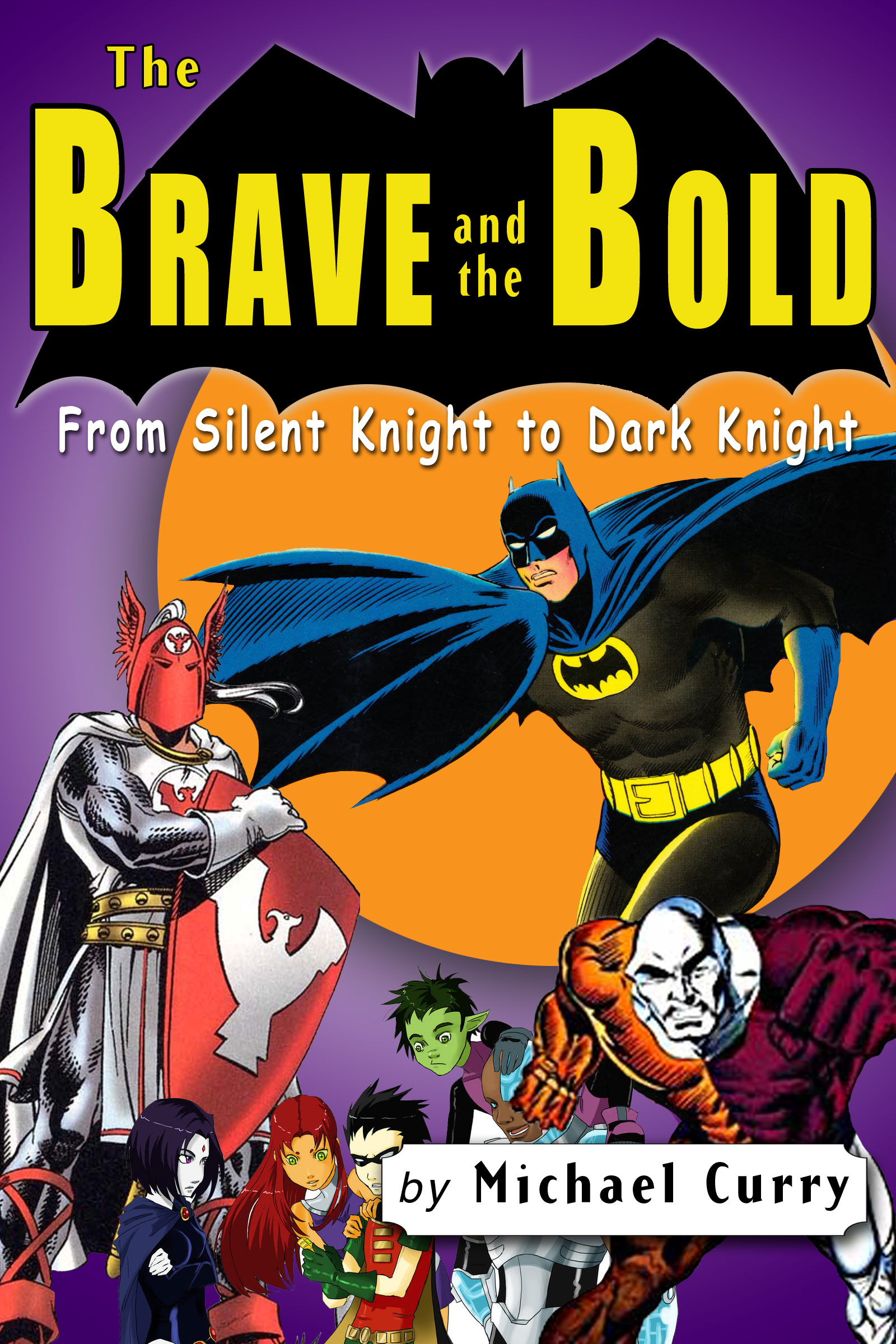
 brave-and-bold-cover

            The Barnes and Noble link is here: http://www.barnesandnoble.com/w/the-brave-and-the-bold-michael-curry/1120872264?ean=2940046443011

            The Brave & the Bold ran for 200 issues from 1955 through 1983. During its run, the best writers and artists in the business introduced us to comic book icons, some of which are still published today: the Justice League of America, the Teen Titans, the Suicide Squad, the Outsiders, The Viking Prince, the Silent Knight, Metamorpho, Katanna, Nemesis, Wonder Girl/Donna Troy, the silver age reboot of Hawkman, the revival of Green Arrow (he changed costumes and grew his beard). Those were just the good guys. Starro, Amazo, Bork, Copperhead, Shadow Thief, Matter Master and the Manhawks also made their villainous debut in B&B.

            It began with swashbuckling features such as the Viking Prince, Silent Knight, the Golden Gladiator and Robin Hood. Five years later it changed to a Showcase-style try-out anthology featuring the Justice League of America, the Suicide Squad, Hawkman and others. Next came something new in comics – regular team-ups of characters throughout the DC Universe: war comics characters, established superheroes, even a meeting of the various youthful sidekicks from the superhero line. The aforementioned Teen Titans were one of their many successes.

            By the time of the Batman TV show any comic graced with the Caped Crusader on the cover outsold any other comic, Brave and Bold included. It wasn’t long before the dollar signs in front of the eyes of National Comics’ owners and editors helped them decide to keep Batman as the permanent star of the comic.

            As a third Batman title, it was criticized even then for being out of the regular Batman continuity. Regular writer Bob Haney wrote in his own continuity bubble – he was even jokingly given his own “alternate earth” where events of his comics happened; events that were mentioned nowhere else in DC’s comics. Bruce Wayne had a brief stint as a Senator. Wayne adopted many more wards than just Dick Grayson (most of them were either killed or sent to prison as criminals…). Wayne’s chief financial rival was the femme fatale Ruby Ryder – who continuously planned the demise of Wayne Enterprises! And she appeared no where else – only in the pages of B&B.

      By its Bicentennial issue the comic was coasting on its once vast popularity.  Quoting From Silent Knight to Dark Knight: “B&B still had good sales* and loyal readers from years past (the sales drop was proportionate to the industry as a whole), and the marvelous Aparo art was always spectacular, giving B&B its distinct look. … It wasn’t the best comic book in terms of sales, story and originality, but it was still good!” Before this point in its history, B&B was at the very top. But once you are at the top, there is only one place to go.

       This issue in some ways reflected that problem…

This is one of the few Bicentennial issues I owned when they were published.

***

Death by the Ounce, starring Batman and Mister Miracle, Bob Haney ( w ), Jim Aparo (a).

            The Shah of Karkan, the world’s richest ruler, is landing in Gotham (of all placed) to sign a peace treaty. Gotham’s finest and Batman scour the city for spies and assassins. While searching a condemned sports arena, Batman sees a body being dumped from the rafters. He is beaten by the shadowed killers, only to discover it is Big Barda and Oberon – the body being “dumped” was Mr. Miracle practicing an escape for his big comeback.

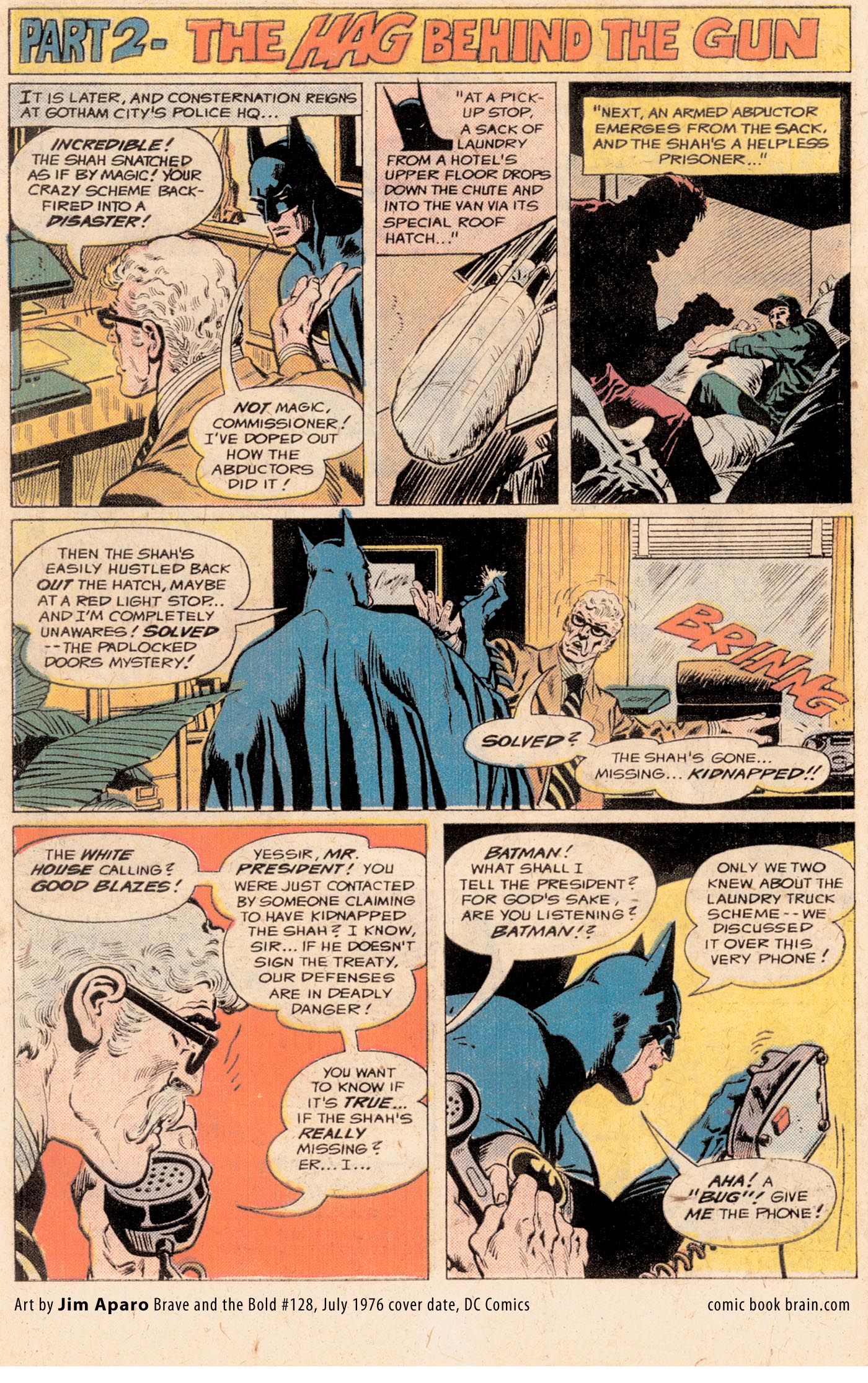
            Things get worse for Batman – his idea of smuggling the Shah in a laundry truck backfires and the Shah is kidnapped by someone called “Gigi”.
 b&b 128-2

(dig this beautiful Aparo art!)

            Via a tapped phone to the president, they fool the kidnappers into thinking they only have a decoy and the Shah is safe in his hotel room.

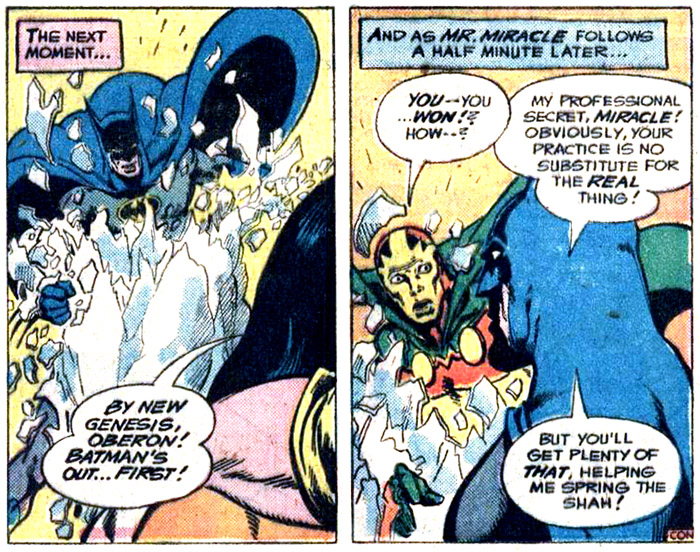
            Batman enlists the help of Mr. Miracle by besting him in an escape routine.
 b&b 128-3

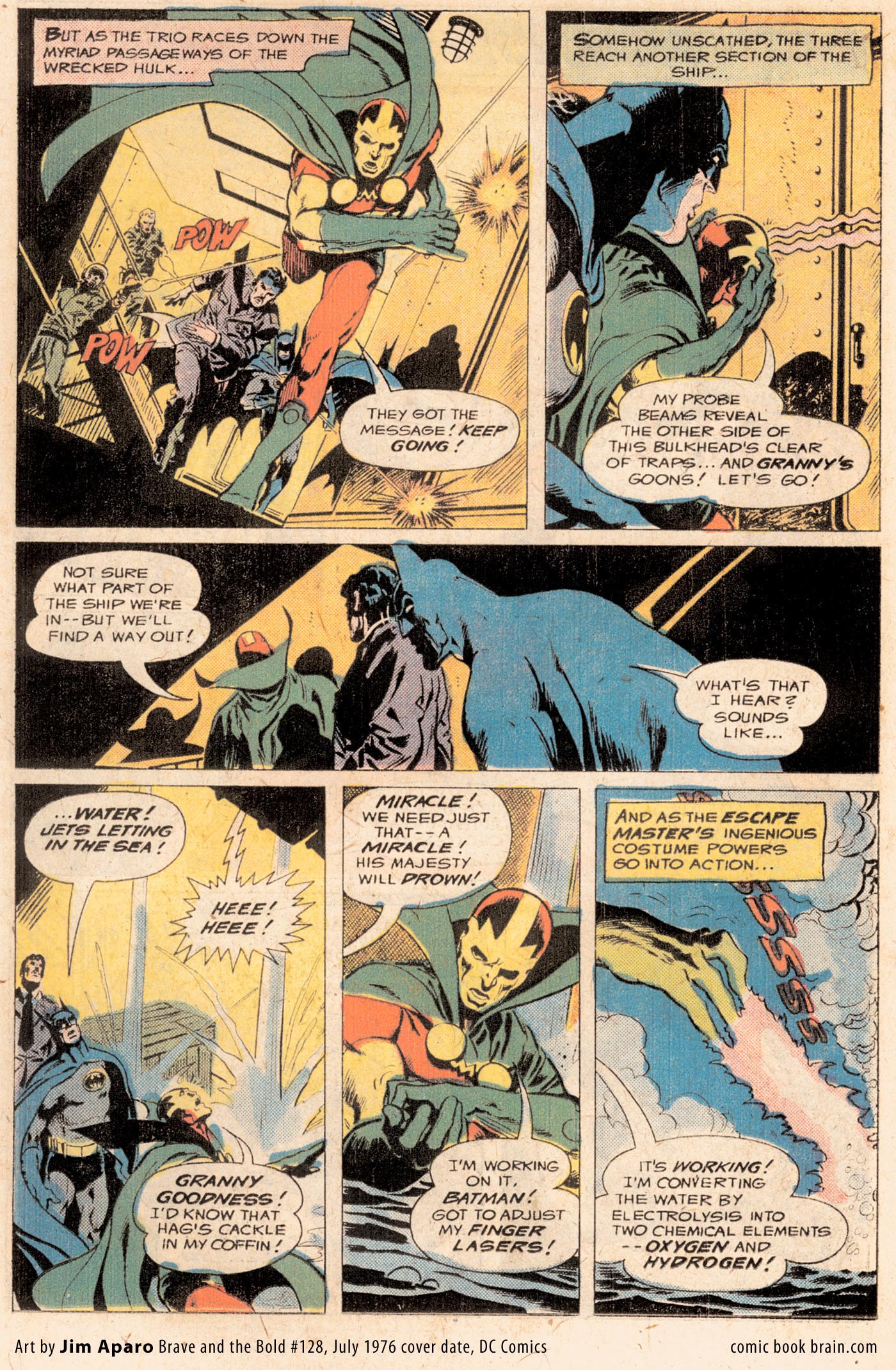
            Batman, disguised as the Shah, is kidnapped in his bed and taken to an underwater derelict redesigned as a headquarters for Mr. Miracle baddie Apokolypsian Granny Goodness (G.G. – “Gigi” – get it?). She agreed to kidnap the Shah in exchange for one ounce of a youth-restoring potion created by a Dr. Kiev.

            Mr. Miracle, hiding all this time under the bed on which the Shah/Batman slept (the kidnappers lifted the bed through he skylight while the “Shah” slept) frees Batman and the real Shah. They escape and Mr. Miracle detonates left-over gun powder in the derelict ship – destroying Granny Goodness once and for all … yeah right…
 b&b 128-1

            The second of only three appearances by Mister Miracle, and the only issue of B&B that gave even a small nod to Kirby’s Fourth World with an appearance by Granny Goodness (a bit out of character and out of place here, I think) and a few mentions of Darkseid.

            Using Granny Goodness seemed an afterthought – something to link with Mr. Miracle. Any super villain could have been used. Any non-powered villain could have been used. Come to think of it, any guest star could probably have been used. Anybody can hide in a bed – you don’t have to be the World’s Greatest Escape Artist to stow away. The Marx Brothers could stow away.

            Now that would have made a fun comic…

            See what I mean by coasting?


Brave and Bold Mailbag (letter column): comments mainly on issue #125 and as always peppered with team-up suggestions, edited and answered by Jack C Harris. B&B’s letter columns read more like movie posters than actual letters – “Fantastic,” says Bob Rozakis of Elmont, NY; “Fair,” Keith Griffin of Mobile, Ala. writes; “Blows!” Michael Curry of St. Louis, MO shouts. This way the editors can mention twenty or more letter-writers in one issue.

            David A. Jones of Horse Cave, KY (positive)

            Jim Dever of Philadelphia, PA, Robert Gustive of Grand Island, Neb., “Hackman” of Santa Martia, CA and Joe Peluso (he contributed five total letters to the comic during its series) all ask for Aparo to draw Flash in his regular series.  I would add Aparo should draw EVERY DC series. JCH says Aparo’s schedule will nor permit it.

            Burt Fowler of Jacksonville, FL thinks Aparo’s Barry Allen looks too much like Aquaman…

Jim Planack of Poughkeepsie, NY, Scott Taylor of Portland, TX, Jerry Rosen of New York, NY, Thomas Russon of Mt. Kisco, NY and John Jesse of Hobart, IN are mentioned.

***

Join me next time for DC’s Bicentennial issue #20: Blitzkrieg #4


Original Material copyright 2015 Michael Curry

Images used are copyright their respective holders and reproduced here under the “Fair Use” doctrine of 17 USC 106 & 106a for the purposes of criticism and comment.


* Here is a sample of sales figures published in DC’s annual “required by law” financial statement for 1976:

Brave and Bold: 151,000

Justice League of America: 193,000

World’s Finest: 132,185

Adventure Comics: 104,309

Superman: 216,122

Superman Family: 156,636
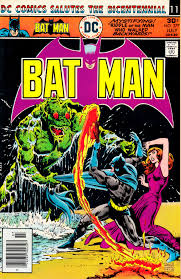
Batman #277: my Bicentennial blog continues!

DC SALUTES THE BICENTENNIAL

#11

Batman #277

277 cover

Published monthly, thirty cents, July

Cover artist: Ernie Chua (Chan)

Editor: Julius Schwartz

            Batman debuted in Detective Comics #27 cover dated May of 1939. The next spring in 1940 he was given his own comic. Batman #1 featured the debut of iconic villains the Joker and Catwoman. For the past 70+ years, renamings and renumberings notwithstanding, there has been a Batman comic book published ever since.

            By the time of the Bicentennial, though, Batman was suffering a lull in sales, if not popularity. The popularity of the television show in the 1960s turned the comic into a campy child-like (or even child-ish) version of the Caped Crusader.  The 1970s turned him back into the dark knight of vengence. The pendulum swung even farther in that direction in the 1980s and has yet to swing back to even a middle ground. That is in the future, however, on July 1976, Batman the character and the comic were somewhere in between…

***

            “The Riddle of the Man Who Walked Backwards”, David V. Reed ( w ), Ernie Chua and Tex Blaisdell (a)

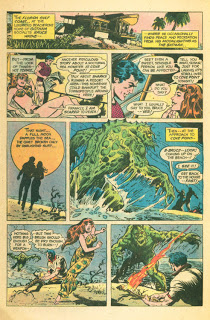
            A Black-Lagoon-ish sea creature terrorizes the sitizens of a Florida resort town. A vacationing Bruce Wayne and girlfriend investigate and fight off the beast near a cave on the beach.


277-1


            The next night Batman stakes out the cave and spots a man land his small boat on the beach and walk backwards into the cave – sweeping away his prints.


277 backwards


            Batman enters the cave and fights off the stranger only to be knocked out by a third man!

            Batman awakes … as Bruce Wayne! His assailant is dead and Wayne arrested. He escapes from the local jail and meets Alfred. Alfred had followed Batman to the cave and quickly removed his costume to protect his identity from the killer and the police!

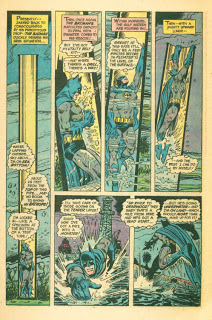
            Escaping, Batman – back in costume – searches the cave for clues and finds oily goo, that leads him to an off-shore oil rig. He overhears crooks talking about a “drop”. They catch Batman and throw him in a huge tube under the sea.


277 tube


            Escaping again, Batman goes to the new drop point discussed by the crooks in the rig – their old drop point, the cave, is now compromised. He fights the sea creature again – it is one of the crooks in disguise, and stops their drug-smuggling ring.

            Bruce Wayne is released and returns to Gotham City, where an unbelievable naive Jim Gordon believes that he and Batman being at the same Florida resort is entirely a coincidence…


Letters to the Batman, answered by the Answer Man himself, Bob Rozakis for issue #273. Rod McLaughlin of Ramsey, Mont. (positive), Peter Sanderson of New York, NY (guesses that David V Reed is another name for Julius Schwartz;  Rozakis debunks it), Fred Schneider of New York, NY, Mike White, Mackinaw, IL, & Michael D. Darguy of Royal, MI all contribute with positive comments.

***

            Join me for my next review of DC’s Bicentennial issue #12, a little magazine called PLOP!


Original Material copyright 2015 Michael Curry

Images used are copyright their respective holders and reproduced here under the “Fair Use” doctrine of 17 USC 106 & 106a for the purposes of criticism and comment.


Joker #8 – DC’s Bicentennial blog continues!

DC SALUTES THE BICENTENNIAL

#7

Joker #8

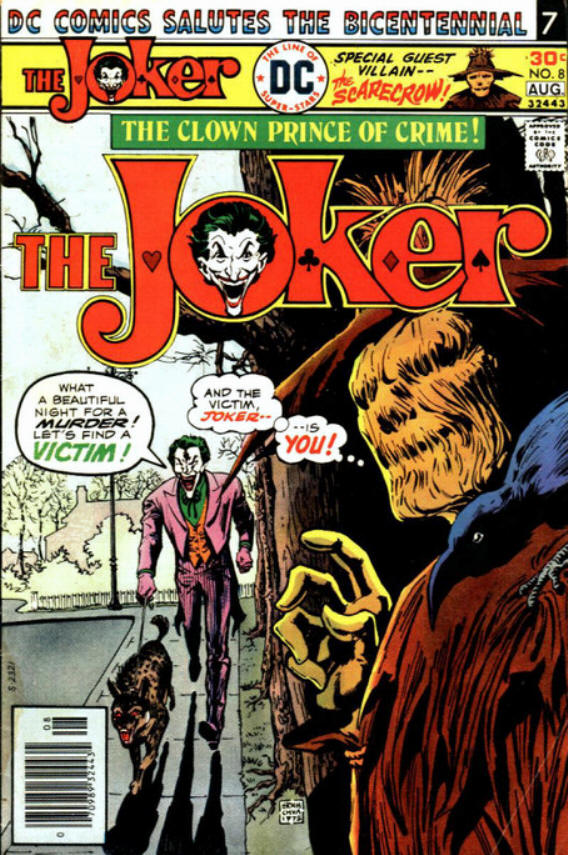
Joker 8

Published bi-monthly, thirty cents, August

Cover artist: Ernie Chua (he dates his covers 1975 throughout)

Editor: Julius Schwartz

            The Clown Prince of Crime first appeared in Batman #1 in 1940 (below)

 Joker first

 … and has since become the most successful and recognizable bad guy in comics; and only the most obstinant Marvel Zombie would disagree. Even my daughter at three years of age knew the Joker.

            Why then did it take until May of 1975 for the Joker to get his own book?  Villains were given their own titles even in the pulp era – the Mysterious Wu Fang and Dr. Yen Sin to name two; both of them spawned from the Fu Manchu novels of a century ago.

            Villains headlining comics were not unknown in the Golden Age – Yellow Claw for example. But not by the Silver Age … nothing. What happened in the interrim?

             The dearth of superhero titles is what happened. There weren’t that many mask-and-cape-dogooders headlining comics out there (although there were lots of other genres published in the 1950s) and therefore not much room to give a bad guy his own magazine. 

            The Comics Code Authority is what also happened. Although Marvel’s Doctor Doom had his own series in Astonishing Tales, giving a villain his own book was dicey stuff back then – especially if that villain was a homicidal maniac! To appease the code, Joker’s insanity was toned down and he was always captured or surrendered by book’s end.

             The Joker reflected his nemesis over the decades – from a dark criminal in the 1940s to a more gimmicky criminal in the 1950s. 

             By the time of the 1966 Batman TV show, well … 

joker


            I think the Joker is the one on the far right. It’s hard to tell; they are all wearing masks. 

            And just so you know, as of today? What is the arch nemesis to Batman’s violent-porn-brooding-sociopath-like? He’s carved his face off and stitched it back on. 

joker face'


             Maybe toning back his insanity wasn’t such a bad idea…

***


            If the Joker is/was so popular, why wasn’t the title a smash hit? Throughout the comic’s run (to issue #9 in October 1976) the art was wonderful – this Bicetnennial issue especially features the marvelous work of Irv Novick.

 scarecrow

            But the stories were uneven. That’s being kind.

            The first issue was a battle royale with Two Face. Excellent start. The silly issues afterwards likely didn’t even please the youngsters. The fight with Luthor is embarrassingly bad. Great issues, however, were peppered throughout – the fight with “Sherlock Holmes” and this Bicetennial issue are examples of how good the book could have been.

sherlock


            Joker #10 was plugged in the letter column of issue #9 and in the “Daily Planet” house ad featuring upcoming releases. The cover and some interiors are found on the internet if you do some searching. When this comic was cancelled, why didn’t they run it in Batman Family? Why not then continue the series in its sister title? Were sales that bad? Were the stories not taken seriously?

Joker10

The proposed cover for Joker #10 

            Would the comic have been more successful with a full-time hero opposing him? Robin or Batgirl?  Perhaps a non-caped hero like Jason Bard or someone else from the back issues of Detective? The comic could have been better and should have lasted a hundred issues!

            Wisely, Batman did not appear in the series, not even in a cameo. His image was peppered throughout – a face on a dartboard, for example.  In this issue Batman’s mug was on a safety net and a “bullet” that popped out of a toy gun.  Thus it is hard to count this as a “Batman” title.

            This was only one of four Bicentennial comics I owned at the time of their publication. It took me 38 years to finish the collection!

***

“The Scarecrow’s Fearsome Face-off”,

Elliot S! Maggin (w ), Irv Novick and Ted Blaisdell (a)

            Disguised as the Scarecrow, Joker steals a canister of fear formula from Star Labs in Metropolis. An angry Scarecrow frightens the location of Joker’s Ha-Hacienda from a former lackey. Joker discovers the Scarecrow’s impending visit and leaves a message to meet him at the local zoo. There, Joker uses the fear formula via a swarm of moths to scare away guards and patrons while he steals a hyena mural for his hide-out!

            The Scarecrow flies in and battle ensues! Scarecrow’s pet crow Nightmare pinches out Joker’s nose plugs while Scarecrow uses acid to release the gas from Joker’s canister. Gas billows out and Joker is on his knees, terrified. The Scarecrow giggles. Giggles? Yes, Joker switched the fear formula for his own laughing gas! His fear was feigned!

            Scarecrow is caught by the police and Joker makes it back safe and sound to his own padded cell at Arkham Asylum.

            Death toll (despite the attempts to assuage the Comics Code Authorities): two guards and one former henchman.


The Joker’s Ha-Hacienda: letters answered by the Joker himself, mostly for Joker #6! Likely Bob Rozakis answered the letters; these were mostly one-sentence questions and/or comments (“Who is Moriarty?”) answered in a snarky style (“I came home to find all my Batman comics burned, did you do it?” “No, if I did it, I would have burned them while you read them!”). Snarky, but not mean – answers were funny and the insults gentle. This is the Joker, not Murray Boltinoff!

            Mark Wannop of Camden, NJ (positive), Clifford Gerstman of New York, NY (positive), Michael D Dargay of Royal Oak, MI (negative), Fred Schneider, New York, NY (positive), Doil Ward of Ardmore TX (spotted a gaff), Adam Castro of New Rochelle, NY (a general question), Kirk Anderson of DeForest, WI (general questions), Mike White of Mackinaw, IL (negative) and “The Catwoman” challenging Joker to a battle in the next (and last) issue!

            Lots of mail for a failing comic? True, but the nature of the letter column – and answer by the Joker himself – likely had readers send in missives they otherwise would not have done!


 tpb

            This issue is reprinted (as is the entire series) in The Joker: Clown Prince of Crime trade paperback.

 ***

 Original Material copyright 2015 Michael Curry

 Images used are copyright their respective holders and reproduced here under the “Fair Use” doctrine of 17 USC 106 & 106a for the purposes of criticism and comment.


Justice League of America #132

DC SALUTES THE BICENTENNIAL

#6

Justice League of America #132

JLA_v.1_132

Published monthly, thirty cents, July

Cover artist: Ernie Chua (the date under his signature is 1975)

Editor: Julie Schwartz

            The Justice League of America debuted in late 1960 in The Brave and the Bold #28. After a three-issue try-out, they were awarded their own magazine a few months later. There has never been a month without at least some kind of version of the JLA published by National or DC – gaps as publicity stunts aside…

            Superman, Batman, Wonder Woman, Flash, Green Lantern, Martian Manhunter and Aquaman joined together to fight evil. 

            Gardner Fox and Mike Sekowsky wrote and drew the first several years of the series and the editorial reigns were held by Julie Schwartz.  This was Schwartz’s third try at reviving Golden Age characters – updating them for a modern audience.  The Flash and Green Lantern were rousing successes, so he tried again in the pages of Brave and Bold!  This time he brought back the old Justice Society of America: changed the name to something “more exciting” (someone once said a Society makes them sound like they got together to have tea) and updated the roster with the few heroes available at the time.  There was really no one else around: Adam Strange?  He’s good, but harder to work into a plot than Aquaman, so instead he was a frequent guest.  Roy Raymond TV Detective and Rex the Wonder Dog wouldn’t work, Challengers of the Unknown and the Blackhawks would make things too crowded.  Superboy would be impossible!  Batwoman? Robin?  Nah!  Green Arrow?  Oops, forgot about him – he’d join in Justice League of America #4.

            Eventually Fox and Sekowsky left the writing and art chores to others. Some issues were drawn by Neal Adams! But eventually the art was given to Dick Dillin.  Some fans dislike his art even to this day. I loved it! His are the images I have when I think of the Justice League – not Sekowski’s, not Lopez, not Heck’s, not Lee’s nor anyone who drew the later and latter versions of the group. Dillon is my  … Dylan.

            Plus in this particular issue he draws Supergirl! Oh, yummy …

supergirl

            This image is from the next issue, but still …

            Justice League of America was always a sales powerhouse for DC, with only a handful of magazines selling better (Superman for example). Its dip in sales during the 1970s was proportional with the industry as a whole.

            But even in the dip. Marvel was outdoing DC, in buzz if not in sales. Trying to catch up – something DC started in the mid-1960s and continues to this day – DC kept story threads going from issue to issue in some of their comics; Justice League of America included. This bicentennial issue is a fine example: it is part two of a two-part story, but the thread (Supergirl searching for her cousin) continues into the next issue; her search then becomes its own two-parter.

            As is the case with this magazine, the thread is interrupted by the annual JLA/JSA summer multi-parter. One of Justice League of America’s most unforgivable crime in this vein came in the next year with issues #139: Steve Englehart took over the writing chores for an incredible run of issues, but the annual JLA/JSA summer team-up stopped the story in its tracks. When it returned to the storyline (the Construct attacks during dissension amongst the JLAers), it had lost steam and Englehart was gone by issue #150 with his events and changes to the group’s dynamic forgotten.

***

            The inner front cover features a different Hostess ad from the Bicentennial comics so far. Instead of “Superman Saves the Earth”, we have “The Cornered Clown” starring the Joker!

            The annual sales statement “required” of every comic book published showed this magazine was selling 193,000 copies*. A fair amount for the time – and today as well!

            “The Beasts Who Fought Like Men”, Gerry Conway   ( w ), Dick Dillin & Frank McLaughlin (a).

             This story is continued from the previous issue. Returning from a mission in space, the Justice Leaguers not involved in the events of the previous issue are attacked over New York City by Queen Bee and her intelligent swarm! They dispatch the swarm, but Queen Bee escapes. Perhaps they can track her whereabouts in their satellite headquarters…

            … whence they are attacked by Green Lantern foe Sonar! Last issue, Sonar developed a “credit card” that would help him control humans as soon as they touch said card! Instead, the cards made humans as dumb as beasts and as a side effect made animals as intelligent as humans! Sonar defeats the JLA but runs away when nearly bested by Supergirl, who at that moment entered the satellite searching for Superman.

            The team splits up; half go to Washington DC to fight Sonar, who are then also attacked by animals from the Washington Zoo.  Sonar is caught after being nearly trampled by an elephant.

            The other half goes to Chicago to fight Queen Bee. During the fight they discover that although Sonar created the human/animal link, Queen Bee controls it! The two villains were unknowingly in cahoots! Queen Bee is also defeated.

            JLA members missing since the last issue are found – except for the Man of Steel!  Supergirl asks the JLA’s help in finding the missing Superman.


JLA Mailroom: featuring comments on issue #128; Bob Rozakis answered and commented on the letters. Paul Emrath of Milwaukee, WI (positive), Glenn Rowsam of Oakland, CA (positive – and praises Wonder Woman’s return to the group); DK Thomas of Brunswick, ME, Michael D Dargay of Royal Oak, MI, and Fred Schneider of New York, NY are given brief comments discussing an age-old question argued to this day: is Green Lantern’s oath necessary to recharge his ring?

  logo

            This issue is reprinted in the trade paperback Showcase Presents: Justice League of America Vol. 6.


* Here is a sample of sales figures published in DC’s annual “required by law” financial statement for 1976:

Brave and Bold: 151,000

Justice League of America: 193,000

World’s Finest: 132,185

Adventure Comics: 104,309

Superman: 216,122

Superman Family: 156,636


            Shameless plugs department: Some of the information in this blog is gleaned from my new ebook: The Brave and the Bold – from Silent Knight to Dark Knight, an index of the DC comic book. Available at Barnes & Noble, Kobo and Smashwords websites. It’s free, so get it now!

 brave-and-bold-cover

           The Barnes and Noble link is here: http://www.barnesandnoble.com/w/the-brave-and-the-bold-michael-curry/1120872264?ean=2940046443011


***


Original Material copyright 2015 Michael Curry


Images used are copyright their respective holders and reproduced here under the “Fair Use” doctrine of 17 USC 106 & 106a for the purposes of criticism and comment.


Batman Family #6: the debut of the Joker’s Daughter!

Continuing my reviews of the 33 comic books in which …

DC SALUTES THE BICENTENNIAL

#5

Batman Family #6

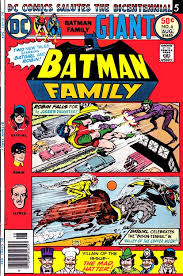
batfam5

Published bi-monthly, fifty cents, August

Cover artist: Ernie Chua

Editor: Julius Schwartz

            In 1975 DC launched three comics as companions to Superman Family (which had debuted the year before – an amalgam of the Lois Lane, Jimmy Olsen and Supergirl titles) – all with a “… Family” title. Tarzan Family, Superteam Family and Batman Family. They were “Giant” comics containing mostly reprints for fifty cents, with the lead story (and sometimes a second feature) as a new piece.

            The debut of Batman Family in October 1975 gave Batman (and it was rare the caped crusader did NOT appear inside the comic – especially in the reprints) five titles; tying with Superman (if you count the Legion comic) six if you count The Joker (and to be fair, if you count Superboy/Legion, you should count Joker).

            Superman had seven titles (counting Supergirl AND Superboy – I think they do, as they also had the Big Red “S” on the cover…) before the coalescing of three titles into Superman Family. Not counting their appearances in Justice League of America…  Superman appeared in Superman, Action Comics, World’s Finest Comics and Superman Family and I would also count Superboy starring the Legion of Superheroes, although that is a stretch. Batman appeared in Batman, Detective Comics, World’s Finest, Brave & Bold and now Batman Family. Not so unusual now, but in the early 1970s out-appearing Superman was quite a feat.  Even Spider-Man was only featured in two comics by this time (his third, Peter Parker, the Spectacular Spider-Man, debuted in December of 1976).

            Also, incredibly to today’s mind, the comic didn’t do well. Batman Family lasted only twenty bi-monthly issues until November 1978. It was by that time a Dollar Comic (and one of my favorites) when it “merged” with Detective Comics – another comic that at the time was such a poor seller it also faced cancellation (the mind reels). The Batman Family/Detective Comics dollar-comic merger lasted fifteen issues before reverting back to a single Batman tale plus an occasional back-up feature.

***

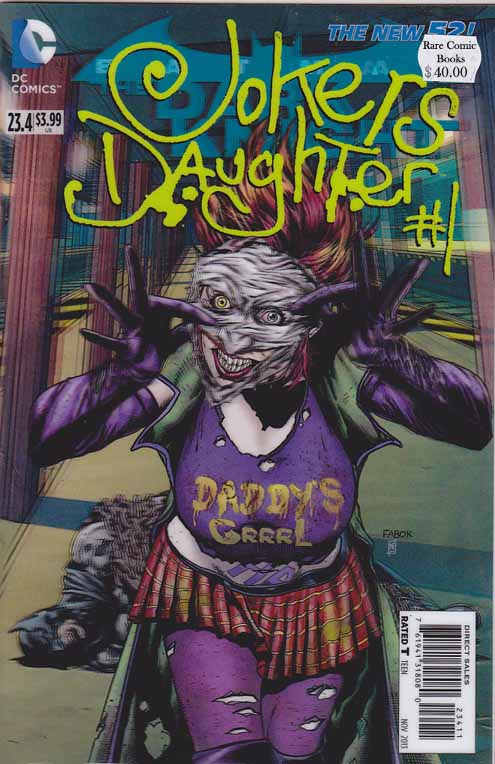
Jokers Daughter

            This is the most collectible of the 33 Bicentennial issues and the most expensive in the secondary markets. This issue was the debut of The Joker’s Daughter, or Duela Dent, who later changed her identity to Harlequin.

harlequin

Although not the same character, the idea morphed into the current Harley Quinn.

harley quinn

Thus this somewhat average entry from a warm August of 1976 turns out to be quite a sought-out collector’s item. It’s no Incredible Hulk #181, but for DC it’s highly prized…

***


“Valley of the Copper Moon”, Elliot S! Maggin ( w ), José Delbo (a), Vince Colletta (i).

            Batgirl is guest of honor at this year’s Matituk Indian Reservation’s 2nd Annual Prairie Festival and Indian Rodeo. Congress(wo)man – don’t call her a Congress”man”! – Barbara Gordon (Batgirl’s secret identity) arranges a junket with other Washington officials. They will soon be voting on whether to allow the Abraxas Syndicate to mine the Matituk’s land. Their guide, Jack Lightfoot, is in cahoots with Abraxas (we don’t find this out until the end) and secretly tries to kill Gordon, the single “nay” vote on the junket!


“The Joker’s Daughter”, Bob Rozakis ( w ), Irv Novick (a), Frank McLaughlin (i).

            Mystery novelist Christine Arindae dies. Upon her death a room sealed for 30 years is to be opened per her Last Will and Testament. The room is rumored to contain a manuscript of a novel: a mystery concluding with the death of her greatest character – Ulysses Pylate. The room is unsealed and is found to be empty! The Joker’s Daughter enters, takes credit for the theft and escapes! She and Robin fight again atop a pedestrian bridge, where Joker’s Daughter admits she did NOT steal the manuscript, although she wanted to! It was Arindae’s last mystery! Joker’s Daughter escapes – vowing to discover Robin’s secret identity!


“Robin’s Cast of Characters” – we are introduced to the supporting cast of the more recent Robin solo stories with brief biographies: Robin/Dick Grayson, Lori Elton, Chief Frank McDonald, Lieutenant Rick Tatem


“The Adventures of Alfred: In the Soup”, Don Cameron & Joe Samachson ( w ), Jerry Robinson (a), Jack Schiff (e), reprinted from Batman #32, December-January 1946

            Thieves steal cans of turtle soup from a factory! Alfred, on loan to Bruce Wayne’s friend, walks the dog of his new temporary “master”, suspects the soup company’s competitor and he and the dog lead the police to the competitor’s factory. Alfred claims the dog is part bloodhound and drags a sausage to the factory so it will sniff its way to the factory and affirm Alfred’s hunch. The unbelieving cops follow and Alfred is proved right! But still, everyone believes it was the dog’s nose, not Alfred’s intuition, that solved the crime!


“Curious Crime Capers”, Henry Boltinoff ( w )(a). One-page humorous cartoons based on true crimes!

  1. Dayton, KY: a prisoner escaped explaining he was claustrophobic and couldn’t stand being locked up!
  2. A Chicago man’s car was stolen! Description? A ’49 body on a ’30 chassis with a ’49 front bumper…
  3. Oklahoma City, OK: a man stole a wrecker – he needed to get a sedan he stole out of a ditch!
  4. Dallas, TX: a safecracker is caught red-handed – he’s going on trial the next day and needed some cash!


“The New Crimes of the Mad Hatter”, Dave Wood ( w ), Sheldon Moldoff (a), Jack Schiff (e), reprinted from Batman #161, February 1964

            The Mad Hatter escapes from prison and starts a crime spree!

            Disguised as a fireman, he robs a bank (“gas leak! Keep your money in my fire truck for safe keeping!” Bankers were idiots back then … ); as Robin Hood he steals $10,000.00 in golden arrows, as a chef at a dinner honoring royalty he steals the queen’s diamond tiara; wearing a bowler had, he robs the prize money from a bowling alley (that’s a stretch…). You see, the jurists who convicted him were a fireman, an amateur bowman, a bowling-alley owner, etc.

            But jurist #5 was a florist, a silk importer and a rabbit breeder … hmm … ah! All those are used by a magician! Sure enough … Mad Hatter disguises himself as a magician to steal diamonds from an exhibit. He tries to get away in a balloon, but Robin pops it with a … hat pin!


Letters of comment from Mike White of Mackinaw, IL (positive), Fred Schneider of New York, New York (positive – he enjoyed Robin finally complaining about how cold his skimp costume is…), Scott R. Taylor of Portland, TX (positive), and “reader roundups” – short clips of letters from Jeff Sporn of Bethesda, MD, Mark McIntyre of Atlanta, GA, The Mighty Hackman of Santa Maria, CA and Tom Weyandt of Broadtop City, PA; all mostly asking for Batgirl/Robin solo stories alternating with team-ups.

Up next: Justice League of America #132

***

Original Material copyright 2015 Michael Curry


Images used are copyright their respective holders and reproduced here under the “Fair Use” doctrine of 17 USC 106 & 106a for the purposes of criticism and comment.