Iron Man: and Call my Killer … Modok! Marvel Novel series #6

#6: Iron Man: and Call my Killer … Modok! by William Rotsler.

The author is a four-time Hugo Award winner for his art and the author of many Star Trek novels as well as the author of the novelizations of the movies Sinbad and the Eye of the Tiger and Futureworld. He died in 1997.

By now the cover artist signs his work: Bob Larkin, cover artist for many Marvel magazines.

The book is “packaged and edited by Len Wein and Marv Wolfman.”  Len Wein is the co-creator of DC’s Swamp Thing and Marvel’s Wolverine as well as joining him with Nightcrawler, Storm and Colossus as the All-New X-Men. Marv Wolfman is known for his excellent run on Tomb of Dracula. Within a few years of this novel he would write for one of the best comics ever created – Night Force – and co-create the New Teen Titans

Released May 1, 1979; the book is 189 pages long, although the story begins at page 9.

Gratman: Evanier Electronics is mentioned as a business. Mark Evanier? He had no connection to Iron Man and at the time of this paperback, he worked mainly with DC Comics. However, the next book, #7’s Dr. Strange, Master of the Mystic Arts: Nightmare is dedicated to him, so it is likely.

***

AIM (Advanced Idea Mechanics, a science-based terrorist group) attacks Tony Stark during a college lecture. Stark, as Iron Man, fights them off successfully but still sustains some harm to his already-damaged heart. Cue origin recap.

One of the sergeants in charge of the failed kidnapping faced AIM’s mysterious leader (we comic book fans – and those who remember the title of the book – have a pretty solid idea who the leader is). The kidnapping having failed, the leader thinks up another cunning plan – he shall create an army of Iron Man suits!

He activates two of his sleeper agents in Stark International to create a diversion to successfully steal the Iron Man armor blueprints.

Modok tries to sell the blueprints to the highest bidder, but Stark outmaneuvers Modok by auctioning off the Iron Man suit directly. At auction, it is bought by an Arabic businessman. Modok kidnaps the businessman and his suit.

Surprise! The suit is really Iron Man himself! He is defeated by Modok and unmasked as Tony Stark.  Stark is then forced to create a new Iron Man suit for Modok’s #1 henchman.

Meanwhile, Happy and Nick Fury & Shield find Modok’s hiding place and attack. Iron Man and the henchman in the new suit duke it out. Ol’ Shellhead then sets his sights squarely on Modok!

***

The author does an excellent job of juggling the superhero action and the “civilian” moments of Tony Stark, Happy Hogan, Pepper Potts and employees of Stark International – we even read moments with the AIM sleepers and soldiers. It makes the novel more … grown up.

It would have made a nice juxtaposition to show Stark creating the original Iron Man suit in Viet Nam with the new suit he was creating for Modok. It would have put the origin flashback near the end of the book, which may have been a drawback being too close to the big finish.

Speaking of that, twenty pages is spent recapping Iron Man’s origins in the jungles of Viet Nam. It is excellently done! The author tells us how Tony met and hired Happy Hogan in a later 15-page flashback. Modok’s origin takes about five pages. More than 20% of the novel is flashback.

Interestingly, I tried to listen to Tony Stark/Iron Man speak in Robert Downey Jr’s voice but could not. Despite his (deservedly) owning the role in the recent spate of movies, and being able to hear his voice in the recent comic books and animated TV shows (where such an imitation is likely done intentionally), I can’t hear Downey speak these lines. Only when he is Modok’s captive and Stark’s dialogue is more smart-alecky and defiant does the current version of Iron Man seep through.

And the author does a wonderful job, despite the sometimes comic-booky dialogue. It does not happen often, but when it does, it is jarring; especially considering how wonderfully the rest of the dialogue is written.

Examples: “Iron Man swears it!” and (I am not kidding you) “I, Modok, knew at once how he hoped to trick me. Me, Modok, he tried to trick!”

Yoda-speak this reads like does…


Original Material Copyright 2016 Michael Curry


Characters mentioned are copyright their respective holders. Thanks to Marvel Comics and Pocket Books for the use of their images. Cover image was taken by the author.

I also thank the original creators of all characters mentioned, whether or not they have been properly compensated or credited.
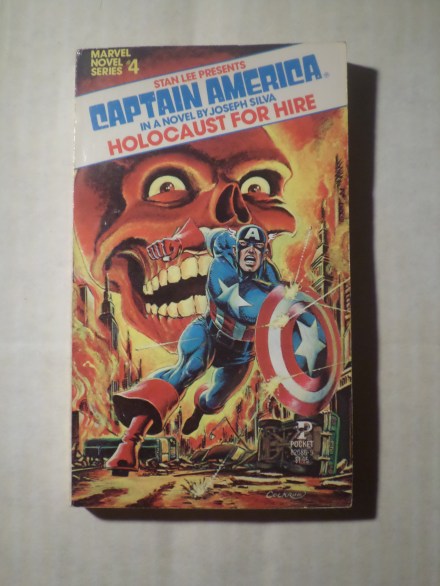
 

Captain America: Holocaust for Hire!!

#4: Captain America: Holocaust for Hire by Joseph Silva.

Released April 1, 1979

The book is 191 pages long, although the story begins at page 9.

Joseph Silva is a pseudonym for Ron Goulart. From Wikipedia: “Ron Goulart (born January 13, 1933) is an American popular culture historian and mystery, fantasy and science fiction author. … (of) … many novelizations and other routine work under various pseudonyms: Kenneth Robeson (pen name), Con Steffanson (pen name), Chad Calhoun, R.T. Edwards, Ian R. Jamieson, Josephine Kains, Jillian Kearny, Howard Lee, Zeke Masters, Frank S. Shawn, and … Joseph Silva.”  He also wrote (as Silva) #2 Stalker from the Stars.

The cover artist is Dave Cockrum, a comic book artist known for his legendary stints on Legion of Super-heroes and X-Men.

The book is “packaged and edited by Len Wein and Marv Wolfman.”  Len Wein is the co-creator of DC’s Swamp Thing and Marvel’s Wolverine as well as joining him with Nightcrawler, Storm and Colossus as the All-New X-Men. Marv Wolfman is known for his excellent run on Tomb of Dracula. Within a few years of this novel he would write for one of the best comics ever created – Night Force – and co-create the New Teen Titans

Gratmens: character Jake Sheridan mentions “great teams” and includes Rodgers & Hart, Laurel & Hardy and Simon & Kirby. Joe Simon and Jack Kirby created Captain America.


An African city is destroyed by an earthquake. We learn that it MAY have been a sonic device created by Dr. Gregory Crandall, a sonic scientist who has disappeared. We meet Dr. Crandall and his daughter being held hostage in a wintry villa.

Captain America, meanwhile, batters his way through New York’s underworld to find the doctor.

Also meanwhile, a Nazi (no spoilers, it is obvious with his mentions of a Fourth Reich and a Master Race), who we met in Chapter 1, was responsible for the African earthquake, as well as others throughout the world; makes a deal with a Texas millionaire.

Captain America reports to Nick Fury and Shield before heading to the chalet in which Dr. Crandall may be kept. They suspect the involvement of Cap’s old enemy – the Red Skull

Cap, Fury and Shield fight off the Skull’s forces in the chalet before the villain can escape with Dr. Crandall in tow. Some detective work leads our heroes on separate paths to Skull Island in the Pacific, but not before Nick Fury and the two reporters also investigating the story are kidnapped!

Can Captain America make it to Skull Island and rescue all the hostages before the Red Skull can use his sonic machine to destroy the world?


By page 45 we flash back to World War II and a ten-page origin story for Captain America.  A little further along we learn the origin of the Red Skull. More pages are spent on the Skull’s story than Cap’s. Perhaps the average reader would not know about how the Red Skull became the Red Skull and survived after WWII. True, it showed the depth of evil within the Skull, but was not integral to the plot (compared to Doctor Doom’s thorough origin story in book #5 Fantastic Four Doomsday).

Nor is there much made of how Captain America still exists in the present day (he was frozen in ice near the end of WWII) and is only mentioned in a few lines. Perhaps the writer thought that was not as important or that most readers would KNOW that fact, but NOT know his origins.

Caroline’s escape from the chalet was VERY well-paced and exciting! Kudos to Silva!

Cap never takes off his mask – we never see anything about Steve Rogers and his private life. This echoes the comics at the time, too…

This book is the most pulpy of the Marvel Novel Series published to date. Perhaps it is the involvement of neo-Nazis wanting to conquer the world and our masked hero with no real civilian identity. Regardless, it was a fun read!

But something nagged me while reading the novel: a scientist was captured, our hero befriends the daughter of the scientist and, with the help of original characters and his frenemy from the comic book series (in this case, Nick Fury), confront and win over the mad dictator before he can use the scientist’s invention to rule (or if not rule, destroy) the world!  Sound familiar? It was also the plot to Novel #3: The Incredible Hulk: Cry of the Beast!

Red Skull discussing New York City:  “To crush them all beneath brick and stone and concrete, to send their steel and glass towers crashing down on them … “.  Well, reading THAT was uncomfortable…


Original Material Copyright 2016 Michael Curry


Characters mentioned are copyright their respective holders. Thanks to Marvel Comics and Pocket Books for the use of their images. Cover image was taken by the author.

I also thank the original creators of all characters mentioned, whether or not they have been properly compensated or credited.
The Incredible Hulk: Stalker from the Stars – Marvel Novel Series #2

The Incredible Hulk: Stalker from the Stars by Len Wein with Marv Wolfman and Joseph Silva. Released January 1, 1978. Really? So says Amazon; if so this paperback was published before Spider-Man’s Mayhem in Manhattan, which has always been listed as #1. …

Len Wein is known for co-creating DC’s Swamp Thing and Marvel’s Wolverine and joining him with Nightcrawler, Storm and Colossus as the All-New X-Men. Marv Wolfman is known for his excellent run on Tomb of Dracula. Within a few years of this novel he would write for one of the best comics ever created – Night Force – and co-create the New Teen Titans.

Joseph Silva is a pseudonym for Ron Goulart. From Wikipedia: “Ron Goulart (born January 13, 1933) is an American popular culture historian and mystery, fantasy and science fiction author. … (of) … many novelizations and other routine work under various pseudonyms: Kenneth Robeson (pen name), Con Steffanson (pen name), Chad Calhoun, R.T. Edwards, Ian R. Jamieson, Josephine Kains, Jillian Kearny, Howard Lee, Zeke Masters, Frank S. Shawn, and … Joseph Silva.”

No mention as to who does the interior art (pictures of the Hulk at the beginning of each chapter) – it is from various Marvel comics, house ads, etc. The internet says the cover is by Bob Larkin.

The book is 174 pages long, although the story begins at page 9.

For the first few pages there is a brief introduction by Stan Lee. He hypes the popularity of the Hulk TV show and explains the characters Rick Jones and Thunderbolt Ross. Both characters are integral to the comic book but neither of whom appear on the television show.

I never liked Thunderbolt Ross: in this novel, as in the comics, Ross is so two-dimensional he makes J Jonah Jameson look like Hamlet. A little goes a long way. WARNING: playing a drinking game where you take a shot every time Ross says “halfwit” may lead to alcohol poisoning.  It is to Thunderbolt Ross was “dolt” and “clod” were to (Tomb of) Dracula. It’s not so bad, but if the book is read in one sitting (and that is easy to do – in a good way, like a great old pulp magazine) its use is frequent.

Gratmens: Buscemas café and Leiber garage are place-names in the book, named for Sal Buscema who drew the Hulk for ten years (it could be for his brother John, who drew the Hulk for only a few issues, but my money is on Sal) and Larry Leiber, Stan Lee’s younger brother who at that time was penciling the Hulk newspaper strip.

The origin of how Bruce Banner became the Hulk is given its own chapter early in the novel. Compare that to the two-page origin of Book #1 starring Spider-Man. This makes some sense – Hulk’s origins are less-known to the general public and varied greatly from the Bill Bixby/Lou Ferrigno-starring television show.


Rick Jones wanders into the town of Crater Falls looking for Dr. Rudolph Stein, a contemporary of Bruce Banner who is also known for his research into gamma radiation.  Rick learns Dr. Stein is missing – he wanders the woods and finds the crater from which the town founded its name.

While searching the woods Rick finds a murder victim bathed in green gamma radiation (the identity of the body is a SPOILER and won’t be revealed here). He calls the local sheriff but the body disappears before anyone else can see it.

Also, at night the entire citizenship of Crater Falls walk zombie-like from the town into the woods. Rick’s attempts to find out what is going on is rewarded with a thump on the head (at first) and then by his disappearing – just like Dr. Stein!

Meanwhile, Bruce Banner is hunted by General Thunderbolt Ross – who finally manages to capture the Hulk!

Banner escapes Gamma Base when he hears of Rick’s troubles. Rick’s phone went dead during a conversation with Ross and Rick has not been seen nor heard since. Banner goes to Crater Falls, meets the same citizens Rick did, learns of Stein’s disappearance and investigates.

As the title suggests, our green goliath comes in contact with an alien menace that can control the minds of puny humans.

The Hulk and his friends must find a way to stop the evil alien Sh-mballah while also fighting off the hypnotized citizens of Crater Falls!


By the time this paperback came out the Incredible Hulk TV show was in full vigor. The book was an obvious attempt to cash in on the success of the show. That’s not a criticism.

The story leans more toward the comic books – the regular comic book cast is present and the Hulk fights off super baddies with onomatopoetic names (“Whence Comes Vrloom!”).  It’s no spoiler to say Hulk fights off a Cthulhu-esque alien.

And by the way, an alien buried beneath a small town who mentally manipulates the citizenry pre-dates Stephen King’s Tommyknockers by nine years. To be fair, though, that science fiction trope has been around for decades.

Should I ever meet Len Wein or Marv Wolfman I would ask them about how they collaborated – did they each do a different section (“You do Rick Jones and Crater Falls and I’ll do the Hulk/Gamma Base stuff”) or did they Lennon-McCartney with their typewriters back-to-back telling each other their ideas?

A great read – very comic booky. Even moreso than the previous Spider-Man novel which was in itself an excellent read. A comic book in prose, which is the whole idea of the series, isn’t it? This story even has sound effects!  Chuff! Karash! Kaslam!


Original Material Copyright 2016 Michael Curry


Characters mentioned are copyright their respective holders. Thanks to Marvel Comics and Pocket Books for the use of their images. Cover image was taken by the author.

I also thank the original creators of all characters mentioned, whether or not they have been properly compensated or credited.

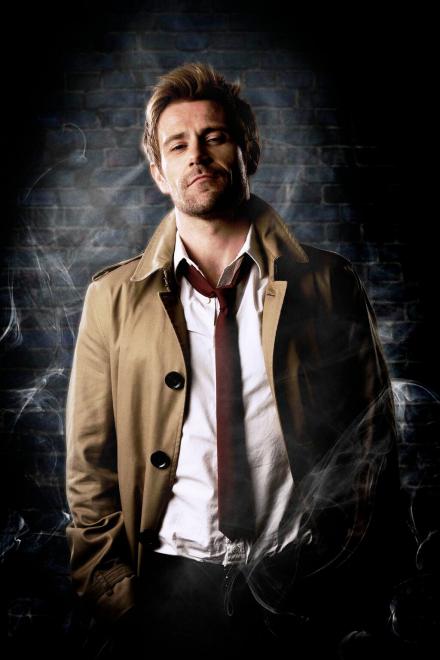
Constantine returns!! (to CW Seed)

Excellent news:

Read my original review of the Constantine.

Read the original article reprinted below: http://comicbook.com/2017/01/08/constantine-picked-up-by-the-cw/

The CW has just announced it has picked up Constantine as an animated series for CW Seed during its Television Critics Association panel.

The show will feature Matt Ryan, who starred as the title character in the fan favorite but short-lived NBC show.

Fans can expect the episodes to be 10 minute in length similar to the Vixen series that ran on CW Seed. Right now, episode count is expected to be either five or six. The show, like Vixen, will exist in the Arrow-verse which consists of Arrow, Flash, Legends Of Tomorrow & Supergirl.

While fans were expecting another live-action cameo from the character, they will be more than pleased with this. Back at New York Comic Con, Ryan told our own Russ Burlingame that while he was at the time doing the voice for Constantine in Justice League Dark, he’s learned “not to rule anything out.” He said that in terms of an Arrow return, he’s open to it because: “I love the character.”

Both Constantine and Arrow, like all of DC Comics-inspired TV series, are produced by Warner Bros. TV.


Article written by James Viscardi- 01/08/2017.

The Marvel Novel Series

Stan Lee always wanted comic books to be more than just “kiddie” books. He strived to make them more acceptable to teens and adults. Over the years he (and others who worked in the genre) succeeded.

But back in the late 1970s, Marvel had only made its way into the magazine market.

In the mid-to-late 1970s Marvel published books reprinting the origins of various Marvel heroes and villains – Origins of Marvel Comics, Son of Origins, Bring on the Bad Guys, and The Superhero Women – with Lee providing the prose introduction to the featured superheroes.

Marvel also launched a successful series of reprint books in paperback through Pocket Books. Each book contained about six issues (more if the stories were from the various anthologies) of the original run of Fantastic Four, Spider-Man (three volumes), Conan (six volumes) and books devoted to the early tales of the Hulk, Dr. Strange, Captain America and Spider-Woman.

Finally, starting in 1978, Pocket Books released prose novels starring various Marvel heroes.

Bantam Books published two novels in the late 1960s based on Marvel characters: The Avengers Battle the Earth Wrecker by Otto Binder (1967) and Captain America: The Great Gold Steal by Ted White (1968).

Eleven years later, Marvel once again hoped to bring comics into the genre of “true” literature. The books were aimed at the Young Adult audience so craved in today’s market. The first two of the eleven books were not numbered; perhaps they were the only ones planned until they proved successful. They were printed by Simon & Schuster’s under their Pocket Books imprint:

#1: The Amazing Spider-Man: Mayhem in Manhattan by Len Wein and Marv Wolfman

#2: The Incredible Hulk: Stalker from the Stars by Len Wein with Marv Wolfman and Joseph Silva

#3: The Incredible Hulk: Cry of the Beast by Richard S. Meyers

#4: Captain America: Holocaust for Hire by Joseph Silva

#5: The Fantastic Four: Doomsday by Marv Wolfman

#6: The Invincible Iron Man: And Call My Killer…Modok! by William Rotsler

#7: Dr. Strange, Master of the Mystic Arts: Nightmare by William Rotsler

#8: The Amazing Spider-Man: Crime Campaign by Paul Kupperberg

#9: Stan Lee Presents: the Marvel Superheroes edited by Len Wein and Marv Wolfman

#10: The Avengers: The Man Who Stole Tomorrow by David Michelinie

#11: The Hulk and Spider-Man: Murdermoon by Paul Kupperberg

The first two books were not hyped by Marvel and only appeared in a full-page ad along with other comic book-related wares by an independent mail-order business. The rest of the series (when it became a series with #3), were mentioned as an item in Marvel’s Bullpen Bulletins. Had Marvel pushed the books with their house ads, the series may have been more successful and more books published.

I will spend the next few blogs reviewing the books. They are over-all well-done and, although aimed at the pre-teen to early-teen audience, are exciting and hold the attention of adults; particularly Bronze Age comic book fans like me!

I hope you enjoy it! If you have read these almost-40-year old books, I hope it brings back good memories. If it piques your interest, the books pop up frequently on ebay and, if you are not too picky about the condition, cost about the same as a current paperback.


Original Material Copyright 2016 Michael Curry


Characters mentioned are copyright their respective holders. Thanks to Marvel Comics and Pocket Books for the use of their images. Cover image was photographed by the author.

I also thank the original creators of all characters mentioned, whether or not they have been properly compensated or credited.


GI Combat #192: More bicentennial banner blogging

DC SALUTES THE BICENTENNIAL

#27

GI Combat #192

GI_Combat_Vol_1_192

Published monthly, thirty cents, July

Cover artist: Luis Dominguez

Editor: Murray Boltinoff, Asst. Ed: Jack C. Harris

            GI Combat was another comic acquired by DC when they bought out Quality Comics. I wrote this in my reviews of the Bicentennial issues of Blackhawk and Freedom Fighters … Quality Comics was a successful comic book company during the medium’s golden age. It introduced Kid Eternity, the Blackhawks, the much-lauded Spirit and Plastic Man to comics. The company closed shop in the mid-1950s and the catalogue of characters was bought by DC/National. They continued only four of Quality’s titles: GI Combat, Plastic Man (although DC would not publish a Plastic Man comic until the 1960s), Blackhawk, and Heart Throbs – all but the latter were still being published by the time of the Bicentennial (Plastic Man would get much more popular in the coming decades).

            GI Combat debuted in October 1952 featuring US soldiers fighting godless commies across the globe. It later featured stories set during World War Two. The first DC issue was #44 (January 1957).

            It was a standard anthology with standard war stories, but eventually a starring feature took over as lead.  The Haunted Tank debuted in issue #87 (May 1961) and continued as the main feature until they shared cover billing with The Mercenaries in the comic’s later issues.

Haunted_Tank_001


            Confederate General J.E.B Stuart’s ghost is sent to guard his descendant and name-sake Jeb Stuart during his battles on the European front in World War II. In one story I remember fondly, Stuart’s tank is destroyed and replaced by a Sherman. “Sherman!” The ghostly Stuart was aghast that his descendant would use a tank named after a Union general! A great story, but I cannot find the specific issue.

            With issue #201 (May 1977) GI Combat became a Dollar Comic with increased page count and all-new stories such as Tales of the OSS. It returned to “normal” size with # 282 (March 1986) – making it one of the last Dollar Comics. By now the Haunted Tank was occasionally replaced as the lead feature by The Mercenaries, a fighting troupe set in modern times. The last issue was #288 (March 1987). It was the second-most successful war comic DC produced next to Sgt. Rock.

            The comic is also notable for being the debut vehicle for The Losers, who moved to their own starring feature in Our Fighting Forces. “The Rock”, a one-shot character, arguably the prototype of Sgt. Rock, had his one appearance in a 1959 issue.

            GI Combat was revived as part of the “New 52” line, but was cancelled after seven issues. The Haunted Tank was also revived with Stuart, the WWII descendant, haunting his granddaughter in modern times. A few other revivals also proved unsuccessful.

***

“The General Has Two Faces”, Bob Kanigher ( w ), Sam Glanzman (a)

            The Haunted Tank crew is tasked with killing Field Marshall Erwin Rommel. A squadron of tanks and planes would be expected and fought off, but a single recon tank might make it through.

            As the tank crosses a bridge, it is attacked by two fighters. Jeb is severely injured, leaving Gus to take command and stop the fighter planes. He sees JEB Stuart, who warns him of dangers to come. The other crewmen, Rick and Slim, think Gus is imagining things just like their commander.  They destroy the Krauts and cross the bridge.

            But the tank’s treads bust and they have to hoof it with their injured commander (note the change to a WWII-like vernacular…). They are met by the teenage students of an all-girl school at the Van Maltz castle, led by its Baroness. Helga is angry that the Baroness would allow verdamt Amerikaische soldats into their home. She is locked away until she calms down and the Haunted Tank crew are fed and healed. Jeb and the Baroness share a kiss.

            Someone releases Helga, who immediately gets “help”. The next morning Helga sits in the lead tank of a squadron attacking the school. Sitting beside her in command – Rommel!

            Jeb shoots at the tanks with a crossbow using dynamite sticks instead of bolts – blasting the tanks to smithereens! Rommel’s lead tank makes it to the drawbridge where a mysterious figure is cranking the handle to lift the wooden bridge. Rommel shoot and kills the figure, but too late! The tank falls into the moat – killing all. Jeb discovers the mysterious figure was the Baroness. She saved her enemies from her own people.

            Later the crew discovers it was NOT Rommel in the tank at all, but a double instead.

***

ww-oss

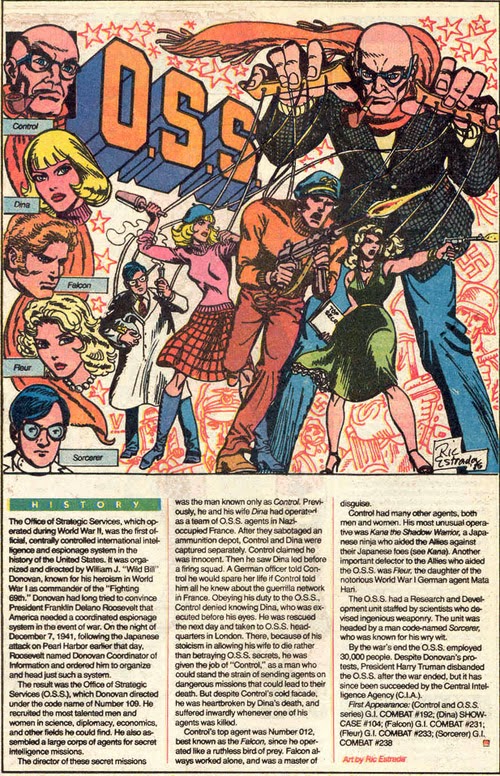
OSS: Office of Strategic Services is a top secret branch of military intelligence. These spy tales were featured throughout GI Combat, especially in its Dollar Comic days. It was also given its own lead feature in the last issue of Showcase (#104). The feature debuts here! Other than the Joker’s Daughter in Batman Family #6 and Earth Man, kind of, in Superboy starring the Legion of Superheroes #218, these three were the only “debuts” featured in the Bicentennial comics.

Target for Tonight – Me!” Bart Regan (w), Ric Estrada (a). Victor Lazlo (intentionally to be confused with Paul Henreid’s character from Casablanca …) and two others parachute into occupied Czechoslovakia. His companions are shot while landing and he is captured and taken to Gestapo HQ (which is made to look like a hospital and therefore, not bombed by allied aircraft) and searched. He is Czech and returned to exact revenge on the Nazis for killing his Jewish wife. He is interrogated and ordered to be hung from the gallows when an Allied bomb raid destroys the headquarters and everyone in it – including Lazlo. Seems the Nazis missed the transmitter implanted in his forehead by the OSS. He was captured intentionally and offered his own life to defeat the damned Boche!


Let’s Make Tracks: letters for #286. A positive letter from Michael Lapsley of Morrow, GA asking about prior crewmembers of the Haunted Tank, Paulo Mariorann of Parma, Ontario asked about the Haunted Tank’s theater of operation – various places in Europe in one issue and Burma the next? The editor explains (as with Sgt Rock) these stories are not in chronological order, Mike Karvalas of Chicago, IL questioned the Tank being in Greece, explaining that there were not many US soldiers in Greece – the editor explains that the Haunted Tank crew were some of the few, Tom Kelleher of Norwalk, Conn. Criticized JEB Stuart’s old man appearance when he was a relatively young man – he is a ghost, says the editor – and he looks like a ghost!

***

Join me next time for DC’s Bicentennial issue #28: The Unexpected #174


Original Material copyright 2015 Michael Curry

Images used are copyright their respective holders and reproduced here under the “Fair Use” doctrine of 17 USC 106 & 106a for the purposes of criticism and comment.


Weird War Tales #47: DC’s Weird Bicentennial Salute!

DC SALUTES THE BICENTENNIAL

#14

Weird War Tales #47

WWT47

Published bi-monthly, thirty cents, August

Cover artist: Joe Kubert

Editor: Joe Orlando

WWT logo

          The Reese’s Peanut Butter Cups of comic books. “You got your horror comic in my war book!” “You’ve for your war book in my horror comic!” I loved this comic book, just LOVED it! It combined the two genres at which DC excelled!

            Weird War Tales debuted in September 1971 and lasted 124 issues until June of 1983. It was an anthology of supernatural stories set during a war. Any war. Vikings, Nazi’s, Yanks & Rebels and post-apocalyptic tales were represented.

            Although not a “personality” such as Cain, Abel or Destiny, the comic was “hosted” by death – a skeleton dressed in a uniform appropriate for the story.

            By the 1980s, regular features or “stars” were introduced – alternating between GI Robot, the Creature Commandos and the War that Time Forgot (dinosaurs) – sometimes alternating between features, sometimes teaming with each other. By that time, though, it had lost some of its horror pedigree in favor of more quasi-superheroics.

***

Bloodbath of the Toy Soldiers”, George Kashdan ( w ), Rubeny (a)

            In a post-apocalyptic world, despotic General Arax’s son Zeron plays with toy soldiers, exactly matching both sides’ moves in the next day’s battle. Arax’s aides, secretly loyal to the opposing force’s democratic leaders, change Zeron’s next battle plans, leading to a huge defeat.

            In a fit of pique, Arax destroys the toy soldiers. When Arax finds Zeron playing with one last toy soldier the boy kept hidden, the general, Arax throws it in the fire.

            Arax melts along with the toy replica.

***

            “The Day After Doomsday”, Steve Skeates ( w ), Paul Kruchner and Tex Blasdell (a)

            The sole survivor of the Great Atomic War hears a cry for help in the rubble. He digs and digs and finds a tape recorder accidentally turned on in the shifting debris replaying a radio soap opera, “Help! Help! Unhand me you brute!” In frustration, he bashes the tape recorder against a wall, causing the fragile masonry to give way and crush him.

This two-page tale is reprinted in the trade paperback “Showcase Presents: the Great Disaster featuring the Atomic Knights”.


showcase


***

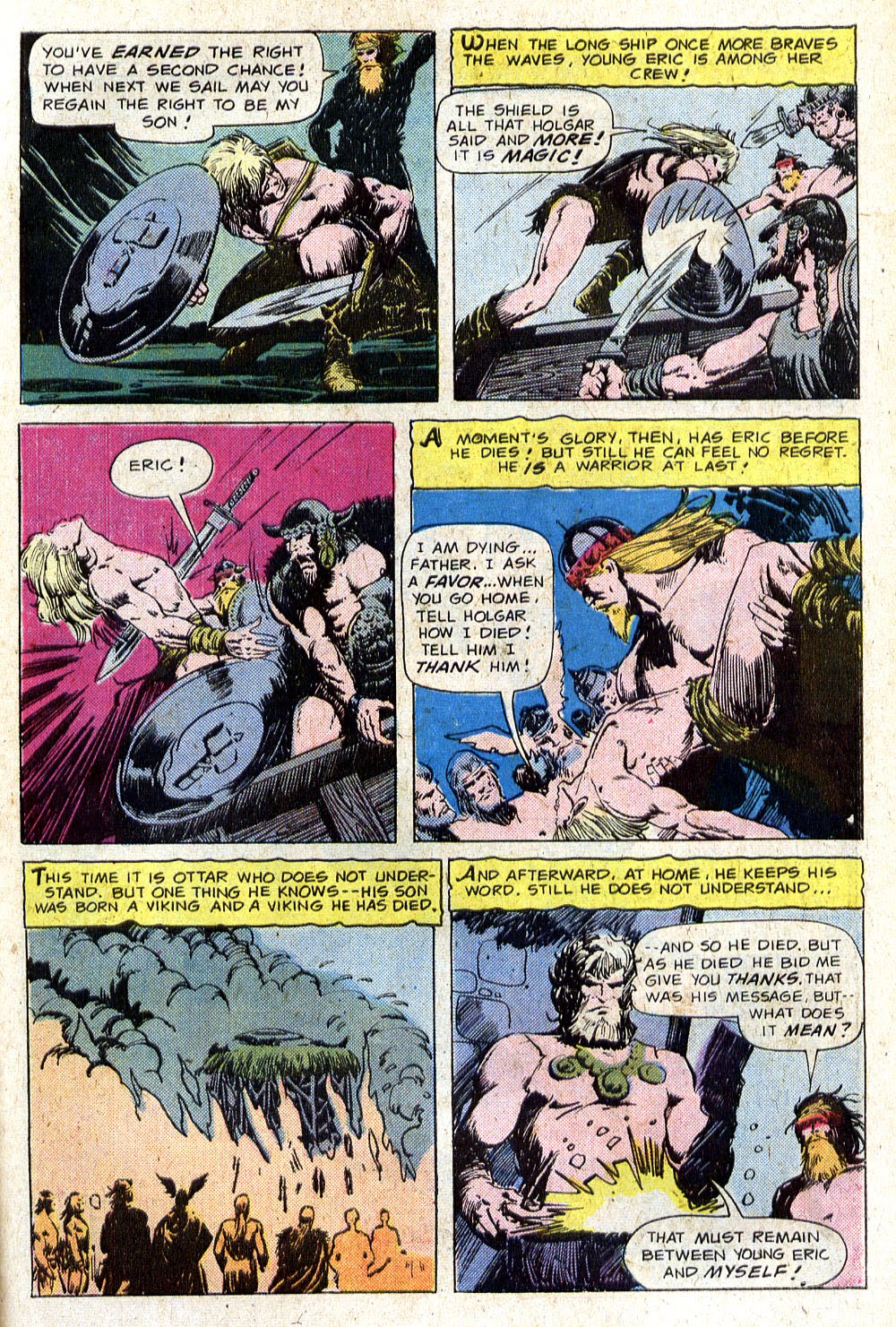
The Warrior”, Jack Oleck ( w ), Ricardo Villamonte (a)

            Hulgar, the elderly Viking, duels Godfred to prove he still is a warrior. Eric, son of their leader Ottar, begs for mercy for Hulgar. Ottar grants it.

           During his first raid, Eric panics and is branded a coward. Holgar gives Eric the Shield of Thor that will make him invincible! With the shield, Eric defeats Godfred to earn his place in the next raid. Eric fights bravely against the British, but is killed.


WWT Viking 2 WWT viking


             Holgar mourns and begins forging another ordinary “Shield of Thor” in case anther youngster needs to find his courage from within…


APO Weird War Tales, letter column for issue #44:

            Linus Sabalys, Lavel PQ, Canada; positive comments on some stories, negative for others.

            Mark Schmieder, Concord, MA; the editor points out that Mark has the opposite view as Linus Sabalys on every story.

            John Elliott, New York, NY, positive, but requests novel-length tales instead of serializing stories over multiple issues.

            The column has a plus for Star Spangled War Stories #200 starring the Unknown Soldier and Enemy Ace.  ), but with no mention of any Bicentennial connection (see my previous blog about the missed opportunity to hype a 200th issue during the Bicentennial)

 ***

            Join me next time for DC’s Bicentennial issue #15: Four Star Spectacular #3.


Original Material copyright 2015 Michael Curry

Images used are copyright their respective holders and reproduced here under the “Fair Use” doctrine of 17 USC 106 & 106a for the purposes of criticism and comment.

DC Comics advertisements (July/August 1976)

DC SALUTES THE BICENTENNIAL

Part Three: But First, a Word from Our Sponsor…


            There have been ads in comic books as long as there have been comic books. Some of the ads have become part of our pop culture – more memorable than most of the comic book characters themselves. Sea Monkeys, anyone?

seamonkeyscomicad

            During my prime-time comic reading, I quaked in fear at the Deadliest Man Alive – Count Dante’! 

Count Dante

             I wanted X-Ray Specs and to learn to throw my voice and go on the Tilt-A-Whirl at Palisades Park (free admission with my Superman coupon) and to win valuable prizes selling Christmas cards and what the hell is Grit?

            The 33 DC comics with the Bicentennial heading contained either 32 pages or 48 pages – not counting the covers (which would add four more pages). Counting those four, all the comics contained 17 pages of the same ads. They might not appear in the same places – an ad from page 12 of one comic would be on page 23 of another – and some reprint titles would have house ads at the bottom third of the page ending a chapter or a story. I will tell you about those variations when I talk about the specific issues. But otherwise the ads were all the same. The centerfold (the middle four pages) of the 32-page comics were all ads, which was traditional for DC at the time.

            I’ll use the first Bicentennial Comic – Our Army At War #294 as the template.

            Inside front cover: Hostess Cupcake ad: “Superman Saves the Earth” – there are websites dedicated to these classic Hostess ads. DC, Marvel, Harvey and Archie comics had dozens of them featuring every popular character you can think of – the Joker starred in three, Josie of “…and the Pussycats” fame? 19! This one is typical – aliens meet to discuss the fate of the earth. Because it is so primitive and backward, humanity must be destroyed! Superman takes the aliens to a grocery store and introduces them to Hostess Cupcakes. The aliens love the cupcakes and spare the earth (the aliens are obviously of great intellect – in this writer’s opinion the original Hostess Cupcakes are tangible proof of the existence of God…). A species that can create such spongy cake and creamy filling deserves a chance! Whew … good thing the aliens decided this in 1976 and not after Hostess went bankrupt … we’d be doomed!

superman saves the earth

            A few DC Comics exchange this Superman ad with one starring the Joker called “The Cornered Clown”. He is trapped in a building cordoned off by the police. He tosses them Hostess Fruit Pies to distract them as he escapes out the back. Despite such tasty treats, the police are not fooled and are waiting to arrest him. Now if he had only thrown glazed doughnuts he might have succeeded. I will let you know which comics feature the Superman ad and which feature the Joker ad.

cornered clown

            Page 5: a full-page ad for Charms Blow Pops.

            Page 6: two half-page ads for selling social security plates (checkbook-sized holders with your number and an American eagle emblazed above it) – this was before identity theft was prevalent, obviously; and an ad for Slim Jims.

            Page 11: a full-page ad for Grit. Grit is still around, you know. It’s not a newspaper anymore; it’s a glossy magazine, but still around. Did anyone out there sell Grit for big money and prizes?

            Page 12: a full-page DC house ad for its latest tabloid-sized Limited Collector’s Edition comics C46 (Justice League of America) and C47 (Superman Salutes the Bicentennial) – see Part Two – the Leftovers for more about these comics.

limited collectors ad

            Page 15: two half-page ads selling Isokinetics (an exercise technique – are they implying that readers of comic books are out of shape? Well, we ARE, but I resent the implication…) and another ad for the social security decorative plates/holders from page 6.

            Page 16: a full-page ad for NCG Merchandise’s comic book binders.

            Page 17: a full-page ad for Action Lure to catch more and bigger fish (comic book fans fish? Really?)

            Page 18: a full page of house ads – a half-page ad for the Amazing World of DC Comics #11 (the Super-Villains issue – I have this one!) and a half-page DC Comics subscription form

            Page 21: a full-page ad from the US School of Music – a self-taught guitar program

            Page 22: a half-page ad for New American Physique and a half page of 10 S. Schwarz & Company ads of various sizes: learn vehicle decor customizing, hobby coin company sales, Universal Inc. muscle growing technique, custom bicentennial t-shirts for sale, Jack Hunt (comic book back issues), the famous X-Ray Specs, Estell (comic book back issues), Abracadabra Magic Tricks, Debt Relief solutions, and Discount Comics (comic book back issues).

            Page 23: a full page public service ad for Justice For All Includes Children. This is #5 of the series. Superman instructs children on their rights and duties as citizens. Here he advises the kids not to crash a party. Trespassing is illegal and could be dangerous!

Justice for all includes children, 5

            Page 27: a full-page ad for “DC Salutes the Bicentennial” reproduced in Part One of this series.

            Page 28: 14 ads from S. Schwarz & Company of varying sizes: “Space 1999” models for sale, learn karate, Robert Bill (comic book back issues), Richard Alt (comic book back issues), Pacific Comics (comic book back issues), weight lifting techniques, stamps for sale, Howard Rogofsky (comic book back issues), muscle building techniques, baseball card holders (called “lockers” – now we would call them deck holders), CCCBA (comic book back issues), techniques to grow taller, live seahorses for sale, and then several small ads designed as “classified newspaper” ads for: earning money stuffing envelopes, selling t-shirt iron-on decals, secret agent pens for sale, gliders for sale, earn money addressing and mailing envelopes.

            Page 32:  a full-page ad for muscle building (from the same company as one of the smaller ads on page 28).

            Inside front cover: a full-page ad for Monogram flying airplanes.

monogram

            Back cover: Spalding gloves (with as-always-excellent Jack Davis art!)

spalding

***

            Eyes spinning yet? I haven’t even begun to review the 33 comics yet! I’ll start with #1: Our Army At War #294…

             All comic covers, advertising, characters and images are the property of their respective copyright holders and reprinted here for your entertainment and review under the Fair Use Doctrine as commentary, criticism and … sometimes … parody.

            Keep in mind the actual creators probably only received a fraction of their creative worth at the time of their creation … but that is a whole other story …


Original Material Copyright 2015 Michael G Curry